2011 TOYOTA VERSO S warning
[x] Cancel search: warningPage 595 of 664
595
8
8-2. Steps to take in an emergency
When trouble arises
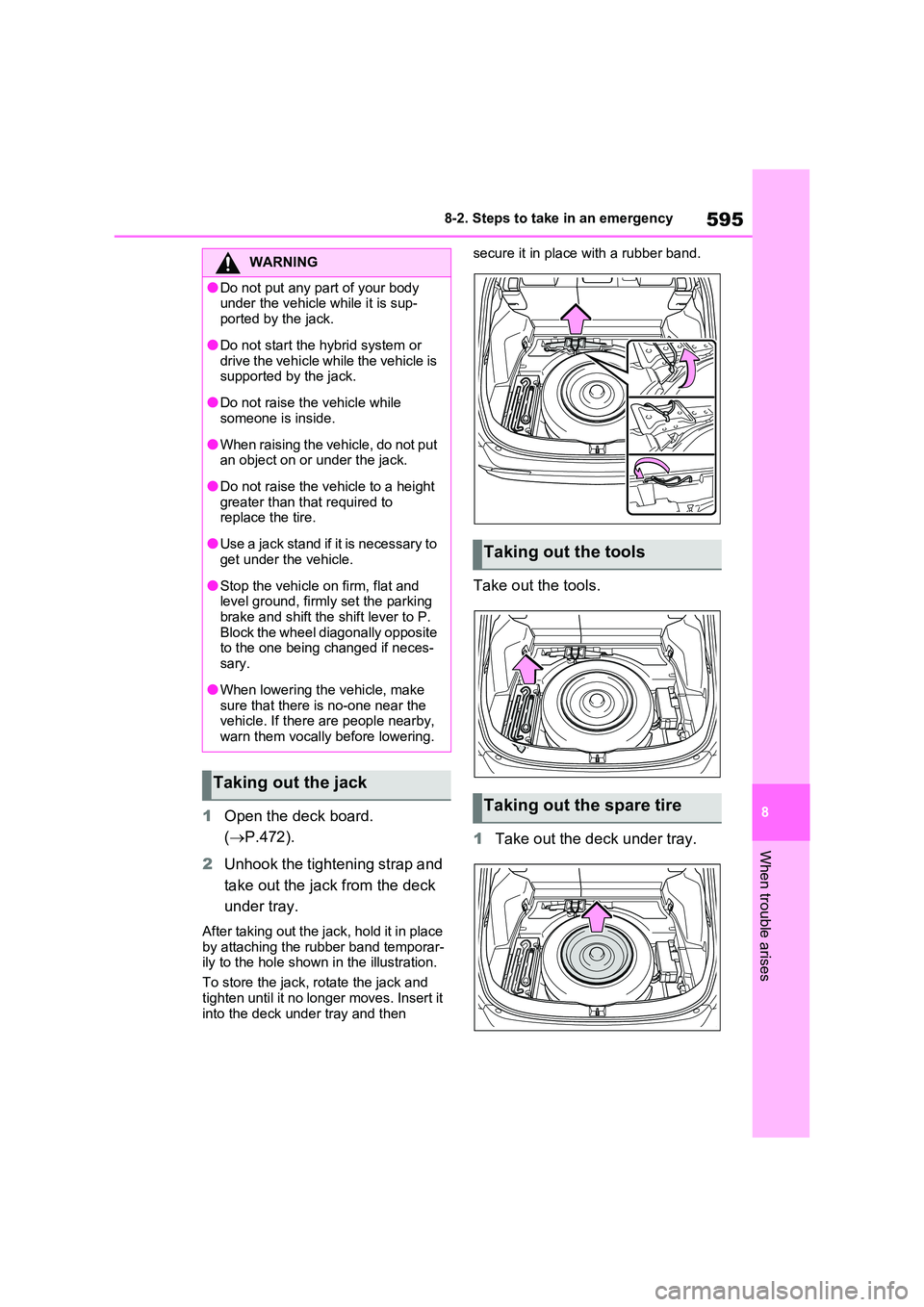
1 Open the deck board.
( P.472).
2 Unhook the tightening strap and
take out the jack from the deck
under tray.
After taking out the jack, hold it in place
by attaching the rubber band temporar- ily to the hole shown in the illustration.
To store the jack, rotate the jack and
tighten until it no longer moves. Insert it into the deck under tray and then
secure it in place with a rubber band.
Take out the tools.
1 Take out the deck under tray.
WARNING
●Do not put any part of your body under the vehicle while it is sup-
ported by the jack.
●Do not start the hybrid system or
drive the vehicle while the vehicle is supported by the jack.
●Do not raise the vehicle while someone is inside.
●When raising the vehicle, do not put an object on or under the jack.
●Do not raise the vehicle to a height greater than that required to replace the tire.
●Use a jack stand if it is necessary to get under the vehicle.
●Stop the vehicle on firm, flat and level ground, firmly set the parking
brake and shift the shift lever to P. Block the wheel diagonally opposite to the one being changed if neces-
sary.
●When lowering the vehicle, make
sure that there is no-one near the vehicle. If there are people nearby, warn them vocally before lowering.
Taking out the jack
Taking out the tools
Taking out the spare tire
Page 596 of 664
5968-2. Steps to take in an emergency
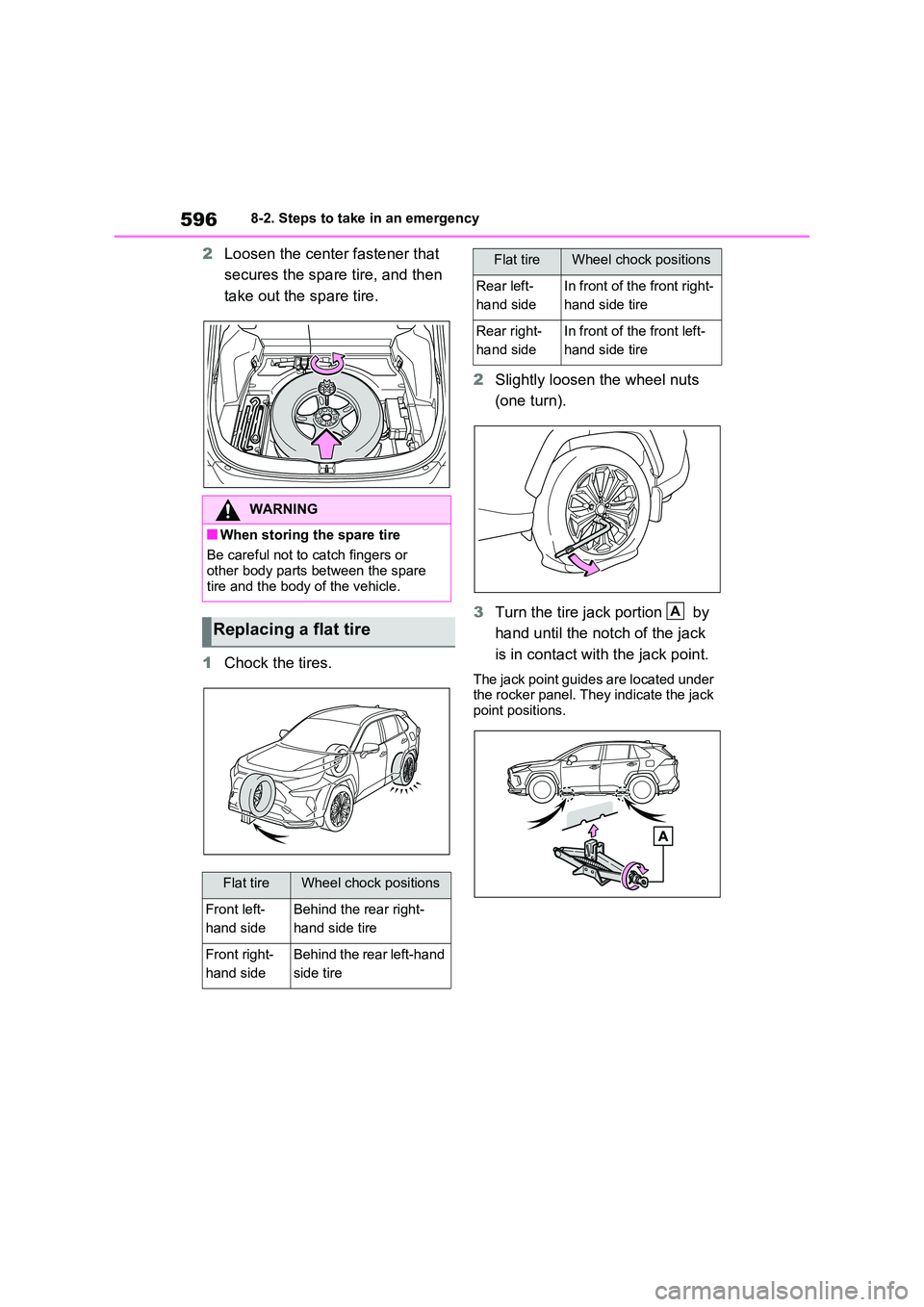
2Loosen the center fastener that
secures the spare tire, and then
take out the spare tire.
1 Chock the tires.
2 Slightly loosen the wheel nuts
(one turn).
3 Turn the tire jack portion by
hand until the notch of the jack
is in contact with the jack point.
The jack point guides are located under the rocker panel. They indicate the jack
point positions.
WARNING
■When storing the spare tire
Be careful not to catch fingers or
other body parts between the spare tire and the body of the vehicle.
Replacing a flat tire
Flat tireWheel chock positions
Front left-
hand side
Behind the rear right-
hand side tire
Front right-
hand side
Behind the rear left-hand
side tire
Rear left-
hand side
In front of the front right-
hand side tire
Rear right-
hand side
In front of the front left-
hand side tire
Flat tireWheel chock positions
A
Page 597 of 664
597
8
8-2. Steps to take in an emergency
When trouble arises
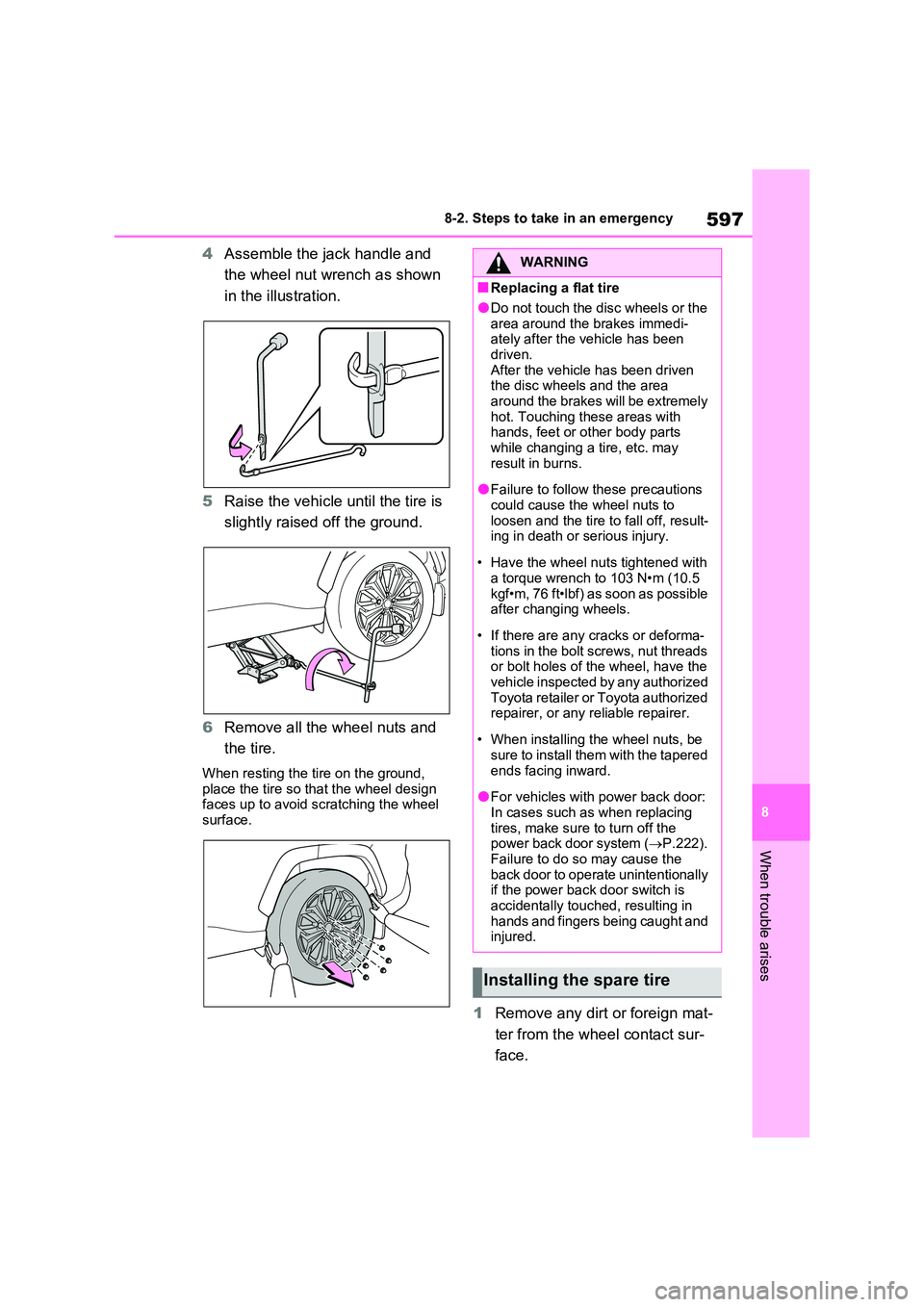
4 Assemble the jack handle and
the wheel nut wrench as shown
in the illustration.
5 Raise the vehicle until the tire is
slightly raised off the ground.
6 Remove all the wheel nuts and
the tire.
When resting the tire on the ground,
place the tire so that the wheel design faces up to avoid scratching the wheel surface.
1 Remove any dirt or foreign mat-
ter from the wheel contact sur-
face.
WARNING
■Replacing a flat tire
●Do not touch the disc wheels or the
area around the brakes immedi- ately after the vehicle has been driven.
After the vehicle has been driven the disc wheels and the area around the brakes will be extremely
hot. Touching these areas with hands, feet or other body parts while changing a tire, etc. may
result in burns.
●Failure to follow these precautions
could cause the wheel nuts to loosen and the tire to fall off, result-ing in death or serious injury.
• Have the wheel nuts tightened with a torque wrench to 103 N•m (10.5
kgf•m, 76 ft•lbf) as soon as possible after changing wheels.
• If there are any cracks or deforma- tions in the bolt screws, nut threads or bolt holes of the wheel, have the
vehicle inspected by any authorized Toyota retailer or Toyota authorized repairer, or any reliable repairer.
• When installing the wheel nuts, be sure to install them with the tapered
ends facing inward.
●For vehicles with power back door:
In cases such as when replacing tires, make sure to turn off the power back door system ( P.222).
Failure to do so may cause the back door to operate unintentionally if the power back door switch is
accidentally touched, resulting in hands and fingers being caught and injured.
Installing the spare tire
Page 598 of 664
5988-2. Steps to take in an emergency
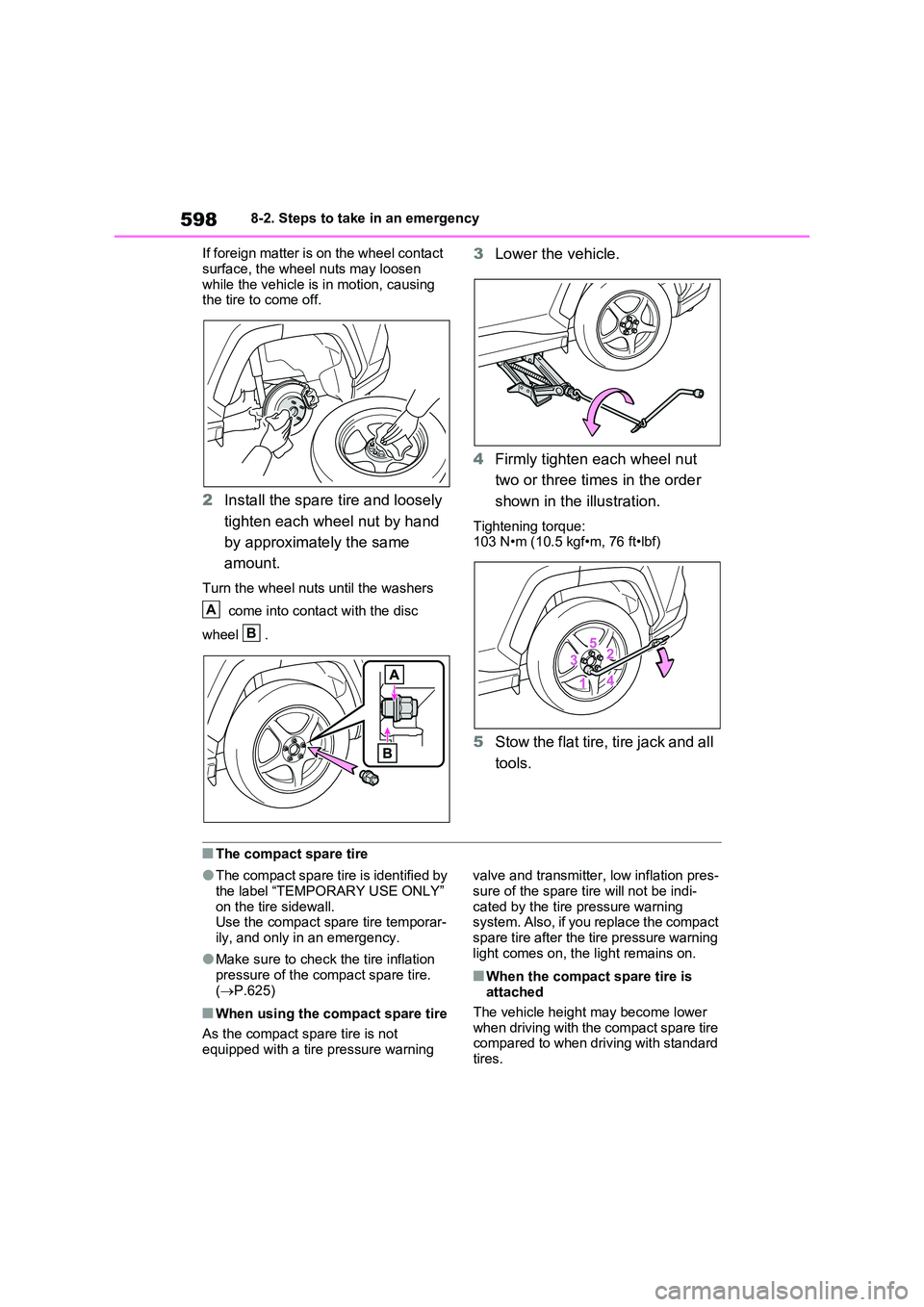
If foreign matter is on the wheel contact
surface, the wheel nuts may loosen while the vehicle is in motion, causing the tire to come off.
2 Install the spare tire and loosely
tighten each wheel nut by hand
by approximately the same
amount.
Turn the wheel nuts until the washers
come into contact with the disc
wheel .
3 Lower the vehicle.
4 Firmly tighten each wheel nut
two or three times in the order
shown in the illustration.
Tightening torque: 103 N•m (10.5 kgf•m, 76 ft•lbf)
5 Stow the flat tire, tire jack and all
tools.
■The compact spare tire
●The compact spare tire is identified by
the label “TEMPORARY USE ONLY” on the tire sidewall.Use the compact spare tire temporar-
ily, and only in an emergency.
●Make sure to check the tire inflation
pressure of the compact spare tire. ( P.625)
■When using the compact spare tire
As the compact spare tire is not
equipped with a tire pressure warning
valve and transmitter, low inflation pres-
sure of the spare tire will not be indi- cated by the tire pressure warning system. Also, if you replace the compact
spare tire after the tire pressure warning light comes on, the light remains on.
■When the compact spare tire is attached
The vehicle height may become lower when driving with the compact spare tire compared to when driving with standard
tires.
A
B
Page 600 of 664

6008-2. Steps to take in an emergency
WARNING
■When using the compact spare tire
●Remember that the compact spare tire provided is specifically designed for use with your vehicle.
Do not use your compact spare tire on another vehicle.
●Do not use more than one compact spare tire simultaneously.
●Replace the compact spare tire with a standard tire as soon as possible.
●Avoid sudden acceleration, abrupt steering, sudden braking and shift-ing operations that cause sudden
engine braking.
■When the compact spare tire is
attached
The vehicle speed may not be cor- rectly detected, and the following sys-
tems may not operate correctly:
• ABS & Brake assist
• VSC/Trailer Sway Control
•TRC
• Cruise control (if equipped)
• Dynamic radar cruise control with full-speed range (if equipped)
• PCS (Pre-Collision System) (if equipped)
• EPS
• LTA (Lane Tracing Assist) (if
equipped)
• Tire pressure warning system
• AHB (Automatic High Beam) (if equipped)
• BSM (Blind Spot Monitor) (if equipped)
• Rear view monitor system (if equipped)
• Panoramic view monitor (if equipped)
• Toyota parking assist monitor (if equipped)
• Toyota parking assist-sensor (if equipped)
• PKSB (Parking Support Brake) (if equipped)
• Navigation system (if equipped)
Also, not only can the following sys-
tem not be utilized fully, but it may actually negatively affect the drive-train components:
• E-Four (Electronic On-Demand AWD system)
■Speed limit when using the com-pact spare tire
Do not drive at speeds in excess of 80
km/h (50 mph) when a compact spare tire is installed on the vehicle.
The compact spare tire is not
designed for driving at high speeds. Failure to observe this precaution may lead to an accident causing
death or serious injury.
■After using the tools and jack
Before driving, make sure all the tools and jack are securely in place in their storage location to reduce the possi-
bility of personal injury during a colli- sion or sudden braking.
NOTICE
■Be careful when driving over
bumps with the compact spare tire installed on the vehicle
The vehicle height may become lower
when driving with the compact spare tire compared to when driving with standard tires. Be careful when driv-
ing over uneven road surfaces.
Page 601 of 664
601
8
8-2. Steps to take in an emergency
When trouble arises
One of the following may be the
cause of the problem:
The AC charging cable may be
attached to the vehicle.
( P.135)
The electronic key may not be
functioning properly. ( P.604)
There may not be sufficient fuel
in the vehicle’s tank.
Refuel the vehicle. ( P.342)
There may be a malfunction in
the immobilizer system. ( P.76)
There may be a malfunction in
the steering lock system.
The hybrid system may be mal-
functioning due to an electrical
problem such as electronic key
battery depletion or a blown fuse.
However, depending on the type
of malfunction, an interim mea-
sure is available to start the
hybrid system. ( P.602)
There is a possibility that the
NOTICE
■Driving with tire chains and the compact spare tire
Do not fit tire chains to the compact spare tire.
Tire chains may damage the vehicle
body and adversely affect driving per- formance.
■When replacing the tires
When removing or fitting the wheels, tires or the tire pressure warning
valve and transmitter, contact any authorized Toyota retailer or Toyota authorized repairer, or any reliable
repairer as the tire pressure warning valve and transmitter may be dam-aged if not handled correctly.
If the hybrid system will
not start
Reasons for the hybrid system
not starting vary depending on
the situation. Check the follow-
ing and perform the appropri-
ate procedure:
The hybrid system will not
start even though the cor-
rect starting procedure is
being followed ( P.317)
Page 605 of 664
605
8
8-2. Steps to take in an emergency
When trouble arises
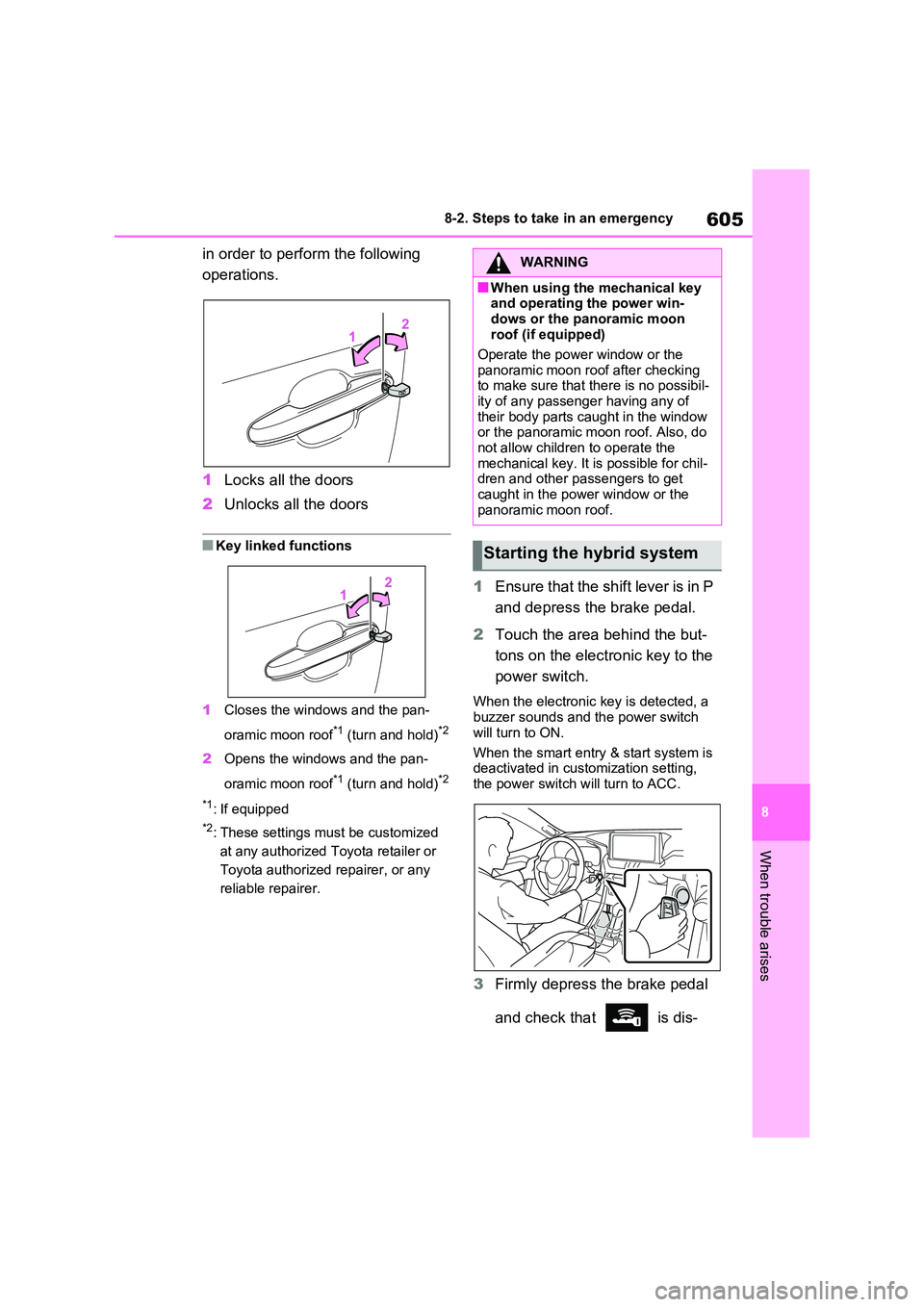
in order to perform the following
operations.
1 Locks all the doors
2 Unlocks all the doors
■Key linked functions
1 Closes the windows and the pan-
oramic moon roof*1 (turn and hold)*2
2 Opens the windows and the pan-
oramic moon roof*1 (turn and hold)*2
*1: If equipped
*2: These settings must be customized
at any authorized Toyota retailer or
Toyota authorized repairer, or any
reliable repairer.
1 Ensure that the shift lever is in P
and depress the brake pedal.
2 Touch the area behind the but-
tons on the electronic key to the
power switch.
When the electronic key is detected, a buzzer sounds and the power switch
will turn to ON.
When the smart entry & start system is deactivated in customization setting,
the power switch will turn to ACC.
3 Firmly depress the brake pedal
and check that is dis-
WARNING
■When using the mechanical key and operating the power win-
dows or the panoramic moon roof (if equipped)
Operate the power window or the
panoramic moon roof after checking to make sure that there is no possibil-ity of any passenger having any of
their body parts caught in the window or the panoramic moon roof. Also, do not allow children to operate the
mechanical key. It is possible for chil- dren and other passengers to get caught in the power window or the
panoramic moon roof.
Starting the hybrid system
Page 609 of 664
609
8
8-2. Steps to take in an emergency
When trouble arises
a malfunction, as the hybrid system
will start normally on the second attempt.
●The power switch mode is memorized by the vehicle. When the 12-volt bat-tery is reconnected, the system will
return to the mode it was in before the 12-volt battery was discharged. Before disconnecting the 12-volt bat-
tery, turn the power switch off. If you are unsure what mode the power switch was in before the 12-volt
battery discharged, be especially careful when reconnecting the 12-volt battery.
■When replacing the 12-volt battery
●Use a 12-volt battery that conforms to European regulations.
●Use a 12-volt battery that the case size is same as the previous one
(LN2), 20 hours rate capacity (20HR) is equivalent (55Ah) or greater, and performance rating (CCA) is equiva-
lent (345A) or greater. • If the sizes differ, the 12-volt battery cannot be properly secured.
• If the 20 hour rate capacity is low, even if the time period where the vehi-cle is not used is a short time, the 12-
volt battery may discharge and hybrid system may not be able to start.
●Use a ventilation type calcium battery
●Use a 12-volt battery with a handle. If
a 12-volt battery without a handle is used, removal is more difficult.
●When removing the 12-volt battery: P.508
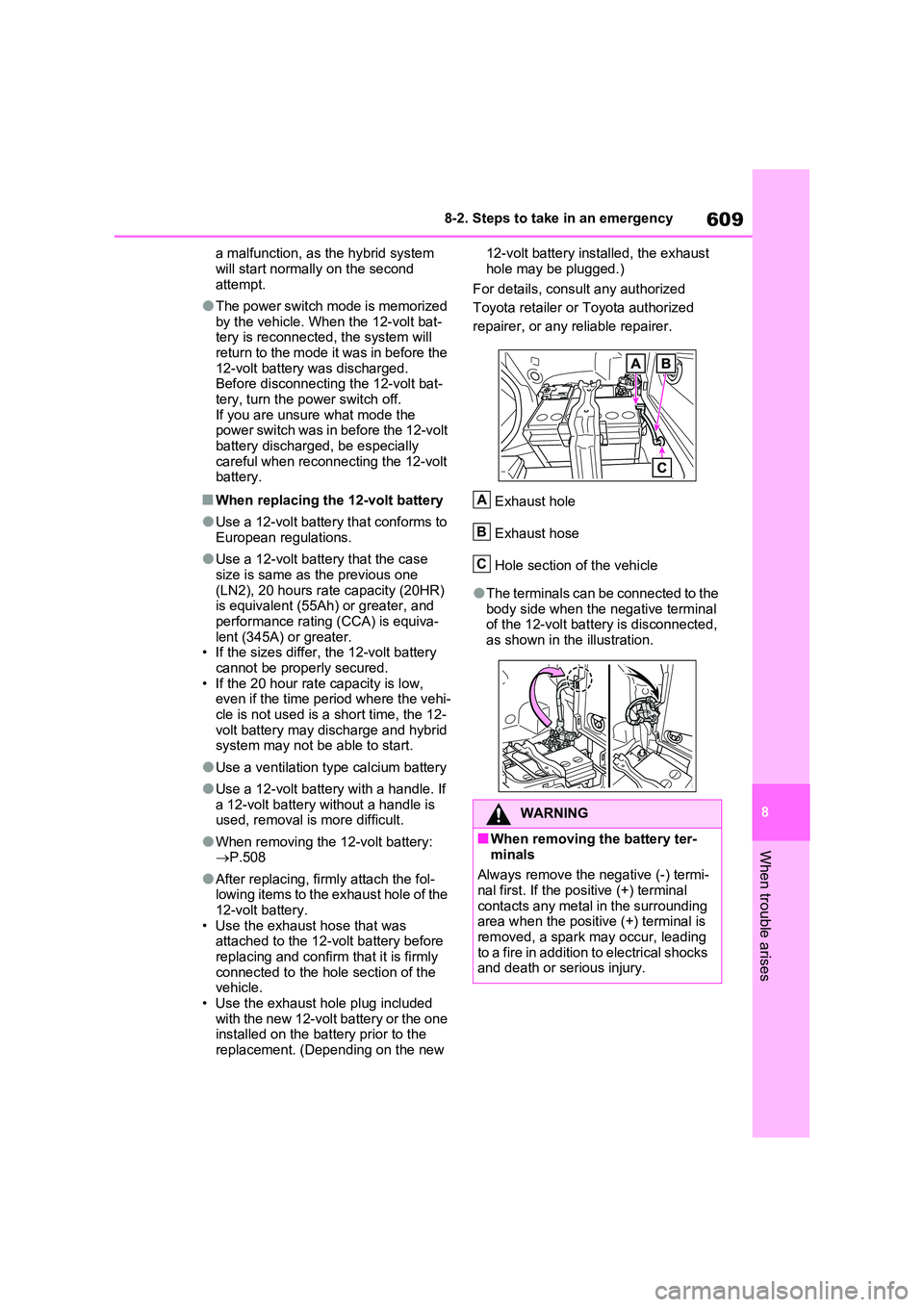
●After replacing, firmly attach the fol- lowing items to the exhaust hole of the 12-volt battery.
• Use the exhaust hose that was attached to the 12-volt battery before replacing and confirm that it is firmly
connected to the hole section of the vehicle.• Use the exhaust hole plug included
with the new 12-volt battery or the one installed on the battery prior to the replacement. (Depending on the new
12-volt battery installed, the exhaust
hole may be plugged.)
For details, consult any authorized
Toyota retailer or Toyota authorized
repairer, or any reliable repairer.
Exhaust hole
Exhaust hose
Hole section of the vehicle
●The terminals can be connected to the body side when the negative terminal of the 12-volt battery is disconnected,
as shown in the illustration.
WARNING
■When removing the battery ter-
minals
Always remove the negative (-) termi- nal first. If the positive (+) terminal
contacts any metal in the surrounding area when the positive (+) terminal is removed, a spark may occur, leading
to a fire in addition to electrical shocks and death or serious injury.
A
B
C