2011 TOYOTA VERSO S air condition
[x] Cancel search: air conditionPage 95 of 664
95
2
2-1. Plug-in hybrid system
Plug-in hybrid system
Hybrid battery (traction battery)
Front electric motor (traction motor)
Air conditioning compressor
Junction box
■Running out of fuel
When the vehicle has run out of fuel and
the hybrid system cannot be started, refuel the vehicle with at least enough gasoline to make the low fuel level warn-
ing light ( P.575) go off. If there is only a small amount of fuel, the hybrid sys-tem may not be able to start. (The stan-
dard amount of fuel is about 8.8 L [2.3 gal., 1.9 Imp.gal.], when the vehicle is on a level surface. This value may vary
when the vehicle is on a slope. Add extra fuel when the vehicle is inclined.)
■Electromagnetic waves
●High voltage parts and cables on the hybrid vehicles incorporate electro-magnetic shielding, and therefore emit
approximately the same amount of electromagnetic waves as conven-tional gasoline powered vehicles or
home electronic appliances.
●Your vehicle may cause sound inter-
ference in some third party-produced radio parts.
■Effect of magnetic forces
If objects that generate strong magnetic
forces, such as large speakers, are placed inside the luggage compartment or installed nearby, the generated mag-
netic forces may negatively affect the hybrid system.
■Hybrid battery (traction battery) (lithium-ion battery)
The hybrid battery (traction battery) has a limited service life.
The hybrid battery (traction battery)
capacity (the ability to hold a charge) reduces with time and use in the same way as other rechargeable batteries.
The extent at which capacity reduces
changes drastically depending on the environment (ambient temperature, etc.)
and usage conditions, such as how the vehicle is driven and how the hybrid bat-tery (traction battery) is charged. This is
a natural characteristic of lithium-ion batteries, and is not a malfunction. Also, even though the EV driving range
becomes shorter when the hybrid bat- tery (traction battery) capacity reduces, vehicle performance does not signifi-
cantly become worse.
In order to reduce the possibility of the capacity reducing, follow the directions
listed on P.134, “Capacity reduction of the hybrid battery (traction battery)”.
■Starting the hybrid system in an extremely cold environment
When the hybrid battery (traction bat- tery) is extremely cold (below approxi-mately -30°C [-22°F]) under the
influence of the outside temperature, it may not be possible to start the hybrid system. In this case, try to start the
hybrid system again after the tempera- ture of the hybrid battery increases due to the outside temperature increase etc.
■Declaration of conformity
This model conforms to hydrogen emis- sions according to regulation ECE100 (Battery electric vehicle safety).
I
J
K
L
WARNING
■High voltage precautions
The vehicle has high voltage DC and
AC systems as well as a 12-volt sys- tem. DC and AC high voltage is very dangerous and can cause severe
burns and electric shock that may result in death or serious injury.
Page 99 of 664
99
2 2-1. Plug-in hybrid system
Plug-in hybrid system
stops the fuel pump to minimize the
risk of electrocution and fuel leak-
age.
If the emergency shut off system
activates, your vehicle will not
restart. To restart the hybrid sys-
tem, contact any authorized Toyota
retailer or Toyota authorized
repairer, or any reliable repairer.
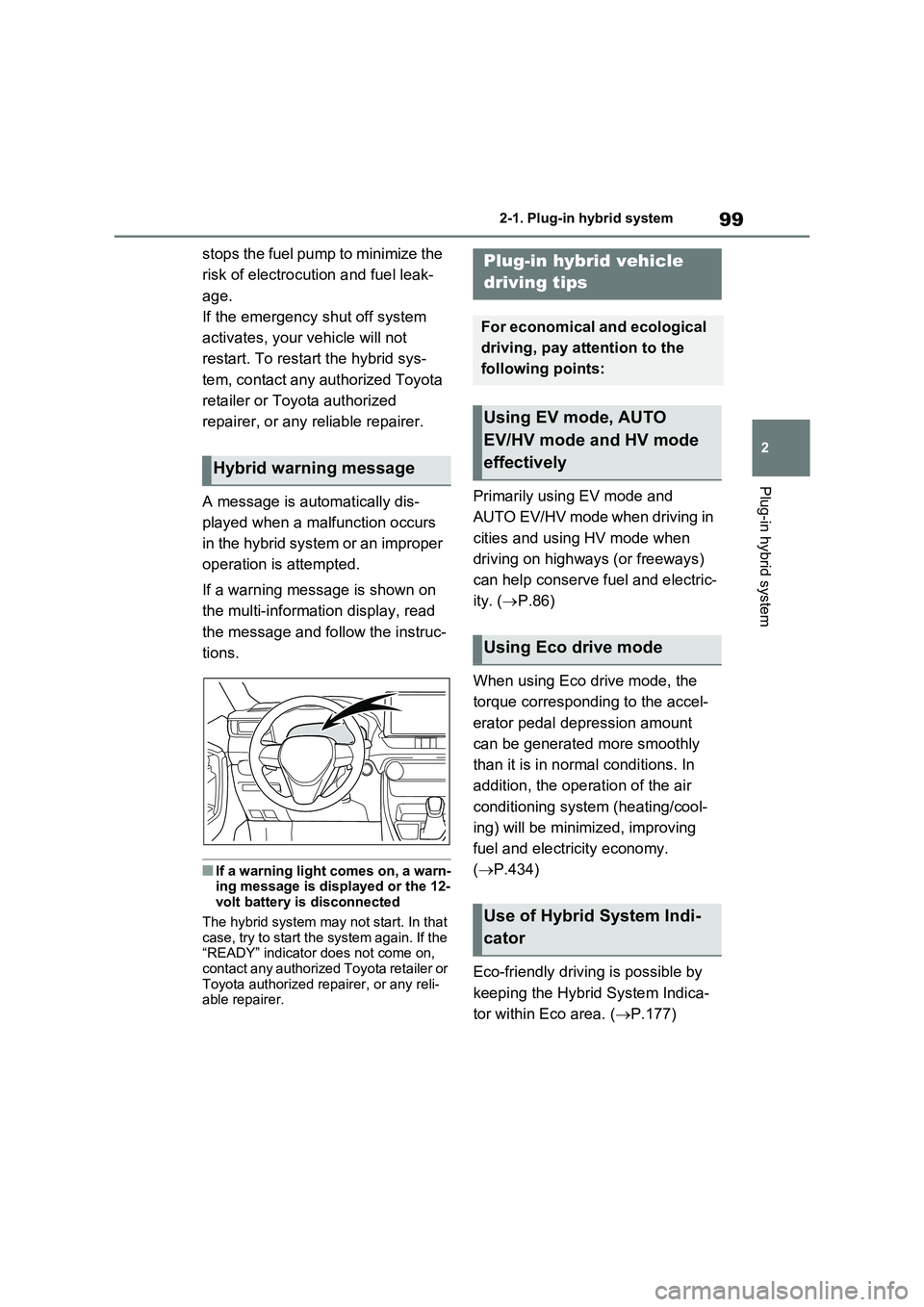
A message is automatically dis-
played when a malfunction occurs
in the hybrid system or an improper
operation is attempted.
If a warning message is shown on
the multi-information display, read
the message and follow the instruc-
tions.
■If a warning light comes on, a warn-
ing message is displayed or the 12-
volt battery is disconnected
The hybrid system may not start. In that
case, try to start the system again. If the
“READY” indicator does not come on,
contact any authorized Toyota retailer or
Toyota authorized repairer, or any reli-
able repairer.
Primarily using EV mode and
AUTO EV/HV mode when driving in
cities and using HV mode when
driving on highways (or freeways)
can help conserve fuel and electric-
ity. (P.86)
When using Eco drive mode, the
torque corresponding to the accel-
erator pedal depression amount
can be generated more smoothly
than it is in normal conditions. In
addition, the operation of the air
conditioning system (heating/cool-
ing) will be minimized, improving
fuel and electricity economy.
(P.434)
Eco-friendly driving is possible by
keeping the Hybrid System Indica-
tor within Eco area. (P.177)
Hybrid warning message
Plug-in hybrid vehicle
driving tips
For economical and ecological
driving, pay attention to the
following points:
Using EV mode, AUTO
EV/HV mode and HV mode
effectively
Using Eco drive mode
Use of Hybrid System Indi-
cator
Page 100 of 664
1002-1. Plug-in hybrid system
Shift the shift lever to D when
stopped at a traffic light, or driving
in heavy traffic etc. Shift the shift
lever to P when parking. When
using the N, there is no positive
effect on fuel consumption. In the
N, the gasoline engine operates but
electricity cannot be generated.
Also, when using the air condition-
ing system, etc., the hybrid battery
(traction battery) power is con-
sumed.
Drive your vehicle smoothly.
Avoid abrupt acceleration and
deceleration. Gradual accelera-
tion and deceleration will make
more effective use of the electric
motor (traction motor) without
having to use gasoline engine
power.
Avoid repeated acceleration.
Repeated acceleration con-
sumes hybrid battery (traction
battery) power, resulting in poor
fuel consumption. Battery power
can be restored by driving with
the accelerator pedal slightly
released.
Make sure to operate the brakes
gently and a timely manner. A greater amount of electrical energy
can be regenerated when slowing
down.
Repeated acceleration and decel-
eration, as well as long waits at traf-
fic lights, will lead to high fuel and
electricity consumption. Check traf-
fic reports before leaving and avoid
delays as much as possible. When
driving in a traffic jam, gently
release the brake pedal to allow the
vehicle to move forward slightly
while avoiding overuse of the accel-
erator pedal. Doing so can help
control excessive electricity and
fuel consumption.
Control and maintain the vehicle
at a constant speed. Before stop-
ping at a toll booth or similar,
allow plenty of time to release
the accelerator and gently apply
the brakes. A greater amount of
electrical energy can be regener-
ated when slowing down.
Electricity consumption will
increase significantly when driv-
ing at high speeds in EV mode or
AUTO EV/HV mode. If there will
be a long distance to the next
external charging point after
leaving a freeway, it is recom-
mended to drive in HV mode
while on the freeway and change
Shift lever operation
Accelerator pedal/brake
pedal operation
When braking
Delays
Highway driving
Page 101 of 664
101
2 2-1. Plug-in hybrid system
Plug-in hybrid system
to EV mode or AUTO EV/HV
mode after leaving the freeway.
(P.86)
Turn the “A/C” switch off when it
is not needed. Doing so can help
reduce excessive electricity and
fuel consumption.
In summer: When the ambient tem-
perature is high, use the recirculated air
mode. Doing so will help to reduce the
burden on the air conditioning system
and reduce electricity and fuel con-
sumption as well.
In winter: Avoid excessive and unnec-
essary use of the heater. Usage of the
heated steering wheel (if equipped)
(P.462) and seat heaters (P.463)
are effective.
Using the Remote Air Condition-
ing System (P.460) while the
AC charging cable is connected
to the vehicle can reduce elec-
tricity consumption immediately
after starting off by operating air
conditioning mainly using elec-
tricity from an external power
source.
When setting the charging
schedule, setting the charging
mode to “Departure” and “Cli-
mate Prep” to on can reduce
electricity consumption immedi-
ately after starting off by operat-
ing air conditioning before
charging is completed. (P.144)Make sure to check the tire inflation
pressure frequently. If there is
improper tire inflation pressure in
the tires, the EV driving range will
become shorter, and fuel consump-
tion when in HV mode will increase.
Also, as snow tires can cause large
amounts of friction, their use on dry
roads can lead to increased fuel
and electricity consumption.
Carrying heavy luggage will lead to
poor fuel economy. Avoid carrying
unnecessary luggage. Installing a
large roof rack will also cause poor
fuel economy.
Since the gasoline engine starts up
and cuts out automatically, warm-
ing up is not necessary.
Air conditioning
Checking tire inflation pres-
sure
Luggage
Warming up before driving
Page 102 of 664

1022-1. Plug-in hybrid system
The value displayed on the SOC
(State of Charge) gauge (P.174)
is estimated from the following
information.
The amount of hybrid battery
(traction battery) charge cur-
rently remaining
The electricity consumption (the
estimated distance that EV driv-
ing is possible per unit of electri-
cal energy) based on the
recorded value
Past air conditioning system
electricity consumption amount
The electricity consumption varies
depending on how the vehicle is
driven. The vehicle automatically
records the electricity consumption
when being charged and uses the electricity consumption for estimat-
ing the EV driving range. Therefore,
the EV driving range displayed
when the hybrid battery (traction
battery) is fully charged may differ
from the previous EV driving range
depending on how the vehicle was
driven.
The EV driving range may change
significantly with each charging
until the electricity consumption
based on the recorded value is sta-
ble (for approximately the first
month or two). However, this does
not indicate a malfunction.
When the air conditioning system is
turned on, the EV driving range
(with using the air conditioning sys-
tem) is estimated based on the past
air conditioning electricity con-
sumption amount considering that
the electricity consumption may
become higher.
The distance that EV driving is pos-
sible varies significantly depending
on how the vehicle is driven, road
conditions, the weather, the outside
temperature, usage conditions of
electrical components and the num-
ber of occupants.
The distance that EV driving is pos-
sible can be extended if the follow-
ing is performed:
EV driving range
The EV driving range displayed
on the multi-information dis-
play shows the reference dis-
tance that EV driving (driving
using only the electric motor)
is possible, and the actual dis-
tance that can be driven may
differ from that displayed.
Even if the EV driving range is
displayed, EV driving may be
canceled and both gasoline
engine and electric motor are
used depending on the situation.
(P.90)
Displayed value
Tips for extending the EV
driving range
Page 103 of 664
103
2 2-1. Plug-in hybrid system
Plug-in hybrid system
■When starting off, depress the
accelerator pedal smoothly to
accelerate
As a guide, accelerate up to
approximately 20 km/h (12mph) in
the first 5 seconds.
Electrical and fuel efficiency can be
improved just by using the ECO
Accelerator Guidance displayed on
the multi-information display and
taking care to start off gently.
(P.182)
When the driving mode is set to Eco
drive mode, depressing the accelerator
pedal generates smooth torque that
makes it easier to operate the accelera-
tor gently.
■Maintain sufficient vehicle-to-
vehicle distance and do not
accelerate or decelerate
unnecessarily
Try to maintain a fixed speed while
driving. Driving at a short vehicle-
to-vehicle distance will result in
repeating wasteful acceleration and
deceleration, which will worsen the
electrical and fuel efficiency.
■Release the accelerator pedal
early before stopping the vehi-
cle, such as at a traffic light
The regenerative brake will operate
to convert the kinetic energy of the
vehicle into electrical energy, which
will charge the hybrid battery (trac-
tion battery).
The regeneration status can be
checked from the Hybrid System
Indicator. (P.177)When the brake pedal is depressed
lightly during deceleration, the
regeneration amount increases,
enabling more electrical energy to
be recovered.
If the brake pedal is depressed too
strongly, the recovered amount indica-
tor will reach the maximum level and
the upper limit of the recoverable
energy will be exceeded. Therefore, be
sure to operate the brake pedal early.
■Use the air conditioning sys-
tem appropriately, and also
utilize the heated steering
wheel (if equipped) and seat
heaters
In EV mode, the vehicle is cooled
and heated by electrical energy.
(Except in extremely cold tempera-
tures of approximately -10°C (14°F)
or less.)
Preventing excessive cooling or
heating of the vehicle will reduce
power consumption and improve
electrical efficiency.
The heated steering wheel (if
equipped) and seat heaters are effi-
cient heating device that directly
warm the body using less electric
power.
When used together with the air condi-
tioning system, a low temperature set-
ting can be used to improve electrical
and fuel efficiency.
■Check the tire pressure
If the tire pressure is lower than the
specified value, it will worsen the
electrical and fuel efficiency.
Page 107 of 664
107
2 2-2. Charging
Plug-in hybrid system
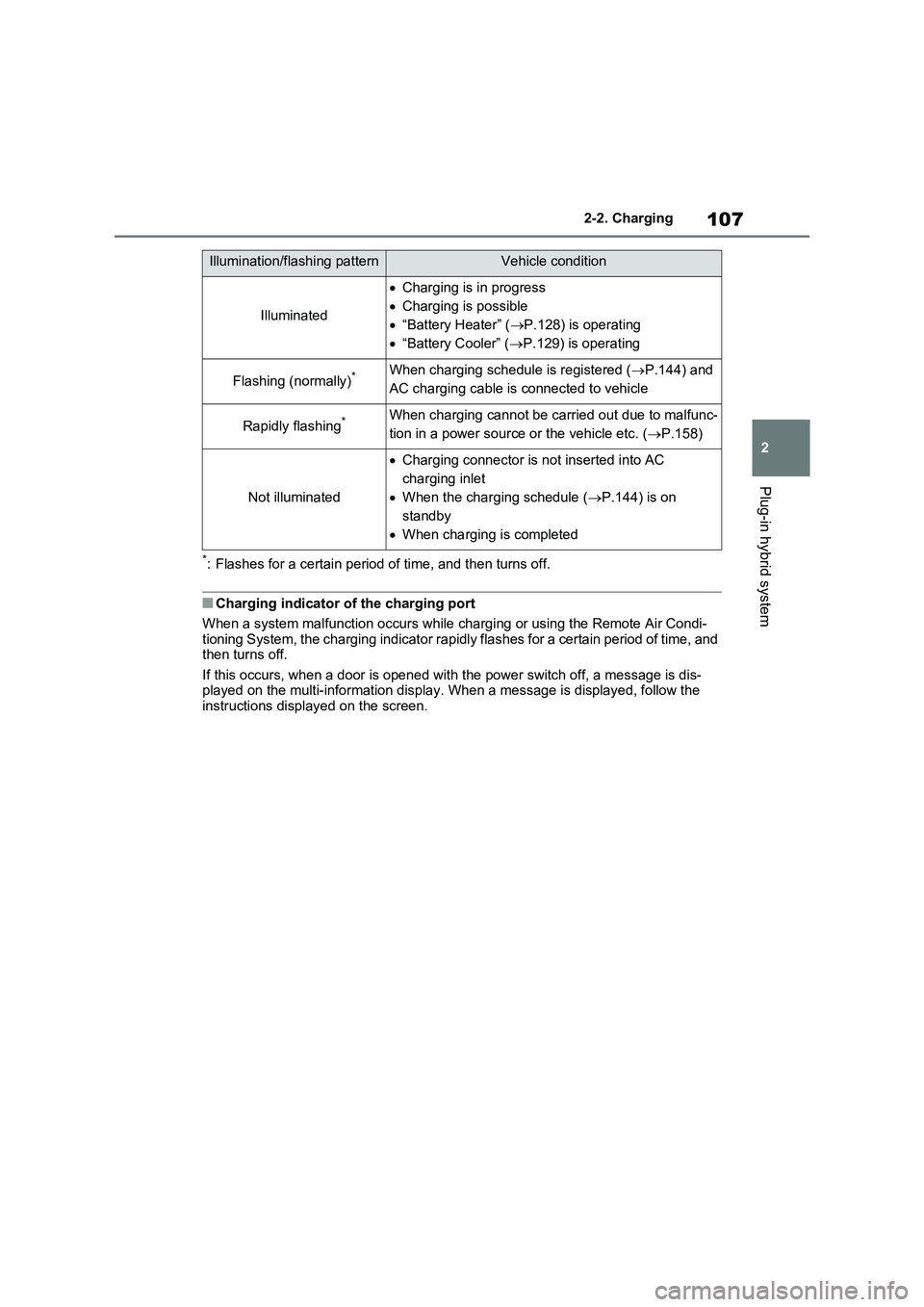
*: Flashes for a certain period of time, and then turns off.
■Charging indicator of the charging port
When a system malfunction occurs while charging or using the Remote Air Condi-
tioning System, the charging indicator rapidly flashes for a certain period of time, and
then turns off.
If this occurs, when a door is opened with the power switch off, a message is dis-
played on the multi-information display. When a message is displayed, follow the
instructions displayed on the screen.
Illumination/flashing patternVehicle condition
Illuminated
Charging is in progress
Charging is possible
“Battery Heater” (P.128) is operating
“Battery Cooler” (P.129) is operating
Flashing (normally)*When charging schedule is registered (P.144) and
AC charging cable is connected to vehicle
Rapidly flashing*When charging cannot be carried out due to malfunc-
tion in a power source or the vehicle etc. (P.158)
Not illuminated
Charging connector is not inserted into AC
charging inlet
When the charging schedule (P.144) is on
standby
When charging is completed
Page 113 of 664
113
2 2-2. Charging
Plug-in hybrid system
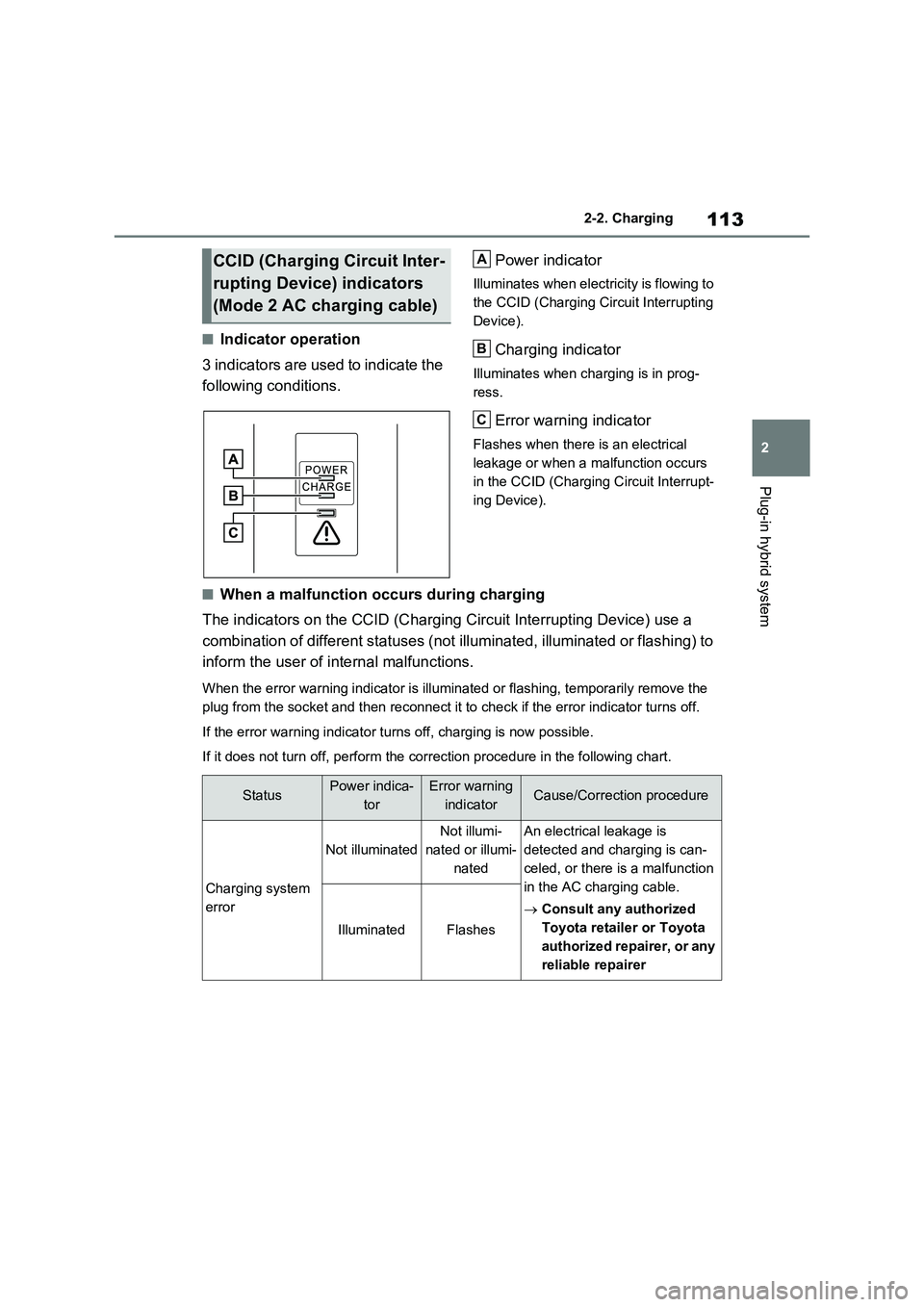
■Indicator operation
3 indicators are used to indicate the
following conditions.Power indicator
Illuminates when electricity is flowing to
the CCID (Charging Circuit Interrupting
Device).
Charging indicator
Illuminates when charging is in prog-
ress.
Error warning indicator
Flashes when there is an electrical
leakage or when a malfunction occurs
in the CCID (Charging Circuit Interrupt-
ing Device).
■When a malfunction occurs during charging
The indicators on the CCID (Charging Circuit Interrupting Device) use a
combination of different statuses (not illuminated, illuminated or flashing) to
inform the user of internal malfunctions.
When the error warning indicator is illuminated or flashing, temporarily remove the
plug from the socket and then reconnect it to check if the error indicator turns off.
If the error warning indicator turns off, charging is now possible.
If it does not turn off, perform the correction procedure in the following chart.
CCID (Charging Circuit Inter-
rupting Device) indicators
(Mode 2 AC charging cable)A
B
C
StatusPower indica-
torError warning
indicatorCause/Correction procedure
Charging system
error
Not illuminated
Not illumi-
nated or illumi-
natedAn electrical leakage is
detected and charging is can-
celed, or there is a malfunction
in the AC charging cable.
Consult any authorized
Toyota retailer or Toyota
authorized repairer, or any
reliable repairer
IlluminatedFlashes