2011 SUBARU IMPREZA ECO mode
[x] Cancel search: ECO modePage 292 of 458
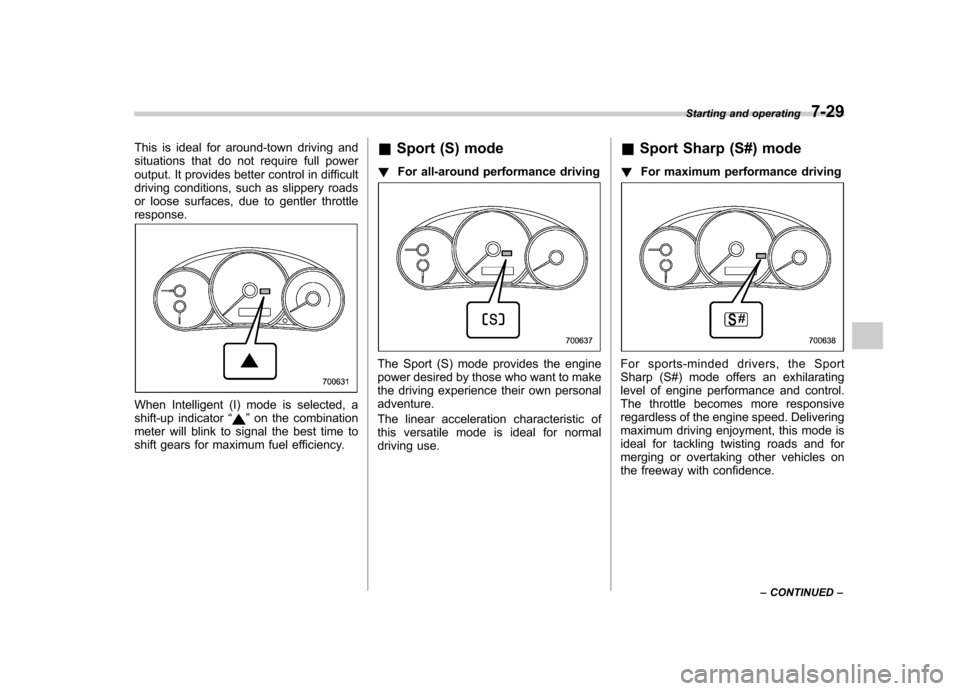
This is ideal for around-town driving and
situations that do not require full power
output. It provides better control in difficult
driving conditions, such as slippery roads
or loose surfaces, due to gentler throttleresponse.
When Intelligent (I) mode is selected, a
shift-up indicator“”on the combination
meter will blink to signal the best time to
shift gears for maximum fuel efficiency. &
Sport (S) mode
! For all-around performance driving
The Sport (S) mode provides the engine
power desired by those who want to make
the driving experience their own personaladventure.
The linear acceleration characteristic of
this versatile mode is ideal for normal
driving use. &
Sport Sharp (S#) mode
! For maximum performance drivingFor sports-minded drivers, the Sport
Sharp (S#) mode offers an exhilarating
level of engine performance and control.
The throttle becomes more responsive
regardless of the engine speed. Delivering
maximum driving enjoyment, this mode is
ideal for tackling twisting roads and for
merging or overtaking other vehicles on
the freeway with confidence. Starting and operating
7-29
– CONTINUED –
Page 299 of 458

7-36Starting and operating
The Vehicle Dynamics Control System
may therefore operate. Such operation
does not indicate a system malfunc-tion. –on gravel-covered or rutted
roads – on unfinished roads
– when the vehicle is fitted with
snow tires or winter tires
. Activation of the Vehicle Dynamics
Control system will cause operation of
the steering wheel to feel slightly
different compared to that for normalconditions. . It is always important to reduce
speed when approaching a corner,
even if the vehicle is equipped with
Vehicle Dynamics Control. . Always turn off the engine before
replacing a tire as failure to do so may
render the Vehicle Dynamics Control
system unable to operate correctly. & Vehicle Dynamics Control
system monitor
Refer to “Vehicle Dynamics Control opera-
tion indicator light ”F 3-23 and “Vehicle
Dynamics Control warning light/Vehicle
Dynamics Control OFF indicator light/
Traction Control OFF indicator light (STI) ”
F 3-23. &
Vehicle Dynamics Control
mode switch (STI)
Indicator light
Vehicle Dynamics Control mode switch
When the switch is pressed briefly or for
more than approximately 3 seconds dur- ing engine operation, the mode of the
Vehicle Dynamics Control System will bechanged. !
Vehicle Dynamics Control mode
When the ignition switch is on, this mode
is selected.
This mode enables all controls for ABS,
the Traction Control System, and the
Vehicle Dynamics Control system. Select
this mode for most driving situations.
When this mode is selected, the indicator
light on the combination meter turns off. ! Traction mode
This mode restricts the functions of the
Traction Control System and Vehicle
Dynamics Control system and thus delays
utilizing their functions as a reaction to
vehicle behavior in comparison with the
Vehicle Dynamics Control mode. This
mode should be used in driving situations
where the vehicle dynamic performance
will improve without decreasing engine
torque control.
When the switch is pressed briefly during
engine operation, the indicator light on the
combination meter illuminates in green.
When the switch is pressed again to
reactivate the Vehicle Dynamics Control
system, the indicator light turns off.
Page 300 of 458

!Vehicle Dynamics Control OFF mode
This mode allows only the ABS control.
This mode should be used in an emer-
gency situation such as getting out of
snow or mud.
When the switch is pressed for more than
approximately 3 seconds during engine
operation, the indicator light on the com-
bination meter illuminates in yellow. When
the switch is pressed again to reactivate
the Vehicle Dynamics Control system, the
indicator light turns off. NOTE . The Vehicle Dynamics Control sys-
tem will be activated automatically
when the engine is started.. If the switch is held down for 10
seconds or longer, the indicator light
turns off, the Vehicle Dynamics Control
system is activated, and the system
ignores any further pressing of the
switch. To make the switch usable
again, turn the ignition switch to the“ LOCK ”position and restart the en-
gine.. When the Vehicle Dynamics Control
OFF mode is selected, the vehicle ’s
running performance is comparable
with that of a vehicle that does not
have a Vehicle Dynamics Control sys- tem. Do not deactivate the Vehicle
Dynamics Control system except when
absolutely necessary..
Even when the Vehicle Dynamics
Control OFF mode is selected, compo-
nents of the brake control system may
still activate. When the brake control
system is activated, the Vehicle Dy-
namics Control operation indicator
light illuminates.
& Vehicle Dynamics Control
OFF switch (except STI)
Indicator light (turbo models)
Indicator light (non-turbo models)
Vehicle Dynamics Control OFF switch
Pressing the switch to deactivate the
Vehicle Dynamics Control system can
facilitate the following operations: . a standing start on a steeply sloping Starting and operating
7-37
– CONTINUED –
Page 301 of 458

7-38Starting and operating
road with a snowy, gravel-covered, or
otherwise slippery surface .extrication of the vehicle when its
wheels are stuck in mud or deep snow
When the switch is pressed during engine
operation, the Vehicle Dynamics Control
OFF indicator light on the combination
meter illuminates. The Vehicle Dynamics
Control system will be deactivated and the
vehicle will behave like a model not
equipped with the Vehicle Dynamics Con-
trol system. When the switch is pressed
again to reactivate the Vehicle Dynamics
Control system, the Vehicle Dynamics
Control OFF indicator light turns off.
With the Vehicle Dynamics Control system
deactivated, traction and stability en-
hancement offered by Vehicle Dynamics
Control system is unavailable. Therefore
you should not deactivate the Vehicle
Dynamics Control system except under
above-mentioned situations. NOTE . The Vehicle Dynamics Control sys-
tem will be activated automatically
when the engine is started.. If the switch is held down for 10
seconds or longer, the indicator light
turns off, the Vehicle Dynamics Control
system is activated, and the system
ignores any further pressing of the switch. To make the switch usable
again, turn the ignition switch to the“
LOCK ”position and restart the en-
gine.. When the switch is pressed to
deactivate the Vehicle Dynamics Con-
trol system, the vehicle ’s running per-
formance is comparable with that of a
vehicle that does not have a Vehicle
Dynamics Control system. Do not de-
activate the Vehicle Dynamics Control
system except when absolutely neces-
sary.. Even when the Vehicle Dynamics
Control system is deactivated, compo-
nents of the brake control system may
still activate. When the brake control
system is activated, the Vehicle Dy-
namics Control operation indicator
light illuminates. Tire pressure monitoring
system (TPMS) (U.S.-spec.
models)
Turbo models
Non-turbo models
Page 306 of 458
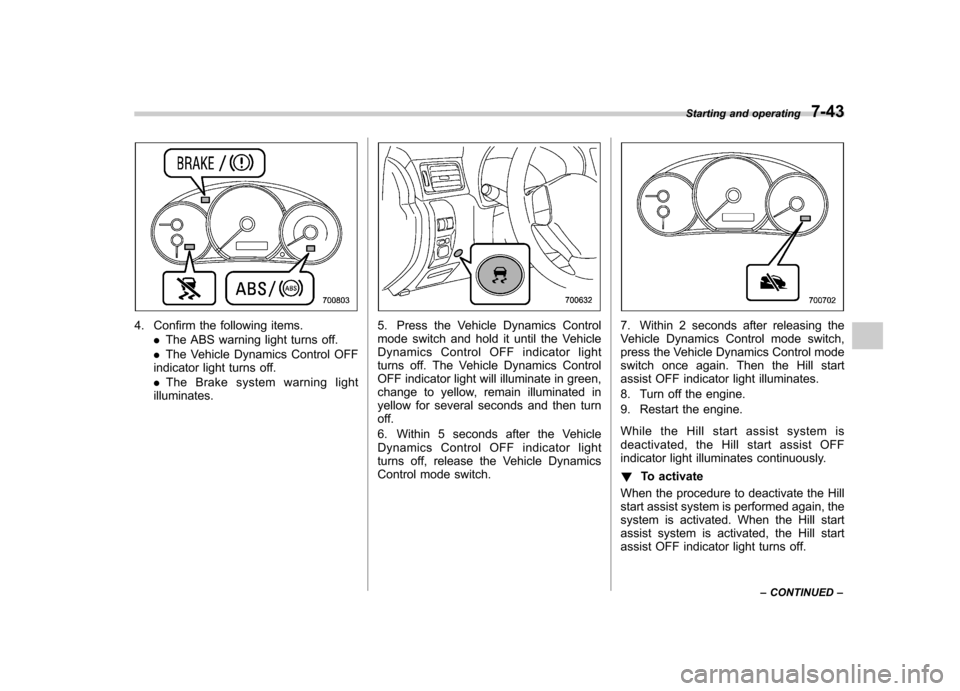
4. Confirm the following items..The ABS warning light turns off.
. The Vehicle Dynamics Control OFF
indicator light turns off. . The Brake system warning light
illuminates.5. Press the Vehicle Dynamics Control
mode switch and hold it until the Vehicle
Dynamics Control OFF indicator light
turns off. The Vehicle Dynamics Control
OFF indicator light will illuminate in green,
change to yellow, remain illuminated in
yellow for several seconds and then turn
off.
6. Within 5 seconds after the Vehicle
Dynamics Control OFF indicator light
turns off, release the Vehicle Dynamics
Control mode switch.7. Within 2 seconds after releasing the
Vehicle Dynamics Control mode switch,
press the Vehicle Dynamics Control mode
switch once again. Then the Hill start
assist OFF indicator light illuminates.
8. Turn off the engine.
9. Restart the engine.
While the Hill start assist system is
deactivated, the Hill start assist OFF
indicator light illuminates continuously. ! To activate
When the procedure to deactivate the Hill
start assist system is performed again, the
system is activated. When the Hill start
assist system is activated, the Hill start
assist OFF indicator light turns off. Starting and operating
7-43
– CONTINUED –
Page 307 of 458
7-44Starting and operating
&Hill start assist warning light/
Hill start assist OFF indicator light
Refer to “Hill start assist warning light (MT
models –if equipped)/Hill start assist OFF
indicator light (STI) ”F 3-22. Cruise control
Cruise control enables you to maintain a
constant vehicle speed without holding
your foot on the accelerator pedal and it is
operative when the vehicle speed is 25
mph (40 km/h) or more.
WARNING
Do not use the cruise control under
any of the following conditions.
These may cause loss of vehiclecontrol. . driving up or down a steep grade
. driving on slippery or winding
roads
. driving in heavy traffic
NOTE . If you press the “CRUISE ”main
switch button while turning the ignition switch “ON ”, the cruise control func-
tion is deactivated and the cruise
control indicator light flashes. To re-
activate the cruise control function,
turn the ignition switch back to the“ Acc ”or “LOCK ”position, and then
turn it again to the “ON ”position.
. Make sure the “CRUISE ”main
switch is turned off when the cruise control is not in use to avoid uninten-
tionally setting of the cruise control.
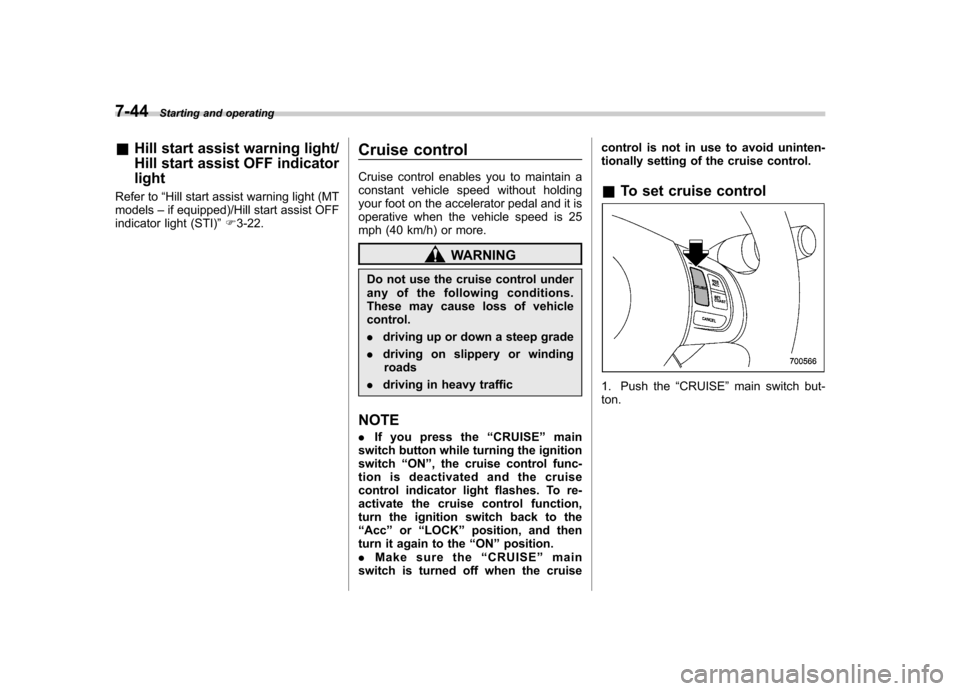
& To set cruise control
1. Push the “CRUISE ”main switch but-
ton.
Page 312 of 458

New vehicle break-in driving–the first
1,000 miles (1,600 km) ..................................... 8-2
Fuel economy hints ............................................ 8-2
Engine exhaust gas (carbon monoxide) ............ 8-2
Catalytic converter .............................................. 8-3
Periodic inspections ........................................... 8-4
Driving in foreign countries ............................... 8-4
Driving tips for AWD models .............................. 8-5
Off road driving ................................................... 8-6
All AWD models except OUTBACK ...................... 8-6
OUTBACK ........................................................... 8-6 Winter driving
...................................................... 8-8
Operation during cold weather . ............................ 8-8
Driving on snowy and icy roads ........................... 8-9
Corrosion protection .......................................... 8-10
Snow tires ......................................................... 8-10
Tire chains ........................................................ 8-11
Rocking the vehicle ........................................... 8-11
Loading your vehicle ......................................... 8-12
Vehicle capacity weight ...................................... 8-12
GVWR and GAWR (Gross Vehicle Weight Rating and Gross Axle Weight Rating) ........................ 8-13
Roof molding and crossbar (if equipped) ............ 8-14
Trailer towing ..................................................... 8-15 Driving tips
8
Page 316 of 458

Driving tips for AWD models
All-Wheel Drive distributes the engine
power to all four wheels. AWD models
provide better traction when driving on
slippery, wet or snow-covered roads and
when moving out of mud, dirt and sand.
By shifting power between the front and
rear wheels, SUBARU AWD can also
provide added traction during acceleration
and added engine braking force duringdeceleration.
Therefore, your SUBARU AWD vehicle
may handle differently than an ordinary
two wheel drive vehicle and it contains
some features unique to AWD. For safety
purposes as well as to avoid damaging
the AWD system, you should keep the
following tips in mind..
An AWD model is better able to climb
steeper roads under snowy or slippery
conditions than a two wheel drive vehicle.
There is little difference in handling,
however, during extremely sharp turns or
sudden braking. Therefore, when driving
down a slope or turning corners, be sure
to reduce your speed and maintain an
ample distance from other vehicles. . When replacing a tire, make sure you
use only the same size, construction,
brand, and load range as the original tires
listed on the tire placard. Using other
sizes, circumference or construction may
result in severe mechanical damage to the
drive train of your vehicle and may affect
ride, handling, braking, speedometer/od-
ometer calibration, and clearance be-
tween the body and tires. It also may be
dangerous and lead to loss of vehiclecontrol. . If you use a temporary spare tire to
replace a flat tire, be sure to use the
original temporary spare tire stored in the
vehicle. Using other sizes may result in
severe mechanical damage to the drive
train of your vehicle. . Always check the cold tire pressure
before starting to drive. The recom-
mended tire pressure is provided on the
tire placard, which is located under the
door latch on the driver ’s side. .
There are some precautions that you
must observe when towing your vehicle.
For detailed information, refer to “Towing ”
F 9-14.
WARNING
. Always maintain a safe driving
speed according to the road and
weather conditions in order to
avoid having an accident on a
sharp turn, during sudden brak-
ing or under other similar condi-tions.
. Always use the utmost care in
driving –overconfidence be-
cause you are driving an All-
Wheel Drive model could easily
lead to a serious accident. Driving tips
8-5