2011 SKODA YETI trailer
[x] Cancel search: trailerPage 211 of 252

The vehicle tool kit and the lifting jack, on which a sign is affixed, are stowed in a
box in the luggage compartment
⇒
fig. 164; there is also space here for the de-
tachable ball head of the towing device. The box is secured with a strap. The
placement of the vehicle tool kit can vary depending on the vehicle equipment.
The vehicle tool kit contains the following parts (depending on equipment fitted):
● Tyre repair kit
● Wire clamps for removing the full wheel trims,
● Wheel wrench,
● Towing eye,
● Adapter for the wheel bolts lock,
● Replacement lamp,
● Torx screwdriver.
Before placing the lifting jack back in its storage area, screw in the arm of the lift-
ing jack fully. WARNING
● The factory-supplied lifting jack is only intended for your model of vehicle.
On no account attempt to lift a heavier vehicle or other loads - risk of injury!
● Ensure that the vehicle tool kit is safely attached in the luggage compart-
ment. Note
Ensure that the box is always secured with the strap.
Spare wheel Fig. 165 Luggage compartment: Spare
wheelThe spare wheel is stowed in the luggage compartment in the area below the var-
iable loading floor and is secured with a special screw
⇒ fig. 165.
One should check the inflation pressure in the spare wheel (at best when general-
ly checking the tyre air pressures - see sign on the fuel filler flap ⇒ page 201) to
ensure that the spare wheel is always ready to use.
Temporary spare wheel
A yellow warning label is displayed on the rim of the temporary spare wheel.
Please observe the following notes when driving with a temporary spare wheel:
● The warning label must not be covered after installing the wheel.
● Do not drive faster than 80 km/h with this spare wheel and pay particular at-
tention while driving. Avoid accelerating at full throttle, sharp braking and fast
cornering.
● The inflation pressure for this spare wheel is identical to the maximum infla-
tion pressure of the standard tyres.
● Use this spare wheel only to reach the nearest specialist garage as it is not in-
tended for continuous use.
Changing a wheel Preliminary work The following steps should be carried out before actually changing the wheel.
– If it is necessary to change a wheel, park the vehicle as far away as possible
from the traffic flow. The place you choose should be level.
– Have all the occupants get out. While changing a tyre, the occupants of the
vehicle should not stand on the road (instead they should remain behind a
crash barrier, for example).
– Apply the handbrake firmly.
– Engage 1st gear or if your vehicle is fitted with an automatic gearbox, position
the selector lever into position P .
– If a trailer is coupled, uncouple it.
– Take the vehicle tool kit ⇒ page 208
and the spare wheel ⇒ page 209 out of
the luggage compartment. £ 209
Breakdown assistance Using the system Safety Driving Tips General Maintenance Breakdown assistance Technical data
Page 217 of 252

–
Have all the occupants get out. While changing a tyre, the occupants of the
vehicle should not stand on the road (instead they should remain behind a
crash barrier, for example).
– Switch off the engine and engage 1st gear or if your vehicle is fitted with an
automatic gearbox, position the selector lever into position P .
– Apply the handbrake firmly.
– Check whether you can carry out the repairs with the tyre repair kit
⇒ page 213, General information.
– If a trailer is coupled, uncouple it.
– Remove the tyre repair kit from the luggage compartment.
– Stick the sticker 2
⇒
fig. 172 on the dash panel in view of the driver.
– Do not remove the foreign body, e.g. screw or nail, from the tyre.
– Unscrew the valve cap.
– Use the valve remover 1 to remove the valve core and place it down on a
clean surface.
Seal and inflate tyres Sealing tyres
–
Forcefully shake the tyre inflator bottle 10
⇒ fig. 172 several times.
– Firmly screw inflation hose 3 onto the tyre inflator bottle in a clockwise direc-
tion 10 . The film on the cap is pierced automatically.
– Remove the plug from the inflation hose 3 and plug the open end fully into
the tyre valve.
– Hold the bottle 10 with the floor facing upwards and fill the whole sealing
agent in the tyre inflator bottle into the tyres.
– Remove the empty tyre inflator bottle from the valve.
– Screw the valve core back into the tyre valve using the valve remover 1 .
Pumping up the tyres
– Screw the tyre inflation hose 5
⇒
fig. 172 of the air compressor firmly onto the
tyre valve.
– Check whether the air release valve 7 is closed.–
On vehicles fitted with a manual gearbox, move the gearshift lever into Neu-
tral.
– Start the engine and run it in idle.
– Insert the plug 9 into the 12 Volt socket. ⇒
page 79
– Switch on the air compressor with the ON and OFF switch 8 .
– Allow the air compressor to run until reaching a pressure of 2.0 - 2.5 bar. Maxi-
mum run time of 8 minutes ⇒ !
– Switch off the air compressor with the ON and OFF switch.
– If you cannot reach an air pressure of 2.0 – 2.5 bar, unscrew the tyre inflation
hose 5 from the tyre valve.
– Drive the vehicle approx. 10 metres forwards or backwards to allow the sealing
agent to distribute in the tyre.
– Screw the tyre inflation hose of the air compressor 5 firmly back onto the
tyre valve and repeat the inflation procedure.
– If you cannot reach the required tyre inflation pressure here either, this means
the tyre has sustained too much damage. You cannot seal with tyre with the
breakdown kit ⇒ .
– Switch off the air compressor with the ON and OFF switch.
– Remove the tyre inflation hose 5 from the tyre valve.
After reaching a tyre inflation pressure of 2.0 – 2.5 bar, drive at a maximum speed
of 80 km/h (50
mph).
Check the tyre inflation pressure after driving 10 minutes ⇒ page 216, Check after
driving for 10 minutes. WARNING
● During inflation, the tyre inflation hose and air compressor may get hot-
risk of injury!
● Do not place hot tyre inflation hoses or hot air compressors on flammable
materials - risk of fire!
● If you cannot inflate the tyre to at least 2.0 bar, this means the damage
sustained was too serious. The sealing agent cannot be used to seal the tyre.
Do not drive the vehicle. Get professional assistance. £ 215
Breakdown assistance Using the system Safety Driving Tips General Maintenance Breakdown assistance Technical data
Page 220 of 252

The maximum towing speed is
50 km/h.
Driver of the towed vehicle
– Switch the ignition on so that the steering wheel is not blocked and you can
also operate the turn signal lights, the headlight flasher, the windscreen wip-
ers and windscreen washer system.
– Take the vehicle out of gear or move the selector lever into position N if your
vehicle is fitted with an automatic gearbox.
Note that the brake servo unit and power steering only operate if the engine is
running. You will require significantly greater physical force to depress the brake
pedal and to steer the vehicle if the engine is not running.
When using a tow rope, always ensure that the tow rope is always kept taught. CAUTION
● Do not tow start the engine - danger of damaging the engine. On vehicles with
a catalytic converter, unburnt fuel may get into the catalytic converter where it
may ignite. This in turn may damage or destroy the catalytic converter. You can
use the battery of another vehicle as a jump-start aid ⇒ page 216, Jump-starting
.
● If the gearbox of your vehicle no longer contains any oil because of a defect,
your vehicle must only be towed in with the driven wheels raised clear of the
ground, or on a special vehicle transporter or trailer.
● The vehicle must be transported on a special vehicle or trailer if it is not possi-
ble to tow in the vehicle in the way described or if the towing distance is greater
than 50
km.
● To protect both vehicles when tow-starting or towing, the tow rope should be
elastic. Thus one should only use plastic fibre rope or a rope made out of a similar-
ly elastic material.
● One should be constantly vigilant not to allow impermissibly high towing
forces or jerky loadings. There is always a risk of excessive stresses and damage
resulting at the points to which you attach the tow rope or tow bar when you at-
tempt to tow a vehicle which is not standing on a paved road.
● Attach the tow rope or the tow bar only to the towing eyes provided for this
purpose ⇒ page 218
, Front towing eye and ⇒ page 219, Rear towing eye Note
● We recommend a tow rope from the range of
ŠKODA Original Accessories that
you can purchase from an authorised ŠKODA Service Partner.
● Towing another vehicle requires a certain amount of practice. Both drivers
should be familiar with the particular points about towing a vehicle. Unskilled driv-
ers should not attempt to tow in another vehicle or to be towed in.
● When towing, respect the national legal provisions, especially those which re-
late to the identification of the towing vehicle and the vehicle being towed.
● The tow rope must not be twisted as it may in certain circumstances result in
the front towing eye being unscrewed out of your vehicle.
Front towing eye The towing eye is stored in the box of the vehicle tool kit.
Fig. 175 Front bumper: Removing the cover/installing the towing eye
–
Press on the upper half of the cover in direction of arrow 1
⇒ fig. 175 .
– Pull the cover out of the front bumper.
– Screw in the towing eye by hand to the left up to the stop ⇒ fig. 175 - right and
tighten it as much as possible. For tightening, we recommend that you use for
example the wheel wrench, the lashing eye of another vehicle or a similar ob-
ject which you can push through the eye.
– In order to reinstall the cover after screwing out the towing eye, first of all in-
sert the upper part of the cover and then press in the lower part. The cover
must engage firmly. £218
Breakdown assistance
Page 230 of 252

Technical data
Technical data General information The details given in the official vehicle registration documents always take prece-
dence over the details in the Owner's Manual. Please refer to the official vehicle
registration documents or consult a specialist garage concerning the engine with
which your vehicle is equipped.
Used abbreviations Abbreviation Importance
kW Kilowatt, measuring unit for the engine output
rpm Engine revolutions per minute
Nm Newton meter, measuring unit for the engine torque
CO
2 in g/km discharged quantity of carbon dioxide in grams per driven
kilometre
TSI Petrol engine with a turbocharger and a direct fuel injec-
tion system TDI CR Diesel engine with turbocharger and injection system
Common Rail
M5/M6 5-speed/6-speed manual gearbox
DQ6/DQ7 6 speed-/7 speed automatic gearbox DSG
N1 The vehicles of this category are designed and construc-
ted for conveying goods with a maximum weight of
3.5
tons DPF Diesel particle filter
Performances The listed performance values were determined without performance-reducing
equipment, e.g. air conditioning system.
Weight
Fig. 190 Type plate
The indicated unloaded weight is for orientation purposes only. It is for the basic
equipment variant of the vehicle not including special features or accessories.
The kerb weight contains a fuel tank topped up to 90 % and a driver weight of
75 kg.
It is possible to calculate the approximate loading capacity from the difference be-
tween the permissible total weight and the unloaded weight.
You need to include the following into the loading capacity:
● passengers,
● all items of luggage and other loads,
● roof loads incl. the roof rack,
● when using a trailer hitch, the corresponding trailer nose weight (max. 80 kg).
The following specifications are listed on the type plate ⇒
fig. 190 :
Permissible gross weight
The permissible overall weight of the vehicle/trailer combination when the
vehicle is being operated with a trailer
Maximum permissible front axle load
Maximum permissible rear axle load £
1 2
3
4228
Technical data
Page 234 of 252

Engine 1.2 l/77 kW TSI - EU5
Output (kW per rpm) Max. torque (Nm per rpm) Number of cylinders/Displacement (cm
3
) 77/5000 175/1550-4100 4/1197
Performances M6 DQ7
Maximum speed (km/h) 175 173
Acceleration 0 - 100 km/h (s) 11.8 12.0
Fuel consumption (in ltr./100 km) and CO
2 (in g/km) Urban 7.6 7.8
a)
/8.0 b) Non-urban 5.9 5.7
a)
/5.8 b) Combination 6.4 6.4
a)
/6.6 b) CO
2 emission - combination 149 149
a)
/154 b) Weight (in kg)
Permissible gross weight 1885/1940
c) 1915/1970
c)Kerb weight ready for operation 1340 1370
Permissible trailer loads, trailer braked 1200
d)
/1500 e)Permissible trailer loads, trailer unbraked 670 680
a)
Unloaded weight with special equipment up to 1,505 kg.
b) Unloaded weight with special equipment more than 1,505 kg.
c) Vehicles of the group N1.
d) Uphills up to 12 %
e) Uphills up to 8 % 232
Technical data
Page 235 of 252
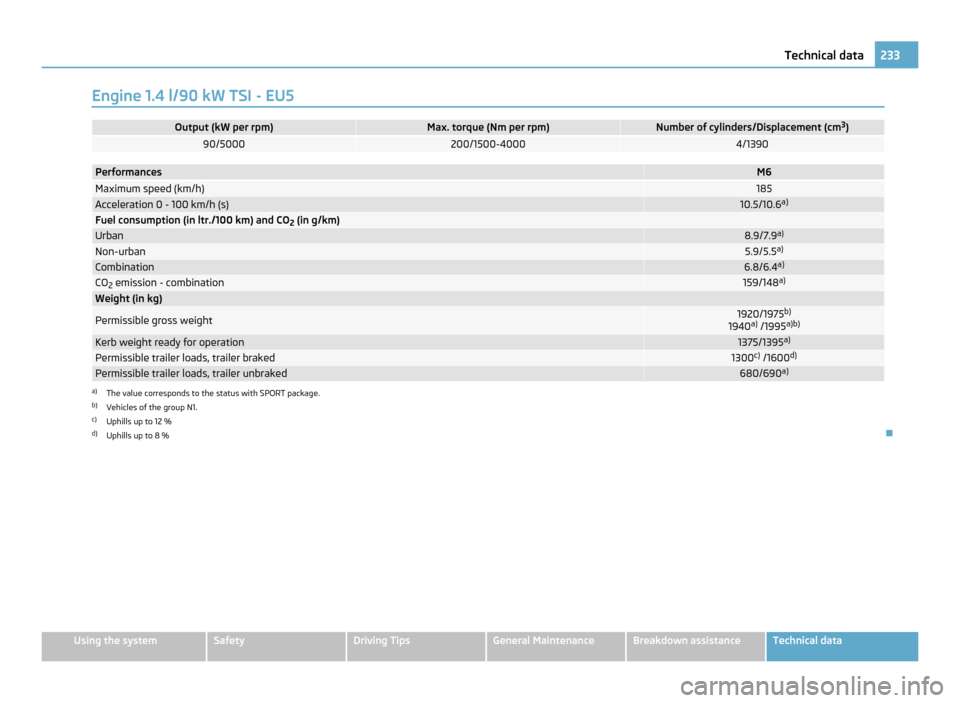
Engine 1.4 l/90 kW TSI - EU5
Output (kW per rpm) Max. torque (Nm per rpm) Number of cylinders/Displacement (cm
3
) 90/5000 200/1500-4000 4/1390
Performances M6
Maximum speed (km/h) 185
Acceleration 0 - 100 km/h (s) 10.5/10.6
a) Fuel consumption (in ltr./100 km) and CO
2 (in g/km) Urban 8.9/7.9
a) Non-urban 5.9/5.5
a) Combination 6.8/6.4
a) CO
2 emission - combination 159/148
a) Weight (in kg)
Permissible gross weight 1920/1975
b)
1940 a)
/1995 a)
b)Kerb weight ready for operation 1375/1395
a) Permissible trailer loads, trailer braked 1300
c)
/1600 d) Permissible trailer loads, trailer unbraked 680/690
a) a)
The value corresponds to the status with SPORT package.
b) Vehicles of the group N1.
c) Uphills up to 12 %
d) Uphills up to 8 % 233
Technical data Using the system Safety Driving Tips General Maintenance Breakdown assistance Technical data
Page 236 of 252

Engine 1.8 ltr./118 kW TSI - EU2, EU5 (1.8 ltr./112 kW TSI - EU5)
Output (kW per rpm) Max. torque (Nm per rpm) Number of cylinders/Displacement (cm
3
) 118/4500-6200 (112/4300 - 6200)
a) 250/1500-4500 (250/1500 - 4200)
a) 4/1798
a)
1.8 ltr./112 kW TSI Performances M6 4x4 DQ6
a) Maximum speed (km/h) 200/196
a) 192
Acceleration 0 - 100 km/h (s) 8.4/8.7
a) 9.0
Fuel consumption (in ltr./100 km) and CO
2 (in g/km) Urban 10.1 10.6
Non-urban 6.9 6.8
Combination 8.0 8.0
CO
2 emission - combination 189
Weight (in kg)
Permissible gross weight 2050/2105
b) 2085/2140
b)Unloaden weight ready for work 1505 1540
Permissible trailer loads, trailer braked 1800
Permissible trailer loads, trailer unbraked 750
a)
1.8 ltr./112 kW TSI
b) Vehicles of the group N1. 234
Technical data
Page 237 of 252
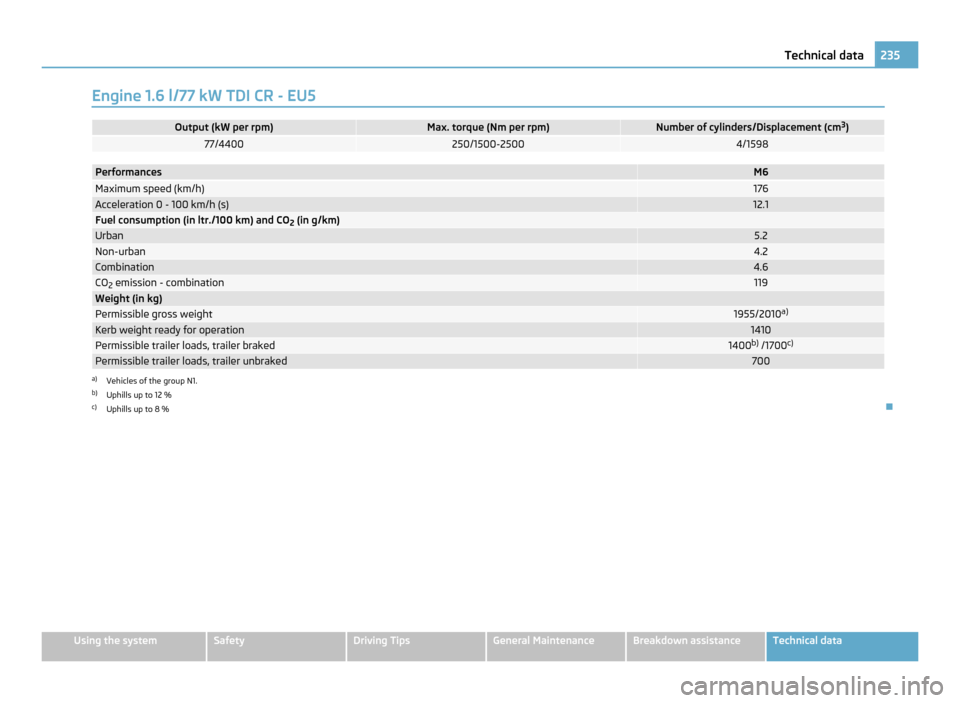
Engine 1.6 l/77 kW TDI CR - EU5
Output (kW per rpm) Max. torque (Nm per rpm) Number of cylinders/Displacement (cm
3
) 77/4400 250/1500-2500 4/1598
Performances M6
Maximum speed (km/h) 176
Acceleration 0 - 100 km/h (s) 12.1
Fuel consumption (in ltr./100 km) and CO
2 (in g/km) Urban 5.2
Non-urban 4.2
Combination 4.6
CO
2 emission - combination 119
Weight (in kg)
Permissible gross weight 1955/2010
a) Kerb weight ready for operation 1410
Permissible trailer loads, trailer braked 1400
b)
/1700 c) Permissible trailer loads, trailer unbraked 700
a)
Vehicles of the group N1.
b) Uphills up to 12 %
c) Uphills up to 8 % 235
Technical data Using the system Safety Driving Tips General Maintenance Breakdown assistance Technical data