2011 SKODA YETI change wheel
[x] Cancel search: change wheelPage 160 of 252
The Brake Assist is able to help you achieve a shorter braking distance in emer-
gency situations by rapidly producing the pressure required in the brake system. It
fully exploits the attributes of the ABS. After you release the brake pedal, the
function of the Brake Assist is automatically switched off and the brakes operate
in the normal way.
The Brake Assist is part of the ESP system. If a fault occurs in the ESP, the Brake
Assist function is also not available. Further information on the ESP
⇒ page 153.WARNING
● The Brake Assist is also not able to overcome the physical limits of your car
in terms of the braking distance required.
● Adapt your speed to the conditions of the road surface and to the traffic
situation.
● The increased safety offered by the Brake Assist must not tempt you to
take a greater safety risk than otherwise.
Uphill Start Assist The uphill start assist makes it easier to start off on steep hills. The system assists
a start off by holding the brake pressure produced by the brake pedal actuation
for approx. 2 seconds after releasing the brake pedal. The driver can therefore
move his foot from the brake pedal to the accelerator pedal and start off on the
slope, without having to actuate the handbrake. The brake pressure drops gradu-
ally the more you operate the accelerator pedal. If the vehicle does not start off
within 2 seconds, it starts to roll back.
The uphill start assist is active as of a 3 % slope, if the driver door is closed. It is
always active on slopes when in forward or reverse start off. When driving down-
hill, it is inactive.
Electromechanical power steering The power steering enables you to steer the vehicle with less physical force.
With the electromechanical power steering, the steering assist is automatically
adapted to the speed and to the steering angle.
It is still possible to fully steer the vehicle if the power steering fails or if the en-
gine is not running (vehicle being towed in). The only difference is that greater
physical effort is required. If there is a fault in the power steering, the warning light
or lights up in the
instrument cluster ⇒
page 25. WARNING
Contact your specialist garage if the power steering is defective.
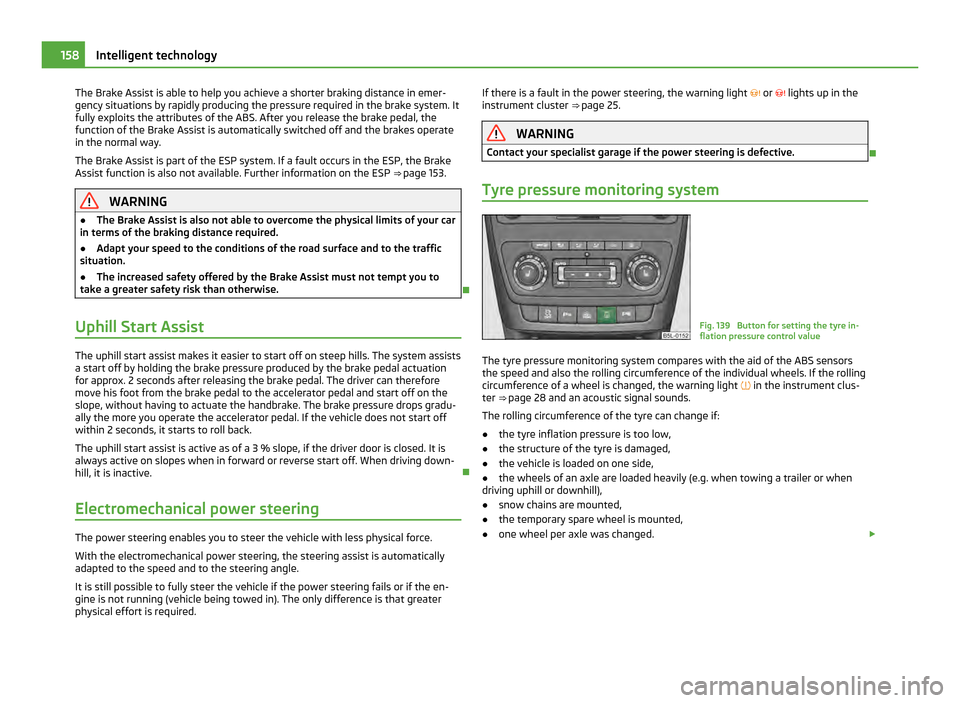
Tyre pressure monitoring system Fig. 139 Button for setting the tyre in-
flation pressure control value
The tyre pressure monitoring system compares with the aid of the ABS sensors
the speed and also the rolling circumference of the individual wheels. If the rolling
circumference of a wheel is changed, the warning light
in the instrument clus-
ter ⇒ page 28 and an acoustic signal sounds.
The rolling circumference of the tyre can change if:
● the tyre inflation pressure is too low,
● the structure of the tyre is damaged,
● the vehicle is loaded on one side,
● the wheels of an axle are loaded heavily (e.g. when towing a trailer or when
driving uphill or downhill),
● snow chains are mounted,
● the temporary spare wheel is mounted,
● one wheel per axle was changed. £158
Intelligent technology
Page 174 of 252

CAUTION
● Pay attention to the ground clearance of the vehicle! The vehicle can be se-
verely damaged and become disabled once it touches the ground.
● Never drive off-road with an almost empty fuel tank. The fuel supply to the en-
gine can be interrupted and therefore the catalytic converter can be severely
damaged.
● Do not leave your foot on the clutch pedal or let the clutch slip when driving
off-road. Overwise you may unintentionally depress the clutch pedal on uneven
ground leading to a loss of control over the vehicle. In addition, the force for con-
necting the engine and the gearbox is lost. Moreover, driving while letting the
clutch slip causes a fast wear of the clutch linings. Note
The fuel consumption is higher when driving off-road than when driving on con-
ventional roads, especially through difficult terrain. When you prepare for your
journey, be aware of an increase in fuel consumption; the nearest filling station
may be far away.
Shifting gears correctly The gear you must shift into depends on the terrain. Choosing the correct gear
contributes to safe driving. In particular if you do not have much experience driv-
ing off-road, it is always better, before negotiating a difficult stretch of the road,
to pause and reflect on which gear to engage. Your experience will tell you which
gear is the best for certain sections of the terrain.
Basically:
● When the gear or the driving stage has been properly selected, it is unneces-
sary to slow down the vehicle on a downhill section using the footbrake as in
most cases the engine braking power is sufficient.
● Depress the accelerator only as much as is necessary. A too great acceleration
may lead to the wheels spinning and thus results in the loss over the control of
the vehicle. Manual gearbox
● If you are driving through difficult terrain, on no account use the clutch or
change the gear. When the clutch is depressed, the vehicle may come to a stand-
still because of the increased grip of all the tyres of the vehicle (e.g. in the mud, in
deep sand or on a slope). Once the vehicle has come to a standstill, it may be diffi-
cult or even impossible to start off under these conditions.
● When negotiating a steep downhill section or a steep uphill section, always
shift into the 1st or 2nd gear.
● On a soft or slippery ground, you must drive at the appropriate speed and you
must select the highest possible gear for this.
Automatic gearbox
● Select the selector lever position D for normal flat stretches of terrain
⇒ page 113.
● While in the Tiptronic mode, select the selector lever position 3 or
2 if you
are driving through mud, sand, water or hilly sections of terrain ⇒ page 115.
● When negotiating a steep downhill section or a steep uphill section, select the
selector lever position 1 while in the Tiptronic mode.
● On a soft or slippery ground, you must drive at the appropriate speed and you
must select the highest possible driving stage.
Driving over rough and smooth Fig. 148 Observe the ground clearance
– Switch on the Off-road mode ⇒ page 160 .
– Drive at walking speed over rocky passages.
– If it is not possible to drive around a stone, gently drive onto the stone with
one of the front wheels and then drive over it slowly. £172
Driving and the environment
Page 177 of 252

Exiting the vehicle on a hillside
If the vehicle comes to a standstill at a steep angle on a hillside and you and your
passengers must exit the vehicle, then all the occupants should exit on the side
facing up the hill
⇒
fig. 149 on the right. WARNING
● Never attempt to drive uphill or downhill if it is too steep for your vehicle.
The vehicle could slip, tilt or roll over - risk of accident!
● When driving at an angle on a hillside, the vehicle can lose its grip and
slide sideways. The vehicle can tilt or roll over and then roll down the hillside.
This can lead to serious injuries.
● Always make sure that when the vehicle is at an angle, the wheels on the
low side do not sink deeply into the ground or into troughs and do not drive
over stones, tree stumps or other obstructions with the alternate raised
wheels - risk of accident!
● Before you drive at an angle on a hillside ⇒
fig. 149 , make sure that you can
steer and maintain your trajectory. If this is not possible, choose a different
path. If you drive at an angle on a hillside and there is a risk your vehicle may
tilt, steer immediately downhill on your trajectory and lightly depress the ac-
celerator.
● If the vehicle is stationary on a hillside with a too great angle of lateral in-
clination, avoid sudden and uncontrolled movements in the vehicle. The vehi-
cle can roll over and then roll down the hillside. This can lead to serious inju-
ries.
● If the vehicle is stationary on a hillside with a too great angle of lateral in-
clination, neither you nor your occupants must exit the vehicle through the
doors facing downhill. This can lead to a shift of the overall centre of gravity.
The vehicle can tilt or roll over and then roll down the hillside. This can lead to
serious injuries. To avoid this, you and your occupants must exit the vehicle
only on the side facing uphill ⇒ fig. 149 .
● When you exit the vehicle, make sure that the door which faces uphill does
not close by its own weight or by carelessness - risk of injury!
● Observe the important guidelines ⇒
page 168.
Driving over rutted roads and troughs You will always encounter ruts when driving on forest roads, through wet mead-
ows and fields as well as on rutted stretches of terrain. If the ruts and troughs are on firm and soft ground, you can simply follow the ruts.
Do not drive over ruts and troughs which are too deep. If you cannot avoid this, it
is better that you turn back. CAUTION
If the ruts or troughs become too deep, the underbody of the vehicle can touch
the ground, which might cause the underbody to get damaged. Therefore, avoid
driving in deep ruts and troughs.
Crossing a trench If possible, drive through the trench at an acute angle. Make sure when driving
through the trench that the tilt angle is not too steep.
WARNING
Never attempt to drive through a trench if its embankment is too steep. The
vehicle could slip, tilt or roll over - risk of accident! CAUTION
If you drive into the trench at a right angle, the front wheels will sink into the
trench. There is also the danger that the underbody of the vehicle touches the
ground and is damaged. For these reasons (even with four-wheel drive) it is rarely
possible to get out of the trench.
Driving in sand and mud You should therefore always drive at a constant speed through sand or mud
whenever possible and at the same time do not shift gears or change the driving
stage.
–
Switch on the Off-road mode ⇒ page 160
.
– Select a suitable gear or driving stage and maintain the gear or driving stage.
– Keep your vehicle in constant motion and do not stop until you have reached
firm ground.
Never drive too fast, otherwise the wheels may spin and the vehicle can get stuck.
If you feel that the tyres do no longer grip, then turn the steering wheel quickly
back and forth. This leads to an improved adhesion of the front tyres of the vehi-
cle for a short period of time. £ 175
Driving and the environment Using the system Safety Driving Tips General Maintenance Breakdown assistance Technical data
Page 178 of 252

Driving through sand
Do not reduce
the tyre inflation pressure. If you nevertheless reduce the inflation
pressure, do not forget to re-establish the correct tyre inflation pressure level be-
fore you continue driving. Driving with a reduced tyre inflation pressure increases
the risk that you lose control over your vehicle and that the vehicle rolls over.
Driving through mud
Do not change speed or direction when you drive through the mud. The tyres can
lose their grip in the mud. If the vehicle slides, you must steer in the appropriate
direction in order to regain control over the vehicle. WARNING
● Driving through mud can be dangerous. The vehicle can slide uncontrolla-
bly which causes an increased risk of injury. Adopt a particularly cautious style
of driving. Pay attention to the information and warning notes.
● An incorrect tyre inflation pressure may cause a major or fatal accident! An
incorrect tyre inflation pressure may result in bursting of a tyre, which causes
the vehicle to get out of control.
● Observe the important guidelines ⇒ page 168.
Stuck vehicle If you can no longer drive on ...
–
Carefully dig out all the wheels and make sure that no other parts of the vehi-
cle are stuck in the sand.
– Engage reverse gear.
– Gently depress the accelerator and try to drive backwards in your own track.
– Place scrub, footmats or a sackcloth directly in front of the tyres in order to im-
prove the road adherence and thus achieve an improved traction to drive out.
Rocking out vehicle
– Switch off the TCS ⇒ page 155.
– Set the steering wheel straight.
– Drive so far back until the wheels just begin to spin.
– Quickly shift into first gear and drive forwards until the wheels begin to spin. –
Drive back and forth repeatedly until the momentum is sufficient to free the
vehicle.
– Switch on the TCS.
A few tips
– Ensure that the Off-road mode is switched on ⇒ page 160.
– Avoid prolonged spinning of the wheels, otherwise the vehicle would still sink
deeper into the ground.
– Remove mud, dirt and stones from the tread of the tyre.
You need training and experience if you wish to rock out a vehicle. If you make a
mistake, the vehicle can still sink in further and you can only free it with the help
of others. WARNING
Observe the important guidelines ⇒
page 168.
After driving off-road Check the vehicle for damage after driving off-road - especially on the underside
of the vehicle.
–
Switch off the Off-road mode
⇒
page 160.
– Check the tyres and the axles for damage and remove coarse dirt, stones and
foreign bodies from the tyre tread.
– Clean the turn signal lights, the headlights, the number plate and the win-
dows.
– Check the underbody of the vehicle and remove trapped objects, such as scrub
or wood pieces.
– Contact your specialist garage if you detect any damage.
– In case of thick layers of dirt, clean the radiator grille, the engine compartment
and the underbody of the vehicle. £176
Driving and the environment
Page 187 of 252

CAUTION
● You must on no account treat the leather with solvents (e.g. gasoline, turpen-
tine), floor wax, shoe cream or such like.
● Avoid leaving your vehicle for lengthy periods in bright sunlight in order to
avoid bleaching the leather. If you leave your vehicle parked in the open for
lengthy periods, protect the leather from the direct rays of the sun by covering it
over.
● Sharp-edged objects on items of clothing such as zip fasteners, rivets, sharp-
edged belts may leave permanent scratches or signs of rubbing on the surface.
● The use of a mechanical steering wheel lock may damage the leather surface
of the steering wheel. Note
● Use a care cream with light blocker and impregnation effect regularly and each
time after cleaning the leather. The cream nourishes the leather, allows it to
breathe and keeps it supple and also provides moisture. It also creates surface
protection.
● Clean the leather every 2 to 3 months, remove fresh soiling each time this oc-
curs.
● Remove fresh stains such as those from ball-point pens, ink, lipstick, shoe
cream, etc., as quickly as possible.
● Care also for the leather dye. Refreshen areas which have lost their colour
with a special coloured leather cream as required.
● The leather is a natural material with specific properties. During the use of the
vehicle, minor optical changes can occur on the leather parts of the covers (e. g
wrinkles or creases as a result of the stress of the covers).
Seat belts –
Keep the seat belts clean!
– Wash seat belts which have become soiled using a mild soapy solution.
– Inspect the seat belts regularly to ensure they are in good condition.
Belt webbing which has become severely soiled may prevent the inertia reel from
reeling up the belt properly. WARNING
● The seat belts must not be removed for cleaning.
● Never clean the seat belts chemically as dry cleaning may destroy the fab-
ric. The seat belts must also not be allowed to come into contact with corro-
sive liquids (such as acids etc.).
● Seat belts which have damage to the webbing, the connections, the inertia
reel or the lock should be replaced by a specialist garage.
● Inertia reel belts must be completely dried before being reeled up. 185
Taking care of your vehicle and cleaning the vehicle Using the system Safety Driving Tips General Maintenance Breakdown assistance Technical data
Page 205 of 252

Changing wheels around
Fig. 162 Changing wheels around
If significantly greater wear is present on the front tyres, we recommend changing
the front wheels around with the rear wheels as shown in the diagram ⇒
fig. 162.
You will then obtain approximately the same life for all the tyres.
It may be advantageous to swap the tyres over “crosswise” when uneven wear
characteristic arise on the running surfaces of the tyres (but not in the case of uni-
directional tyres). We recommend that you contact an authorised ŠKODA Service
Partner. They have extensive knowledge about the possible combinations.
We recommend that you change the wheels around every 10 000 km in order to
achieve even wear on all wheels and to obtain optimal tyre life.
New tyres and wheels Tyres and wheel rims are important design elements. One should therefore use
the tyres and wheel rims which have been released for use by
ŠKODA. They are
exactly matched to the vehicle type and therefore contribute significantly to good
road holding and safe driving characteristics ⇒ .
Only fit radial tyres of the same type on all 4 wheels, size (rolling circumference)
and, if possible, the same tread pattern on one axle.
Authorised
ŠKODA Service Partners have access to the most current information
about which tyres we have released for use on your vehicle.
We recommend that you have any work relating to tyres or wheels carried out by
an authorised ŠKODA Service Partner. Authorised ŠKODA Service Partners have all
of the necessary special tools and replacement parts available plus the required
specialist knowledge and are also in a position to properly dispose of the old tyres.
A large number of authorised ŠKODA Service Partners also have an attractive
range of tyres and wheels available. The tyre/wheel combinations which are approved for your vehicle are indicated in
your vehicle documents. Approval and licensing may differ according to the legis-
lation prevailing in individual countries.
Proper knowledge of the tyre data makes it easier for you to select the correct
type of tyre. Tyres do, for example, have the following inscription on their walls:
225/50R
17 91 T
What this means is: 225 Tyre width in mm
50 Height/width ratio in %
R Code letter for the type of tyre -
R adial 17 Diameter of wheel in inches
91 Load index
T Speed symbol
The following speed restrictions apply to tyres.
Speed symbol Permissible maximum speed
S 180 km/h
T 190 km/h
U 200 km/h
H 210 km/h
V 240 km/h
W 270 km/h
Y 300 km/h
The date of manufacture
is also stated on the tyre wall (possibly only on the in-
side of wheel):
DOT ... 20 11...
means, for example, that the tyre was manufactured in the 20th week of the year
2011.
Any spare wheel which differs from the tyres fitted to the vehicle (e.g. winter
tyres or low-profile tyres) should only be used only for a short time in the event of
a puncture and when adopting an appropriately cautious style of driving. It should
be replaced as quickly as possible by a normal wheel. £ 203
Wheels and Tyres Using the system Safety Driving Tips General Maintenance Breakdown assistance Technical data
Page 211 of 252

The vehicle tool kit and the lifting jack, on which a sign is affixed, are stowed in a
box in the luggage compartment
⇒
fig. 164; there is also space here for the de-
tachable ball head of the towing device. The box is secured with a strap. The
placement of the vehicle tool kit can vary depending on the vehicle equipment.
The vehicle tool kit contains the following parts (depending on equipment fitted):
● Tyre repair kit
● Wire clamps for removing the full wheel trims,
● Wheel wrench,
● Towing eye,
● Adapter for the wheel bolts lock,
● Replacement lamp,
● Torx screwdriver.
Before placing the lifting jack back in its storage area, screw in the arm of the lift-
ing jack fully. WARNING
● The factory-supplied lifting jack is only intended for your model of vehicle.
On no account attempt to lift a heavier vehicle or other loads - risk of injury!
● Ensure that the vehicle tool kit is safely attached in the luggage compart-
ment. Note
Ensure that the box is always secured with the strap.
Spare wheel Fig. 165 Luggage compartment: Spare
wheelThe spare wheel is stowed in the luggage compartment in the area below the var-
iable loading floor and is secured with a special screw
⇒ fig. 165.
One should check the inflation pressure in the spare wheel (at best when general-
ly checking the tyre air pressures - see sign on the fuel filler flap ⇒ page 201) to
ensure that the spare wheel is always ready to use.
Temporary spare wheel
A yellow warning label is displayed on the rim of the temporary spare wheel.
Please observe the following notes when driving with a temporary spare wheel:
● The warning label must not be covered after installing the wheel.
● Do not drive faster than 80 km/h with this spare wheel and pay particular at-
tention while driving. Avoid accelerating at full throttle, sharp braking and fast
cornering.
● The inflation pressure for this spare wheel is identical to the maximum infla-
tion pressure of the standard tyres.
● Use this spare wheel only to reach the nearest specialist garage as it is not in-
tended for continuous use.
Changing a wheel Preliminary work The following steps should be carried out before actually changing the wheel.
– If it is necessary to change a wheel, park the vehicle as far away as possible
from the traffic flow. The place you choose should be level.
– Have all the occupants get out. While changing a tyre, the occupants of the
vehicle should not stand on the road (instead they should remain behind a
crash barrier, for example).
– Apply the handbrake firmly.
– Engage 1st gear or if your vehicle is fitted with an automatic gearbox, position
the selector lever into position P .
– If a trailer is coupled, uncouple it.
– Take the vehicle tool kit ⇒ page 208
and the spare wheel ⇒ page 209 out of
the luggage compartment. £ 209
Breakdown assistance Using the system Safety Driving Tips General Maintenance Breakdown assistance Technical data
Page 212 of 252

WARNING
● If you find yourself in flowing traffic switch on the hazard warning lights
system and place the warning triangle on the side of the road at the prescri-
bed distance from your vehicle. Comply with the national legal regulations. In
this way you are protecting not only yourself but also other road users.
● Never start the engine with the vehicle sitting on the raised jack - danger
of suffering injury. CAUTION
If you have to change a wheel on a slope first block the opposite wheel with a
stone or similar object in order to secure the vehicle from unexpectedly rolling
away. Note
Comply with the national legal regulations.
Changing a wheel Always change a wheel on a level surface as far as possible.
–
Take off the full wheel trim ⇒ page 210 or the wheel trim cap ⇒ page 211 or
the caps ⇒ page 211.
– In the case of light alloy wheels remove the wheel trim cap ⇒
page 211.
– First of all slacken the safety wheel bolt and afterwards the other wheel bolts
⇒ page 211.
– Jack up the vehicle until the wheel to be changed is clear of the ground
⇒ page 212.
– Unscrew the wheel bolts and place them on a clean surface (cloth, paper etc.).
– Take off the wheel.
– Fit on the spare wheel and tighten the wheel bolts slightly.
– Lower the car.
– Tighten the wheel bolts firmly, alternately and diagonally using the wheel
wrench (crosswise) and lastly the wheel safety bolt ⇒
page 211.
– Mount the full wheel trim/wheel trim cap or the caps. Note
● All bolts must be clean and must turn easily.
● You must never grease or oil the wheel bolts!
● When fitting on unidirectional tyres, ensure that the tyres rotate in the correct
direction ⇒ page 201
.
Subsequent steps After changing the wheel, you must perform the following steps.
–
Stow and attach the replaced wheel in the spare wheel well using a special
screw ⇒ fig. 165 .
– Stow the vehicle tool kit in the space provided.
– Check the tyre pressure on the spare wheel just mounted as soon as possible.
– Have the tightening torque of the wheel bolts checked with a torque wrench
as soon as possible. Steel and light alloy wheels must be tightened to a tight-
ening torque of 120
Nm.
– Change the damaged wheel or consult a specialist garage about possibilities
for getting repairs done. WARNING
It is necessary to observe the guidelines given on ⇒
page 203 if the vehicle is
subsequently fitted with tyres which are different to those it was fitted with
at the works. Note
● If you find, when changing the wheel, that the wheel bolts are corroded and
difficult to turn, the bolts must be replaced before checking the tightening torque.
● Drive cautiously and only at a moderate speed to a workshop where the tight-
ening torque can be checked.
Full wheel trim Pulling off
–
Hook the clamp found in the vehicle tool kit into the reinforced edge of the full
wheel trim. £210
Breakdown assistance