2011 SKODA YETI power steering
[x] Cancel search: power steeringPage 113 of 252

The pressure in the brake system is sufficient.
The difference between the outdoor- and the set temperature in the interior is
not too great.
The vehicle speed since the last time the engine was switched off was greater
than 3 km/h.
No cleaning of the diesel particle filter takes place
⇒ page 24The front wheels are not turned excessively (the steering angle is less than 3/4
of a steering wheel revolution). Conditions for an automatic restart (start phase)
The clutch is pressed.
The max./min. temperature is set.
The Defrost function for the windscreen is switched on.
A high blower stage has been selected.
The “START STOP” button is pressed.
Conditions for an automatic restart without driver intervention
The vehicle moves at a speed of more than 3 km/h.
The difference between the outdoor- and the set temperature in the interior is
too great.
The charge state of the vehicle battery is not sufficient.
The pressure in the brake system is not sufficient.
Messages in the instrument cluster display (valid for vehicles without
Information display) ERROR: START STOP
Error in the START-STOP system
START STOP NOT POSSIBLE Automatic engine shut down is not
possible
START STOP ACTIVE Automatic engine shut down (stop
phase)
SWITCH OFF IGNITION
Switch off the ignition
START MANUALLY
Start the engine manually WARNING
● The brake servo unit and power steering only operate if the engine is run-
ning.
● Never let the vehicle roll with the engine switched off. CAUTION
If the “START-STOP” system is used at very high outside temperatures over a very
long period of time, the vehicle battery can be damaged. Note
● Changes to the outdoor temperature can have an effect on the internal tem-
perature of the vehicle battery even after several hours. If the vehicle remains
outdoors for a long time in minus temperatures or in direct sunlight, it can take
several hours until the internal temperature of the vehicle battery reaches a suita-
ble temperature for proper operation of the
“START STOP” system.
● In some instances it may be necessary to start the engine manually with the
ignition key (e.g. when the seat belt is not inserted or the driver's door is opened
for more than 30 seconds). Follow the messages in the instrument cluster display.
● If the Climatronic is running in automatic mode, under certain conditions, the
engine may not switch off automatically. 111
Starting-off and Driving Using the system Safety Driving Tips General Maintenance Breakdown assistance Technical data
Page 114 of 252

Automatic gearbox DSG
Automatic gearbox DSG
Information for driving with the automatic gearbox DSG The abbreviation DSG means Direct shift gearbox (Direct shift gear-
box).
Two independent clutches are needed for the power transmission between the
engine and the gearbox. These replace the torque converter of the conventional
automatic gearbox. Their shifting is matched in such a way that there are no jerks
when shifting the gear and the power transmission of the engine to the front
wheels is not interrupted. You can also, however, switch the gearbox over into the
Tiptronic mode . This mode makes it possible for you to also shift gears manually
⇒
page 115.
Starting-off and Driving
– Depress the brake pedal fully and keep it depressed.
– Press the Shiftlock button (button in handle of the selector lever), move the
selector lever into the desired position, e.g. D ⇒
page 113, and then release
the Shiftlock button.
– Release the brake pedal and depress the accelerator ⇒
.
Stop
– The selector lever position N does not have to be selected when stopping just
for a short time, such as at a cross roads. It is sufficient to hold the vehicle sta-
tionary using the foot brake. The engine can, however, be allowed just to idle.
Parking
– Depress the brake pedal and hold it depressed.
– Apply the handbrake firmly.
– Press and Shiftlock button in the selector lever, move the selector lever to P
and then release the Shiftlock button.
The engine can only be started when the selector lever is in position P or N . If the
selector lever is not in the P or N positions when locking the steering, switching
the ignition on or off or when leaving the engine on, the following message will appear in the Information display
Move selector lever to position P/N! or, in the
instrument cluster display: P/N. At temperatures below -10 °C the engine can
only be started in the selector lever position P.
It is sufficient to engage selector lever position P when parking on a flat surface.
When parking on a slope you should first apply the handbrake firmly and then
move the selector lever into position P. This is to ensure that there is no excessive
pressure acting on the lock mechanism and that it is easier to subsequently move
the selector lever out of position P. If the selector lever is not in the P positin
when the driver's door is open and the ignition is switched off, or if it is not in the
P position when the ignition is switched off and the driver's door is opened, the
following message will appear in the Information display: Move selector lever to
position P! or, in the instrument cluster display: P. The message disappears af-
ter a few seconds by switching on the ignition or by moving the selector lever into
the position P .
If the selector lever position N is selected by accident while driving it is first nec-
essary to release pressure on the accelerator pedal and wait for idling speed of
the engine to be reached before engaging a drive position in the selector lever. WARNING
● Do not depress the accelerator when changing the position of the selector
lever if the car is stationary and the engine is running - risk of accident!
● Never move the selector lever into position R or P when driving - risk of an
accident!
● If you are stopping at a hill (downhill section), never try to hold the car sta-
tionary with the gear engaged by means of the
“accelerator”, this means by
letting the clutch slip. This can lead to overheating of the clutch. If there is a
risk of overheating of the clutch due to overload, the clutch is opened auto-
matically and the vehicle rolls backward - risk of accident!
● If you must stop at a slope, depress and hold the brake pedal, so that you
can prevent the vehicle from rolling back. £112
Automatic gearbox DSG
Page 121 of 252

for your mobile phone, use your mobile phone exclusively in the adapter so that
the radiation in the vehicle drops to a minimum. This also improves the quality of
the connection.
Operation of mobile phones or two-way radio systems may interfere with func-
tioning of the electronic systems of your vehicle. The reasons for this may be:
● no external aerial,
● external aerial incorrectly installed,
● transmission power greater than 10 watts. WARNING
● If a mobile phone or a two-way radio system is operated in the vehicle
without using an external aerial or an external aerial which has been incor-
rectly installed, this can increase the strength of the electromagnetic field in
the interior of the vehicle.
● Please concentrate fully at all times on your driving!
● You must not install two-way radio systems, mobile phones or mounts on
the covers of the airbags or within the immediate deployment range of air-
bags. This might result in injuries to the occupants in the event of an accident.
● Never leave a mobile phone on a seat, on the dash panel or in another
area, from which it can be thrown during a sudden braking manoeuvre, an ac-
cident or a collision. In this case, the occupants of the vehicle might be injured. Note
Observe the country-specific regulations for the use of mobile phones in vehicles.
Universal telephone preinstallation GSM II Introduction The universal telephone preinstallation GSM II has a built-in “speakerphone”. It
provides convenient operation by voice, via the multifunction steering wheel or
radio-navigation system.
All communication between a telephone and the hands-free system of your vehi-
cle can only be established with the help of the Bluetooth ®
technology. The
adapter serves only for charging the telephone and for transmitting the signal to
the external aerial of the vehicle. To ensure an optimum signal transmission, always leave the telephone with the
adapter in the telephone mount.
Furthermore the volume can be changed individually during the call at any time
with the button for setting the radio or radio navigation system or with the but-
tons on the multifunction steering wheel.
WARNING
Pay attention primarily to the traffic situation! As the driver you are fully re-
sponsible for road safety. Use the telephone system only to such an extent
that you are in full control of your vehicle at any time. Note
● Please refer to the following guidelines ⇒ page 118, Mobile phones and two-
way radio systems.
● Should you have any questions, please contact an authorised ŠKODA Service
Partner.
Phone Phonebook A phone phonebook is part of the mobile phone preinstallation with voice control.
In the phone phonebook there are 2,500 free memory locations available. Each
contact can contain up to 4 telephone numbers. This phone phonebook can be
used in line with the mobile telephone.
On vehicles fitted with the radio navigation system Columbus, a maximum of 1200
telephone contacts are shown in the display of this appliance.
After the first connection of the telephone, the system begins to load the phone
book from the phone and the SIM card into the memory of the control unit.
Each time the telephone has established a new connection with the hands-free
system, an update of the relevant phone book is performed. The updating can
take a few minutes. During this time the phone book, which was stored after the
last update was completed, is available. Newly stored telephone numbers are only
shown after the updating has ended.
If the number of contacts loaded exceeds 2 500, the phone book is not complete.
If a telephone event (e.g. incoming or outgoing call, dialogue of the voice control)
occurs during the updating procedure, the updating is interrupted. After the tele-
phone event has ended, the updating starts anew. 119
Communication Using the system Safety Driving Tips General Maintenance Breakdown assistance Technical data
Page 159 of 252

Antilock brake system (ABS)
ABS prevents the wheels locking when braking.
General
The ABS contributes significantly to enhancing the active safety of your vehicle.
Compared to a car not fitted with the ABS brake system, you are able to retain op-
timal steering ability even during a full brake application on a slippery road surface
because the wheels do not lock up.
You must not expect, however, that the braking distance will be shorter under all
circumstances as a result of the ABS. The braking distance for example on gravel
and fresh snow, when you should anyway be driving slowly and cautiously, will be
longer.
Operating principle
The brake pressure will be reduced on a wheel which is rotating at a speed which
is too low for the speed of the vehicle and tending to lock. This control cycle is
noticeable from a pulsating movement of the brake pedal which is accompanied
by noises. This is consciously intended to provide the driver with the information
that the wheels are tending to lock (ABS control range). You must always keep the
brake pedal depressed to enable the ABS to optimally control the brake applica-
tion in this braking range. Never interrupt the application of the brakes!
As soon as the vehicle speed has increased to about 20 km/hour an automatic
test procedure is conducted during which you will be able to hear a pumping noise
for about 1 second.
ABS Off-road
After switching on the Off-road mode ⇒ page 160, ABS Off-road is activated.
ABS Off-road increases the braking power of the vehicle on an unfirm ground, as it
keeps the wheels blocked for a longer period of time when the brake is applied
while sliding. The system is only available, if the front wheels are in the straight-
ahead position.
The system operates at speeds of up to 50
km/h. WARNING
● The ABS can also not overcome the physical limits of your vehicle. Please
do not forget this, particularly when driving on icy or wet road surfaces. If the
ABS is operating within the control range, adapt your speed immediately to
the conditions of the road surface and the traffic situation. The increased
safety offered by the ABS must not tempt you to take greater risks than oth-
erwise - risk of an accident!
● The normal braking system is still fully functional if there is an ABS fault.
Visit a specialist garage immediately and adjust your style of driving according
to the damage to the ABS as you will not know how great the damage is and
the limitation it is placing on the braking efficiency. Note
● A warning light comes on if a fault occurs in the ABS system ⇒
page 28.
● Changes to vehicle (e.g. on engine, on the brakes, on chassis or another combi-
nation of tyres and wheels) can influence the function of the ABS ⇒
page 207,
Accessories, changes and replacement of parts.
Brake Assist During a severe brake application (e.g. if a hazard exists), the Brake Assist increa-
ses the braking force and thus makes it possible to rapidly produce the pressure
required in the brake system.
The majority of drivers do apply the brakes in good time in dangerous situations,
but do not depress the brake pedal with sufficient pressure. Consequently, it is
not possible for the car to achieve its maximum deceleration and the car covers a
greater distance than necessary.
The Brake Assist is activated by the very quick operation of the brake pedal. In
such cases, a much greater braking pressure exists than during a normal brake ap-
plication. This makes it possible, even with a relatively low resistance of the brake
pedal, to produce an adequate pressure in the brake system in the shortest possi-
ble time, which is required for maximum deceleration of the car. You must apply
the brake pedal firmly and hold it in this position in order to achieve the shortest
possible braking distance. £ 157
Intelligent technology Using the system Safety Driving Tips General Maintenance Breakdown assistance Technical data
Page 160 of 252
The Brake Assist is able to help you achieve a shorter braking distance in emer-
gency situations by rapidly producing the pressure required in the brake system. It
fully exploits the attributes of the ABS. After you release the brake pedal, the
function of the Brake Assist is automatically switched off and the brakes operate
in the normal way.
The Brake Assist is part of the ESP system. If a fault occurs in the ESP, the Brake
Assist function is also not available. Further information on the ESP
⇒ page 153.WARNING
● The Brake Assist is also not able to overcome the physical limits of your car
in terms of the braking distance required.
● Adapt your speed to the conditions of the road surface and to the traffic
situation.
● The increased safety offered by the Brake Assist must not tempt you to
take a greater safety risk than otherwise.
Uphill Start Assist The uphill start assist makes it easier to start off on steep hills. The system assists
a start off by holding the brake pressure produced by the brake pedal actuation
for approx. 2 seconds after releasing the brake pedal. The driver can therefore
move his foot from the brake pedal to the accelerator pedal and start off on the
slope, without having to actuate the handbrake. The brake pressure drops gradu-
ally the more you operate the accelerator pedal. If the vehicle does not start off
within 2 seconds, it starts to roll back.
The uphill start assist is active as of a 3 % slope, if the driver door is closed. It is
always active on slopes when in forward or reverse start off. When driving down-
hill, it is inactive.
Electromechanical power steering The power steering enables you to steer the vehicle with less physical force.
With the electromechanical power steering, the steering assist is automatically
adapted to the speed and to the steering angle.
It is still possible to fully steer the vehicle if the power steering fails or if the en-
gine is not running (vehicle being towed in). The only difference is that greater
physical effort is required. If there is a fault in the power steering, the warning light
or lights up in the
instrument cluster ⇒
page 25. WARNING
Contact your specialist garage if the power steering is defective.
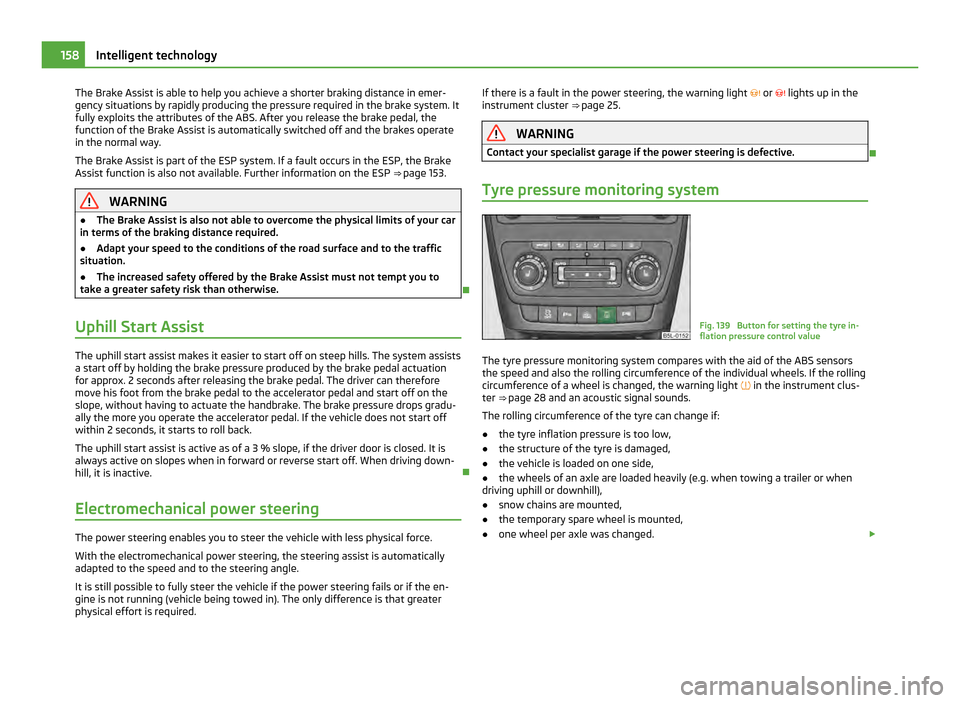
Tyre pressure monitoring system Fig. 139 Button for setting the tyre in-
flation pressure control value
The tyre pressure monitoring system compares with the aid of the ABS sensors
the speed and also the rolling circumference of the individual wheels. If the rolling
circumference of a wheel is changed, the warning light
in the instrument clus-
ter ⇒ page 28 and an acoustic signal sounds.
The rolling circumference of the tyre can change if:
● the tyre inflation pressure is too low,
● the structure of the tyre is damaged,
● the vehicle is loaded on one side,
● the wheels of an axle are loaded heavily (e.g. when towing a trailer or when
driving uphill or downhill),
● snow chains are mounted,
● the temporary spare wheel is mounted,
● one wheel per axle was changed. £158
Intelligent technology
Page 170 of 252

WARNING
● Driving through water, mud, sludge etc. can reduce the braking power and
extend the braking distance - risk of accident!
● Avoid sudden and severe braking manoeuvres immediately after driving
through bodies of water.
● After driving through bodies of water, the brakes must be cleaned and
dried as soon as possible by intermittent braking. Only apply the brakes for
the purpose of drying and cleaning the brake discs if the traffic conditions per-
mit this. Do not place any other road users in jeopardy. CAUTION
● When driving through bodies of water, parts of the vehicle such as the engine,
gearbox, catalytic converter, chassis or electrics can be severely damaged.
● Oncoming vehicles can generate water waves which can exceed the permissi-
ble water level for your vehicle.
● Potholes, mud or rocks can be hidden under the water making it difficult or im-
possible to drive through the body of water.
● Do not drive through salt water. The salt can lead to corrosion. Immediately
rinse all the parts of the vehicle, which came into contact with the salt water, with
fresh water. Note
After driving through a body of water, we recommend that the vehicle is checked
by a specialist garage.
Off-road driving Important information WARNING
● Never drive too fast, particularly not around curves, and never undertake
extreme driving manoeuvres.
● Always adjust your speed and adapt your style of driving to suit road, off-
road, traffic and weather conditions. WARNING (Continued)
● In case the vehicle is stationary on a hillside at a steep angle, do not exit
the vehicle when it is facing downhill. Through this the overall centre of gravi-
ty can shift in such a way that the vehicle tilts and rolls down the hillside -
hazard! Always carefully exit your vehicle on the side facing uphill
⇒ page 174
.
● A lack of experience and knowledge when driving off-road can lead to criti-
cal situations and serious injuries.
● Never choose a dangerous route and never take a risk which could jeop-
ardize your safety and that of your passengers. If you cannot go on or if you
doubt the safety of the route, turn back and choose another way. Even a ter-
rain, which looks harmless, can be difficult and dangerous, and may bring you
and your passengers into a critical situation.
● If you have not fastened your seat belt correctly or you are not wearing
your seat belt at all, or you are holding the steering wheel incorrectly when
driving off-road, the risk of severe or even fatal injuries increases. Correctly
fastened seat belts reduce serious injuries in case of sudden braking manoeu-
vers and accidents. As long as the vehicle is in motion, always have your seat
belt and those of your passengers correctly fastened. Take your thumbs off
the steering wheel when driving off-road. Should resistance build up in front
of the wheels, the steering wheel may suddenly and unexpectedly spin and
hurt you. Hold the steering wheel with both hands firmly on the outer edge in
the 9 o'clock and 3 o'clock position.
● If you have not fastened your seat belt correctly or you are not wearing
your seat belt at all, or you are holding the steering wheel incorrectly when
driving off-road, the risk of severe or even fatal injuries increases.
● Correctly fastened seat belts reduce serious injuries in case of sudden
braking manoeuvres and accidents. Therefore you and your passengers must
always fasten your seat belts correctly as long as the vehicle is moving.
● Take your thumbs off the steering wheel when driving off-road. If the
wheels hit an obstacle, the steering wheel may suddenly and unexpectedly
spin and hurt you!
● Never use the cruise control system when driving off-road. The use of the
cruise control system when driving off-road is unsuitable and can even be
dangerous.
● Do not drive over embankments, ramps or hillsides at too high a speed.
This can lead to the wheels of the vehicle lifting off the ground so that you
can no longer steer and control the vehicle. £168
Driving and the environment
Page 220 of 252

The maximum towing speed is
50 km/h.
Driver of the towed vehicle
– Switch the ignition on so that the steering wheel is not blocked and you can
also operate the turn signal lights, the headlight flasher, the windscreen wip-
ers and windscreen washer system.
– Take the vehicle out of gear or move the selector lever into position N if your
vehicle is fitted with an automatic gearbox.
Note that the brake servo unit and power steering only operate if the engine is
running. You will require significantly greater physical force to depress the brake
pedal and to steer the vehicle if the engine is not running.
When using a tow rope, always ensure that the tow rope is always kept taught. CAUTION
● Do not tow start the engine - danger of damaging the engine. On vehicles with
a catalytic converter, unburnt fuel may get into the catalytic converter where it
may ignite. This in turn may damage or destroy the catalytic converter. You can
use the battery of another vehicle as a jump-start aid ⇒ page 216, Jump-starting
.
● If the gearbox of your vehicle no longer contains any oil because of a defect,
your vehicle must only be towed in with the driven wheels raised clear of the
ground, or on a special vehicle transporter or trailer.
● The vehicle must be transported on a special vehicle or trailer if it is not possi-
ble to tow in the vehicle in the way described or if the towing distance is greater
than 50
km.
● To protect both vehicles when tow-starting or towing, the tow rope should be
elastic. Thus one should only use plastic fibre rope or a rope made out of a similar-
ly elastic material.
● One should be constantly vigilant not to allow impermissibly high towing
forces or jerky loadings. There is always a risk of excessive stresses and damage
resulting at the points to which you attach the tow rope or tow bar when you at-
tempt to tow a vehicle which is not standing on a paved road.
● Attach the tow rope or the tow bar only to the towing eyes provided for this
purpose ⇒ page 218
, Front towing eye and ⇒ page 219, Rear towing eye Note
● We recommend a tow rope from the range of
ŠKODA Original Accessories that
you can purchase from an authorised ŠKODA Service Partner.
● Towing another vehicle requires a certain amount of practice. Both drivers
should be familiar with the particular points about towing a vehicle. Unskilled driv-
ers should not attempt to tow in another vehicle or to be towed in.
● When towing, respect the national legal provisions, especially those which re-
late to the identification of the towing vehicle and the vehicle being towed.
● The tow rope must not be twisted as it may in certain circumstances result in
the front towing eye being unscrewed out of your vehicle.
Front towing eye The towing eye is stored in the box of the vehicle tool kit.
Fig. 175 Front bumper: Removing the cover/installing the towing eye
–
Press on the upper half of the cover in direction of arrow 1
⇒ fig. 175 .
– Pull the cover out of the front bumper.
– Screw in the towing eye by hand to the left up to the stop ⇒ fig. 175 - right and
tighten it as much as possible. For tightening, we recommend that you use for
example the wheel wrench, the lashing eye of another vehicle or a similar ob-
ject which you can push through the eye.
– In order to reinstall the cover after screwing out the towing eye, first of all in-
sert the upper part of the cover and then press in the lower part. The cover
must engage firmly. £218
Breakdown assistance
Page 224 of 252

Fuse assignment in the dash panel
Fig. 180 Schematic representation of
the fuse carrier in the dash panel
Certain electrical components are only standard on certain vehicle model versions
or only suppliable as optional equipment for certain models. No. Power consumer
1 Heating of the gearbox ventilation (diesel engine)
Control unit for automatic gearbox DQ200 2 Towing device
3 Towing device
4 Instrument cluster, windshield wiper lever, turn signal light lever
5 Air blower for heating, radiator fan, air conditioning system, Climatron-
ic 6 Rear window wiper
7 Phone
8 Towing device
9 Central control unit - Interior lighting
Rear fog light
10 Rain sensor, light switch, diagnostic socket
11 Left side cornering lights
12 Right side cornering lights
13 Radio, changer for mobile navigation
14 Towing device
15 Light switch
16 Heated windscreen washer nozzles
17 Control unit for headlamp beam adjustment and headlight swivel No. Power consumer
18 Diagnostic socket, engine control unit, brake sensor
19 Control unit for ABS, ESP, switch for tyre air pressure control, control
unit for parking aid, switch for Offroad mode, start/stop button 20 Switch and control unit for airbag
21 WIV, parking light, dimming mirrors, pressure sensor, telephone prein-
stallation, air mass meter
22 Instrument cluster, control unit for electromechanical power steering,
Haldex 23 Central locking system and bonnet lid
24 Rear power window
25 Rear window heater
Rear window heater, Auxiliary heating (auxiliary heating and ventila-
tion)
26 Power socket in the luggage compartment
27 Electric sliding/tilting roof, electric sun screen
28 Fuel pump relay, control unit for fuel pump, injection valves
29 Front power window
30 front and rear lighter
31 Headlight cleaning system
32 Front seat heating, regulator for seat heating
33 Heating, Air conditioning, Climatronic
34 Alarm, spare horn
35 Control unit for automatic gearbox DQ200
36 DVD player
For power consumers, e.g. the car stereo, which can be operated with the ignition
switched off as long as the ignition key is not withdrawn.
Electrically adjustable seats are protected by
automatic circuit breakers, which
switch on again automatically after a few seconds after the overload has been
eliminated. 222
Fuses and light bulbs