2011 SKODA YETI low beam
[x] Cancel search: low beamPage 52 of 252

Headlamp range adjustment
Once the low beam is switched on you can then adapt the range of
the headlights to the load of the vehicle. Fig. 28 Dash panel: Lights and Visibility
– Turn the control dial ⇒ fig. 28 until you have adjusted the low beam so that
oncoming traffic is not dazzled.
Settings
The positions correspond approximately to the following vehicle loads: Front seats occupied, luggage compartment empty.
All seats occupied, luggage compartment empty.
All seats occupied, luggage compartment laden.
Driver seat occupied, luggage compartment laden. CAUTION
Headlamp range adjustment should always be adjusted in a way that:
● it does not dazzle other road users, especially oncoming traffic,
● and the range is sufficient for safe driving. Note
Headlights fitted with Xenon bulbs adapt automatically to the load and driving
state of the vehicle (e.g. accelerating, braking) when the ignition is switched on
and when driving. Vehicles which are equipped with Xenon bulbs do not have a
manual headlight range adjustment control.
- 1
2
3 Switch for hazard warning lights
Fig. 29 Dash panel: Switch for hazard
warning lights
– Press switch ⇒ fig. 29 to switch the hazard warning light system on or off.
All the turn signal lights on the vehicle flash at the same time when the hazard
warning light system is switched on. The indicator light for the turn signals and
the indicator light in the switch also flash at the same time. You can also switch
on the hazard warning light system if the ignition is switched off.
The hazard warning light system is switched on automatically if an airbag is de-
ployed in the event of an accident.
Please comply with any legal requirements when using the hazard warning light
system. Note
Switch on the hazard warning light system if, for example:
● you encounter traffic congestion,
● your vehicle breaks down or an emergency situation occurs. 50
Lights and Visibility
Page 53 of 252

The turn signal
and main beam lever The parking lights and headlight flasher are also switched on and
off using the turn signal and main beam lever.
Fig. 30 Turn signal and main beam lever
The turn signal and main beam lever perform the following functions:
Right and left turn signal light
– Push the lever upwards A or downwards
⇒ fig. 30 B .
– If you only wish to flash three times (the so-called convenience turn signal),
push the lever briefly up to the upper or lower pressure point and release it.
This function can be activated/deactivated in the Information display
⇒ page 18.
– Turn signal for changing lanes - in order to only flash briefly, move the lever up
or down to the pressure point and hold it in this position.
Main beam
– Switch on the low beam.
– Push the lever forwards in direction of arrow C (spring-tensioned position).
– If you push the lever towards the steering wheel in direction of arrow D(spring-tensioned position) the main beam is switched off.
Headlight flasher
– Pull the lever towards the steering wheel (spring-tensioned position) in direc-
tion of arrow D - the main beam and warning light
in the instrument clus-
ter come on.
Parking light
For a description of the operation, see ⇒ page 47, Parking light
.Information concerning the function of the lights.
● The turn signal system only operates when the ignition is switched on. The
corresponding warning light or in the instrument cluster also flashes.
● The turn signal is automatically cancelled after negotiating a curve.
● The indicator light flashes at twice its normal rate if a bulb of the turn signal
light fails. CAUTION
Use main beam or the headlight flasher only if this does not risk dazzling other
road users. Note
Use only in accordance with the legal requirements the described lighting and sig-
nal systems. 51
Lights and Visibility Using the system Safety Driving Tips General Maintenance Breakdown assistance Technical data
Page 55 of 252
Switching on the interior lighting
–
Press the cover glass in the area of the symbol ⇒ fig. 33.
Switching off the interior lighting
– Press the cover glass in the area of the symbol O.
Operating the lights with the door contact switch
– Position the cover glass into middle position .
Front door warning light Fig. 34 Front door: Warning light
The warning light is located in the door trim panel below ⇒ fig. 34.
The warning light goes on every time the door is opened. The light goes out about
10 minutes after opening the door in order to avoid discharging the battery of the
vehicle.
There is a reflector installed on some vehicles instead of the warning light.
Entry lighting The lighting is positioned on the bottom edge of the exterior mirror.
The light beam is directed towards the entry area of the front door.
The light comes on after the doors have been locked or on opening the boot lid.
The light goes out after switching on the ignition or up to 30 seconds after closing
all the doors and the boot lid.
If a door or the boot lid remains open, the light goes out within 2 minutes if the
ignition is switched off. WARNING
If the entry light comes on, do not touch its cover - risk of burns!
Luggage compartment light The lighting comes on automatically when the boot lid is opened. If the lid remains
open for more than about 10 minutes, the luggage compartment lighting switches
off automatically.
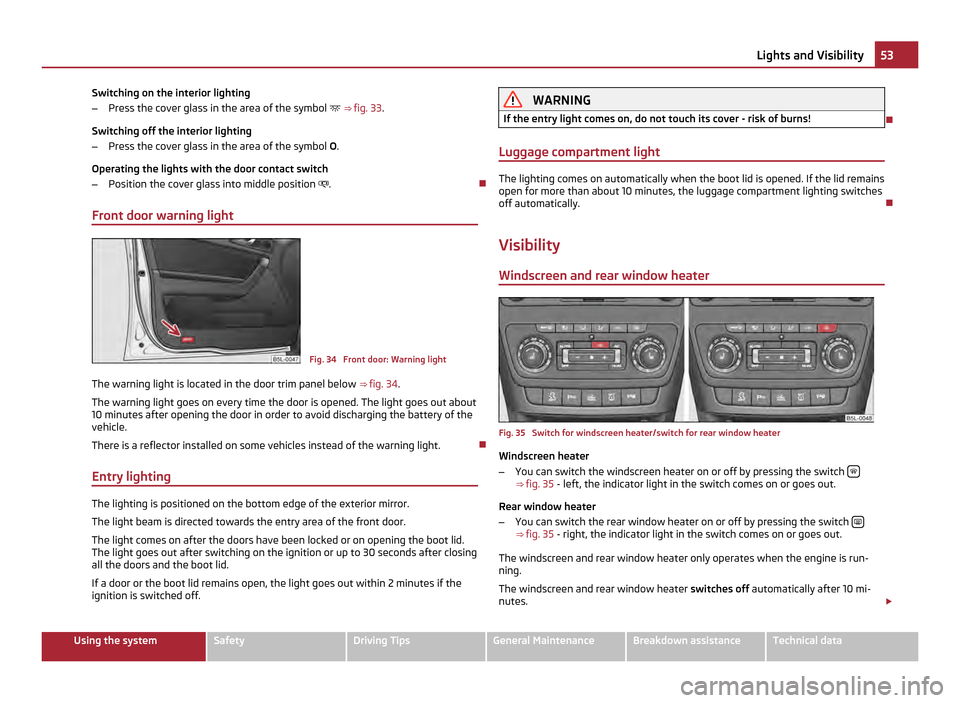
Visibility Windscreen and rear window heater Fig. 35 Switch for windscreen heater/switch for rear window heater
Windscreen heater
– You can switch the windscreen heater on or off by pressing the switch ⇒
fig. 35 - left, the indicator light in the switch comes on or goes out.
Rear window heater
– You can switch the rear window heater on or off by pressing the switch ⇒
fig. 35 - right, the indicator light in the switch comes on or goes out.
The windscreen and rear window heater only operates when the engine is run-
ning.
The windscreen and rear window heater switches off automatically after 10
mi-
nutes. £ 53
Lights and Visibility Using the system Safety Driving Tips General Maintenance Breakdown assistance Technical data
Page 58 of 252

CAUTION
● In cold temperatures and in winter, check before the trip or before switching
on the ignition that the wiper blades are not frozen. Switching on windscreen
wipers when the blades are frozen to the windscreen may result in damage both
to the blades and the motor of the windscreen wipers!
● If you switch off the ignition while the windscreen wipers are on, the wipers
will sweep in the same mode the next time the ignition is switched on. At low
temperatures, the wipers may freeze to the window between switching off the ig-
nition and the next time you switch the ignition on again.
● Carefully detach frozen wiper blades from the front or rear window.
● Remove snow and ice from the window wipers before driving. Note
● If the slower 2 ⇒ fig. 37 or the faster
3 wiper setting is switched on and the
vehicle speed decreases to below 4 km/h, the lower wiper step is switched on au-
tomatically. At a speed increase of more than 8 km/h the previous wiper setting is
established again.
● If there is an obstacle on the windscreen, the wiper will try to push away the
obstacle. If the obstacle continues to block the wiper, the wiper stops automati-
cally after 5 attempts to eliminate the obstacle, in order to avoid a damage to the
wiper. Remove the obstacle and and switch on the wiper again.
● The windscreen washer nozzles for the windscreen are heated when the en-
gine is running and the outside temperature is less than +10 °C.
● The content of the windscreen wiper reservoir is 3 litres. On vehicles which are
equipped with a headlight cleaning system, the content of the reservoir is 5.5
li-
tres. On vehicles fitted with auxiliary heating, the content of the windscreen wiper
reservoir is 4.5 litres.
Automatic rear window wiper If the windshield wiper is in position
2 or
3 , the rear view window is wiped ev-
ery 30 seconds if the vehicle's speed exceeds 5
km/h.
When the rain sensor is active (the lever is in the position 1 ) the function is only
active if the front window wipers continue to operate (no break between each
wiping process). Activation/deactivation
The function of the automatic rear window wiper is activated/deactivated in the
information display in the menu:
■ Settings
■ Lights & Vision
■Rear wiper Note
The function of the automatic rear window wiper is only valid for vehicles which
are equipped with the information display. The function is activated in the factory.
Alternative park position of the rear window wiper Each time after switching off the engine for the second time, the wiper blade of
the rear window wiper is tilted. Thus, the life of the wiper blade is prolonged.
Activation/deactivation
– Switch on the ignition.
– Push the operating level into the position 6
⇒ fig. 37 five times in succession
within 5 seconds.
– Switch off the ignition. After switching on the ignition again, the alternative
park position of the rear window wiper is activated/deactivated.
Headlight cleaning system The headlights are being cleaned after the windscreen has been sprayed for the
first time and fifth time, the low beam or main beam are switched on and the
windscreen wiper lever was held in the position 5
⇒ fig. 37 for about 1 second.
The headlight washer nozzles are moved forward out of the bumper by the water
pressure for cleaning the headlights.
You should remove stubborn dirt (such as insect residues) from the headlight len-
ses at regular intervals, for example when refuelling. Please refer to the following
guidelines ⇒
page 183, The headlight lenses.
You should remove any snow from the fixtures of the washer nozzles and clear ice
in winter with a de-icing spray in order to ensure proper operation of the cleaning
system. £56
Lights and Visibility
Page 169 of 252

been created, where you can trade-in your vehicle. After you trade-in your vehicle,
you will receive a confirmation stating the recycling in accordance with environ-
mental regulations.
Vehicles with special built-on types
Technical documents regarding changes carried out on the vehicle must be kept
by the vehicle user, in order to hand over later to the old car user. This ensures the
recycling in accordance with environmental regulations. Note
Detailed information about the trade-in and recycling of old cars is available from
a ŠKODA Service Partner.
Motoring abroad General Other circumstances may exist abroad.
It is also possible, in certain countries, that the ŠKODA Service Partner network is
limited or has not been established yet. This is the reason why obtaining certain
spare parts may be somewhat complicated and specialist garage personnel may
only be able to make limited repairs. ŠKODA in the Czech Republic and its foreign
importers are happy to provide information about technical aspects of the vehicle,
required maintenance work and possibilities for getting repairs done.
Unleaded petrol A vehicle fitted with a petrol engine must always be refuelled with unleaded pet-
rol
⇒ page 162
. The automobile associations can provide you with information re-
garding the locations of filling stations which offer unleaded petrol.
Headlight The low beam of your headlights is set asymmetrically. It illuminates the side of
the road on which you are driving to a greater extent. If you drive abroad on the
other side of the road, you will dazzle oncoming traffic.
In order to prevent the dazzling of oncoming traffic, it is necessary that an adjust-
ment of the headlights is carried out by a specialist garage. The adaptation of the headlights with Xenon lights (applies to vehicles which are
designed for driving on the left and on the right) is performed in the menu Set-
tings Travel mode of the information display ⇒ page 18
.
Avoiding damage to your vehicle When driving on poor roads and lanes or when driving over kerbstones, steep
ramps etc., you must pay particular attention to ensuring that any low-slung parts
of the vehicle, such as spoiler and exhaust, do not touch the ground and get dam-
aged.
This particularly applies to models with a lowered suspension (sport suspension)
and also when your vehicle is fully laden.
Driving through bodies of water on roads Fig. 145 Crossing bodies of water
In order to avoid damage to the vehicle when driving through bodies of water (e.g.
flooded roads), observe the following:
● Determine the depth of the water when driving through bodies of water. The
water can reach at the maximum the web on the lower sill of the vehicle
⇒ fig. 145 .
● Drive no more than at walking speed. At a higher speed, a water wave can
form in front of the vehicle which can cause water to penetrate into the air induc-
tion system of the engine or into other parts of the vehicle.
● Never let the vehicle stand in the water, never drive backwards and do not
switch off the engine. £ 167
Driving and the environment Using the system Safety Driving Tips General Maintenance Breakdown assistance Technical data
Page 180 of 252

Towing a trailer
Towing a trailer
Technical requirements Your vehicle is designed primarily for transporting persons and luggage. It can,
however, also be used for towing a trailer - provided certain technical equipment
is fitted.
If your vehicle has been
factory-fitted with a towing device or has a towing device
from
ŠKODA Original Accessories, the towing device satisfies all technical and le-
gal requirements.
Your vehicle is fitted with a 13-pin power socket for the electrical connection be-
tween the vehicle and trailer. If the trailer which you wish to tow has a 7-pin con-
nector , you can use a suitable adapter from ŠKODA Original Accessories.
This work must be carried out in accordance with the manufacturer's specifica-
tions if a towing device is retrofitted.
Authorised ŠKODA Service Partners can provide detailed information about retro-
fitting a towing device and for any necessary modifications to the cooling system. WARNING
We recommend that you have the towing device from ŠKODA Original Acces-
sories installed by an authorised
ŠKODA Service Partner. He is familiar with all
the relevant details relating to retrofitting such equipment. There is a risk of
an accident if the towing device is not properly fitted!
General Maintenance Trailer load
The permissible trailer load must on no account be exceeded.
You can negotiate appropriately steeper inclines and descents if you do not make
full use of the permissible trailer load.
The trailer loads specified only apply for
altitudes up to 1000 metres above mean
sea level. The fact that the engine power output drops with increasing height due
to a lowering of air pressure and thus the ability to climb, means that the towed
weight must be reduced by 10 % for every further increase of 1 000 metres in height above sea level. The towed weight is the weight of the (laden) vehicle and
the (laden) trailer together. One should take this into account before driving up to
higher altitudes.
The trailer and drawbar load information on the type plate of the towing device
are merely test data for the towing device The data relating to your vehicle,
which is often less than this test data, can be found in your vehicle registration
documents.
Distribution of the load
Distribute the load in the trailer in such a way that any heavy items are located as
close as possible to the axle. Secure the items to prevent them slipping.
Tyre pressure
Correct the tyre inflation pressure on your vehicle for that of
“fully laden”
⇒ page 201. The inflation pressure of the tyres fitted to the trailer adjust in ac-
cordance with the manufacturer's recommendation.
Exterior mirrors
You have to have additional exterior mirrors fitted if you are not able to see the
traffic behind the trailer with the standard rear-view mirrors. Both exterior mirrors
should be attached to folding arms. Adjust the mirrors so that they provide you
with an adequate field of view to the rear.
Headlights
Before starting off with a hitched trailer, also check the setting of the headlights.
Alter the setting as necessary with the aid of the headlight beam adjuster
⇒ page 50.
Detachable ball head
The ball head is detachable on vehicles with towing device and can be obtained
from ŠKODA Original Accessories. It is stowed together with separate fitting in-
structions in the spare wheel well in the luggage compartment of the vehicle. Note
● We recommend that you also have your vehicle inspected between service in-
tervals if you tow a trailer frequently.
● The handbrake on the towing vehicle must be put on when coupling and de-
coupling the trailer. 178
Towing a trailer
Page 224 of 252

Fuse assignment in the dash panel
Fig. 180 Schematic representation of
the fuse carrier in the dash panel
Certain electrical components are only standard on certain vehicle model versions
or only suppliable as optional equipment for certain models. No. Power consumer
1 Heating of the gearbox ventilation (diesel engine)
Control unit for automatic gearbox DQ200 2 Towing device
3 Towing device
4 Instrument cluster, windshield wiper lever, turn signal light lever
5 Air blower for heating, radiator fan, air conditioning system, Climatron-
ic 6 Rear window wiper
7 Phone
8 Towing device
9 Central control unit - Interior lighting
Rear fog light
10 Rain sensor, light switch, diagnostic socket
11 Left side cornering lights
12 Right side cornering lights
13 Radio, changer for mobile navigation
14 Towing device
15 Light switch
16 Heated windscreen washer nozzles
17 Control unit for headlamp beam adjustment and headlight swivel No. Power consumer
18 Diagnostic socket, engine control unit, brake sensor
19 Control unit for ABS, ESP, switch for tyre air pressure control, control
unit for parking aid, switch for Offroad mode, start/stop button 20 Switch and control unit for airbag
21 WIV, parking light, dimming mirrors, pressure sensor, telephone prein-
stallation, air mass meter
22 Instrument cluster, control unit for electromechanical power steering,
Haldex 23 Central locking system and bonnet lid
24 Rear power window
25 Rear window heater
Rear window heater, Auxiliary heating (auxiliary heating and ventila-
tion)
26 Power socket in the luggage compartment
27 Electric sliding/tilting roof, electric sun screen
28 Fuel pump relay, control unit for fuel pump, injection valves
29 Front power window
30 front and rear lighter
31 Headlight cleaning system
32 Front seat heating, regulator for seat heating
33 Heating, Air conditioning, Climatronic
34 Alarm, spare horn
35 Control unit for automatic gearbox DQ200
36 DVD player
For power consumers, e.g. the car stereo, which can be operated with the ignition
switched off as long as the ignition key is not withdrawn.
Electrically adjustable seats are protected by
automatic circuit breakers, which
switch on again automatically after a few seconds after the overload has been
eliminated. 222
Fuses and light bulbs
Page 225 of 252

Bulbs
Changing bulbs The relevant lamp must always be switched off before a light bulb is replaced.
Defect light bulbs should only be replaced with light bulbs of the same type. The
designation is located on the light socket or the glass bulb.
Changing certain bulbs is not something which you can do yourself, but requires
to be done by a specialist. Other parts of the vehicle must be removed in order to
change the light bulbs. This applies, in particular, to bulbs which can only be
reached from the engine compartment.
We therefore recommend that you have any bulbs changed by an authorised
ŠKODA Service Partner or, in exceptional cases, by calling on other professional
assistance.
Please note that the engine compartment is a hazardous area ⇒
page 190, Work-
ing in the engine compartment.
We recommend that you always have a small box of replacement bulbs in your ve-
hicle. You can purchase replacement bulbs from the range of the ŠKODA Original
Accessories 1)
.
The set of light bulbs can be stowed in the box in the luggage compartment.
Fitted with a xenon headlight
Change of bulbs on vehicles with Xenon lights (low beam lights, parking lights and
main beam lights) should be undertaken by a specialist garage.
Bulb - Overview Front headlight Halogen headlight Xenon headlight
Low beam H4 D1S
Main beam H4 D1S
Parking lights W5W W5W BL
Daylight driving lights P13W
Turn signals HPC24WY
Fog lights H7 Rear light unit Bulb
Reversing lights, brake lights and rear fog light P21W
Turn signals PY21W
Parking lights W5W
Others Bulb
Licence plate light C5W
3. Brake light LED
Entry lighting W5W
front interior lighting W5W
Reading lights W5W
Rear interior lighting C5W
Luggage compartment light W5W
Door warning light W5W
Lighting in storage compartment on front passenger
side C3W
WARNING
● Bulbs H7 and H4 are pressurised and may burst when changing the bulb -
risk of injury!
● It is recommended to wear gloves and safety glasses when changing a
bulb.
● Gas discharge bulbs (xenon bulbs) operate with a high voltage, professio-
nal knowledge is required - danger to life! CAUTION
Do not take hold of the glass bulb with naked fingers (even the smallest amount
of dirt reduces the working life of the light bulb). Use a clean cloth, serviette or
something similar. Note
This Owner's Manual only describes the replacement of bulbs where it is assumed
that no major complications will arise. Other light bulbs should be changed by your
specialist garage. 1)
The small box with replacement bulbs is part of the basic equipping of the vehicle in some countries. 223
Fuses and light bulbs Using the system Safety Driving Tips General Maintenance Breakdown assistance Technical data