2011 SKODA YETI maintenance
[x] Cancel search: maintenancePage 191 of 252

Inspecting and Replenishing
Engine compartment
Bonnet remote release Fig. 151 Bonnet release lever
Bonnet remote release
– Pull the unlocking lever below the dash panel on the left-hand side ⇒ fig. 151.
The bonnet jumps out of its lock as a result of the spring force.
Opening and closing the bonnet. Fig. 152 Radiator grille: Locking lever/securing the bonnet with the bonnet support
Opening the bonnet
–
Unlock the bonnet ⇒
fig. 151. –
Ensure that the arms of the windshield wipers are correctly in place against
the windshield before opening the bonnet, otherwise damage could occur to
the paintwork.
– Pressing on the locking lever in direction of arrow 1 ⇒
fig. 152 will unlock the
bonnet.
– Grasp the front part of the bonnet under the chrome trim.
– Take the bonnet support out of its holder in direction of arrow 2 and secure
the opened bonnet by inserting the end of the support in the opening 3 de-
signed for it ⇒ fig. 152.
Closing the bonnet
– Lift the bonnet slightly and unhook the bonnet support. Press the bonnet sup-
port into the holder designed to hold it.
– Allow the bonnet to drop from a height of about 20 cm into the lock - bonnet
do not press down on it!
– Check whether the bonnet is properly closed. WARNING
● Never open the bonnet if you see that steam or coolant is flowing out of
the engine compartment - risk of scalding! Wait long enough until the steam
or coolant has stopped escaping.
● For safety reasons, the bonnet must always be properly closed when driv-
ing. One should therefore check that the lock has in fact engaged properly af-
ter closing the bonnet.
● Stop your vehicle immediately while driving if you notice that the lock is
not properly engaged and close the bonnet properly - risk of an accident! 189
Inspecting and Replenishing Using the system Safety Driving Tips General Maintenance Breakdown assistance Technical data
Page 193 of 252

Overview of the engine compartment
The main inspection points.
Fig. 153 Petrol engine 1.8 ltr./118 kW TSI
Engine coolant expansion reservoir . . . . . . . . . . . . . . . . . . . . . . . . . . . . . . . . . . . 193
Windshield washer fluid reservoir . . . . . . . . . . . . . . . . . . . . . . . . . . . . . . . . . . . . . 199
Engine oil filler opening . . . . . . . . . . . . . . . . . . . . . . . . . . . . . . . . . . . . . . . . . . . . . . . . 192
Engine oil dipstick . . . . . . . . . . . . . . . . . . . . . . . . . . . . . . . . . . . . . . . . . . . . . . . . . . . . . . 191
Brake fluid reservoir . . . . . . . . . . . . . . . . . . . . . . . . . . . . . . . . . . . . . . . . . . . . . . . . . . . . 195
Battery (below a cover) . . . . . . . . . . . . . . . . . . . . . . . . . . . . . . . . . . . . . . . . . . . . . . . . . 196Note
The location of the inspection points in the engine compartment of petrol and die-
sel engines is practically identical.
1 2
3
4
5
6 Engine oil
Check engine oil level The dipstick indicates the level of oil in the engine.
Fig. 154 Dipstick
Checking the oil level
– Ensure that the vehicle is positioned on a level surface and the engine has
reached its operating temperature.
– Switch the engine off.
– Open the bonnet ⇒ in Working in the engine compartment on page 190.
– Wait a few minutes until the engine oil flows back into the oil sump. Take out
the dipstick.
– Wipe off the dipstick with a clean cloth and insert it again fully.
– Then withdraw the dipstick again and read off the oil level.
Oil level within range A –
You must not top up the oil.
Oil level within range B –
You may top up the oil. It is possible that the oil level may then be within
range A after doing this.
Oil level within range C –
You must top up the oil ⇒ page 192. It is sufficient, once this is done, to keep
the oil level within range B .
£ 191
Inspecting and Replenishing Using the system Safety Driving Tips General Maintenance Breakdown assistance Technical data
Page 195 of 252

Note
After your skin has come in contact with the oil, you must thoroughly wash your
skin.
Cooling system
Coolant The job of the coolant is to cool the engine.
The cooling system does not require any maintenance under normal operating
conditions. The coolant consists of water with a concentration of coolant additive
of 40 %. This mixture not only provides antifreeze protection down to -25 °C but
also protects the cooling and heating system from corrosion. It also prevents the
formation of scale and significantly increases the boiling point of the coolant.
You must therefore not reduce the concentration of antifreeze agent in the cool-
ant by adding water, also not during the summer months or in countries with a
warm climate. The concentration of coolant additive in the coolant must be at
least 40 %.
You can increase the amount of antifreeze in the coolant if a higher concentration
of antifreeze is necessary for climatic reasons but only up to 60 % (antifreeze pro-
tection down to approx. -40 °C). The antifreeze protection tails off above that con-
centration.
Vehicles exported to countries with a cold climate (e.g. Sweden, Norway, Finland)
are already factory-filled with a coolant which offers antifreeze protection down
to about -35 °C. In these countries the concentration of coolant additive should be
at least 50 %.
Coolant
The cooling system is factory-filled with coolant (purple in colour), which complies
with the specification TL-VW
774 G.
When refilling, we only recommend you use the same antifreeze described on the
antifreeze expansion tank.
Please contact an authorised ŠKODA Service Partner if you have any questions re-
garding the coolant or if you wish to fill up with a different coolant.
An authorised ŠKODA Service Partner can also supply you with the correct coolant
additives. Coolant capacity Petrol engines Capacities (in litres)
1.2 ltr./77 kW TSI - EU 5 7.7
1.4 ltr./90 kW TSI - EU5 7.7
1.8 ltr./118 kW TSI - EU5, EU2
(1.8 ltr./112 kW TSI - EU5)
8.6
Diesel engines Capacities (in litres)
1.6 l/77 kW TDI CR - EU5 8.4
2.0 ltr./81 kW TDI CR - EU 5 8.6
2.0 ltr./103 kW TDI CR - EU 5 8.7
2.0 ltr./125 kW TDI CR - EU 5 8.4
CAUTION
● Other coolant additives may cause operational problems which, in particular,
involves significantly reducing the anticorrosion effect.
● Any faults or problems resulting from corrosion may cause a loss of coolant
and, as a consequence of this, result in major engine damage. Note
On vehicles which are fitted with an independent auxiliary heating and ventila-
tion, the volume of the coolant is greater by approx. 1 ltr.
Inspecting the coolant level Fig. 155 Engine compartment: Coolant
expansion bottle
The coolant expansion bottle is located in the engine compartment on the right.
– Switch the engine off. £ 193
Inspecting and Replenishing Using the system Safety Driving Tips General Maintenance Breakdown assistance Technical data
Page 197 of 252

Radiator fan
The radiator fan may switch on suddenly.
The radiator fan is driven by an electric motor and controlled according to the
coolant temperature.
The radiator fan may continue running for up to 10 minutes after the engine has
been switched off - even if the ignition is also off. It may also switch on suddenly
after a certain time, if
● the coolant temperature has risen because of an accumulation of heat or
● the warm engine compartment is heated up additionally by strong sunlight. WARNING
You must therefore be aware when working in the engine compartment that
the fan may switch on suddenly - risk of injury!
Brake fluid
Inspecting the brake fluid level Fig. 156 Engine compartment: Brake
fluid reservoir
The brake fluid reservoir is located on the left of the engine compartment. The
brake fluid reservoir on right-hand steering models is positioned on the other side
of the engine compartment.
– Switch the engine off.
– Open the bonnet ⇒ page 189 . –
Inspect the brake fluid level in the reservoir ⇒
fig. 156. The level must be be-
tween the “MIN” and “MAX” markings.
A slight drop in the fluid level results when driving due to normal wear-and-tear
and automatic adjustment of the brake pads, and is perfectly normal.
There may be an indication of a leak in the brake system, however, if the fluid lev-
el drops significantly within a short time or if it drops below the “MIN” marking. If
the brake fluid level is too low, this is indicated by the warning light lighting up in
the instrument cluster ⇒ page 29, Brake system . In this case stop immediately
and do not drive any further! Obtain professional assistance. WARNING
● Read and observe the warning notes ⇒
page 190, Working in the engine
compartment before working in the engine compartment.
● If the fluid level has dropped below the MIN marking, do not drive any fur-
ther - risk of accident! Contact a Škoda dealer to obtain professional assis-
tance.
Replacing brake fluid Brake fluid absorbs moisture. This causes the fluid to absorb moisture from the
surrounding air over a period of time. Excessive water in the brake fluid may be
the cause of corrosion in the brake system. The water content also lowers the
boiling point of the brake fluid.
Only new genuine brake fluid from
ŠKODA may be used. The brake fluid must
comply with one of the following standards or specifications:
● VW 50114,
● FMVSS 116 DOT4,
● DIN ISO 4925 CLASS 4
We recommend that you have the brake fluid replaced by an authorised
ŠKODA
Service Partner as part of an Inspection Service. WARNING
Using old brake fluid can result in severe stress on the brakes because of the
formation of vapour bubbles in the brake system. This greatly impairs the
braking efficiency and thus also the safety of your vehicle. £ 195
Inspecting and Replenishing Using the system Safety Driving Tips General Maintenance Breakdown assistance Technical data
Page 199 of 252

●
Do not place the battery in direct daylight in order to protect the battery hous-
ing from the effects of ultra-violet light.
● If the vehicle has not been driven for more than 3 to 4 weeks, the battery will
discharge This is because certain electrical components consume electricity (e. g.
control units) also in idle state. You can prevent the discharging of the battery by
disconnecting the negative terminal or charging the battery constantly with a very
low charging current. For the sake of the environment
A removed battery is a special type of waste which is harmful to the environment
- contact your specialist garage regarding disposing of the battery. Note
● Please also refer to the guidelines ⇒ page 198
, also after connecting the bat-
tery.
● You should replace batteries older than 5 years.
Battery cover Fig. 157 Engine compartment: Polyester cover of the vehicle battery/plastic cover of the vehi-
cle battery
The battery is located in the engine compartment in a polyester cover ⇒ fig. 157 -
left or in a polyester cover ⇒ fig. 157 - right.
– Open the battery cover in direction of arrow 1 or press the interlock on the
side of the battery cover in direction of arrow 2
⇒
fig. 157, fold the cover up
and remove the battery.
– The installation of the battery cover takes place in the reverse order. The edge of the polyester battery cover
⇒
fig. 157 - left is inserted between the
battery and the side wall of the battery cover when working on the battery.
Battery control Fig. 158 The battery: Electrolyte level
indicator
The battery is practically maintenance-free under normal operating conditions.
We recommend you have the electrolyte level checked by a specialist garage from
time to time, especially in the following cases.
● High outside temperatures.
● Long daily drives
● After each charge ⇒
page 198.
On vehicles with a vehicle battery fitted with a colour indicator, the so-called mag-
ic eye ⇒ fig. 158 , the electrolyte level can be determined by looking at the change
in colour.
Air bubbles can influence the colour of the indicator. For this reason carefully
knock on the indicator before carrying out the check.
● Black colour - electrolyte level is correct.
● Colourless or light yellow colour - electrolyte level too low, the battery must be
replaced. Note
● The battery electrolyte level is periodically checked by an authorised
ŠKODA
Service Partner as part of the Inspection Service.
● For technical reasons, on vehicles with the description “AGM”, the electrolyte
level cannot be checked.
● Vehicles with a “START-STOP” system are fitted with a battery control unit for
checking the energy level for the recurring engine start. 197
Inspecting and Replenishing Using the system Safety Driving Tips General Maintenance Breakdown assistance Technical data
Page 201 of 252
Replacing the battery
When replacing a battery, the new new battery must have the same capacity,
voltage (12
V), amperage and be the same size. Suitable types of vehicle battery
are available from an authorised ŠKODA Service Partner.
We recommend you have a battery change carried out by an authorised ŠKODA
Service Partner, who will properly install the new battery and dispose of the origi-
nal one. CAUTION
Vehicles with a “START-STOP” system are fitted with a special battery type which
allows the battery control unit to check the energy level for recurring engine start.
This battery must only be replaced by a battery of the same type. For the sake of the environment
Batteries contain poisonous substances such as sulphuric acid and lead. For this
reason, it must be disposed of properly. Under no circumstances must it be dis-
posed of in the communal rubbish.
Automatic consumer shut-off Under heavy load on the vehicle battery, the vehicle electrical system manage-
ment automatically takes various measures to avoid draining the vehicle battery.
●
The idling speed is raised to allow the generator to deliver more electricity to
the electrical system.
● If necessary, some electrical consumers are limited in their performance or are
temporarily switched off completely. Note
Despite such intervention by the vehicle electric system management, the vehicle
battery may be drained. For example, when the ignition is switched on a long time
with the engine turned off or the side or parking lights are turned on during lon-
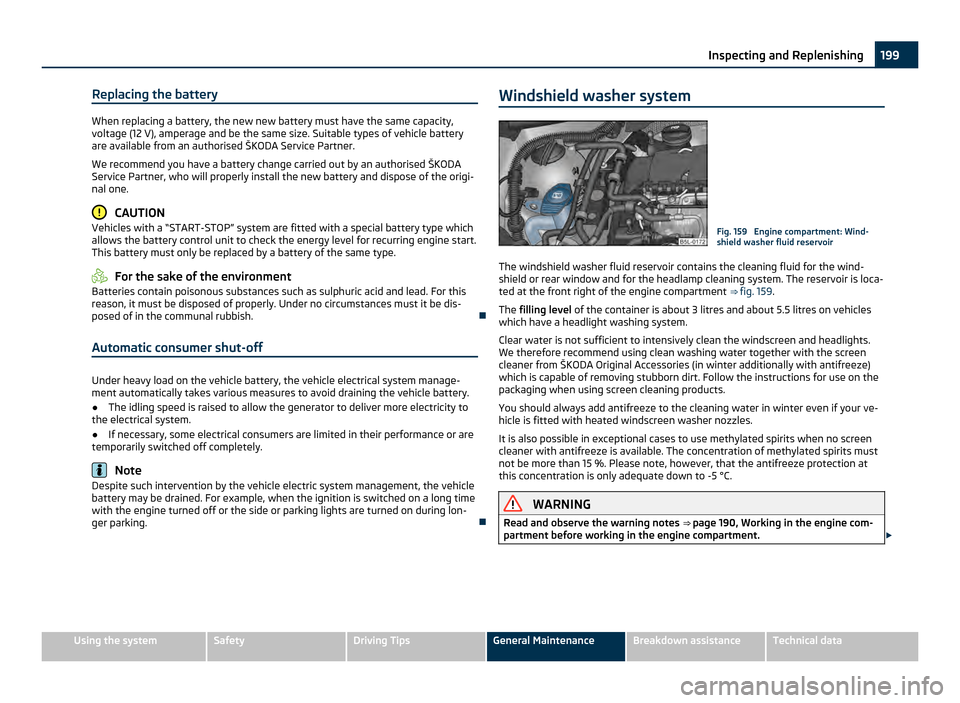
ger parking. Windshield washer system Fig. 159 Engine compartment: Wind-
shield washer fluid reservoir
The windshield washer fluid reservoir contains the cleaning fluid for the wind-
shield or rear window and for the headlamp cleaning system. The reservoir is loca-
ted at the front right of the engine compartment ⇒ fig. 159 .
The filling level of the container is about 3 litres and about 5.5 litres on vehicles
which have a headlight washing system.
Clear water is not sufficient to intensively clean the windscreen and headlights.
We therefore recommend using clean washing water together with the screen
cleaner from
ŠKODA Original Accessories (in winter additionally with antifreeze)
which is capable of removing stubborn dirt. Follow the instructions for use on the
packaging when using screen cleaning products.
You should always add antifreeze to the cleaning water in winter even if your ve-
hicle is fitted with heated windscreen washer nozzles.
It is also possible in exceptional cases to use methylated spirits when no screen
cleaner with antifreeze is available. The concentration of methylated spirits must
not be more than 15 %. Please note, however, that the antifreeze protection at
this concentration is only adequate down to -5 °C. WARNING
Read and observe the warning notes ⇒ page 190
, Working in the engine com-
partment before working in the engine compartment. £ 199
Inspecting and Replenishing Using the system Safety Driving Tips General Maintenance Breakdown assistance Technical data
Page 203 of 252

Wheels and Tyres
Wheels
General information ●
New tyres do not offer optimal grip at first. They should therefore be run in for
about 500 km at a moderate speed and an appropriately cautious style of driving.
You will also profit from longer tyre life.
● The tread depth of new tyres may differ because of design features and the
configuration of the tread (depending on the type of tyre and the manufacturer).
● Drive over curbs on the side of the road and other such obstacles slowly and,
where possible, at a right angle in order to avoid damage to tyres and wheel trims.
● We recommend you Inspect your tyres and rims from time to time for damage
(punctures, cuts, splits and bulges). Remove foreign bodies from the tyre profile.
● Damage to tyres is frequently not visible. Unusual vibrations or pulling of the
vehicle to one side could be a sign of tyre damage. Please reduce your speed im-
mediately and stop if you suspect that a wheel is damaged. Inspect the tyres for
signs of damage (bulges, splits, etc.) If no visible damage is present, please drive
at an appropriately slow speed and carefully to the nearest specialist garage in or-
der to have your vehicle inspected.
● Also protect your tyres from contact with oil, grease and fuel.
● Immediately replace any dust caps of the valves which have got lost.
● Mark wheels before removing them so that their previous direction of running
can be maintained when mounted them again.
● Always store wheels or tyres which been removed in a cool, dry and, where
possible, dark place. Tyres which are not fixed to a wheel trim should be stored
upright.
Unidirectional tyres
The direction of rotation of the tyres is marked by arrows on the wall of the tyre.
This indicates the direction of rotation of the tyre, and it is essential that the tyres
are fitted on to run in this direction. Only then are the tyres able to provide the
optimal properties in terms of grip, low noise, wear-and-tear and aquaplaning.
Further information concerning the use of unidirectional tyres ⇒
page 205. WARNING
● New tyres during the first approximately 500 km do not offer optimal grip
and should therefore be run appropriately - risk of accident!
● Never drive with damaged tyres - risk of accident! Note
Please observe the various differing legal requirements regarding tyres.
Tyre life Fig. 160 An opened fuel filler flap with a
tyre size and tyre inflation pressure ta-
ble
The life of your tyres very much depends on the following points:
Tyre pressure
The working life of tyres will be shortened considerably if the tyres are insuffi-
ciently or over-inflated and this will have an adverse effect on the handling of
your vehicle.
Correctly inflated tyres are of particular importance when travelling at high
speeds . It is therefore good to check the tyre pressure, including that of the spare
wheel, at least once a month and also before setting off on a long trip.
The tyre inflation pressures for summer tyres are indicated on the inside of the
fuel filler flap ⇒ fig. 160 . The inflation pressures for winter tyres are 20 kPa
(0.2
bar) higher than those for summer tyres ⇒ page 204. £ 201
Wheels and Tyres Using the system Safety Driving Tips General Maintenance Breakdown assistance Technical data
Page 205 of 252

Changing wheels around
Fig. 162 Changing wheels around
If significantly greater wear is present on the front tyres, we recommend changing
the front wheels around with the rear wheels as shown in the diagram ⇒
fig. 162.
You will then obtain approximately the same life for all the tyres.
It may be advantageous to swap the tyres over “crosswise” when uneven wear
characteristic arise on the running surfaces of the tyres (but not in the case of uni-
directional tyres). We recommend that you contact an authorised ŠKODA Service
Partner. They have extensive knowledge about the possible combinations.
We recommend that you change the wheels around every 10 000 km in order to
achieve even wear on all wheels and to obtain optimal tyre life.
New tyres and wheels Tyres and wheel rims are important design elements. One should therefore use
the tyres and wheel rims which have been released for use by
ŠKODA. They are
exactly matched to the vehicle type and therefore contribute significantly to good
road holding and safe driving characteristics ⇒ .
Only fit radial tyres of the same type on all 4 wheels, size (rolling circumference)
and, if possible, the same tread pattern on one axle.
Authorised
ŠKODA Service Partners have access to the most current information
about which tyres we have released for use on your vehicle.
We recommend that you have any work relating to tyres or wheels carried out by
an authorised ŠKODA Service Partner. Authorised ŠKODA Service Partners have all
of the necessary special tools and replacement parts available plus the required
specialist knowledge and are also in a position to properly dispose of the old tyres.
A large number of authorised ŠKODA Service Partners also have an attractive
range of tyres and wheels available. The tyre/wheel combinations which are approved for your vehicle are indicated in
your vehicle documents. Approval and licensing may differ according to the legis-
lation prevailing in individual countries.
Proper knowledge of the tyre data makes it easier for you to select the correct
type of tyre. Tyres do, for example, have the following inscription on their walls:
225/50R
17 91 T
What this means is: 225 Tyre width in mm
50 Height/width ratio in %
R Code letter for the type of tyre -
R adial 17 Diameter of wheel in inches
91 Load index
T Speed symbol
The following speed restrictions apply to tyres.
Speed symbol Permissible maximum speed
S 180 km/h
T 190 km/h
U 200 km/h
H 210 km/h
V 240 km/h
W 270 km/h
Y 300 km/h
The date of manufacture
is also stated on the tyre wall (possibly only on the in-
side of wheel):
DOT ... 20 11...
means, for example, that the tyre was manufactured in the 20th week of the year
2011.
Any spare wheel which differs from the tyres fitted to the vehicle (e.g. winter
tyres or low-profile tyres) should only be used only for a short time in the event of
a puncture and when adopting an appropriately cautious style of driving. It should
be replaced as quickly as possible by a normal wheel. £ 203
Wheels and Tyres Using the system Safety Driving Tips General Maintenance Breakdown assistance Technical data