2011 SKODA YETI lights
[x] Cancel search: lightsPage 212 of 252

WARNING
● If you find yourself in flowing traffic switch on the hazard warning lights
system and place the warning triangle on the side of the road at the prescri-
bed distance from your vehicle. Comply with the national legal regulations. In
this way you are protecting not only yourself but also other road users.
● Never start the engine with the vehicle sitting on the raised jack - danger
of suffering injury. CAUTION
If you have to change a wheel on a slope first block the opposite wheel with a
stone or similar object in order to secure the vehicle from unexpectedly rolling
away. Note
Comply with the national legal regulations.
Changing a wheel Always change a wheel on a level surface as far as possible.
–
Take off the full wheel trim ⇒ page 210 or the wheel trim cap ⇒ page 211 or
the caps ⇒ page 211.
– In the case of light alloy wheels remove the wheel trim cap ⇒
page 211.
– First of all slacken the safety wheel bolt and afterwards the other wheel bolts
⇒ page 211.
– Jack up the vehicle until the wheel to be changed is clear of the ground
⇒ page 212.
– Unscrew the wheel bolts and place them on a clean surface (cloth, paper etc.).
– Take off the wheel.
– Fit on the spare wheel and tighten the wheel bolts slightly.
– Lower the car.
– Tighten the wheel bolts firmly, alternately and diagonally using the wheel
wrench (crosswise) and lastly the wheel safety bolt ⇒
page 211.
– Mount the full wheel trim/wheel trim cap or the caps. Note
● All bolts must be clean and must turn easily.
● You must never grease or oil the wheel bolts!
● When fitting on unidirectional tyres, ensure that the tyres rotate in the correct
direction ⇒ page 201
.
Subsequent steps After changing the wheel, you must perform the following steps.
–
Stow and attach the replaced wheel in the spare wheel well using a special
screw ⇒ fig. 165 .
– Stow the vehicle tool kit in the space provided.
– Check the tyre pressure on the spare wheel just mounted as soon as possible.
– Have the tightening torque of the wheel bolts checked with a torque wrench
as soon as possible. Steel and light alloy wheels must be tightened to a tight-
ening torque of 120
Nm.
– Change the damaged wheel or consult a specialist garage about possibilities
for getting repairs done. WARNING
It is necessary to observe the guidelines given on ⇒
page 203 if the vehicle is
subsequently fitted with tyres which are different to those it was fitted with
at the works. Note
● If you find, when changing the wheel, that the wheel bolts are corroded and
difficult to turn, the bolts must be replaced before checking the tightening torque.
● Drive cautiously and only at a moderate speed to a workshop where the tight-
ening torque can be checked.
Full wheel trim Pulling off
–
Hook the clamp found in the vehicle tool kit into the reinforced edge of the full
wheel trim. £210
Breakdown assistance
Page 216 of 252

WARNING
● If you find yourself in flowing traffic switch on the hazard warning lights
system and place the warning triangle on the side of the road at the prescri-
bed distance from your vehicle. Comply with the national legal regulations. In
this way you are protecting not only yourself but also other road users.
● Park the vehicle as far away as possible from the traffic flow. Park on as
flat and firm a surface as possible.
● A tyre filled with sealant has the same driving characteristics as a standard
tyre.
● Do not drive faster than 80 km/h, 50 mph.
● Avoid accelerating at full throttle, sharp braking and fast cornering.
● Check the tyre inflation pressure after driving 10 minutes.
● Sealant is hazardous to heath. Remove immediately if it comes into con-
tact with the skin. For the sake of the environment
Used sealant or sealant whose expiry date has passed must be disposed of in ac-
cordance with environmental protection regulations. Note
● Observe the manufacturer's usage instructions for the tyre repair kit.
● You can purchase a new bottle of sealant from the range of the ŠKODA Origi-
nal Accessories.
● Change the wheel that was repaired using the tyre repair kit or consult a spe-
cialist garage about possibilities for getting repairs done. Components of the tyre repair kit Fig. 172 Components of the tyre repair kit
The tyre repair kit is made up of the following parts:
Valve remover
Sticker with speed designation
“max. 80 km/h”/“max. 50 mph”
Inflation hose with plug
Air compressor
Tyre inflation hose
Tyre inflation pressure indicator
Air release valve
ON and OFF switch
12 volt cable connector ⇒ page 79
Tyre inflator bottle with sealing agent
Replacement valve core
The valve remover 1 has a slot at its lower end which fits into the valve core.
This is the only way in which you can remove and re-install the valve core from the
tyre valve. The same also applies to the replacement valve core 11 .
Preparing to use the tyre repair kit Before using the tyre repair kit, carry out the following preparatory work:
–
Park the vehicle as far away as possible from the traffic flow. Park on as flat
and firm a surface as possible. £
1 2
3
4
5
6
7
8
9
10
11214
Breakdown assistance
Page 220 of 252

The maximum towing speed is
50 km/h.
Driver of the towed vehicle
– Switch the ignition on so that the steering wheel is not blocked and you can
also operate the turn signal lights, the headlight flasher, the windscreen wip-
ers and windscreen washer system.
– Take the vehicle out of gear or move the selector lever into position N if your
vehicle is fitted with an automatic gearbox.
Note that the brake servo unit and power steering only operate if the engine is
running. You will require significantly greater physical force to depress the brake
pedal and to steer the vehicle if the engine is not running.
When using a tow rope, always ensure that the tow rope is always kept taught. CAUTION
● Do not tow start the engine - danger of damaging the engine. On vehicles with
a catalytic converter, unburnt fuel may get into the catalytic converter where it
may ignite. This in turn may damage or destroy the catalytic converter. You can
use the battery of another vehicle as a jump-start aid ⇒ page 216, Jump-starting
.
● If the gearbox of your vehicle no longer contains any oil because of a defect,
your vehicle must only be towed in with the driven wheels raised clear of the
ground, or on a special vehicle transporter or trailer.
● The vehicle must be transported on a special vehicle or trailer if it is not possi-
ble to tow in the vehicle in the way described or if the towing distance is greater
than 50
km.
● To protect both vehicles when tow-starting or towing, the tow rope should be
elastic. Thus one should only use plastic fibre rope or a rope made out of a similar-
ly elastic material.
● One should be constantly vigilant not to allow impermissibly high towing
forces or jerky loadings. There is always a risk of excessive stresses and damage
resulting at the points to which you attach the tow rope or tow bar when you at-
tempt to tow a vehicle which is not standing on a paved road.
● Attach the tow rope or the tow bar only to the towing eyes provided for this
purpose ⇒ page 218
, Front towing eye and ⇒ page 219, Rear towing eye Note
● We recommend a tow rope from the range of
ŠKODA Original Accessories that
you can purchase from an authorised ŠKODA Service Partner.
● Towing another vehicle requires a certain amount of practice. Both drivers
should be familiar with the particular points about towing a vehicle. Unskilled driv-
ers should not attempt to tow in another vehicle or to be towed in.
● When towing, respect the national legal provisions, especially those which re-
late to the identification of the towing vehicle and the vehicle being towed.
● The tow rope must not be twisted as it may in certain circumstances result in
the front towing eye being unscrewed out of your vehicle.
Front towing eye The towing eye is stored in the box of the vehicle tool kit.
Fig. 175 Front bumper: Removing the cover/installing the towing eye
–
Press on the upper half of the cover in direction of arrow 1
⇒ fig. 175 .
– Pull the cover out of the front bumper.
– Screw in the towing eye by hand to the left up to the stop ⇒ fig. 175 - right and
tighten it as much as possible. For tightening, we recommend that you use for
example the wheel wrench, the lashing eye of another vehicle or a similar ob-
ject which you can push through the eye.
– In order to reinstall the cover after screwing out the towing eye, first of all in-
sert the upper part of the cover and then press in the lower part. The cover
must engage firmly. £218
Breakdown assistance
Page 224 of 252

Fuse assignment in the dash panel
Fig. 180 Schematic representation of
the fuse carrier in the dash panel
Certain electrical components are only standard on certain vehicle model versions
or only suppliable as optional equipment for certain models. No. Power consumer
1 Heating of the gearbox ventilation (diesel engine)
Control unit for automatic gearbox DQ200 2 Towing device
3 Towing device
4 Instrument cluster, windshield wiper lever, turn signal light lever
5 Air blower for heating, radiator fan, air conditioning system, Climatron-
ic 6 Rear window wiper
7 Phone
8 Towing device
9 Central control unit - Interior lighting
Rear fog light
10 Rain sensor, light switch, diagnostic socket
11 Left side cornering lights
12 Right side cornering lights
13 Radio, changer for mobile navigation
14 Towing device
15 Light switch
16 Heated windscreen washer nozzles
17 Control unit for headlamp beam adjustment and headlight swivel No. Power consumer
18 Diagnostic socket, engine control unit, brake sensor
19 Control unit for ABS, ESP, switch for tyre air pressure control, control
unit for parking aid, switch for Offroad mode, start/stop button 20 Switch and control unit for airbag
21 WIV, parking light, dimming mirrors, pressure sensor, telephone prein-
stallation, air mass meter
22 Instrument cluster, control unit for electromechanical power steering,
Haldex 23 Central locking system and bonnet lid
24 Rear power window
25 Rear window heater
Rear window heater, Auxiliary heating (auxiliary heating and ventila-
tion)
26 Power socket in the luggage compartment
27 Electric sliding/tilting roof, electric sun screen
28 Fuel pump relay, control unit for fuel pump, injection valves
29 Front power window
30 front and rear lighter
31 Headlight cleaning system
32 Front seat heating, regulator for seat heating
33 Heating, Air conditioning, Climatronic
34 Alarm, spare horn
35 Control unit for automatic gearbox DQ200
36 DVD player
For power consumers, e.g. the car stereo, which can be operated with the ignition
switched off as long as the ignition key is not withdrawn.
Electrically adjustable seats are protected by
automatic circuit breakers, which
switch on again automatically after a few seconds after the overload has been
eliminated. 222
Fuses and light bulbs
Page 225 of 252

Bulbs
Changing bulbs The relevant lamp must always be switched off before a light bulb is replaced.
Defect light bulbs should only be replaced with light bulbs of the same type. The
designation is located on the light socket or the glass bulb.
Changing certain bulbs is not something which you can do yourself, but requires
to be done by a specialist. Other parts of the vehicle must be removed in order to
change the light bulbs. This applies, in particular, to bulbs which can only be
reached from the engine compartment.
We therefore recommend that you have any bulbs changed by an authorised
ŠKODA Service Partner or, in exceptional cases, by calling on other professional
assistance.
Please note that the engine compartment is a hazardous area ⇒
page 190, Work-
ing in the engine compartment.
We recommend that you always have a small box of replacement bulbs in your ve-
hicle. You can purchase replacement bulbs from the range of the ŠKODA Original
Accessories 1)
.
The set of light bulbs can be stowed in the box in the luggage compartment.
Fitted with a xenon headlight
Change of bulbs on vehicles with Xenon lights (low beam lights, parking lights and
main beam lights) should be undertaken by a specialist garage.
Bulb - Overview Front headlight Halogen headlight Xenon headlight
Low beam H4 D1S
Main beam H4 D1S
Parking lights W5W W5W BL
Daylight driving lights P13W
Turn signals HPC24WY
Fog lights H7 Rear light unit Bulb
Reversing lights, brake lights and rear fog light P21W
Turn signals PY21W
Parking lights W5W
Others Bulb
Licence plate light C5W
3. Brake light LED
Entry lighting W5W
front interior lighting W5W
Reading lights W5W
Rear interior lighting C5W
Luggage compartment light W5W
Door warning light W5W
Lighting in storage compartment on front passenger
side C3W
WARNING
● Bulbs H7 and H4 are pressurised and may burst when changing the bulb -
risk of injury!
● It is recommended to wear gloves and safety glasses when changing a
bulb.
● Gas discharge bulbs (xenon bulbs) operate with a high voltage, professio-
nal knowledge is required - danger to life! CAUTION
Do not take hold of the glass bulb with naked fingers (even the smallest amount
of dirt reduces the working life of the light bulb). Use a clean cloth, serviette or
something similar. Note
This Owner's Manual only describes the replacement of bulbs where it is assumed
that no major complications will arise. Other light bulbs should be changed by your
specialist garage. 1)
The small box with replacement bulbs is part of the basic equipping of the vehicle in some countries. 223
Fuses and light bulbs Using the system Safety Driving Tips General Maintenance Breakdown assistance Technical data
Page 226 of 252

Front headlight
Fig. 181 Front headlight: Fitting position
of the bulbs
Positions of the light bulbs in the front headlight ⇒ fig. 181 .
A - Fog lights and daylight driving lights
B - Parking lights (Xenon headlight)
C - Parking lights (halogen headlight), low beam lights and main beam lights
Parking light at the front Fig. 182 Remove cap/removing the fixture for the parking light (halogen headlight) Fig. 183 Removing the fixture for the
parking light (Xenon headlight)
Removing the light bulb for the parking light (halogen headlight)
– Switch the ignition and all lights off.
– Turn the protective cap in direction of arrow 1 OPEN
and remove it ⇒ fig. 182 .
– Pull out the fixture in direction of arrow 2
⇒ fig. 182 .
– Take the faulty bulb out of the fixture and insert a new one.
– Insert the protective cap.
Removing the light bulb for the parking light (Xenon headlight)
– Switch the ignition and all lights off.
– Remove the rubber protective cap B
⇒ fig. 181 .
– Pull out the fixture in direction of arrow 3
⇒ fig. 183 .
– Take the faulty bulb out of the fixture and insert a new one.
– Insert the protective cap. Note
● In order to facilitate the removal of the fixture with the bulb for the parking
light (halogen headlight), we recommend to remove first of all the connector of
the bulb for the low beam light.
● We recommend that you have the headlight setting checked by a Skoda Serv-
ice Partner after replacing the light bulb. 224
Fuses and light bulbs
Page 227 of 252
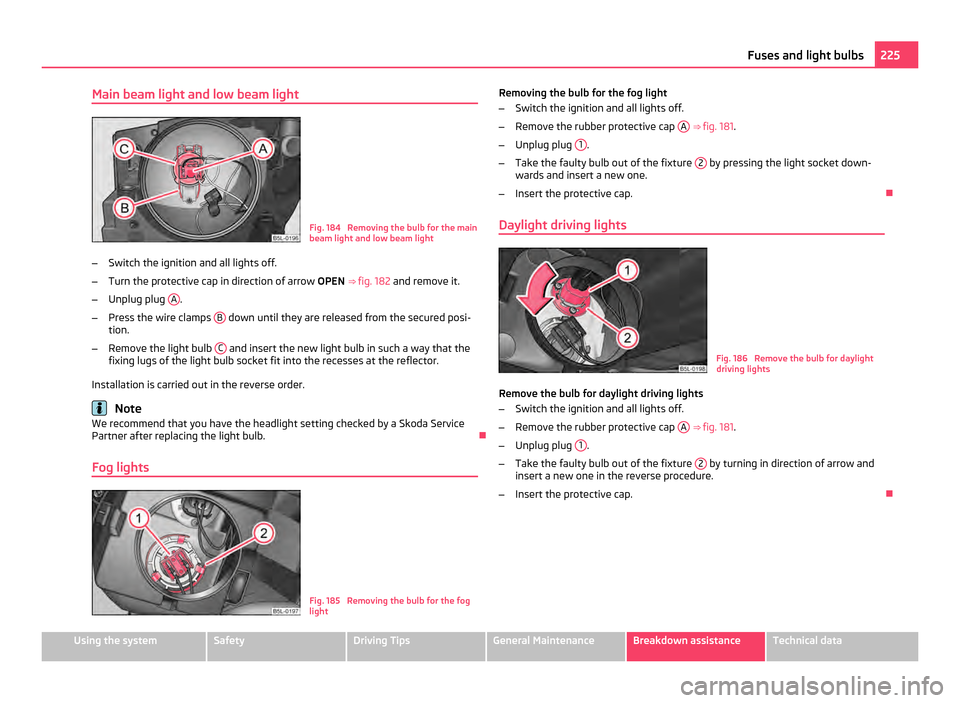
Main beam light and low beam light
Fig. 184 Removing the bulb for the main
beam light and low beam light
– Switch the ignition and all lights off.
– Turn the protective cap in direction of arrow OPEN ⇒ fig. 182 and remove it.
– Unplug plug A .
– Press the wire clamps B down until they are released from the secured posi-
tion.
– Remove the light bulb C and insert the new light bulb in such a way that the
fixing lugs of the light bulb socket fit into the recesses at the reflector.
Installation is carried out in the reverse order. Note
We recommend that you have the headlight setting checked by a Skoda Service
Partner after replacing the light bulb.
Fog lights Fig. 185 Removing the bulb for the fog
light Removing the bulb for the fog light
–
Switch the ignition and all lights off.
– Remove the rubber protective cap A ⇒ fig. 181
.
– Unplug plug 1 .
– Take the faulty bulb out of the fixture 2 by pressing the light socket down-
wards and insert a new one.
– Insert the protective cap.
Daylight driving lights Fig. 186 Remove the bulb for daylight
driving lights
Remove the bulb for daylight driving lights
– Switch the ignition and all lights off.
– Remove the rubber protective cap A
⇒ fig. 181 .
– Unplug plug 1 .
– Take the faulty bulb out of the fixture 2 by turning in direction of arrow and
insert a new one in the reverse procedure.
– Insert the protective cap. 225
Fuses and light bulbs Using the system Safety Driving Tips General Maintenance Breakdown assistance Technical data
Page 228 of 252

Rear light unit
Fig. 187 Removing the rear light unit/disconnecting the plug connection
– Open the boot lid/luggage compartment door.
– Unscrew the light with the aid of the Torx wrench from the vehicle tool kit.
The shorter side of the wrench is used for loosening the screws and the longer
side for screwing the screws out completely 1
⇒ fig. 187.
– Grasp the light at the top and bottom part and pull it slightly to the rear.
– Disconnect the plug connection by pressing the catches in direction of arrow
2 and by pulling them in direction of arrow
3
⇒
fig. 187.
Changing light bulbs in the rear light unit Fig. 188 Remove the middle part of the light/rear light unit: Fitting position of the bulbs
–
Unscrew the securing screw A with the aid of the Torx wrench and press the
three catches in direction of arrow ⇒ fig. 188 .
– Remove the plastic lamp holder. –
Replace the defective light bulb.
– In order to replace a bulb for the brake light, reversing light, rear fog or turn
signal light, turn the fixture of the bulb to the left up to the stop and take the
bulb out of the housing or pull the bulb for the parking light out of the fixture
⇒ fig. 188 .
– Change the bulb, install again the fixture with the bulb in the housing and turn
it to the right up to the stop or insert it.
– Insert the plastic lamp holder into the illumination unit until the interlocks are
heard to engage and screw in the securing screw with the aid of the Torx
wrench ⇒
fig. 188 .
– Reconnect the plug connector and insert the bulb in the original position.
– Screw on the bulb ⇒
fig. 187 - left.
Fitting position of the light bulbs in the rear light unit ⇒ fig. 188
1 - Brake lights
2 - Reversing light
3 - Rear fog light
4 - Turn signal lights
5 - parking lights
Licence plate light Fig. 189 Licence plate light
– Unscrew the glass cover of the light ⇒
fig. 189 .
– Take the defective bulb out of the holder and insert a new one. £226
Fuses and light bulbs