2011 SKODA OCTAVIA belt
[x] Cancel search: beltPage 149 of 248

Transporting children safely
What you should know about transporting children! An introduction to the subject Accident statistics have revealed that children are generally more
safely transported on the rear seats than on the front passenger
seat.
Children who are less than 1.50 m in height and who weigh less than 36 kg should,
under normal circumstances, sit on the rear seat (take note of any national legal
provisions which differ from this). They should be secured there by means of a
child restraint system or by using the existing seat belts depending on their body
size and weight. The child seat should be mounted behind the front passenger
seat for safety reasons.
The physical principle of an accident does, of course, also apply to children
⇒
page 135, The physical principle of a frontal collision. They differ from adults in
that their muscles and bone structure of children are not yet fully developed. Thus
children are exposed to increased risk of injury.
Children should be transported by using special child safety seats in order to re-
duce this risk of injury.
Only use child safety seats which are officially approved, suitable for children and
which comply with the standard ECE-R 44, which classifies child safety seats into
5 groups ⇒ page 149, Classification of child seats into groups. Child restraint sys-
tems which have been tested for conformity to ECE-R 44 standard have a non-de-
tachable test seal (a large E within a circle and below this the test number) attach-
ed to the seat.
We recommend that you use child safety seats from the ŠKODA Original Accesso-
ries range. These child seats were developed and also tested for use in ŠKODA
vehicles. They fulfil the ECE-R 44 standard. WARNING
Always comply with national legal provisions and instructions from the rele-
vant child safety seat manufacturer when installing and using a child seat
⇒
page 147. Note
National legal provisions, which deviate from the information contained in these
operating instructions, take precedence over the information contained in the op-
erating instructions.
Important safety information regarding the use of child safety
seats Correct use of child safety seats considerably reduces the risk of in-
jury!
WARNING
● All the occupants of the car - in particular children - must wear a seat belt
when the car is moving.
● Children who are less than 1.50 m in height and who weigh less than 36 kg
must not use a normal seat belt without a child restraint system, otherwise
this may result in injuries to the stomach and neck areas. Comply with the na-
tional legal requirements.
● One should never carry children, and also not babies! - on one's lap.
● You can transport a child safely in a suitable child safety seat ⇒
page 149,
Child seat!
● Only one child may be fastened with a seat belt into a child safety seat.
● Never leave the child sitting unattended in the seat.
● Certain outside climatic conditions can cause life-threatening tempera-
tures in the vehicle.
● Never allow your child to be transported in a vehicle without the use of a
suitable restraint system.
● Children should also never stand up in a vehicle or kneel on the seats
when the vehicle is moving. In the event of an accident the child will be
thrown through the vehicle and may as a result suffer fatal injuries, and also
injure other occupants. £ 147
Transporting children safely Using the system Safety Driving Tips General Maintenance Breakdown assistance Technical data
Page 150 of 248
WARNING (Continued)
● Children are exposed to an increased risk of injury in the event of an acci-
dent if they lean forward or adopt an incorrect seated position when the vehi-
cle is moving. This particularly applies to children who are transported on the
front passenger seat if the airbag system deploys in the event of an accident.
This can result in severe or even fatal injuries.
● It is important that the belt webbing is properly routed if the seat belts are
to offer their maximum protection ⇒
page 137, How are seat belts correctly
fastened?. Pay particular attention to the information provided by the manu-
facturer of the child safety seat regarding correct routing of the belt. Seat
belts which are not correctly adjusted can themselves cause injuries even in
minor accidents.
● Safety belts must be checked to ensure that they are running properly.
One should also ensure that the belt is not damaged by sharp-edged fittings.
● It is essential to always switch off the front passenger airbag when attach-
ing a child safety seat to the front passenger seat where the child is seated
with its back facing in direction of travel ⇒ page 146
. If this is not done, there
is a risk of the child suffering severe or even fatal injuries if the front passen-
ger airbag is deployed. When transporting a child on the front passenger seat,
please comply with the appropriate national regulations regarding the use of
child safety seats.
Use of child safety seats on the front passenger seat Child safety seats should always be attached to the rear seats.
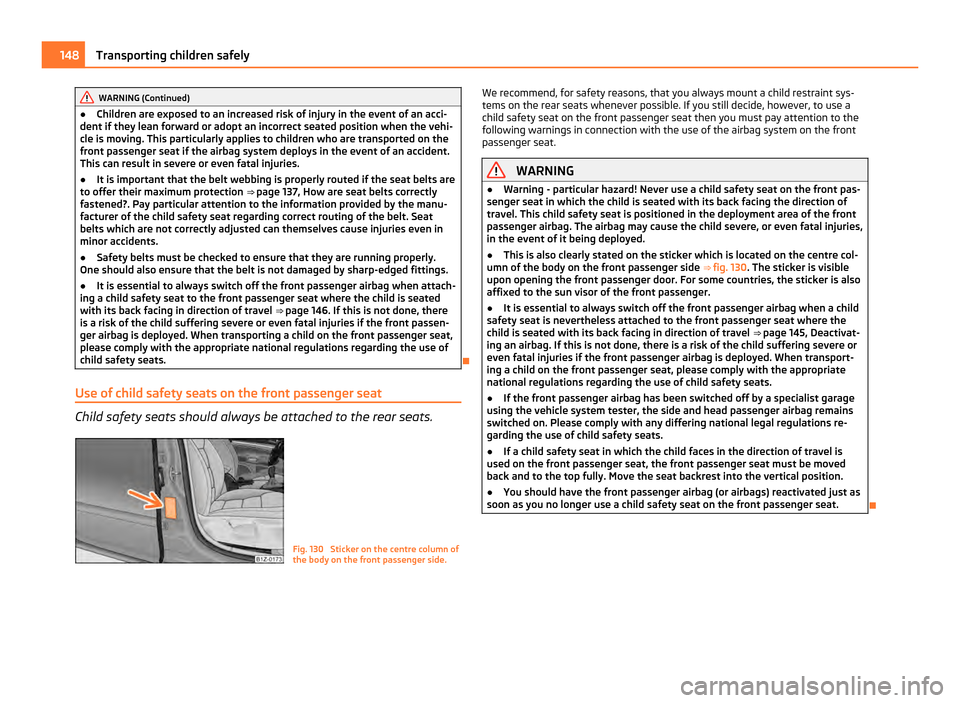
Fig. 130 Sticker on the centre column of
the body on the front passenger side. We recommend, for safety reasons, that you always mount a child restraint sys-
tems on the rear seats whenever possible. If you still decide, however, to use a
child safety seat on the front passenger seat then you must pay attention to the
following warnings in connection with the use of the airbag system on the front
passenger seat. WARNING
● Warning - particular hazard! Never use a child safety seat on the front pas-
senger seat in which the child is seated with its back facing the direction of
travel. This child safety seat is positioned in the deployment area of the front
passenger airbag. The airbag may cause the child severe, or even fatal injuries,
in the event of it being deployed.
● This is also clearly stated on the sticker which is located on the centre col-
umn of the body on the front passenger side ⇒ fig. 130. The sticker is visible
upon opening the front passenger door. For some countries, the sticker is also
affixed to the sun visor of the front passenger.
● It is essential to always switch off the front passenger airbag when a child
safety seat is nevertheless attached to the front passenger seat where the
child is seated with its back facing in direction of travel ⇒
page 145, Deactivat-
ing an airbag. If this is not done, there is a risk of the child suffering severe or
even fatal injuries if the front passenger airbag is deployed. When transport-
ing a child on the front passenger seat, please comply with the appropriate
national regulations regarding the use of child safety seats.
● If the front passenger airbag has been switched off by a specialist garage
using the vehicle system tester, the side and head passenger airbag remains
switched on. Please comply with any differing national legal regulations re-
garding the use of child safety seats.
● If a child safety seat in which the child faces in the direction of travel is
used on the front passenger seat, the front passenger seat must be moved
back and to the top fully. Move the seat backrest into the vertical position.
● You should have the front passenger airbag (or airbags) reactivated just as
soon as you no longer use a child safety seat on the front passenger seat. 148
Transporting children safely
Page 152 of 248
Children who are more than 1.50 m in height or who weigh more than 36 kg can
use normal seat belts without a seat bolster.
Use of child seats An overview of the usefulness of child seats on each of the seats according to the
ECE-R 44 standard: Child seat
of the group Front passenger
seat Rear seat
outside Rear seat
middle 0 U
+ U
+
T U
0+ U
+ U
+
T U
1 U
+ U
+
T U
2 and 3 U U U
Universal category - seat is suitable for all approved types of child safety
seats.
The seat can be fitted with fixing eyes for the
“ISOFIX ”system.
The divided rear seat - seat can be fitted with fixing eyes for the system “ Top
Tether” ⇒ page 153, Attaching child seat using the “Top Tether” system.
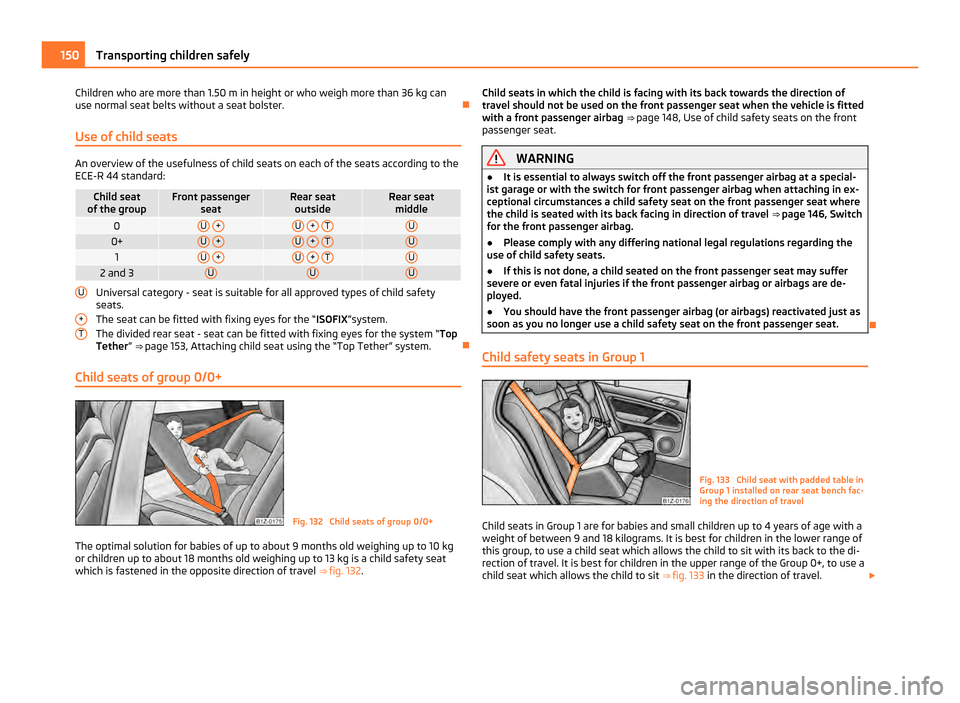
Child seats of group 0/0+ Fig. 132 Child seats of group 0/0+
The optimal solution for babies of up to about 9 months old weighing up to 10 kg
or children up to about 18 months old weighing up to 13 kg is a child safety seat
which is fastened in the opposite direction of travel ⇒
fig. 132.
U +
T Child seats in which the child is facing with its back towards the direction of
travel should not be used on the front passenger seat when the vehicle is fitted
with a front passenger airbag
⇒
page 148, Use of child safety seats on the front
passenger seat. WARNING
● It is essential to always switch off the front passenger airbag at a special-
ist garage or with the switch for front passenger airbag when attaching in ex-
ceptional circumstances a child safety seat on the front passenger seat where
the child is seated with its back facing in direction of travel ⇒
page 146, Switch
for the front passenger airbag.
● Please comply with any differing national legal regulations regarding the
use of child safety seats.
● If this is not done, a child seated on the front passenger seat may suffer
severe or even fatal injuries if the front passenger airbag or airbags are de-
ployed.
● You should have the front passenger airbag (or airbags) reactivated just as
soon as you no longer use a child safety seat on the front passenger seat.
Child safety seats in Group 1 Fig. 133 Child seat with padded table in
Group 1 installed on rear seat bench fac-
ing the direction of travel
Child seats in Group 1 are for babies and small children up to 4 years of age with a
weight of between 9 and 18 kilograms. It is best for children in the lower range of
this group, to use a child seat which allows the child to sit with its back to the di-
rection of travel. It is best for children in the upper range of the Group 0+, to use a
child seat which allows the child to sit ⇒ fig. 133 in the direction of travel. £150
Transporting children safely
Page 153 of 248

Child seats in which the child is facing with its back towards the direction of
travel should not be used on the front passenger seat when the vehicle is fitted
with a front passenger airbag
⇒
page 148, Use of child safety seats on the front
passenger seat. WARNING
● It is essential to always switch off the front passenger airbag at a special-
ist garage or with the switch for front passenger airbag when attaching in ex-
ceptional circumstances a child safety seat on the front passenger seat where
the child is seated with its back facing in direction of travel ⇒
page 146, Switch
for the front passenger airbag.
● Please comply with any differing national legal regulations regarding the
use of child safety seats.
● If this is not done, a child seated on the front passenger seat may suffer
severe or even fatal injuries if the front passenger airbag or airbags are de-
ployed.
● You should have the front passenger airbag (or airbags) reactivated just as
soon as you no longer use a child safety seat on the front passenger seat.
Child safety seats in Group 2 Fig. 134 Child seat in Group 2 installed
on the rear seat facing the direction of
travel
For children up to about 7 years of age weighing between 15 and 25 kg the opti-
mal solution is a child safety seat in combination with the three-point seat belt
⇒ fig. 134. WARNING
● When transporting a child on the front passenger seat, please comply with
the appropriate national regulations regarding the use of child safety seats.
Switch off the front passenger airbag if necessary at a specialist garage or
switch it off with the switch for front passenger airbag ⇒
page 146, Switch for
the front passenger airbag.
● The shoulder part of the seat belt must run approximately across the mid-
dle of the shoulder and fit snugly against the chest. It must on no account run
across the neck. The lap part of the seat belt must run across the pelvis and
fits snugly; it must not run over the belly. Tighten the belt webbing over your
hip if necessary.
● Please comply with any differing national legal regulations regarding the
use of child safety seats.
Child safety seats in Group 3 Fig. 135 Child seat in Group 3 installed
on the rear seat facing the direction of
travel
For children of about 7 years of age weighing between 22 and 36 kg and of a
height of less than 150
cm, the optimal solution is a child safety seat (seat bolster)
in combination with the three-point seat belt ⇒ fig. 135 .
Children who are more than 1.50 m in height or who weigh more than 36 kg can
use normal seat belts without a seat bolster. £ 151
Transporting children safely Using the system Safety Driving Tips General Maintenance Breakdown assistance Technical data
Page 154 of 248

WARNING
● When transporting a child on the front passenger seat, please comply with
the appropriate national regulations regarding the use of child safety seats.
Switch off the front passenger airbag if necessary at a specialist garage or
switch it off with the switch for front passenger airbag ⇒
page 146, Switch for
the front passenger airbag.
● The shoulder part of the seat belt must run approximately across the mid-
dle of the shoulder and fit snugly against the chest. It must on no account run
across the neck. The lap part of the seat belt must run across the pelvis and
fits snugly; it must not run over the belly. Tighten the belt webbing over your
hip if necessary.
● Please comply with any differing national legal regulations regarding the
use of child safety seats.
Attaching a child seat using the “ISOFIX” system Fig. 136 Locking eyes (ISOFIX system)/Push the ISOFIX child seat into the installed mounting
funnels
There are two fixing eyes between the seat backrest and the seat cushion of the
front passenger seat for fixing the
“ISOFIX” system child seat in place. The locking
eyes on the rear outside seats are located below the upholstery. The places are
marked with signs with the logo “ISOFIX” ⇒ fig. 136 - left.
Install child seat
– Open the zip fasteners between the seat cushion and the seat backrest of the
rear exterior seat.
– Insert the mounting funnels A onto the locking eyes
B between the seat
backrest and the seat cushion ⇒
fig. 136. –
Push the notched arms of the child seat into the locking eyes in direction of
arrow 1 , until they are heard to lock in place
⇒ fig. 136.
– Pull on both sides of the child seat!
One can mount a child safety seat using the
“ISOFIX” system quickly, easily and
reliably. Please pay close attention to instructions from the manufacturer of the
child safety seat when installing and removing the seat.
Child seats fitted with the “ISOFIX” system can only be mounted and fixed in a ve-
hicle fitted with an “ISOFIX” system when these child seats have been released
for this type of vehicle according to the ECE-R 44 standard.
Child safety seats with the fixing system “ISOFIX” can be obtained from ŠKODA
Original Accessories.
Complete installation instructions are enclosed with the child safety seat. WARNING
● The locking eyes have just been developed for child safety seats which use
the
“ISOFIX” system. You should therefore never attach other child safety
seats, seat belts or objects to the locking eyes - hazard!
● Ask an authorised ŠKODA Service Partner whether a child seat which you
bought for another vehicle is recommended for use in your vehicle before us-
ing a child seat with
“ISOFIX” system.
● Certain child seats which use the “ISOFIX” system can be attached with
standard three-point seat belts. Please pay close attention to instructions
from the manufacturer of the child safety seat when installing and removing
the seat. Note
● Child seats which use the
“ISOFIX” system are currently available for children
weighing up to about 18 kg. This corresponds to an age range up to 4 years.
● The child seats can also be fitted with the “Top Tether” system ⇒
page 153. 152
Transporting children safely
Page 155 of 248

Attaching child seat using the “Top Tether” system
Fig. 137 Rear seat: Top Tether
IIn certain countries national legal provisions also require the equipment of the
rear seat with fixing eyes for child seat using the “Top Tether” system ⇒ fig. 137.
Always perform the installation and removal of the child seat using the “Top Teth-
er” system as stated in the instructions from the manufacturer of the child seat. WARNING
● Attach the child seats with the
“Top Tether” system only to the points pro-
vided for this purpose ⇒ fig. 137.
● On no account should you equip your vehicle, e.g. mount screws or other
anchorage points.
● Pay attention to the important safety information regarding the use of
child seats. Note
Store the remaining part of the belt for the “Top Tether” system in a textile pock-
et, which is located at the child seat. 153
Transporting children safely Using the system Safety Driving Tips General Maintenance Breakdown assistance Technical data
Page 177 of 248

●
Sharp-edged objects on items of clothing such as zip fasteners, rivets, sharp-
edged belts may leave permanent scratches or signs of rubbing on the surface.
● The use of a mechanical steering wheel lock may damage the leather surface
of the steering wheel. Note
● Use a care cream with light blocker and impregnation effect regularly and each
time after cleaning the leather. The cream nourishes the leather, allows it to
breathe and keeps it supple and also provides moisture. It also creates surface
protection.
● Clean the leather every 2 to 3 months, remove fresh soiling each time this oc-
curs.
● Remove fresh stains such as those from ball-point pens, ink, lipstick, shoe
cream etc., as quickly as possible.
● Care also for the leather dye. Refreshen areas which have lost their colour
with a special coloured leather cream as required.
● The leather is a natural material with specific properties. During the use of the
vehicle, minor optical changes can occur on the leather parts of the covers (e. g
wrinkles or creases as a result of the stress of the covers).
Seat belts –
Keep the seat belts clean!
– Wash seat belts which have become soiled using a mild soapy solution.
– Inspect the seat belts regularly to ensure they are in good condition.
Belt webbing which has become severely soiled may prevent the inertia reel from
reeling up the belt properly. WARNING
● The seat belts must not be removed for cleaning.
● Never clean the seat belts chemically as dry cleaning may destroy the fab-
ric. The seat belts must also not be allowed to come into contact with corro-
sive liquids (such as acids etc.).
● Seat belts which have damage to the webbing, the connections, the inertia
reel or the lock should be replaced by a specialist garage.
● Inertia reel belts must be completely dried before being reeled up. 175
Taking care of your vehicle and cleaning the vehicle Using the system Safety Driving Tips General Maintenance Breakdown assistance Technical data
Page 183 of 248

Working in the engine compartment
Particular care is required when carrying out any work in the en-
gine compartment!
There is a risk of injuries, scalding, accidents and fire when working in the en-
gine compartment, e.g. inspecting and replenishing oil and other fluids. For this
reason, it is essential to comply with the warning instructions stated below and
with the general applicable rules of safety. The engine compartment of your car
is a hazardous area ⇒
.
WARNING
● Never open the bonnet if you see that steam or coolant is flowing out of
the engine compartment - risk of scalding! Wait long enough until the steam
or coolant has stopped escaping.
● Switch off the engine and pull out the ignition key.
● Apply the handbrake firmly.
● If your vehicle is fitted with a manual gearbox, move the gearshift lever in-
to Neutral, or if it is fitted with automatic gearbox, move the selector lever in-
to position
P.
● Allow the engine to cool down.
● Keep children clear of the engine compartment.
● Do not touch any hot engine parts - risk of burns!
● Never spill oil and other fluids over the hot engine. Such fluids (e.g. the an-
tifreeze contained in the coolant) may ignite!
● Avoid short circuits in the electrical system - particularly on the battery.
● Never place your hand into the radiator fan as long as the engine is still
warm. The fan might suddenly start running!
● Never open the cap of the coolant expansion reservoir so long as the en-
gine is still warm. The cooling system is pressurized!
● Cover over the cap of the reservoir with a large cloth when opening it as
protection for your face, hands and arms from hot steam or hot coolant.
● Do not let objects, such as e.g cleaning cloth or tools lie in the engine com-
partment. WARNING (Continued)
● If you wish to work under the vehicle, you must secure the vehicle from
rolling away and support it with suitable supporting blocks: the car jack is not
sufficient for this - risk of injury!
● In cases where it be necessary to carry out inspection work when the en-
gine is running there is an additional risk from rotating parts (e.g. the V-ribbed
belt, alternator, radiator fan) and from the high-voltage ignition system.
Please observe in addition the following:
–Never touch the electrical cables of the ignition system.
– Absolutely avoid any jewellery, loose items of clothing or long hair from
getting into the rotating parts of the engine - Hazard! Therefore remove
any jewellery beforehand, tie up your hair and wear tight fitting clothing.
● Please also comply with the warning instructions stated below when car-
rying out any essential work on the fuel system or on the electrical system.
–Always separate the car battery from the electrical system.
– Do not smoke.
– Never carry out any work close to naked flames.
– Always keep a working fire extinguisher at hand. CAUTION
When replenishing fluids in the engine, always ensure that the fluids are on no ac-
count mixed up. This may result in major operating problems and also vehicle
damage! 181
Inspecting and Replenishing Using the system Safety Driving Tips General Maintenance Breakdown assistance Technical data