2011 SKODA OCTAVIA ECU
[x] Cancel search: ECUPage 132 of 248
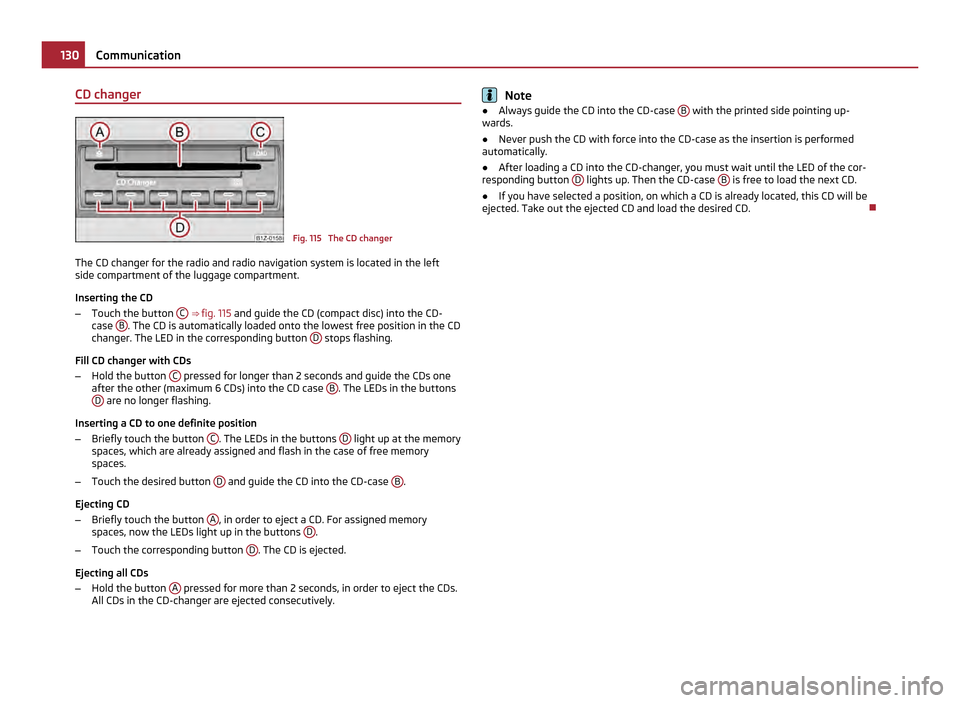
CD changer
Fig. 115 The CD changer
The CD changer for the radio and radio navigation system is located in the left
side compartment of the luggage compartment.
Inserting the CD
– Touch the button C
⇒ fig. 115 and guide the CD (compact disc) into the CD-
case B . The CD is automatically loaded onto the lowest free position in the CD
changer. The LED in the corresponding button D stops flashing.
Fill CD changer with CDs
– Hold the button C pressed for longer than 2 seconds and guide the CDs one
after the other (maximum 6
CDs) into the CD case B . The LEDs in the buttons
D are no longer flashing.
Inserting a CD to one definite position
– Briefly touch the button C . The LEDs in the buttons
D light up at the memory
spaces, which are already assigned and flash in the case of free memory
spaces.
– Touch the desired button D and guide the CD into the CD-case
B .
Ejecting CD
– Briefly touch the button A , in order to eject a CD. For assigned memory
spaces, now the LEDs light up in the buttons D .
– Touch the corresponding button D . The CD is ejected.
Ejecting all CDs
– Hold the button A pressed for more than 2 seconds, in order to eject the CDs.
All CDs in the CD-changer are ejected consecutively. Note
● Always guide the CD into the CD-case B with the printed side pointing up-
wards.
● Never push the CD with force into the CD-case as the insertion is performed
automatically.
● After loading a CD into the CD-changer, you must wait until the LED of the cor-
responding button D lights up. Then the CD-case
B is free to load the next CD.
● If you have selected a position, on which a CD is already located, this CD will be
ejected. Take out the ejected CD and load the desired CD. 130
Communication
Page 149 of 248

Transporting children safely
What you should know about transporting children! An introduction to the subject Accident statistics have revealed that children are generally more
safely transported on the rear seats than on the front passenger
seat.
Children who are less than 1.50 m in height and who weigh less than 36 kg should,
under normal circumstances, sit on the rear seat (take note of any national legal
provisions which differ from this). They should be secured there by means of a
child restraint system or by using the existing seat belts depending on their body
size and weight. The child seat should be mounted behind the front passenger
seat for safety reasons.
The physical principle of an accident does, of course, also apply to children
⇒
page 135, The physical principle of a frontal collision. They differ from adults in
that their muscles and bone structure of children are not yet fully developed. Thus
children are exposed to increased risk of injury.
Children should be transported by using special child safety seats in order to re-
duce this risk of injury.
Only use child safety seats which are officially approved, suitable for children and
which comply with the standard ECE-R 44, which classifies child safety seats into
5 groups ⇒ page 149, Classification of child seats into groups. Child restraint sys-
tems which have been tested for conformity to ECE-R 44 standard have a non-de-
tachable test seal (a large E within a circle and below this the test number) attach-
ed to the seat.
We recommend that you use child safety seats from the ŠKODA Original Accesso-
ries range. These child seats were developed and also tested for use in ŠKODA
vehicles. They fulfil the ECE-R 44 standard. WARNING
Always comply with national legal provisions and instructions from the rele-
vant child safety seat manufacturer when installing and using a child seat
⇒
page 147. Note
National legal provisions, which deviate from the information contained in these
operating instructions, take precedence over the information contained in the op-
erating instructions.
Important safety information regarding the use of child safety
seats Correct use of child safety seats considerably reduces the risk of in-
jury!
WARNING
● All the occupants of the car - in particular children - must wear a seat belt
when the car is moving.
● Children who are less than 1.50 m in height and who weigh less than 36 kg
must not use a normal seat belt without a child restraint system, otherwise
this may result in injuries to the stomach and neck areas. Comply with the na-
tional legal requirements.
● One should never carry children, and also not babies! - on one's lap.
● You can transport a child safely in a suitable child safety seat ⇒
page 149,
Child seat!
● Only one child may be fastened with a seat belt into a child safety seat.
● Never leave the child sitting unattended in the seat.
● Certain outside climatic conditions can cause life-threatening tempera-
tures in the vehicle.
● Never allow your child to be transported in a vehicle without the use of a
suitable restraint system.
● Children should also never stand up in a vehicle or kneel on the seats
when the vehicle is moving. In the event of an accident the child will be
thrown through the vehicle and may as a result suffer fatal injuries, and also
injure other occupants. £ 147
Transporting children safely Using the system Safety Driving Tips General Maintenance Breakdown assistance Technical data
Page 170 of 248

Towing a trailer
Technical requirements Your vehicle is designed primarily for transporting persons and luggage. It can,
however, also be used for towing a trailer - provided certain technical equipment
is fitted.
If your vehicle has been
factory-fitted with a towing device or has a towing device
from ŠKODA Original Accessories, then the towing device satisfies all technical
and legal requirements.
Your vehicle is fitted with a 13-pin power socket for the electrical connection be-
tween the vehicle and trailer. If the trailer which you wish to tow has a 7-pin con-
nector, you can use a suitable adapter from
ŠKODA Original Accessories.
This work must be carried out in accordance with the manufacturer's specifica-
tions if a towing device is retrofitted.
Authorised ŠKODA Service Partners can provide detailed information about retro-
fitting a towing device and for any necessary modifications to the cooling system. WARNING
We recommend that you have the towing device from ŠKODA Original Acces-
sories installed by an authorised
ŠKODA Service Partner. He is familiar with all
the relevant details relating to retrofitting such equipment. There is a risk of
an accident if the towing device is not properly fitted!
General Maintenance Trailer load
The permissible trailer load must on no account be exceeded.
You can negotiate appropriately steeper inclines and descents if you do not make
full use of the permissible trailer load.
The trailer loads specified only apply for
altitudes up to 1000 metres above mean
sea level. The fact that the engine power output drops with increasing height due
to a lowering of air pressure and thus the ability to climb, means that the towed
weight must be reduced by 10 % for every further increase of 1 000 metres in height above sea level. The towed weight is the weight of the (laden) vehicle and
the (laden) trailer together. One should take this into account before driving up to
higher altitudes.
The trailer and drawbar load information on the type plate of the towing device
are merely test data for the towing device The data relating to your vehicle,
which is often less than this test data, can be found in your vehicle registration
documents.
Distribution of the load
Distribute the load in the trailer in such a way that any heavy items are located as
close as possible to the axle. Secure the items to prevent them slipping.
Tyre pressure
Correct the tyre inflation pressure on your vehicle for that of
“fully laden”
⇒ page 192. The inflation pressure of the tyres fitted to the trailer adjust in ac-
cordance with the manufacturer's recommendation.
Exterior mirrors
You have to have additional exterior mirrors fitted if you are not able to see the
traffic behind the trailer with the standard rear-view mirrors. Both exterior mirrors
should be attached to folding arms. Adjust the mirrors so that they provide you
with an adequate field of view to the rear.
Headlights
Before starting off with a hitched trailer, also check the setting of the headlights.
Alter the setting as necessary with the aid of the headlight beam adjuster
⇒ page 49.
Detachable ball head
The ball head is detachable on vehicles with towing device and can be obtained
from ŠKODA Original Accessories. It is stowed together with separate fitting in-
structions in the spare wheel well in the luggage compartment of the vehicle. Note
● We recommend that you also have your vehicle inspected between service in-
tervals if you tow a trailer frequently.
● The handbrake on the towing vehicle must be put on when coupling and de-
coupling the trailer. 168
Towing a trailer
Page 180 of 248

For the sake of the environment
The use of engine preheating at temperatures below -10 °C has a positive effect
on the fuel consumption and thus on the environment. Note
An extension cable used for connecting to the electrical network is located in the
luggage compartment.
Diesel Diesel fuel Your vehicle can only be operated with
diesel fuel, which complies with the stand-
ard EN 590 (standard DIN 51628 in Germany, standard ÖNORM
C 1590 in Austria,
GOST R 52368-2005/EN 590:2004 in Russia).
Fuel additives
You must not use fuel additives, so-called “flow improvers” (petrol and similar
products) in diesel fuel.
You can find information on refuelling ⇒ page 178, Refuelling. CAUTION
● Your vehicle can only be operated with diesel fuel, which complies with the
standard EN 590 (standard DIN 51628 in Germany, standard ÖNORM
C 1590 in
Austria, GOST R 52368-2005/EN 590:2004 in Russia). Filling the tank even only
once with diesel fuel which does not comply with the standard, can result in dam-
age to the engine parts, the lubrication system, the fuel and exhaust system.
● If by mistake you have refuelled with a different fuel other than the diesel fuel
which complies to the above mentioned standards (e.
g. petrol), do not start the
engine or switch on the ignition! Severe damage damage is possible! Contact a
specialist garage and have the fuel system of the engine cleaned.
● Water which has collected in the fuel filter can result in engine problems.
● Your vehicle is not adapted for use of biofuel (RME), therefore this fuel must
not be refuelled and driven. The use of biofuel (RME) can lead to damage to the
engine or the fuel system. Operation in winter Winter-grade diesel fuel
A different grade of diesel fuel is available at filling stations in winter than during
the summer. Using
“summer-grade diesel fuel” at temperatures below 0 °C can re-
sult in operational problems because the diesel becomes viscous as a result of
paraffin separation.
It is therefore the case that the standard EN 590 (standard DIN 51628 in Germany,
standard ÖNORM C 1590 in Austria, GOST R 52368-2005/EN 590:2004 in Russia)
is the diesel fuel class prescribed for certain periods of the year which can also be
purchased at the corresponding time during the year. “Winter-grade diesel fuel”
will still operate properly even at a temperature of -20 °C.
It is often the case in countries with different climatic conditions that diesel fuels
available have a different temperature characteristic. The authorised ŠKODA Serv-
ice Partners and filling stations in the country concerned will be able to provide
you with information regarding the diesel fuels available.
Preheating fuel
The vehicle is fitted with a fuel filter preheating system. This secures operation of
a vehicle using diesel fuel down to an environmental temperature of -25 °C. CAUTION
It is not permitted to add the various fuel additives on the market, including pet-
rol, to diesel fuel in order to improve its flow properties.
Refuelling Fig. 147 Right rear side of the vehicle: Open fuel filler flap/fuel filler flap with cap unscrewed
£178
Fuel
Page 182 of 248

Inspecting and Replenishing
Engine compartment
Bonnet remote release Fig. 148 Bonnet release lever
Bonnet remote release
– Pull the unlocking lever below the dash panel on the driver's side ⇒ fig. 148 .
The bonnet jumps out of its lock as a result of the spring force. A locking lever ap-
pears at the same time in the radiator grille.
Opening and closing the bonnet. Fig. 149 Radiator grille: Locking lever/securing the bonnet with the bonnet support
Opening the bonnet
–
Unlock the bonnet ⇒
fig. 148 . –
Ensure that the arms of the windscreen wipers are correctly in place against
the windscreen before opening the bonnet otherwise damage could occur to
the paintwork.
– Pulling on the locking lever in direction of arrow 1 ⇒
fig. 149
will unlock the
bonnet.
– Grip with the hand under the radiator grille and lift up the bonnet.
– Take the bonnet support out of its holder and set it in the opening 2 de-
signed for it.
Closing the bonnet
– Lift the bonnet slightly and unhook the bonnet support. Press the bonnet sup-
port into the holder designed to hold it.
– Allow the bonnet to drop from a height of about 20 cm into the lock - bonnet
do not press down on it!
– Check whether the bonnet is properly closed. WARNING
● Never open the bonnet if you see that steam or coolant is flowing out of
the engine compartment - risk of scalding! Wait long enough until the steam
or coolant has stopped escaping.
● For safety reasons, the bonnet must always be properly closed when driv-
ing. One should therefore check that the lock has in fact engaged properly af-
ter closing the bonnet.
● Stop your vehicle immediately while driving if you notice that the lock is
not properly engaged and close the bonnet properly - risk of an accident! CAUTION
Never open the bonnet using the locking lever - danger of causing damage. 180
Inspecting and Replenishing
Page 183 of 248

Working in the engine compartment
Particular care is required when carrying out any work in the en-
gine compartment!
There is a risk of injuries, scalding, accidents and fire when working in the en-
gine compartment, e.g. inspecting and replenishing oil and other fluids. For this
reason, it is essential to comply with the warning instructions stated below and
with the general applicable rules of safety. The engine compartment of your car
is a hazardous area ⇒
.
WARNING
● Never open the bonnet if you see that steam or coolant is flowing out of
the engine compartment - risk of scalding! Wait long enough until the steam
or coolant has stopped escaping.
● Switch off the engine and pull out the ignition key.
● Apply the handbrake firmly.
● If your vehicle is fitted with a manual gearbox, move the gearshift lever in-
to Neutral, or if it is fitted with automatic gearbox, move the selector lever in-
to position
P.
● Allow the engine to cool down.
● Keep children clear of the engine compartment.
● Do not touch any hot engine parts - risk of burns!
● Never spill oil and other fluids over the hot engine. Such fluids (e.g. the an-
tifreeze contained in the coolant) may ignite!
● Avoid short circuits in the electrical system - particularly on the battery.
● Never place your hand into the radiator fan as long as the engine is still
warm. The fan might suddenly start running!
● Never open the cap of the coolant expansion reservoir so long as the en-
gine is still warm. The cooling system is pressurized!
● Cover over the cap of the reservoir with a large cloth when opening it as
protection for your face, hands and arms from hot steam or hot coolant.
● Do not let objects, such as e.g cleaning cloth or tools lie in the engine com-
partment. WARNING (Continued)
● If you wish to work under the vehicle, you must secure the vehicle from
rolling away and support it with suitable supporting blocks: the car jack is not
sufficient for this - risk of injury!
● In cases where it be necessary to carry out inspection work when the en-
gine is running there is an additional risk from rotating parts (e.g. the V-ribbed
belt, alternator, radiator fan) and from the high-voltage ignition system.
Please observe in addition the following:
–Never touch the electrical cables of the ignition system.
– Absolutely avoid any jewellery, loose items of clothing or long hair from
getting into the rotating parts of the engine - Hazard! Therefore remove
any jewellery beforehand, tie up your hair and wear tight fitting clothing.
● Please also comply with the warning instructions stated below when car-
rying out any essential work on the fuel system or on the electrical system.
–Always separate the car battery from the electrical system.
– Do not smoke.
– Never carry out any work close to naked flames.
– Always keep a working fire extinguisher at hand. CAUTION
When replenishing fluids in the engine, always ensure that the fluids are on no ac-
count mixed up. This may result in major operating problems and also vehicle
damage! 181
Inspecting and Replenishing Using the system Safety Driving Tips General Maintenance Breakdown assistance Technical data
Page 191 of 248

We recommend you have the electrolyte level checked by a specialist garage from
time to time, especially in the following cases.
● High outside temperatures.
● Long daily drives
● After each charge ⇒ page 189.
On vehicles with a vehicle battery fitted with a colour indicator, the so-called mag-
ic eye ⇒ fig. 155 , the electrolyte level can be determined by looking at the change
in colour.
Air bubbles can influence the colour of the indicator. For this reason carefully
knock on the indicator before carrying out the check.
● Black colour - electrolyte level is correct.
● Colourless or light yellow colour - electrolyte level too low, the battery must be
replaced. Note
● The battery electrolyte level is periodically checked by an authorised
ŠKODA
Service Partner as part of the Inspection Service.
● For technical reasons, on vehicles with the description “AGM”, the electrolyte
level cannot be checked.
● Vehicles with a “START-STOP” system are fitted with a battery control unit for
checking the energy level for the recurring engine start.
Operation in winter The battery has to provide greater amounts of electricity during the winter. It also
has only part of the initial power output at low temperatures that it has at normal
temperatures.
A discharged battery may already freeze at temperatures just below 0 °C.
We therefore recommend that you have the battery checked by a specialist ga-
rage before the start of winter and recharged if necessary. WARNING
Never charge a frozen or thawed battery - risk of explosion and caustic burns.
Replace a frozen battery. Charging the battery A properly charged battery is essential for reliably starting the en-
gine.
– Read the warning notes ⇒
in General information on page 187 and ⇒
.
– Switch the ignition and all electrical components off.
– Only for “quick-charging”: Disconnect both battery cables (first of all “nega-
tive
”, then “positive”).
– Carefully attach the terminal clamps of the charger to the battery terminals
(red = “positive
”, black = “negative”).
– You can now plug the mains cable of the charger into the power socket and
switch on the charger.
– When charging is completed: switch the charger off and unplug the mains ca-
ble from the power socket.
– Only then should you disconnect the terminal clamps of the charger.
– Reconnect the cables to the battery (first of all “positive”, then “negative”).
It is not normally necessary to disconnect the cables of the battery if you recharge
the battery using low amperages (as for example from a mini-charger). Please al-
so refer to the instructions from the charger manufacturer.
A charging current of 0.1 of the total battery capacity (or lower) is that which
should be used until full charging is achieved.
It is, however, necessary to disconnect both cables before charging the battery
with high amperages, so-called
“quick-charging ”.
“Quick-charging” a battery is dangerous ⇒ in General information on page 187.
It requires a special charger and specialist knowledge. We recommend having the
quick charging of vehicle batteries undertaken by a specialist garage.
A discharged battery may already freeze at temperatures just below 0
°C ⇒ . We
recommend that you no longer use a battery which has thawed out because the
casing of the battery may be cracked through the formation of ice and this would
allow battery electrolyte to flow out.
The vent plugs of the battery should not be opened for charging. £ 189
Inspecting and Replenishing Using the system Safety Driving Tips General Maintenance Breakdown assistance Technical data
Page 192 of 248

WARNING
● Never charge a frozen or thawed battery - risk of explosion and caustic
burns. Replace a frozen battery.
● Never charge a battery which has a too low electrolyte level - risk of explo-
sion and caustic burns. CAUTION
On vehicles with the “START/STOP” system, the pole terminal of the charger must
not be connected directly to the negative terminal of the vehicle battery, but only
to the engine earth ⇒ fig. 172.
Disconnecting and reconnecting the battery On disconnecting and reconnecting the battery the following functions are initially
deactivated or are no longer able to operate fault-free.
Operation Operating measure
Electrical power window (operational faults) ⇒ page 41
Enter the car stereo/radio navigation system
code number see operating instructions for the
car stereo/radio navigation sys-
tem
Setting the clock ⇒ page 13
Data in the multi-functional indicator are de-
leted. ⇒ page 14
We recommend having the vehicle checked by an authorised ŠKODA Service Part-
ner to ensure full functionality of all electrical systems.
Replacing the battery When replacing a battery, the new new battery must have the same capacity,
voltage (12
V), amperage and be the same size. Suitable types of vehicle battery
are available from an authorised ŠKODA Service Partner.
We recommend you have a battery change carried out by an authorised ŠKODA
Service Partner, who will properly install the new battery and dispose of the origi-
nal one. CAUTION
Vehicles with a “START-STOP” system are fitted with a special battery type which
allows the battery control unit to check the energy level for recurring engine start.
This battery must only be replaced by a battery of the same type. For the sake of the environment
Batteries contain poisonous substances such as sulphuric acid and lead. For this
reason, it must be disposed of properly. Under no circumstances must it be dis-
posed of in the communal rubbish.
Automatic consumer shut-off Under heavy load on the vehicle battery, the vehicle electrical system manage-
ment automatically takes various measures to avoid draining the vehicle battery.
●
The idling speed is raised to allow the generator to deliver more electricity to
the electrical system.
● If necessary, some electrical consumers are limited in their performance or are
temporarily switched off completely. Note
Despite such intervention by the vehicle electric system management, the vehicle
battery may be drained. For example, when the ignition is switched on a long time
with the engine turned off or the side or parking lights are turned on during lon-
ger parking.
Windshield washer system Fig. 156 Engine compartment: Wind-
shield washer fluid reservoir
£190
Inspecting and Replenishing