2011 SKODA OCTAVIA engine oil
[x] Cancel search: engine oilPage 168 of 248

Trade-in and recycling of old cars
ŠKODA meets the requirements of the brand and its products regarding environ-
ment and resource protection. All new
ŠKODA vehicles can be utilized up to 95 %
and always 1)
be returned. In a lot of countries sufficient trade-in networks have
been created, where you can trade-in your vehicle. After you trade-in your vehicle,
you will receive a confirmation stating the recycling in accordance with environ-
mental regulations.
Vehicles with special built-on types
Technical documents regarding changes carried out on the vehicle must be kept
by the vehicle user, in order to hand over later to the old car user. This ensures the
recycling in accordance with environmental regulations. Note
Detailed information about the trade-in and recycling of old cars is available from
a ŠKODA Service Partner.
Motoring abroad General Other circumstances may exist abroad.
It is also possible, in certain countries, that the
ŠKODA Service Partner network is
limited or has not been established yet. This is the reason why obtaining certain
spare parts may be somewhat complicated and specialist garage personnel may
only be able to make limited repairs. ŠKODA in the Czech Republic and its foreign
importers are happy to provide information about technical aspects of the vehicle,
required maintenance work and possibilities for getting repairs done.
Unleaded petrol A vehicle fitted with a petrol engine must always be refuelled with unleaded pet-
rol
⇒ page 161
. The automobile associations can provide you with information re-
garding the locations of filling stations which offer unleaded petrol. Headlight The low beam of your headlights is set asymmetrically. It illuminates the side of
the road on which you are driving to a greater extent. If you drive abroad on the
other side of the road, you will dazzle oncoming traffic.
In order to prevent the dazzling of oncoming traffic, it is necessary that an adjust-
ment of the headlights is carried out by a specialist garage.
The adaptation of the headlights with Xenon lights (applies only to vehicles which
are designed for driving on the left and on the right) is performed in the menu
Settings Lights & Vision Travel mode in the main menu of the Information display
⇒ page 17
.
Avoiding damage to your vehicle When driving on poor roads and lanes or when driving over kerb stones, steep
ramps, etc., you must pay particular attention to ensuring that any low-slung parts
of the vehicle, such as spoiler and exhaust, do not touch the ground and get dam-
aged.
This particularly applies to models with a lowered suspension (sport suspension)
and also when your vehicle is fully laden.
Driving through bodies of water on roads Fig. 145 Crossing bodies of water
£1)
Subject to fulfilment of the national legal requirements. 166
Driving and the Environment
Page 175 of 248

CAUTION
Never wipe the headlights dry and do not use any sharp objects for cleaning the
plastic lenses, this may result in damage to the protective paintwork and conse-
quently in formation of cracks on the headlight lenses, e.g. through effect of
chemical products.
Door and window seals The rubber seals on the doors, boot lid, bonnet, roof window and windows remain
supple and last longer if you treat them from time to time with a rubber care prod-
uct (e.g. with a spray with silicone-free oil). You also avoid premature wear of the
seals and prevent leakages in this way. It is also easier to open the doors. Rubber
seals which are well cared for also do not stick together in cold winter weather.
Locking cylinder Use specific products for de-icing locking cylinders.
Note
When washing your vehicle, ensure that as little water as possible gets into the
locking cylinders.
Wheels Steel wheels
You should also thoroughly wash the wheels and wheel trims when giving your
vehicle its regular wash. This prevents any brake dust, dirt and road salt from
sticking to the wheel hubs. You can remove stubborn brake abrasion adhering to
the wheels with an industrial cleaner. Touch up any damage to the paintwork on
the wheels before rust is able to form.
Light alloy wheels
Regular care of light alloy wheels is necessary in order to retain their decorative
appearance over long periods. It is particularly important to remove regularly any
road salt and brake abrasion from light alloy wheels, otherwise the light metal will
suffer. Wash thoroughly and then treat the wheels with a protective product for
light alloy wheels which does not contain any acidic components. We recommend to apply a hard wax layer onto the wheel hubs every three months. You must not
use any products which cause abrasion when treating the wheel hubs. Any dam-
age to the paint layer on the wheel hubs must be touched up immediately. WARNING
One should remember when cleaning the wheels that moisture, ice and road
salt may adversely affect braking efficiency - risk of an accident! Note
Severe layers of dirt on the wheels can also result in wheel imbalance. This may
show itself in the form of a wheel vibration which is transmitted to the steering
wheel which, in certain circumstances, can cause premature wear of the steering.
This means it is necessary to remove the dirt.
Underbody protection The underside of your vehicle is protected for life against chemical and mechanical
influences.
One cannot, however, completely rule out damage to the protective layer
when
driving so we recommend that you inspect the protective layer on the underside
of your vehicle and on the chassis at certain intervals - this is best done at the be-
ginning and end of the winter - and to touch up any damaged areas.
The authorised ŠKODA Service Partners have suitable spray products available as
well as the necessary equipment and are familiar with the instructions for use.
Therefore, we recommend you have such touch-up work or additional corrosion
protection measures carried out by an authorised ŠKODA Service Partner. WARNING
Never use additional underbody protection or corrosion-protection agents for
the exhaust pipes, catalytic converters, diesel particle filter or heat shields.
When the engine reaches its operating temperature, these substances might
ignite - risk of fire!
Protection of hollow spaces All the cavities of your vehicle which are at risk from corrosion are protected for
life by a layer of protective wax applied in the factory. £ 173
Taking care of your vehicle and cleaning the vehicle Using the system Safety Driving Tips General Maintenance Breakdown assistance Technical data
Page 179 of 248

Biofuel Ethanol E85
Ethanol E85 Only valid for vehicles with 1.6/75°kW MultiFuel engine.
Biofuel Ethanol E85 consists of 85 % bioethanol and 15 % unleaded petrol com-
plying with the standard (DIN) EN°228.
Biofuel Ethanol E85 in accordance with the standard (DIN) EN 228 can be mixed in
any desired ratio with unleaded petrol.
Drive the vehicle for at least 5 minutes without interruption, if biofuel Ethanol E85
has been refuelled, so that the engine control unit can determine the share of the
biofuel in the fuel. During this period do not drive at top speed of your vehicle or
high engine speeds and not at full throttle. During this process decrease the idling
speed. WARNING
Pay attention to any legal requirements if you do carry a spare canister in the
vehicle. We do not recommend carrying any fuel canisters in your vehicle for
safety reasons. The canister can be damaged in the event of an accident and
fuel may leak out. CAUTION
● Even inadvertently filling the fuel tank with another biofuel such as Ethanol
°E85 can result in damage to the fuel system.
● If you park your vehicle for a lengthy period, fill with petrol complying with
(DIN) EN°228, because Ethanol E85 can contain low quantities of impurities, which
can lead to corrosion. For the sake of the environment
If you use Ethanol E85, the CO 2 emission of your vehicle is lowered up to 5 %. Note
● When operating with Ethanol E85, the fuel consumption increases by approx
33 %, as a lower quantity of energy is contained in the bioethanol than in unlea-
ded petrol.
● Biofuel Ethanol E85 contains only a low quantity of additives in contrast to un-
leaded petrol. Therefore we recommend to fill up the tank with unleaded petrol
complying with EN 228 every 15 000 km (e.g. before the oil change) and run it
empty, so that the engine remains clean. Make sure not to use the whole content
of the tank ⇒ page 178, Refuelling
.
● The interval of 15 000 km applies for the oil change.
Operation in winter Fig. 146 MultiFuel - power socket
If you use biofuel Ethanol E85 at very low temperatures, it is necessary to preheat
the engine before an engine start.
The power socket for the engine preheating is located in the front bumper next to
the fog light ⇒
fig. 146 . The outside temperature Duration of engine preheating
lower than -10
℃ We recommend up to 1 hour
lower than -15
℃ at least 1 hours.
lower than -25
℃ at least 2 hours.
If an engine preheating is not possible at outside temperatures lower than -10 °C,
the share of unleaded petrol complying with EN 228 must be as high as possible.
Thus the cold start property of the engine is clearly improved.
If there is biofuel Ethanol E85 in the tank and the engine is not preheated, it can
lead at temperatures below -15 °C to very poor or no starting of the engine. £ 177
Fuel Using the system Safety Driving Tips General Maintenance Breakdown assistance Technical data
Page 183 of 248

Working in the engine compartment
Particular care is required when carrying out any work in the en-
gine compartment!
There is a risk of injuries, scalding, accidents and fire when working in the en-
gine compartment, e.g. inspecting and replenishing oil and other fluids. For this
reason, it is essential to comply with the warning instructions stated below and
with the general applicable rules of safety. The engine compartment of your car
is a hazardous area ⇒
.
WARNING
● Never open the bonnet if you see that steam or coolant is flowing out of
the engine compartment - risk of scalding! Wait long enough until the steam
or coolant has stopped escaping.
● Switch off the engine and pull out the ignition key.
● Apply the handbrake firmly.
● If your vehicle is fitted with a manual gearbox, move the gearshift lever in-
to Neutral, or if it is fitted with automatic gearbox, move the selector lever in-
to position
P.
● Allow the engine to cool down.
● Keep children clear of the engine compartment.
● Do not touch any hot engine parts - risk of burns!
● Never spill oil and other fluids over the hot engine. Such fluids (e.g. the an-
tifreeze contained in the coolant) may ignite!
● Avoid short circuits in the electrical system - particularly on the battery.
● Never place your hand into the radiator fan as long as the engine is still
warm. The fan might suddenly start running!
● Never open the cap of the coolant expansion reservoir so long as the en-
gine is still warm. The cooling system is pressurized!
● Cover over the cap of the reservoir with a large cloth when opening it as
protection for your face, hands and arms from hot steam or hot coolant.
● Do not let objects, such as e.g cleaning cloth or tools lie in the engine com-
partment. WARNING (Continued)
● If you wish to work under the vehicle, you must secure the vehicle from
rolling away and support it with suitable supporting blocks: the car jack is not
sufficient for this - risk of injury!
● In cases where it be necessary to carry out inspection work when the en-
gine is running there is an additional risk from rotating parts (e.g. the V-ribbed
belt, alternator, radiator fan) and from the high-voltage ignition system.
Please observe in addition the following:
–Never touch the electrical cables of the ignition system.
– Absolutely avoid any jewellery, loose items of clothing or long hair from
getting into the rotating parts of the engine - Hazard! Therefore remove
any jewellery beforehand, tie up your hair and wear tight fitting clothing.
● Please also comply with the warning instructions stated below when car-
rying out any essential work on the fuel system or on the electrical system.
–Always separate the car battery from the electrical system.
– Do not smoke.
– Never carry out any work close to naked flames.
– Always keep a working fire extinguisher at hand. CAUTION
When replenishing fluids in the engine, always ensure that the fluids are on no ac-
count mixed up. This may result in major operating problems and also vehicle
damage! 181
Inspecting and Replenishing Using the system Safety Driving Tips General Maintenance Breakdown assistance Technical data
Page 184 of 248

Overview of the engine compartment
The main inspection points.
Fig. 150 Petrol engine 1.8 ltr./118 kW TSI
Coolant expansion bottle . . . . . . . . . . . . . . . . . . . . . . . . . . . . . . . . . . . . . . . . . . . . . . 185
Windshield washer fluid reservoir . . . . . . . . . . . . . . . . . . . . . . . . . . . . . . . . . . . . . 190
Engine oil filler opening . . . . . . . . . . . . . . . . . . . . . . . . . . . . . . . . . . . . . . . . . . . . . . . . 183
Engine oil dipstick . . . . . . . . . . . . . . . . . . . . . . . . . . . . . . . . . . . . . . . . . . . . . . . . . . . . . . 182
Brake fluid reservoir . . . . . . . . . . . . . . . . . . . . . . . . . . . . . . . . . . . . . . . . . . . . . . . . . . . . 186
Battery (below a cover) . . . . . . . . . . . . . . . . . . . . . . . . . . . . . . . . . . . . . . . . . . . . . . . . . 187Note
The location of the inspection points in the engine compartment of petrol and die-
sel engines is practically identical.
1 2
3
4
5
6 Engine oil
Check engine oil level The dipstick indicates the level of oil in the engine.
Fig. 151 Dipstick
Checking the oil level
– Ensure that the vehicle is positioned on a level surface and the engine has
reached its operating temperature.
– Switch the engine off.
– Open the bonnet ⇒ in Working in the engine compartment on page 181.
– Wait a few minutes until the engine oil flows back into the oil sump. Take out
the dipstick.
– Wipe off the dipstick with a clean cloth and insert it again fully.
– Then withdraw the dipstick again and read off the oil level.
Oil level within range A –
You must not top up the oil.
Oil level within range B –
You may top up the oil. It is possible that the oil level may then be within
range A after doing this.
Oil level within range C –
You must top up the oil ⇒ page 183. It is sufficient, once this is done, to keep
the oil level within range B .
£182
Inspecting and Replenishing
Page 185 of 248

It is normal for the engine to consume oil. The oil consumption may be as much as
0.5 l/1 000 km depending on your style of driving and the conditions under which
you operate your vehicle. The oil consumption may be slightly higher than this
during the first 5 000 kilometres.
One should therefore check the oil level at regular intervals, preferably every time
after the fuel tank is filled or after driving for long stretches.
We recommend maintaining the oil level within the range A - but not above this
,
if the engine has been operating at high loads, for example during a lengthy mo-
torway trip during the summer months, towing a trailer or negotiating a high
mountain pass.
The warning light in the instrument cluster will indicate whether the oil level is
too low ⇒ page 25, Engine oil pressure . In this case, check the oil level as soon
as possible. Top up with an appropriate quantity of oil. CAUTION
● The oil level must on no account extend beyond the range A . Danger of dam-
aging the catalytic converter.
● Do not continue your journey if for some reason it is not possible under the
conditions prevailing to top up with oil. Switch the engine off and obtain profes-
sional assistance from a specialist garage, otherwise it could lead to severe en-
gine damage. Note
Engine oil specifications ⇒ page 221, Technical data.
Replenishing engine oil –
Inspecting the engine oil level ⇒
page 182.
– Unscrew the cap of the engine oil filler opening.
– Pour in a suitable grade of oil in portions of 0.5 litres ⇒ page 224, Engine oil
specifications.
– Inspect the oil level ⇒ page 182
.
– Carefully screw on the cap of the filler opening and push the dipstick in fully. WARNING
● Avoid dripping oil onto hot parts of the engine when topping up will oil - a
risk of fire!
● Read and observe the warning notes ⇒
page 181, Working in the engine
compartment before working in the engine compartment. For the sake of the environment
The oil level must on no account extend beyond the range A ⇒
page 182. Oil will
otherwise be drawn in through the crankcase ventilation and may pass through
the exhaust system to atmosphere. The oil may combust in the catalytic converter
and damage it.
Changing engine oil The engine oil must be changed at the intervals stated in the Service schedule or
according to the service interval indicator
⇒ page 12, Service reminder indicator
. WARNING
● Only carry out the engine oil change, if you have the required professional
knowledge!
● Read and observe the warning notes ⇒
page 181, Working in the engine
compartment before working in the engine compartment.
● First of all, let the engine cool down, wear an eye protection and gloves -
risk of caustic burns due to hot oil. CAUTION
You must not pour any additives into the engine oil - risk of engine damage! Dam-
age, which results from such product, are excluded from the warranty. For the sake of the environment
● You must on no account pour oil into the ground or into the sewage system.
● In view of the problems involved in properly disposing of old oil, the necessary
special tools and the knowledge required for such work, we recommend that you
have the oil and oil filter change carried out by an authorised
ŠKODA Service Part-
ner. £ 183
Inspecting and Replenishing Using the system Safety Driving Tips General Maintenance Breakdown assistance Technical data
Page 186 of 248

Note
After your skin has come in contact with the oil, you must thoroughly wash your
skin.
Cooling system
Coolant The job of the coolant is to cool the engine.
The cooling system does not require any maintenance under normal operating
conditions. The coolant consists of water with a concentration of coolant additive
of 40 %. This mixture not only provides antifreeze protection down to -25 °C but
also protects the cooling and heating system from corrosion. It also prevents the
formation of scale and significantly increases the boiling point of the coolant.
You must therefore not reduce the concentration of antifreeze agent in the cool-
ant by adding water, also not during the summer months or in countries with a
warm climate. The concentration of coolant additive in the coolant must be at
least 40 %.
You can increase the amount of antifreeze in the coolant if a higher concentration
of antifreeze is necessary for climatic reasons but only up to 60 % (antifreeze pro-
tection down to approx. -40 °C). The antifreeze protection tails off above that con-
centration.
Vehicles exported to countries with a cold climate (e.g. Sweden, Norway, Finland)
are already factory-filled with a coolant which offers antifreeze protection down
to about -35 °C. In these countries the concentration of coolant additive should be
at least 50 %.
Coolant
The cooling system is factory-filled with coolant (purple in colour), which complies
with the specification TL-VW
774 G.
When refilling, we only recommend you use the same antifreeze described on the
antifreeze expansion tank.
Please contact an authorised ŠKODA Service Partner if you have any questions re-
garding the coolant or if you wish to fill up with a different coolant.
An authorised ŠKODA Service Partner can also supply you with the correct coolant
additives. Coolant capacity Petrol engines Capacities (in liter)
1.2 ltr./77 kW TSI - EU5 7,7
1.4 ltr./59 kW - EU4 7,1
1.4 ltr./90 kW TSI - EU5 7,7
1.6 ltr./75 kW - EU4, EU2 7,4
1.8 ltr./118 kW TSI - EU5, EU2 DDK
(1.8 ltr./112 kW TSI - EU5)
8,6
2.0 ltr./147 kW TSI - EU5 8,6
Diesel engines Capacities (in liter)
1.6 l/77 kW TDI CR - EU5 8,4
1.9 ltr./77 kW TDI PD - EU4, EU3 8,4
1.9 ltr./77 kW TDI PD DPF - EU4 8,4
2.0 ltr./81 kW TDI CR - EU4, EU5 8,4
2.0 ltr./103 kW TDI CR DPF - EU4, EU5 8,4
2.0 l/125 kW TDI CR - EU5 8,4
CAUTION
● Other coolant additives may cause operational problems which, in particular,
involves significantly reducing the anticorrosion effect.
● Any faults or problems resulting from corrosion may cause a loss of coolant
and, as a consequence of this, result in major engine damage. Note
On vehicles which are fitted with an independent auxiliary heating and ventila-
tion, the volume of the coolant is greater by approx. 1 ltr. 184
Inspecting and Replenishing
Page 187 of 248
Inspecting the coolant level
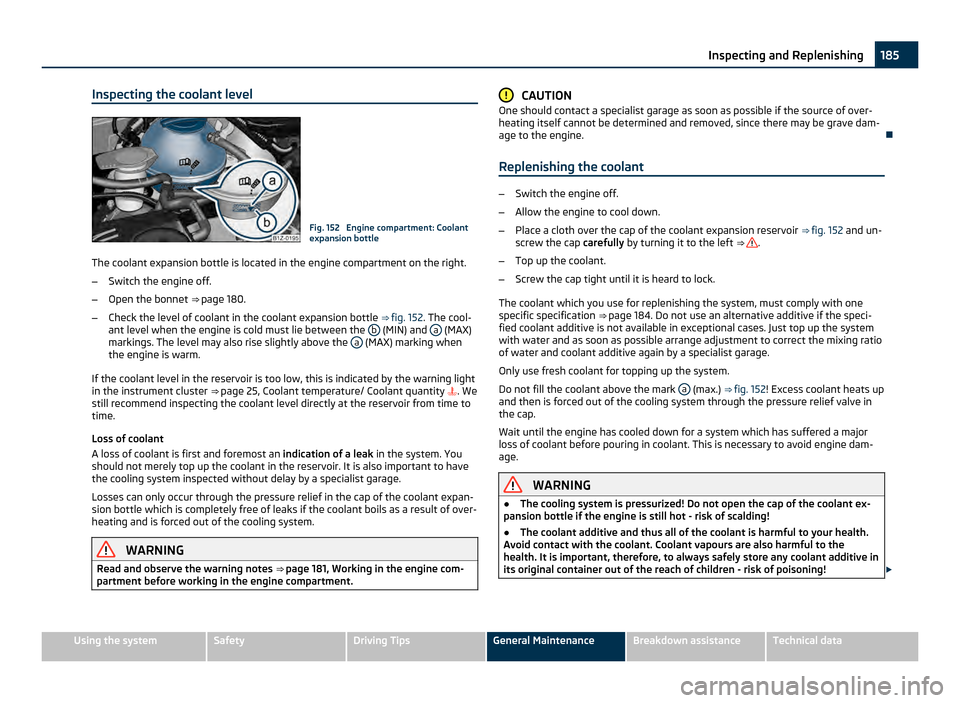
Fig. 152 Engine compartment: Coolant
expansion bottle
The coolant expansion bottle is located in the engine compartment on the right.
– Switch the engine off.
– Open the bonnet ⇒ page 180 .
– Check the level of coolant in the coolant expansion bottle ⇒ fig. 152 . The cool-
ant level when the engine is cold must lie between the b (MIN) and
a (MAX)
markings. The level may also rise slightly above the a (MAX) marking when
the engine is warm.
If the coolant level in the reservoir is too low, this is indicated by the warning light
in the instrument cluster ⇒ page 25, Coolant temperature/ Coolant quantity
. We
still recommend inspecting the coolant level directly at the reservoir from time to
time.
Loss of coolant
A loss of coolant is first and foremost an indication of a leak in the system. You
should not merely top up the coolant in the reservoir. It is also important to have
the cooling system inspected without delay by a specialist garage.
Losses can only occur through the pressure relief in the cap of the coolant expan-
sion bottle which is completely free of leaks if the coolant boils as a result of over-
heating and is forced out of the cooling system. WARNING
Read and observe the warning notes ⇒ page 181, Working in the engine com-
partment
before working in the engine compartment. CAUTION
One should contact a specialist garage as soon as possible if the source of over-
heating itself cannot be determined and removed, since there may be grave dam-
age to the engine.
Replenishing the coolant –
Switch the engine off.
– Allow the engine to cool down.
– Place a cloth over the cap of the coolant expansion reservoir ⇒
fig. 152 and un-
screw the cap carefully by turning it to the left ⇒ .
– Top up the coolant.
– Screw the cap tight until it is heard to lock.
The coolant which you use for replenishing the system, must comply with one
specific specification ⇒ page 184
. Do not use an alternative additive if the speci-
fied coolant additive is not available in exceptional cases. Just top up the system
with water and as soon as possible arrange adjustment to correct the mixing ratio
of water and coolant additive again by a specialist garage.
Only use fresh coolant for topping up the system.
Do not fill the coolant above the mark a (max.)
⇒ fig. 152 ! Excess coolant heats up
and then is forced out of the cooling system through the pressure relief valve in
the cap.
Wait until the engine has cooled down for a system which has suffered a major
loss of coolant before pouring in coolant. This is necessary to avoid engine dam-
age. WARNING
● The cooling system is pressurized! Do not open the cap of the coolant ex-
pansion bottle if the engine is still hot - risk of scalding!
● The coolant additive and thus all of the coolant is harmful to your health.
Avoid contact with the coolant. Coolant vapours are also harmful to the
health. It is important, therefore, to always safely store any coolant additive in
its original container out of the reach of children - risk of poisoning! £ 185
Inspecting and Replenishing Using the system Safety Driving Tips General Maintenance Breakdown assistance Technical data