2011 Seat Ibiza SC mirror
[x] Cancel search: mirrorPage 111 of 278

109
Lights and visibility
Note
● If the electrical adjustment ever fails to operate, the mirrors can be ad-
justed by hand by lightly pressing the edge of the mirror glass.
● In vehicles with electric exterior mirrors, the following points should be
observed: if, due to an external force (e.g. a knock while manoeuvring), the
adjustment of the mirror housing is altered, the mirror will have to be com-
pletely folded electrically. Do not readjust the mirror housing by hand, as
this will interfere with the mirror adjuster function.
● The rear view mirrors can be adjusted separately or simultaneously, as
described before.
● The fold-in function on the exterior mirrors is not active at speeds over
40 km/h.
Safety FirstOperating InstructionsPractical TipsTechnical Specifications
Page 157 of 278

155
Driving
Activation
The system is activated by engagement of the reverse gear. A brief acoustic
signal confirms the activation and correct function of the system.
Reverse gear
The distance warning will begin as soon as an obstacle is detected by the
system. The frequency of the bleeps emitted by the system will increase rap-
idly as the vehicle approaches the obstacle.
Within a short distance of about 30cm, a continuous signal sounds (stop
signal). The driver should not reverse any further.
Models with a factory-fitted towing bracket: When the vehicle is less than
0.35 m away from the obstacle the warning tone will sound continuously.
The driver should then not reverse any further.
The warning tone decreases by 30% after 3 seconds from the start of the
system.
Provided that it is not in continuous mode, the tone on the parking aid sys-
tem stops when it detects a wall parallel to the vehicle.
Trailer towing
For vehicles factory-fitted with a towing bar, the parking aid system will not
be activated by the engagement of the reverse gear when pulling a trailer,
as the trailer's electric connector will be plugged into the vehicle.
Possible faults
If a continuous beep sounds for some seconds when the reverse gear is en-
gaged, this indicates that there is a fault in the parking aid system.
If the fault continues until the ignition is turned off, the acoustic signal
warning of the fault will not be emitted every time the system is reactivated
(by engaging the reverse gear). Thus, the system ready indication will not
sound either. Have the fault repaired by an Authorised Service Centre as
soon as possible. If there is no ready signal or no acoustic warning signal, then the parking
aid loudspeaker is faulty and may not warn of obstacles.
To ensure that the system works properly, the sensors must be kept clean
and free of ice and snow.
WARNING
● The sensors have blind spots in which obstacles may not be detected.
● Always look out for small children and animals because the system
will not always detect them. Always pay attention when reversing to
avoid accidents.
● The parking aid is not a replacement for driver awareness. The driver
must take full responsibility for parking and other manoeuvres.
CAUTION
● Please note that low obstacles detected by the system may no longer be
registered by the sensors as the car moves closer, so the system will not
give any further warning. Certain kinds of obstacles (such as wire fences,
chains, thin posts or trailer draw bars, high kerbs or painted railings etc)
may not always be detected by the system, so there is a risk of damaging
the vehicle in such cases.
● In some cases, obstacles with uniform edges and bumps may not be de-
tected immediately by the system due to their geometry. Take special care
of this type of obstacle (corners, rectangular objects, etc.), as they can
cause damage to the vehicle.
● Be especially careful when manoeuvring into a corner between two per-
pendicular walls. Carefully watch the approach of the wall to the side of the
vehicle (using the mirrors).
● The parking aid system does not replace use of the mirrors for manoeu-
vres.
Safety FirstOperating InstructionsPractical TipsTechnical Specifications
Page 174 of 278
172Driving and the environment
The figures for trailer weights and drawbar loads that are given on the data
plate of the towing bracket are for certification purposes only. The correct
figures for your specific model, which may be lower than these figures for
the towing bracket, are given in the vehicle documents or in ⇒ chapter Tech-
nical Data.
Distributing the load
Distribute loads in the trailer so that heavy objects are as near to the axle as
possible. Loads carried in the trailer must be secured to prevent them mov-
ing.
Tyre pressure
Set tyre pressure to the maximum permissible pressure shown on the stick-
er on the inside of the fuel tank flap. Set the tyre pressure of the trailer tyres
in accordance with the trailer manufacturer's recommendations.
Exterior mirrors
Check whether you can see enough of the road behind the trailer with the
standard mirrors. If this is not the case, you should have additional mirrors
fitted. Both exterior mirrors should be mounted on hinged extension brack-
ets. Adjust the mirrors to give sufficient vision to the rear.
WARNING
Never transport people in a trailer. This could result in fatal accidents.
Note
● Towing a trailer places additional demands on the vehicle. We recom-
mend additional services between the normal inspection intervals if the ve-
hicle is used frequently for towing a trailer.
● Find out whether special regulations apply to towing a trailer in your
country. Ball coupling of towing bracket*
The ball coupling is provided with instructions on fitting and removing the
ball coupling of the towing bracket.
WARNING
The towing bracket ball coupling must be stored securely in the luggage
compartment to prevent them being flung through the vehicle and caus-
ing injury.
Note
● By law, the ball coupling must be removed if a trailer is not being towed
and it obscures the number plate.
Driving tips
Driving with a trailer always requires extra care. Weight distribution
The weight distribution of a loaded trailer with an unladen vehicle is very
unfavourable. However, if this cannot be avoided, drive extra slowly to allow
for the unbalanced weight distribution.
Speed
The stability of the vehicle and trailer is reduced with increasing speed. For
this reason, it is advisable not to drive at the maximum permissible speed
in an unfavourable road, weather or wind conditions. This applies especially
when driving downhill.
You should always reduce speed immediately if the trailer shows the slight-
est sign of snaking. Never try to stop the “snaking” by increasing speed.
Page 179 of 278

177
Vehicle maintenance and cleaning
Vehicle paint maintenance
Regular waxing protects the paintwork. You need to apply wax to your vehicle if water does not form small drops
and run off the paintwork when it is clean.
Good quality hard wax products are available at your Authorised Service
Centre.
Regular wax applications help to protect the paintwork from environmental
contaminants ⇒ page 174. It is also effective in protecting against minor
scratches.
Even if a wax solution is used regularly in the vehicle washing tunnel, it is
advisable to protect the paint with a hard wax coating at least twice a year.
Polishing the paintwork
Polishing brings back gloss to the paintwork. Polishing is only necessary if the paint has lost its shine, and the gloss can-
not be brought back by applying wax. Polishing products can be purchased
in your Authorised Service Centre.
The vehicle must be waxed after polishing if the polish used does not con-
tain wax compounds to seal the paint ⇒ page 177, Vehicle paint mainte-
nance.
CAUTION
To prevent damage to the paintwork:
● Do not use polishes and hard wax on painted parts with a matte finish
or on plastic parts.
● Do not polish your vehicle in a sandy or dusty environment. Caring for plastic parts
Solvents damage plastic parts.
If normal washing fails to clean plastic parts, clean them with approved
sol-
vent-free plastic cleaning and care products.
CAUTION
● The use of liquid air freshener directly over the air vents of the vehicle
may damage the plastic parts if the liquid is accidentally spilled.
● Cleaning products which contain solvents will damage the material.
Cleaning windows and exterior mirrors
Cleaning windows
– Moisten the windows with commercially available, alcohol
based glass cleaner.
– Dry the windows with a clean chamois leather or a lint-free
cloth.
Removing snow
– Use a small brush to remove snow from the windows and mir-
rors.
Removing ice
– Use a de-icer spray.
Use a clean cloth or chamois leather to dry the windows. The chamois leath-
ers used on painted surfaces are not suitable to clean windows because
they are soiled with wax deposits which could smear the windows.
Safety FirstOperating InstructionsPractical TipsTechnical Specifications
Page 180 of 278
178Vehicle maintenance and cleaning
If possible, use a de-icing spray to remove ice. If you use an ice scraper,
push it in one direction only without swinging it.
Use window cleaner or a silicone remover to clean rubber, oil, grease and
silicone deposits off.
Wax deposits can be removed with a special cleaner available in your Au-
thorised Service Centre. Wax deposits on the windscreen could cause the
wiper blades to judder. Adding a window cleaner that dissolves wax to the
windscreen washer fluid prevents wiper blades from juddering, but wax de-
posits are not removed.
CAUTION
● Never use warm or hot water to remove snow and ice from windows and
mirrors. This could cause the glass to crack!
● The heating element for the rear window is located on the inner side of
the window. To prevent damage, do not put stickers over the heating ele-
ments on the inside of the window.
Cleaning windscreen wiper blades
Clean wiper blades improve visibility.
1. Use a soft cloth to remove dust and dirt from the windscreen wiper blades.
2. Use window cleaner to clean the windscreen wiper blades. Use a sponge or a cloth to remove stubborn dirt. Rubber seals maintenance
If rubber seals are well looked after, they will not freeze so
quickly.
1. Use a soft cloth to remove dust and dirt from the rubber seals.
2. Apply a specialist care product to the rubber seals.
The rubber strips on the doors, windows, bonnet and tailgate will remain
pliable and last longer if they are treated with a suitable care product (for
example silicone spray).
Caring for rubber seals will also prevent premature ageing and leaks. The
doors will be easier to open. If rubber seals are well looked after, they will
not freeze so quickly in winter.
Door lock cylinders
The door lock cylinders can freeze up in winter.
To de-ice the lock cylinders you should only use spray with lubricating and
anti-corrosive properties.
Cleaning chrome parts
1. Clean chrome parts with a damp cloth.
2. Polish chrome parts with a soft, dry cloth. If this does not provide satisfying results, use a specialist chrome cleaning
product. Chrome cleaning products will remove stains from the surface.
Page 226 of 278

224If and when
Note
● If a newly replaced fuse blows again after a short time, the electrical sys-
tem must be checked by a specialised workshop as soon as possible.
● If you replace a fuse with higher-rating fuse, you could cause damage to
another location in the electrical system.
● Always keep some spare fuses in the vehicle. These are available from
SEAT dealers.
Fuses on left side of dash panel
Fuses
NumberConsumerAmps1Power steering/Engine operation/Flow meter7,5
2
Diagnostics/Heater/Autoclimate/Climatronic/
Electric anti-dazzle mirror/Navigator/Air condi-
tioning pressure switch/ Climate fan/AFS Control
unit/Coming home relay/Soundaktor/CCS
10
3Petrol engine control unit/Diesel engine control
unit/Relay coils/Engine operation/Bi-turbo fuel
control unit5
4ABS-ESP Control unit/RKA Switch/Gateway con-
trol unit/ESP Relay/Rotation sensor10
5Reverse light/Heating nozzles106Instrument panel57Retro fog light/Start-Stop relays7,5
8Paddle levers on steering wheel for automatic
gearbox2
9Headlight lever/Windscreen wiper switch1010BCM Electronic control unit power supply511Airbag control unit5
NumberConsumerAmps12Automatic gearbox/ LPG system1013Exterior mirror control514Left-hand AFS headlights1515Right-hand AFS headlights1516Vacant 17Number plate light518Clean pump7,519Electronic control unit520Indicators/Brake lights1521Lights control, instrument panel522Heated mirrors5
23Engine injection module/ Rain sensor/ Automat-
ic gear lever/ Main petrol relay7,5
24Luggage compartment light, interior light, glove
compartment light10
25Parking aid526Towing hook 27Headlight control528Lambda probe1029Vacuum pump/LPG power supply15, 20 a)
30Engine solenoid coils/Additional heating relay/
Pressure sensor/AKF Valve15
31Petrol engine operation/Glow plugs/Relay coil/
Electric fan/Secondary water pump relay10
32Engine control unit15, 20,
30 b)
33Clutch switch sensor/Additional heating relay
coil/ Servo sensor5
34Fuel control unit / Vacuum pump1535Vacant
Page 228 of 278
226If and when
Fuses in engine compartment above battery
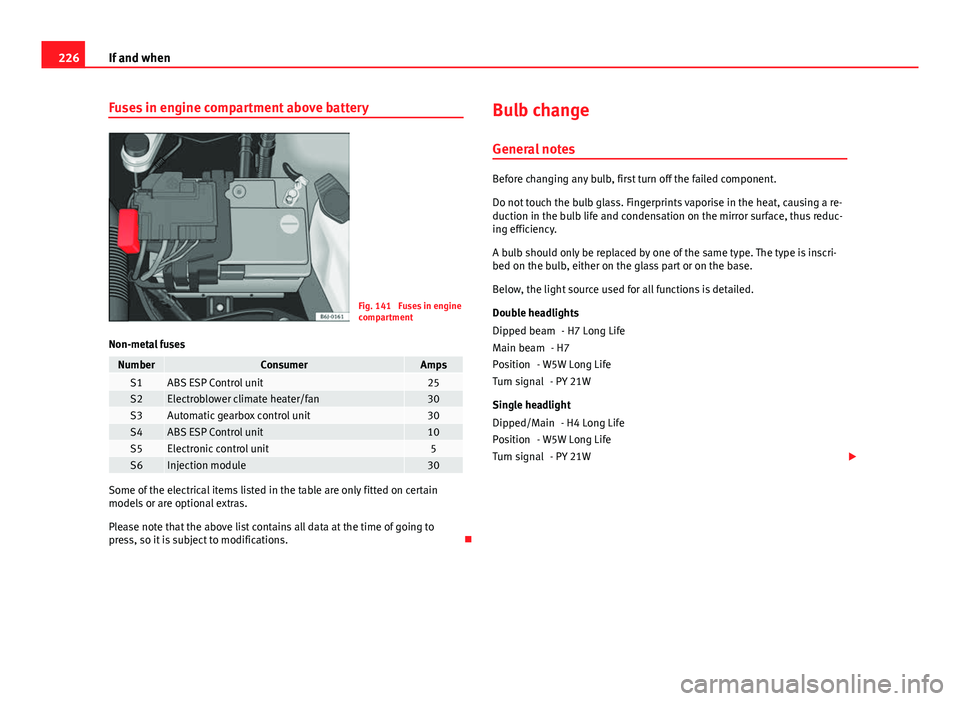
Fig. 141 Fuses in engine
compartment
Non-metal fuses
NumberConsumerAmpsS1ABS ESP Control unit25S2Electroblower climate heater/fan30S3Automatic gearbox control unit30S4ABS ESP Control unit10S5Electronic control unit5S6Injection module30
Some of the electrical items listed in the table are only fitted on certain
models or are optional extras.
Please note that the above list contains all data at the time of going to
press, so it is subject to modifications. Bulb change
General notes
Before changing any bulb, first turn off the failed component.
Do not touch the bulb glass. Fingerprints vaporise in the heat, causing a re-
duction in the bulb life and condensation on the mirror surface, thus reduc-
ing efficiency.
A bulb should only be replaced by one of the same type. The type is inscri-
bed on the bulb, either on the glass part or on the base.
Below, the light source used for all functions is detailed.
Double headlights - H7 Long Life
- H7
- W5W Long Life - PY 21W
Single headlight - H4 Long Life
- W5W Long Life - PY 21W
Dipped beam
Main beam
Position
Turn signal
Dipped/Main
Position
Turn signal
Page 269 of 278
Index
A
ABS . . . . . . . . . . . . . . . . . . . . . . . . . . . . . . . . . . 162Warning lamp . . . . . . . . . . . . . . . . . . . . . . . . 67
Accessories . . . . . . . . . . . . . . . . . . . . . . . . . . . . 183
Acoustic signal . . . . . . . . . . . . . . . . . . . . . . . . . . 19
Acoustic warning . . . . . . . . . . . . . . . . . . . . . . . 136
Adaptive headlights . . . . . . . . . . . . . . . . . . . . . . 97
AFS headlight bulbs . . . . . . . . . . . . . . . . . . . . . 234
Airbag covers . . . . . . . . . . . . . . . . . . . . . . . . . . . 35
Airbag system . . . . . . . . . . . . . . . . . . . . . . . . . . . 29 Front airbags . . . . . . . . . . . . . . . . . . . . . . . . 33
side airbags . . . . . . . . . . . . . . . . . . . . . . . . . 37
Warning lamp . . . . . . . . . . . . . . . . . . . . . . . . 30
Air conditioner Climatronic . . . . . . . . . . . . . . . . . . . . . . . . . 131
General notes . . . . . . . . . . . . . . . . . . . . . . . 133
Air conditioning* . . . . . . . . . . . . . . . . . . . . . . . 128
Air outlets . . . . . . . . . . . . . . . . . . . . . . . . . . . . . 127
Air recirculation Semi-automatic air conditioning . . . . . . . . 130
Air recirculation mode Climatronic . . . . . . . . . . . . . . . . . . . . . . . . . 133
Alarm system Switching off . . . . . . . . . . . . . . . . . . . . . . . . . 84
Alternator Warning lamp . . . . . . . . . . . . . . . . . . . . . . . . 72
Anti-freeze . . . . . . . . . . . . . . . . . . . . . . . . . . . . 200 Anti-lock brake system . . . . . . . . . . . . . . . . . . . 162
Warning lamp . . . . . . . . . . . . . . . . . . . . . . . . 67
Anti-theft alarm system . . . . . . . . . . . . . . . . . . . 84 Switching off . . . . . . . . . . . . . . . . . . . . . . . . . 84
Anti-theft wheel bolts . . . . . . . . . . . . . . . . . . . 218
Aquaplaning . . . . . . . . . . . . . . . . . . . . . . . . . . . 211
Aspects to note before setting off . . . . . . . . . . . . 8
Automatic anti-dazzle interior mirror Deactivating the anti-dazzle function . . . . 107
Automatic anti-dazzle interior mirror* Activating the anti-dazzle function . . . . . . 107
Automatic car washing tunnel . . . . . . . . . . . . . 175
Automatic gearbox . . . . . . . . . . . . . . . . . . . . . . 145 Kick-down feature . . . . . . . . . . . . . . . . . . . . 152
Selector lever positions . . . . . . . . . . . . . . . 150
Automatic lighting . . . . . . . . . . . . . . . . . . . . . . . 95
Automatic windscreeen wiper/washer . . . . . . 103
Auxiliary audio input connection: AUX . . . . . . 122
AUX input connection/USB* . . . . . . . . . . . . . . 122
B
Ball coupling . . . . . . . . . . . . . . . . . . . . . . . . . . . 172
Battery Changing . . . . . . . . . . . . . . . . . . . . . . . . . . 208
Charging . . . . . . . . . . . . . . . . . . . . . . . . . . . 208
Winter conditions . . . . . . . . . . . . . . . . . . . . 207
Before setting off . . . . . . . . . . . . . . . . . . . . . . . . . 8
Belt tensioners . . . . . . . . . . . . . . . . . . . . . . . . . . 27 Biodiesel . . . . . . . . . . . . . . . . . . . . . . . . . . . . . . 192
Biodiesel fuel . . . . . . . . . . . . . . . . . . . . . . . . . . 192
Bonnet . . . . . . . . . . . . . . . . . . . . . . . . . . . . . . . 195
Brake fluid . . . . . . . . . . . . . . . . . . . . . . . . . . . . 205
Changing . . . . . . . . . . . . . . . . . . . . . . . . . . 206
Brake pads . . . . . . . . . . . . . . . . . . . . . . . . . . . . 166
Brakes . . . . . . . . . . . . . . . . . . . . . . . . . . . . . . . . 166
Brake servo . . . . . . . . . . . . . . . . . . . . . . . . 161, 166
Brake system . . . . . . . . . . . . . . . . . . . . . . . . . . 205 Warning lamp . . . . . . . . . . . . . . . . . . . . . . . . 69
Braking distance . . . . . . . . . . . . . . . . . . . . . . . 166
Bulb change double headlight . . . . . . . . . . . . . . . . . . . . 230
Single headlight bulb . . . . . . . . . . . . . . . . 228
Bulb changes General notes . . . . . . . . . . . . . . . . . . . . . . . 226
Bulb defect Warning lamp . . . . . . . . . . . . . . . . . . . . . . . . 67
Buzzer . . . . . . . . . . . . . . . . . . . . . . . . . . . . 101, 136
C
Car care Exterior . . . . . . . . . . . . . . . . . . . . . . . . . . . . 175
Car phone . . . . . . . . . . . . . . . . . . . . . . . . . . . . . 184
Catalytic converter . . . . . . . . . . . . . . . . . . . . . . 167
CCS . . . . . . . . . . . . . . . . . . . . . . . . . . . . . . . . . . 157
267
Index