2011 Seat Alhambra warning light
[x] Cancel search: warning lightPage 127 of 385

125
Seats and storage compartments WARNING
Travelling with the head restraints removed or improperly adjusted in-
cr e
ases the risk of severe or fatal injuries in the event of accidents and
sudden braking or manoeuvres.
● Always fit and adjust the head restraint properly whenever a person
is oc
cupying a seat.
● Refit any removed head restraints immediately so that passengers
are properly
protected. CAUTION
On removing and fitting the head restraint, make sure the head restraint
does not
hit the interior roof of the vehicle or the backrest of the front seat.
This could damage the interior roof and other parts of the vehicle.
Centre armrest Fig. 88 Front centre arm-
re
s
t. To lift the central armrest, lift it upwards in the direction of the arrow
⇒ fig. 88
, setting by setting.
To lower the centre armrest, pull it downwards. Then lower the centre arm-
rest. WARNING
The centre armrest may limit the freedom of movement of the driver's
arm and cau se a seriou
s accident.
● Keep the centre armrest compartments closed while the vehicle is in
motion.
● The centre armrest is not designed for children to sit on! Sitting in
this inc
orrect position can cause severe injuries.
Loading luggage compartment Introduction Always transport heavy loads in the trunk and place the seat backs in a ver-
tical
po
sition. Always use the fastening rings with suitable rope or straps.
Never overload the vehicle. Both the carrying capacity as well as the distri-
bution of the load in the vehicle have effects on the driving behaviour and
braking ability ⇒ .
Addition a
l information and warnings:
● Airbag system ⇒ page 31
● Light
⇒ page 95
● Tr
ansporting ⇒ page 13
● T
owing mode ⇒ page 233
● Wheel
s and tyres ⇒ page 293 Safety First Operating instructions Practical tips Technical Data
Page 136 of 385

134
Seats and storage compartments WARNING (Continued)
● Loose objects in the luggage compartment can suddenly slide and
c h
ange the way the vehicle handles.
● Secure all objects, little and large.
● Never secure a load that is too heavy for the fastening rings.
● Never secure a child seat to the fastening rings. Note
● The maximum load of the fastening rings is approximately 3.5 Kn (3.57
K p).
● Y
ou can find suitable transport straps and load securing systems at a
speci
alist workshop. SEAT recommends visiting a Technical Service.
Rails and attachment system* Fig. 96 In the luggage
comp
ar
tment: System in-
cluding rails, adjustable
attachment elements 1 and adjustable tighten-
ing s
tr
aps 2 .
The rails and attachment system consists of four rails, movable attachment
elements, s tr
aps to be secured to the rails and a net with supports to cover baggage ⇒ page 135.
The rail and attachment system is designed to se-
cure light objects. If the seats in the third row are to be occupied by passen-
gers then attachment elements should never be placed in the section of the
rails close to the seats ⇒ .
Ins t
alling the attachment elements
● Fit the attachment element with the ruts facing upwards ⇒ fig. 96 1 to
the upper p ar
t of the guide and press downwards.
● Move the attachment element to the desired position.
● Always ensure that the attachment inserts into the guide system ⇒ .
Remo v
ing the attachment elements
● Remove the attachment element from the guide and pull downwards.
Securing a lo
ad
● Pull the strap through the attachment element and secure the load
⇒ .
WARNING
In case of an accident or sudden braking, the attachment elements in the
par t
s of the rails close to the seats of the third row could injure seat oc-
cupants.
● Whenever the seats on the third row are to be occupied, remove the
attachment
elements from the rails or move them all the way back. WARNING
Movable attachment elements that are not secured correctly can be re-
le a
sed from the guide in case of sudden braking or accident. As a result,
objects may be fired through the passenger compartment causing seri-
ous injury or death.
● Always ensure that the movable attachment elements are correctly in-
serted int
o the guides.
Page 139 of 385
137
Seats and storage compartments WARNING
Baggage net supports that are not secured correctly can be released from
the guide in ca se of
the sudden braking or accident. As a result, objects
may be fired through the passenger compartment causing serious injury
or death.
● Always ensure that the baggage net supports are correctly inserted
into the rai
ls; the red mark should not be visible.
● Never secure a child seat to the baggage net supports. CAUTION
● The baggage net supports placed on the rail system can be damaged
when f o
lding down seats from the third row or putting them back into posi-
tion and these can also damage the seats themselves. Before folding down
or repositioning the seats, remove the baggage net supports from the rail
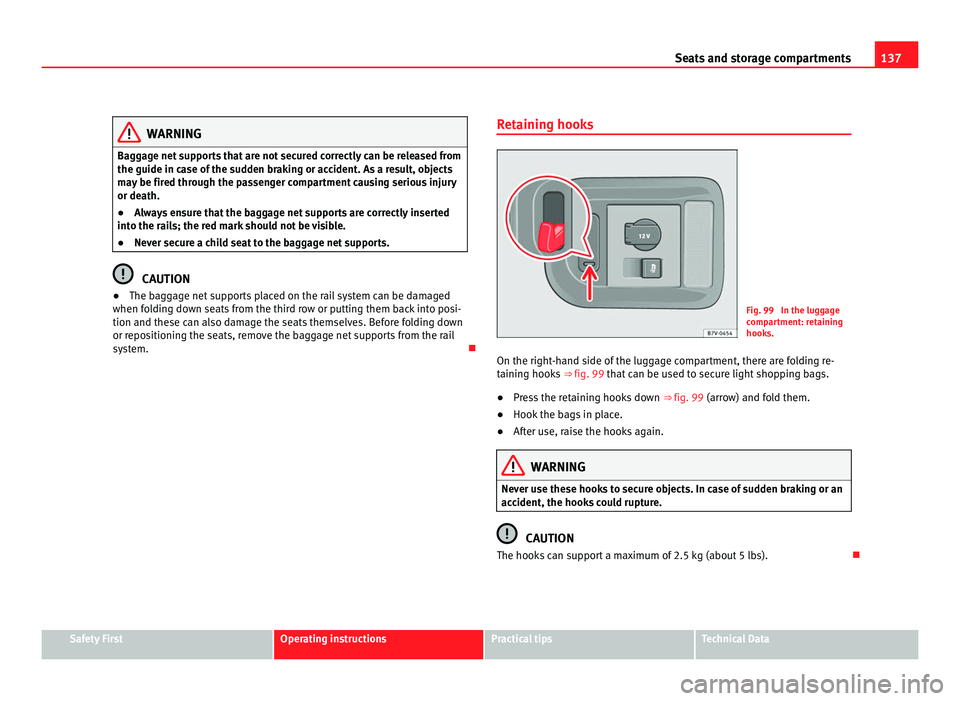
system. Retaining hooks Fig. 99 In the luggage
comp
ar
tment: retaining
hooks.
On the right-hand side of the luggage compartment, there are folding re-
taining hook
s ⇒ fig. 99 that can be used to secure light shopping bags.
● Press the retaining hooks down ⇒ fig. 99 (arrow) and f
old them.
● Hook the bags in place.
● After use, raise the hooks again. WARNING
Never use these hooks to secure objects. In case of sudden braking or an
acc ident, the hook
s could rupture. CAUTION
The hooks can support a maximum of 2.5 kg (about 5 lbs). Safety First Operating instructions Practical tips Technical Data
Page 140 of 385

138
Seats and storage compartments
Luggage net* Fig. 100 In the luggage
comp
ar
tment: net used
on secured baggage.
The baggage net can be used to secure lighter items.
Hooking the b
aggage net into the luggage compartment floor
● Hook the baggage net into the fastening rings ⇒ fig. 100 1 and
2 .
Rel e
asing the baggage net
The secured baggage net is taut ⇒ .
● Carefully unhook the baggage net hooks from the fastening rings 1 .
● Carefully unhook the baggage net hooks from the fastening rings 2 . WARNING
The elastic baggage net stretches when it is secured to the luggage com-
par tment
fastening rings. The secured baggage net is taut. The hooks on
the baggage net can cause injury if the net is incorrectly hooked or un-
hooked.
● Always ensure that the hooks do not suddenly release from the fas-
tening rin
gs when hooking or un-hooking.
● Always keep your face and eyes protected at a safe distance to avoid
injury shou
ld a hook slip while hooking or unhooking.
● Always engage the hooks in the order given. If a baggage net hook
spring
s back this can cause injury.
Roof carrier system* Introduction The vehicle roof has been designed to optimise aerodynamics. For this rea-
son, con
v
entional roof carrier systems cannot be secured to the roof rails.
Given that the water drains have been incorporated into the roof for aerody-
namic reasons, only the SEAT approved basic supports and roof carrier sys-
tems can be used.
When should the roof carrier system be removed?
● When it is not being used.
● When the vehicle is being washed in a car wash.
● When the vehicle height exceeds the maximum height (for example, in a
garag
e).
Page 141 of 385

139
Seats and storage compartments
Additional information and warnings:
● Light ⇒ page 95
● Tr
ansporting ⇒ page 13
● E
cological driving ⇒ page 225
● Wheel
s and tyres ⇒ page 293
● A
ccessories, parts replacement, repairs and modifications ⇒ page 257WARNING
The risk of an accident is increased by transporting heavy or bulky loads
on the roof , whic
h affects the car's handling by shifting the centre of
gravity and increasing susceptibility to cross winds.
● Always secure loads correctly with suitable and undamaged attach-
ment rope or s
traps.
● Large, heavy, wide and flat loads negatively affect the vehicle aerody-
namics, c
entre of gravity and handling.
● Avoid brusque manoeuvres and sudden braking.
● Adjust your speed and driving style to visibility, road, traffic and
weather c
onditions. CAUTION
● Always remove the roof carrier system from the roof before entering a car
w a
sh.
● The height of your vehicle is changed by the installation of the roof carri-
er and the load sec
ured on it. Compare the vehicle height with the passage
height, for example in underground car parks or entering garage doors.
● The roof antenna, the range of the panoramic sliding roof and the tail-
gate shou
ld not be affected by the roof carrier system and the load being
transported.
● Take extra care not to let the tailgate strike the roof load when opening. For the sake of the environment
The vehicle uses more fuel when the roof carrier system is fitted.
Securing the base supports and roof carrier system Fig. 101 Attachment
points
f
or the basic sup-
port and the roof carrier
system.
The mounts are the basis of a complete roof carrier system. Special fixtures
mus t
then be added in order to safely transport luggage, bicycles, skis, surf
boards or boats on the roof. All these system components are available
from an Authorised Service Centre.
It will only be possible to install a basic support or roof carrier system if the
vehicle has a roof rail.
Securing the base supports and roof carrier system
Always secure the base supports and roof carrier system correctly.
The roof carrier system must always be installed exactly according to the in-
structions provided. Safety First Operating instructions Practical tips Technical Data
Page 143 of 385

141
Seats and storage compartments
Storage compartments
Introduction Storage compartments must only be used to store light or small objects.
The front
c
entral armrest compartment houses the factory-fitted AUX-IN or
multimedia (MEDIA-IN) connection sockets.
The factory-fitted CD changer is located in the left-hand storage compart-
ment of the luggage compartment.
Additional information and warnings:
● Child seats (accessories) ⇒ page 39
● L
uggage compartment ⇒ page 125
● C
are and cleaning of the vehicle interior ⇒ page 249
● ⇒
Bookl et Radio or ⇒ Booklet navigation system WARNING
In the event of sudden braking movements or turns, loose objects may be
thro wn ar
ound the vehicle interior. This could cause serious injuries to
passengers and cause the driver to lose control of the vehicle.
● Do not transport animals or place hard, heavy or sharp objects inside
the vehic
le in: open storage compartments, instrument panel, storage
tray, items of clothing or bags.
● While driving, always keep object compartments closed. WARNING
Objects falling into the driver's footwell could prevent use of the pedals.
This c
ould lead the driver to lose control of the vehicle, increasing the
risk of a serious accident.
● Make sure the pedals can be used at all times, with no objects rolling
underneath them.
● The floor m
at should always be secured to the floor.
● Never place other mats or rugs on top of the original mat supplied by
the factor
y.
● Make sure that no objects can fall into the driver's footwell while the
vehicl
e is in motion. CAUTION
● Objects on the shelf could chafe against the wires of the heating ele-
ment in the r
ear window and cause damage.
● Do not keep heat-sensitive objects, food or medicines inside the vehi-
cle. He
at and cold could damage them or render them useless.
● Light-transparent objects placed inside the vehicle, such as lenses,
magnify
ing glasses or transparent suction caps on the windows, could con-
centrate the sun's rays and cause damage to the vehicle. Note
The ventilating slits between the heated rear window and the shelf must not
be co v
ered so that used air can escape from the vehicle. Safety First Operating instructions Practical tips Technical Data
Page 150 of 385

148
Seats and storage compartments
can be located in the storage compartment 1 .. The cover of the compart-
ment 1 can be used to safely store the covers of the rear shelf supports.
Comp ar
tments in the luggage compartment floor
More storage compartments can be found in the luggage compartment
floor. Function Necessary operations
Open the front compartment
⇒ fig. 114
3 :
Pull the front of the luggage compart-
ment floor b
ack using the handle. Open the rear compartment
⇒ fig. 114
4 :
Lift the rear of the luggage compart-
ment floor u
sing the handle. Keeping the rear compartment
open:
Move the hook at the rear right of the
lug g
age compartment and hook the lug-
gage compartment floor onto it
⇒ page 125. Closing the compartment:
Push back the hook and push the rear
of the lug
gage compartment floor 4 down.
Fo l
d the front part of the luggage com-
partment floor forwards 3 .
Other storage compartments:
●
in the centre console, front and rear.
● in the door trims, front and rear.
● Coat hooks on the centr al
door pillars and on the rear roof handles.
● Bag hook in the luggag
e compartment ⇒ page 125. WARNING
Clothing hung on the coat hooks could restrict the driver's view and lead
to seriou s
accidents.
● Hang the clothes from the hooks so that driver's view is not restric-
ted.
● The co
at hook is suitable for light items of clothing. Never place
heavy, h
ard or sharp objects in the bags. CAUTION
Keep the CD changer compartment closed while the vehicle is in motion to
reduc e
vibrations that could damage the changer. Note
The first aid kit is located in the rear left compartment of the luggage com-
par tment
.
Cup holders Introduction Bottle holders
There i
s
a bottle holder in the open compartments in the driver and front
passenger doors and in that of the sliding door.
Additional information and warnings:
● Care and cleaning of the vehicle interior ⇒ pag
e 249
Page 152 of 385

150
Seats and storage compartments
Cup holders, rear* Fig. 116 Centre console,
re
ar section: f
olding out
the cup holder.
Opening and closing the cup holder in the rear centre console
● To open, move the c
up holder downwards in the direction of the arrow
⇒ fig. 116.
● To close, lift the cup holder.
The third r
ow of seats has a cup holder in the side trim compartment on the
rear left.
Ashtray and cigarette lighter*
Introduction Additional information and warnings:
●
Sockets ⇒ page 151.
● A
ccessories, parts replacement, repairs and modifications ⇒ page 257. WARNING
Undue use of the ashtray and cigarette lighter may cause a fire or burns
and other serious injurie
s.
● Never put paper or other flammable objects in the ashtray.
Ashtray Fig. 117 Front centre
con
so
le: ashtray closed.
There are ashtrays located on the front of the centre console ⇒ fig. 117 and
on the rear linin
g of the back door.
Opening and closing the ashtray
● To open, lift the ashtray cover.
● To
close, push the ashtray cover down.