Page 125 of 476
WARNING!
•Actuating the recliner handle will allow the seat-
back to swing (dump) forward on manual recliner
seats. Do not stand or lean in front of the seat
while actuating the handle. The seatback may
swing forward and hit you causing injury. This
dump feature allows access to the storage bin
behind the seat. To avoid injury, place your hand
on the seatback and actuate the handle then posi-
tion the seatback in the desired position.(Continued)
WARNING! (Continued)
•You can be seriously, even fatally, injured riding in
a seat with the seatback reclined. Do not ride with
the seatback reclined so that the shoulder belt is
no longer resting against your chest. If you ride in
this position, the shoulder harness will no longer
be restraining you. In a collision you could slide
under the seat belt and receive serious or fatal
injuries. Recline in a seat only when the vehicle is
parked.
Adjustable Head Restraints
Head restraints can reduce the risk of injury in the event
of a rear impact. The head restraint should be adjusted so
the top of the head restraint is located above the top of
your ear.
124 UNDERSTANDING THE FEATURES OF YOUR VEHICLE
Page 129 of 476
WARNING!
Adjusting a seat while the vehicle is moving is
dangerous. The sudden movement of the seat could
cause you to lose control. The seat belt might not be
properly adjusted and you could be injured. Adjust
any seat only while the vehicle is parked.
CAUTION!
DO NOT place any article under a power seat or
impede its ability to move as it may cause damage to
the seat controls. Seat travel may become limited if
movement is stopped by an obstruction in the seat’s
path.
Power Lumbar — If Equipped
The lumbar controls are located on the outboard side of
the seat cushion. The lumbar support can be increased by
pressing the front of the switch and decreased by press-
ing the back of the switch.
Lumbar Control Switch
128 UNDERSTANDING THE FEATURES OF YOUR VEHICLE
Page 130 of 476
WARNING!
Adjusting a seat while the vehicle is moving is
dangerous. The sudden movement of the seat could
cause you to lose control. The seat belt might not be
properly adjusted and you could be injured. Adjust
any seat only while the vehicle is parked.
Heated Seats — If Equipped
Both front seats and rear passenger outboard seats can be
equipped with heaters. The switches for the front seats
are located in the instrument panel under the climate
controls. The switches for the rear passenger seats are
located on the back of the center console.
After turning the ignition ON, you can choose from High,
Low, or Off heat settings. Amber indicator lights in each
switch indicate the level of heat in use. Two indicator
lights will illuminate for High, one for Low, and none for
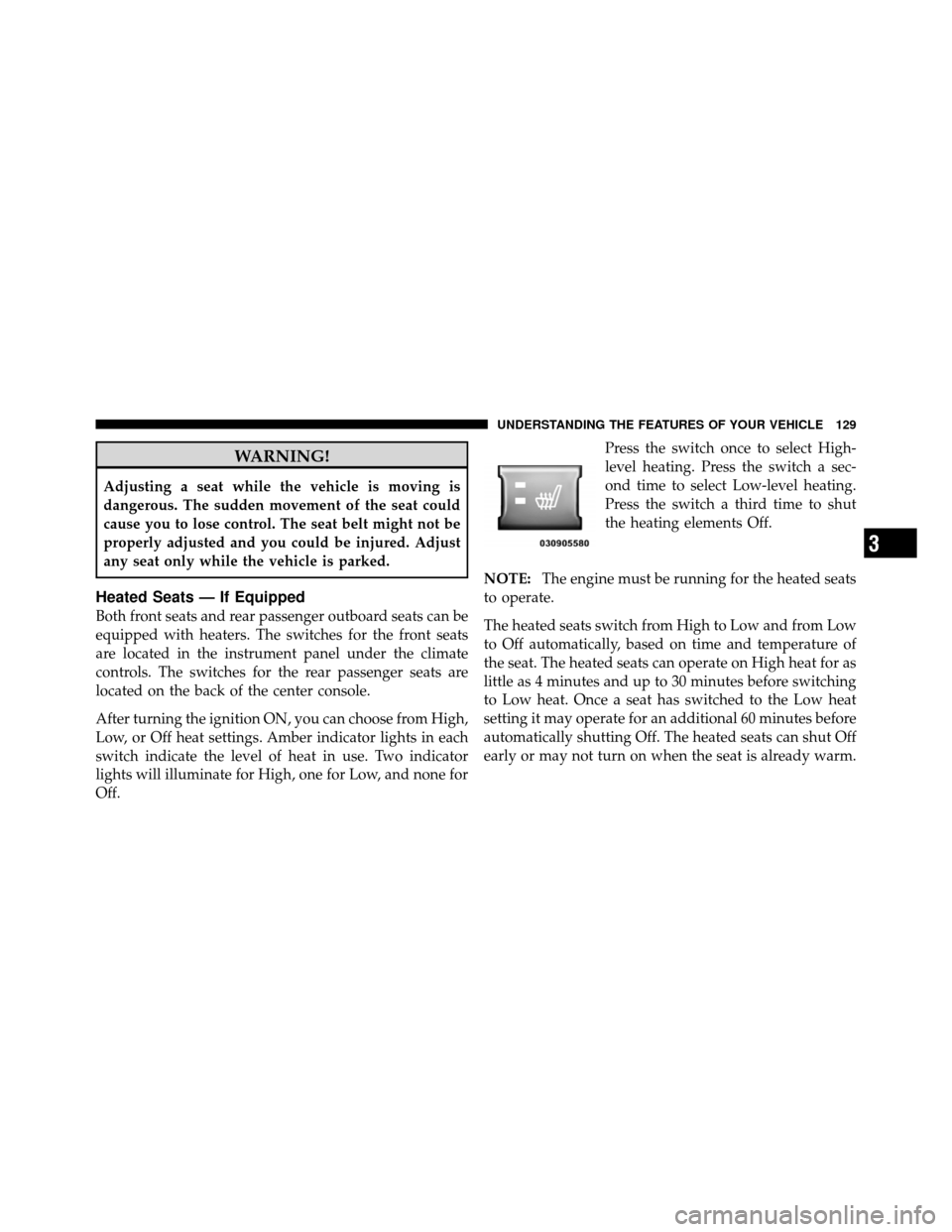
Off.Press the switch once to select High-
level heating. Press the switch a sec-
ond time to select Low-level heating.
Press the switch a third time to shut
the heating elements Off.
NOTE: The engine must be running for the heated seats
to operate.
The heated seats switch from High to Low and from Low
to Off automatically, based on time and temperature of
the seat. The heated seats can operate on High heat for as
little as 4 minutes and up to 30 minutes before switching
to Low heat. Once a seat has switched to the Low heat
setting it may operate for an additional 60 minutes before
automatically shutting Off. The heated seats can shut Off
early or may not turn on when the seat is already warm.
3
UNDERSTANDING THE FEATURES OF YOUR VEHICLE 129
Page 149 of 476
WARNING!
Do not adjust the steering column while driving.
Adjusting the steering column while driving or driv-
ing with the steering column unlocked, could cause
the driver to lose control of the vehicle. Be sure the
steering column is locked before driving your ve-
hicle. Failure to follow this warning may result in
serious injury or death.
DRIVER ADJUSTABLE PEDALS — IF EQUIPPED
The power adjustable accelerator and brake pedals allow
the driver to establish a comfortable position relative to
the steering wheel and pedals.
Adjustment
1. Position the driver’s seat so that you are at least 10 in
(25.4 cm) away from the airbag, located in the center of
the steering wheel.2. Fasten and adjust the seatbelts.
3. Move the adjustable pedal switch, located to the left
side of the steering column, in the direction you desire
the pedals to move.Adjustable Pedals Switch
148 UNDERSTANDING THE FEATURES OF YOUR VEHICLE
Page 194 of 476

28. Seat Belt Reminder LightWhen the ignition switch is first turned ON, this
light will turn on for five to eight seconds as a bulb
check. During the bulb check, if the driver’s seat
belt is unbuckled, a chime will sound. After the bulb
check or when driving, if the driver’s seat belt remains
unbuckled, the seat belt reminder light will flash or
remain on continuously. Refer to “Occupant Restraints”
in “Things To Know Before Starting Your Vehicle” for
further information.
29. Charging System Light This light shows the status of the electrical charg-
ing system. The light should come on when the
ignition switch is first turned ON and remain on briefly as a bulb check. If the light stays on or comes on while
driving, turn off some of the vehicle’s non-essential
electrical devices or increase engine speed (if at idle). If
the charging system light remains on, it means that the
vehicle is experiencing a problem with the charging
system. Obtain SERVICE IMMEDIATELY. See an autho-
rized dealer.
If jump starting is required, refer to “Jump Starting
Procedures” in “What To Do In Emergencies”.
For vehicles equipped with a premium cluster this indi-
cator will display in the Electronic Vehicle Information
Center (EVIC). Refer to ”Electronic Vehicle Information
Center (EVIC) — If Equipped” for further information.
4
UNDERSTANDING YOUR INSTRUMENT PANEL 193
Page 266 of 476

STARTING PROCEDURES
Before starting your vehicle, adjust your seat, adjust both
inside and outside mirrors, and fasten your seat belt.
The starter should not be operated for more than 15-
second intervals. Waiting a few seconds between such
intervals will protect the starter from overheating.
WARNING!
•Accidents can be caused by inadvertently moving
the shift lever or by pressing the accelerator pedal.
This may cause excessive heat in the exhaust
system, resulting in overheating and vehicle fire
which may cause serious or fatal injuries.
•Do not leave children or animals inside parked
vehicles in hot weather. Interior heat buildup may
cause serious injury or death.
Normal Starting
Normal starting of either a warm or cold engine is
obtained without pumping or pressing the accelerator
pedal. Turn the key fob to the START position and release
when the engine starts. If the engine fails to start within
10 seconds, turn the key fob to the OFF position, wait five
seconds, then repeat the “Normal Starting” procedure.
Automatic Transmission
Start the engine with the shift lever in the NEUTRAL or
PARK position. Apply the brake before shifting into any
driving range.
NOTE: This vehicle is equipped with a transmission
shift interlocking system. The brake pedal must be
pressed to shift out of PARK.5
STARTING AND OPERATING 265
Page 391 of 476

WARNING! (Continued)
•Battery posts, terminals and related accessories
contain lead and lead compounds. Wash hands
after handling.
CAUTION!
•It is essential when replacing the cables on the
battery that the positive cable is attached to the
positive post and the negative cable is attached to
the negative post. Battery posts are marked (+)
positive and (-) negative and are identified on the
battery case.
•If a “fast charger” is used while the battery is in
the vehicle, disconnect both vehicle battery cables
before connecting the charger to the battery. Do
not use a “fast charger” to provide starting voltage.
Air Conditioner Maintenance
For best possible performance, your air conditioner
should be checked and serviced by an authorized dealer
at the start of each warm season. This service should
include cleaning of the condenser fins and a performance
test. Drive belt tension should also be checked at this
time.
CAUTION!
Do not use chemical flushes in your air conditioning
system as the chemicals can damage your air condi-
tioning components. Such damage is not covered by
the New Vehicle Limited Warranty.
390 MAINTAINING YOUR VEHICLE
Page 414 of 476

Plastic is not as scratch resistant as glass and therefore
different lens cleaning procedures must be followed.
To minimize the possibility of scratching the lenses and
reducing light output, avoid wiping with a dry cloth. To
remove road dirt, wash with a mild soap solution fol-
lowed by rinsing.
Do not use abrasive cleaning components, solvents, steel
wool or other aggressive material to clean the lenses.
Glass Surfaces
All glass surfaces should be cleaned on a regular basis
with MOPAR�Glass Cleaner or any commercial
household-type glass cleaner. Never use an abrasive type
cleaner. Use caution when cleaning the inside rear win-
dow equipped with electric defrosters or the right rear
quarter window equipped with the radio antenna. Do
not use scrapers or other sharp instruments which may scratch the elements. When cleaning the rearview mirror,
spray cleaner on the towel or rag that you are using. Do
not spray cleaner directly on the mirror.
Cleaning Plastic Instrument Cluster Lenses
The lenses in front of the instruments in this vehicle are
molded in clear plastic. When cleaning the lenses, care
must be taken to avoid scratching the plastic.
1. Clean with a wet soft rag. A mild soap solution may be
used, but do not use high alcohol content or abrasive
cleaners. If soap is used, wipe clean with a clean damp
rag.
2. Dry with a soft tissue.
Seat Belt Maintenance
Do not bleach, dye or clean the belts with chemical
solvents or abrasive cleaners. This will weaken the fabric.
Sun damage can also weaken the fabric.
7
MAINTAINING YOUR VEHICLE 413

