Page 118 of 170

WARNING!
•The warning words “DO NOT OPEN HOT” on
the cooling system pressure cap are a safety pre-
caution. Never add engine coolant (antifreeze)
when the engine is overheated. Do not loosen or
remove the cap to cool an overheated engine. Heat
causes pressure to build up in the cooling system.
To prevent scalding or injury, do not remove the
pressure cap while the system is hot or under
pressure.
•Do not use a pressure cap other than the one
specified for your vehicle. Personal injury or en-
gine damage may result.
Disposal of Used Engine Coolant
Used ethylene glycol based engine coolant (antifreeze) is
a regulated substance requiring proper disposal. Check
with your local authorities to determine the disposalrules for your community. To prevent ingestion by ani-
mals or children, do not store ethylene glycol based
engine coolant (antifreeze) in open containers or allow it
to remain in puddles on the ground. If ingested by a child
or pet, seek emergency assistance immediately. Clean up
any ground spills immediately.
Coolant Level
The coolant bottle provides a quick visual method for
determining that the coolant level is adequate. With the
engine cold, the level of the engine coolant (antifreeze) in
the coolant recovery bottle should be between the ranges
indicated on the bottle.
The radiator normally remains completely full, so there is
no need to remove the radiator cap unless checking for
engine coolant (antifreeze) freeze point or replacing en-
gine coolant (antifreeze). Advise your service attendant
6
MAINTAINING YOUR VEHICLE 117
Page 120 of 170

•Keep the front of the radiator clean. If your vehicle is
equipped with air conditioning, keep the front of the
condenser clean.
•Do not change the thermostat for Summer or Winter
operation. If replacement is ever necessary, install
ONLY the correct type thermostat. Other designs may
result in unsatisfactory cooling performance, poor gas
mileage, and increased emissions.
Charge Air Cooler – Inter-Cooler
The charge air cooler is positioned between the radiator
and the air conditioner condenser. Air enters the engine
through the air cleaner and passes through the turbo-
charger, where it is pressurized. This pressurized air
rapidly reaches high temperature. The air is then directed
through a hose to the charge air cooler and through
another hose to the intake manifold of the engine. The air
entering the engine has been cooled by about 50° to 100°F
(10° to 38°C). This cooling process enables more efficient
burning of fuel resulting in fewer emissions.To guarantee optimum performance of the system, keep
the surfaces of the charge air cooler, condenser and
radiator clean and free of debris. Periodically check the
hoses leading to and from the charge air cooler for cracks
or loose clamps resulting in loss of pressure and reduced
engine performance.
Brake System
Brake Master Cylinder – Brake Fluid Level Check
The fluid level of the master cylinder should be checked
when performing under the hood service, or immedi-
ately if the “Brake System Warning Light” indicates
system failure.
The brake master cylinder has a translucent plastic
reservoir. On the outboard side of the reservoir, there is a
“MAX” mark and an “MIN” mark. The fluid level must
be kept within these two marks. Do not add fluid above
the full mark because leakage may occur at the cap.
6
MAINTAINING YOUR VEHICLE 119
Page 123 of 170

Automatic Transmission – If Equipped
Lubricant Selection
Refer to “Fluids, Lubricants, and Genuine Parts” in
“Maintaining Your Vehicle” for further information.
Fluid Level Check – 68RFE (Ram Truck Only)
If your vehicle is equipped with a dipstick, use the
following procedure. If your vehicle has a capped dip-
stick tube, it is sealed and should not be tampered with.
Your authorized dealer has the proper tools to ensure that
the fluid level is set properly. The fluid level should be
checked when the engine is fully warmed up and the
fluid in the transmission is at normal operating tempera-
ture. Operation of the transmission with an improper
fluid level will greatly reduce the life of the transmission
and of the fluid. Check the fluid level whenever the
vehicle is serviced.
To properly check the automatic transmission fluid level,
the following procedure must be used:1. Operate the engine at idle speed and normal operating
temperature.
2. The vehicle must be on level ground.
3. Fully apply the parking brake and press the brake
pedal.
4. Place the shift lever momentarily into each gear posi-
tion ending with the shift lever in PARK.
5. Remove the dipstick, wipe it clean and reinsert it until
seated.
6. Remove the dipstick again and note the fluid level on
both sides. The fluid level should be between the “HOT”
(upper) reference holes on the dipstick at normal operat-
ing temperature. Verify that solid coating of oil is seen on
both sides of the dipstick. If the fluid is low, add as
required into the dipstick tube.
Do not overfill.After
adding any quantity of oil through the oil fill tube, wait
a minimum of two minutes for the oil to fully drain into
the transmission before rechecking the fluid level.
122 MAINTAINING YOUR VEHICLE
Page 127 of 170

Required Maintenance For Noise Control Systems
The following maintenance services must be performed
every six months or 7,500 miles (12 000 km) whichever
comes first, to assure proper operation of the noise
control systems. In addition, inspection and service
should be performed anytime a malfunction is observed
or suspected. Proper maintenance of the entire vehicle
will help the effectiveness of the noise control systems.Exhaust System
Inspect the entire exhaust system for leaks and damaged
parts. Devices such as hangers, clamps, and U-bolts
should be tight and in good condition. Damaged compo-
nents, burned or blown out mufflers, burned or rusted
out exhaust pipes should be replaced according to the
procedures and specifications outlined in the appropriate
service manual.
Air Cleaner Assembly
Inspect air cleaner housing for proper assembly and fit.
Make certain that the air cleaner is properly positioned
and that the cover is tight. Check all hoses leading to the
air cleaner for tightness. The air filter element must also
be clean and serviced according to the instructions out-
lined in the Maintenance Schedule section of this manual.
Tampering With Noise Control System Prohibited
Federal law prohibits the following acts or the causing
thereof: (1) the removal or rendering inoperative by any
126 MAINTAINING YOUR VEHICLE
Page 129 of 170
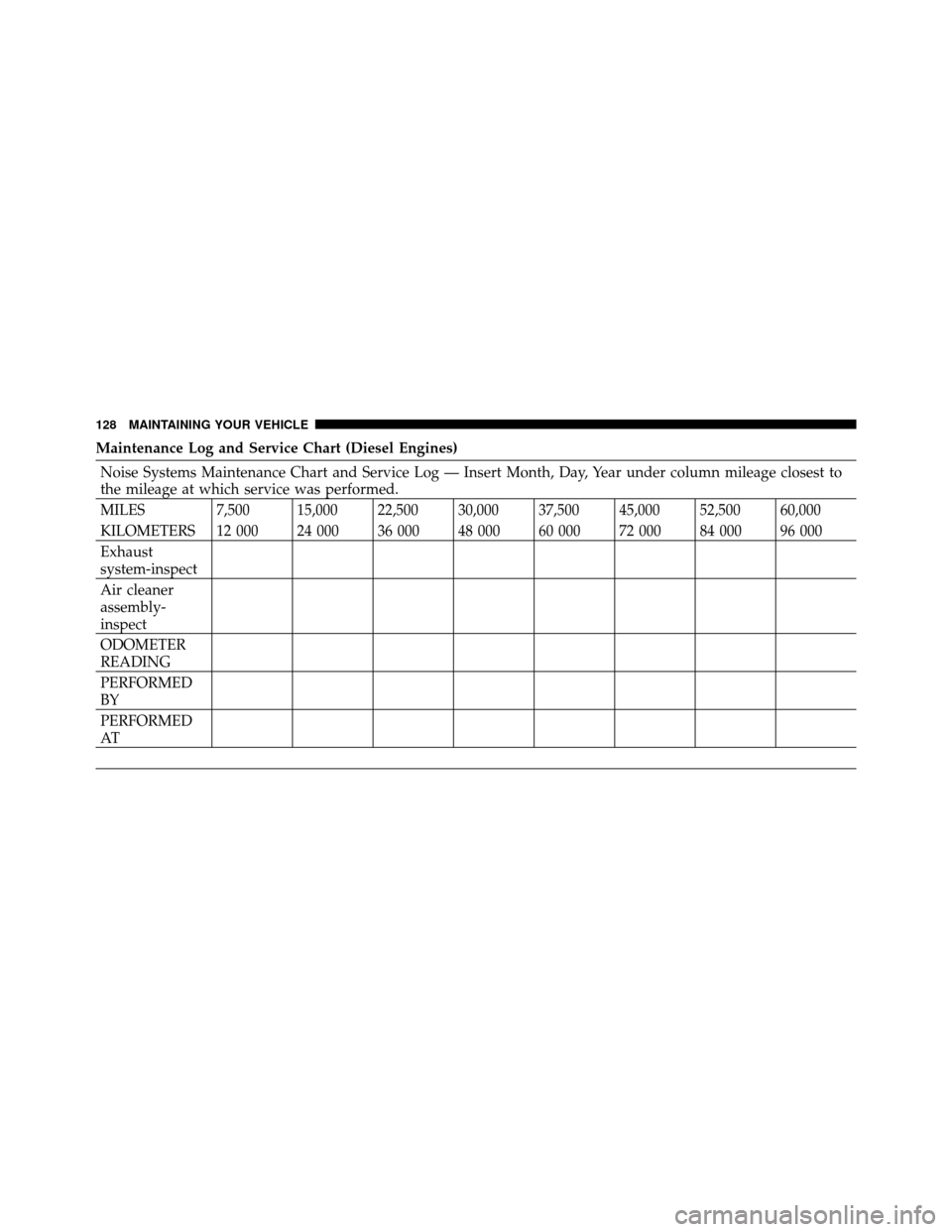
Maintenance Log and Service Chart (Diesel Engines)
Noise Systems Maintenance Chart and Service Log — Insert Month, Day, Year under column mileage closest to
the mileage at which service was performed.
MILES 7,500 15,000 22,500 30,000 37,500 45,000 52,500 60,000
KILOMETERS 12 000 24 000 36 000 48 000 60 000 72 000 84 000 96 000
Exhaust
system-inspect
Air cleaner
assembly-
inspect
ODOMETER
READING
PERFORMED
BY
PERFORMED
AT
128 MAINTAINING YOUR VEHICLE
Page 130 of 170
Noise Systems Maintenance Chart and Service Log — Insert Month, Day, Year under column mileage closest to
the mileage at which service was performed.
MILES 67,500 75,000 82,500 90,000 97,500 105,000 112,500 120,000
KILOMETERS 108 000 120 000 132 000 144 000 156 000 168 000 180 000 192 000
Exhaust
system-inspect
Air cleaner
assembly-
inspect
ODOMETER
READING
PERFORMED
BY
PERFORMED
AT
6
MAINTAINING YOUR VEHICLE 129
Page 133 of 170

ComponentFluid, Lubricant, or Genuine Part
Fuel Selection Use good quality diesel fuel from a reputable supplier in your vehicle.
Federal law requires that you must fuel this vehicle with Ultra Low Sul-
fur Highway Diesel fuel (15 ppm Sulfur maximum) and prohibits the use
of Low Sulfur Highway Diesel fuel (500 ppm Sulfur maximum) to avoid
damage to the emissions control system. For most year-round service, No.
2 diesel fuel meeting ASTM specification D-975 Grade S15 will provide
good performance. If the vehicle is exposed to extreme cold (below 20°F
or -7°C), or is required to operate at colder-than-normal conditions for
prolonged periods, use climatized No. 2 diesel fuel or dilute the No. 2
diesel fuel with 50% No. 1 diesel fuel. This will provide better protection
from fuel gelling or wax-plugging of the fuel filters. This vehicle is fully
compatible with biodiesel blends up to 5% biodiesel meeting ASTM
specification D-975.
Diesel Exhaust Fluid – Chassis Cab
Only MOPAR�
Diesel Exhaust Fluid (API Certified) (DEF) or equivalent that
has been API Certified to the ISO 22241 standard. Use of fluids not API
Certified to ISO 22241 may result in system damage.
132 MAINTAINING YOUR VEHICLE
Page 136 of 170
MAINTENANCE SCHEDULES
CONTENTS
�Maintenance Schedule .................. 136
▫ Oil Change Indicator System ............ 137▫
Perform Service Indicator .............. 138
▫ Required Maintenance Intervals .......... 138
7