2011 Ram 3500 lock
[x] Cancel search: lockPage 62 of 170

WARNING! (Continued)
•It is dangerous to move the shift lever out of PARK
or NEUTRAL if the engine speed is higher than
idle speed. If your foot is not firmly on the brake
pedal, the vehicle could accelerate quickly forward
or in reverse. You could lose control of the vehicle
and hit someone or something. Only shift into
gear when the engine is idling normally and when
your right foot is firmly on the brake pedal.
Brake/Transmission Shift Interlock System
This vehicle is equipped with a Brake Transmission Shift
Interlock System (BTSI) that holds the shift lever in the
PARK position when the ignition switch is in the LOCK
position. To move the shift lever out of the PARK
position, the ignition switch must be turned to any other
switch position (ACC, ON, or START) (engine running or
not) and the brake pedal must be pressed.
Brake/Transmission Interlock Manual Override
Column Shifter
There is an override for the BTSI that allows you to move
the shift lever out of the PARK position if an electrical
system malfunction occurs (i.e., dead battery).
1. Turn the ignition switch to the ACC or ON position
without starting the engine.
2. Tilt the steering wheel to the full up position
3. Firmly set the parking brake.
4. Press and maintain firm pressure on the brake pedal.
4
STARTING AND OPERATING 61
Page 63 of 170
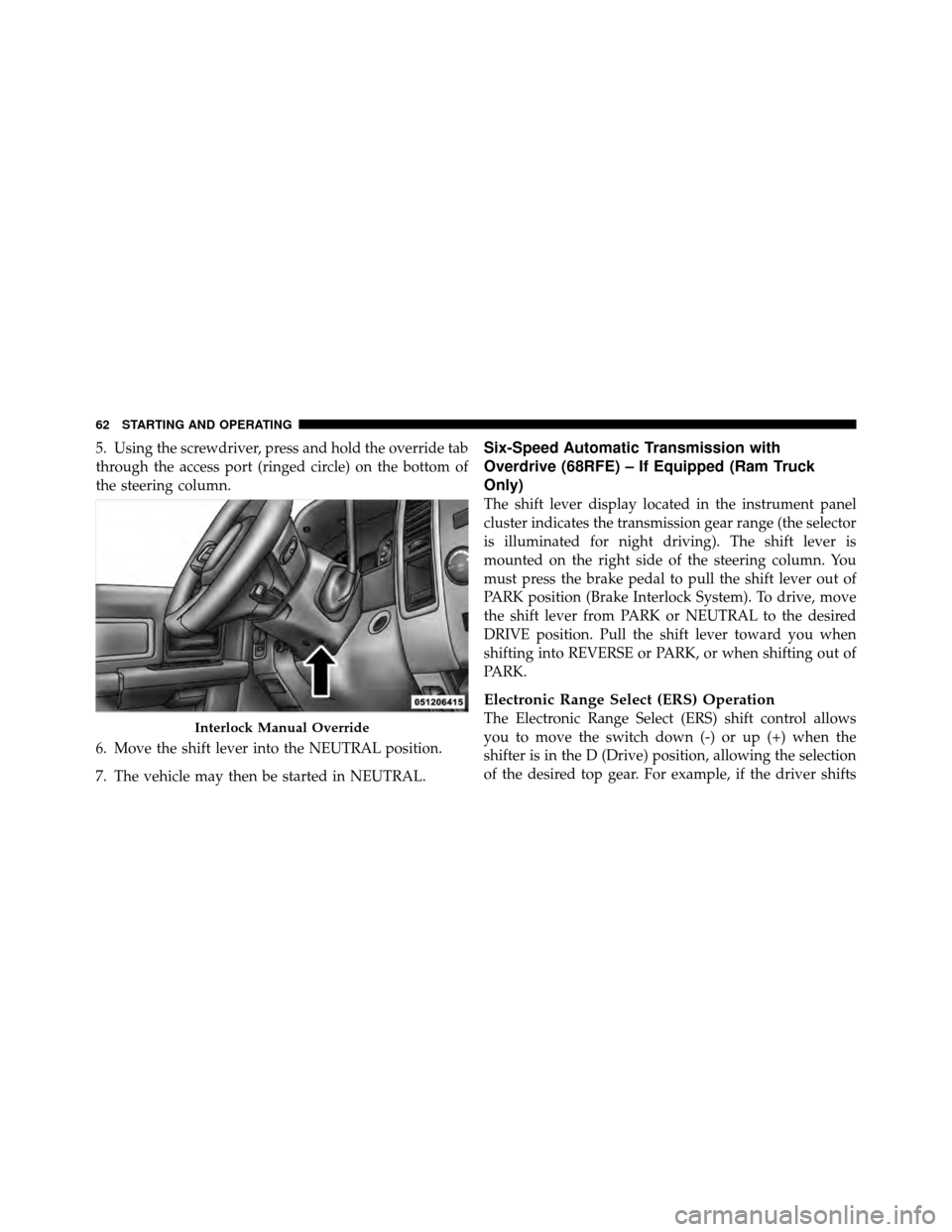
5. Using the screwdriver, press and hold the override tab
through the access port (ringed circle) on the bottom of
the steering column.
6. Move the shift lever into the NEUTRAL position.
7. The vehicle may then be started in NEUTRAL.Six-Speed Automatic Transmission with
Overdrive (68RFE) – If Equipped (Ram Truck
Only)
The shift lever display located in the instrument panel
cluster indicates the transmission gear range (the selector
is illuminated for night driving). The shift lever is
mounted on the right side of the steering column. You
must press the brake pedal to pull the shift lever out of
PARK position (Brake Interlock System). To drive, move
the shift lever from PARK or NEUTRAL to the desired
DRIVE position. Pull the shift lever toward you when
shifting into REVERSE or PARK, or when shifting out of
PARK.
Electronic Range Select (ERS) Operation
The Electronic Range Select (ERS) shift control allows
you to move the switch down (-) or up (+) when the
shifter is in the D (Drive) position, allowing the selection
of the desired top gear. For example, if the driver shiftsInterlock Manual Override
62 STARTING AND OPERATING
Page 65 of 170

Gear Ranges
DO NOT race the engine when shifting from PARK or
NEUTRAL position into another gear range.
PARK
This range supplements the parking brake by locking the
transmission. The engine can be started in this range.
Never use PARK while the vehicle is in motion. Apply
the parking brake when leaving the vehicle in this range.
Always apply the parking brake first, then place the shift
lever into the PARK position. On four-wheel drive ve-
hicles be sure that the transfer case is in a drive position.
WARNING!
•Never use the PARK position as a substitute for
the parking brake. Always apply the parking
brake fully when parked to guard against vehicle
movement and possible injury or damage.(Continued)
WARNING! (Continued)
•Your vehicle could move and injure you and others
if it is not completely in PARK. Check by trying to
move the shift lever back and forth without first
pulling it toward you after you have set it in
PARK. Make sure it is in PARK before leaving the
vehicle.
•It is dangerous to move the shift lever out of PARK
or NEUTRAL if the engine speed is higher than
idle speed. If your foot is not firmly on the brake
pedal, the vehicle could accelerate quickly forward
or in reverse. You could lose control of the vehicle
and hit someone or something. Only shift into
gear when the engine is idling normally and when
your foot is firmly on the brake pedal.
REVERSE
This range should be used only after the vehicle has come
to a complete stop.
64 STARTING AND OPERATING
Page 69 of 170

sufficiently warm, will demonstrate that the transmis-
sion is able to shift into and out of Overdrive.
•If the vehicle has not been driven in several days, the
first few seconds of operation after shifting the trans-
mission into gear may seem sluggish. This is due to the
fluid partially draining from the torque converter into
the transmission. This condition is normal and will not
cause damage to the transmission. The torque con-
verter will refill within five seconds of shifting from
PARK into any other gear position.
Automatic Transmission with Overdrive (AS68RC)
– If Equipped (Chassis Cab Only)
The shift lever display located in the instrument panel
cluster, indicates the transmission gear range (the selector
is illuminated for night driving). The shift lever is
mounted on the right side of the steering column. You
must press the brake pedal to pull the shift lever out of
PARK position (Brake Interlock System). To drive, movethe shift lever from PARK or NEUTRAL to the desired
DRIVE position. Pull the shift lever toward you when
shifting into REVERSE or PARK.
Electronic Range Select (ERS) Operation
The Electronic Range Select (ERS) shift control allows
you to move the switch down (-) or up (+) when the
shifter is in the D (Drive) position, allowing the selection
of the desired top gear. For example, if the driver shifts
the transmission into third gear, the transmission will
never shift above third gear, but can shift down into
second or first gear, when needed.
68 STARTING AND OPERATING
Page 71 of 170

PARK
This range supplements the parking brake by locking the
transmission. The engine can be started in this range.
Never use PARK while the vehicle is in motion. Apply
the parking brake when leaving the vehicle in this range.
Always apply parking brake first, then place the shift
lever in PARK position. On four-wheel drive vehicles be
sure that the transfer case is in a drive position.
WARNING!
•Never use the PARK position as a substitute for
the parking brake. Always apply the parking
brake fully when parked to guard against vehicle
movement and possible injury or damage.(Continued)
WARNING! (Continued)
•Your vehicle could move and injure you and others
if it is not completely in PARK. Check by trying to
move the shift lever back and forth without first
pulling it toward you after you have set it in
PARK. Make sure it is in PARK before leaving the
vehicle.
•It is dangerous to move the shift lever out of PARK
or NEUTRAL if the engine speed is higher than
idle speed. If your foot is not firmly on the brake
pedal, the vehicle could accelerate quickly forward
or in reverse. You could lose control of the vehicle
and hit someone or something. Only shift into
gear when the engine is idling normally and when
your right foot is firmly on the brake pedal.
70 STARTING AND OPERATING
Page 76 of 170

Shifting
Truck models with manual transmission are equipped
with a clutch interlocking ignition system. The clutch
pedal must be fully pressed to start the vehicle.Fully press the clutch pedal before shifting gears. As you
release the clutch pedal, lightly press the accelerator
pedal.
This transmission has a “creeper” first gear (L=Low)
which should be used to start from a standing position
when carrying a payload or towing a trailer. Damage to
the clutch can result from starting in second or third gear
with a loaded vehicle. An unloaded vehicle may be
launched in second gear. Use each gear in numerical
order – do not skip a gear.
You should use first gear when starting from a standing
position if under heavy load or when pulling a trailer.Recommended Vehicle Shift Speeds
To utilize your manual transmission efficiently for both
fuel economy and performance, it should be upshifted as
listed in recommended shift speed chart. Shift at the
Shift Pattern
4
STARTING AND OPERATING 75
Page 80 of 170

The customer has the choice to operate the PTO by
utilizing the cruise control switches or by utilizing a
remote control (provided by the PTO supplier). To oper-
ate the feature using the cruise control switches, the
customer must first activate the upfitter-provided on/off
switch which will turn on the PTO. In order to increase or
decrease the engine idle speed, to optimize the PTO
function, the “RESUME/ACCEL” and “DECEL” cruise
switches can be used respectively. To disengage PTO
operation and return to “standard vehicle operation”
simply turn the upfitter-provided on/off switch to the
OFF position.
The torque converter lockup clutch will automatically
engage at engine speeds above 1,200 RPM (engine speed)
in PTO stationary mode. Once engaged, the lockup clutch
will remain on and not disengage until the engine speed
is below 1,000 RPM. Lockup clutch engagement is desir-
able for certain types of PTO applications (AS68RC
Six-Speed Automatic Transmission Only).To operate the PTO via a remote switch, the customer
must make sure the above conditions are met. It is vital
for proper operation that the PTO and remote have been
installed correctly, paying special attention to ensure the
vehicle provided wiring has been connected properly.
This is the responsibility of the installer of the PTO and
switches/remote system. It is the responsibility of the
PTO manufacturer to ensure that their electrical (switches
and remote) system is compatible with the vehicle’s
electrical architecture and software functionality.
Mobile Mode
To operate the PTO in this mode the vehicle must meet
the following conditions:
•Authorized dealer-selected “mobile” mode activated
via authorized dealer proprietary service tool
•Upfitter-provided (on/off) switch has been activated
4
STARTING AND OPERATING 79
Page 93 of 170

2. Connect one end of the other jumper cable to negative
(-) post of booster battery. Connect the other end of the
jumper cable to a good ground on the engine block of the
vehicle with the discharged battery. Make sure a good
connection is made, free of dirt and grease.
WARNING!
•Do not connect the cable to the negative post of the
discharge battery. The resulting electrical spark
could cause the battery to explode.
•During cold weather when temperatures are be-
low freezing point, electrolyte in a discharged
battery may freeze. Do not attempt jump starting
because the battery could rupture or explode. The
battery temperature must be brought up above
freezing point before attempting to jump start.3. Take care that the clamps from one cable do not
inadvertently touch clamps from the other cable. Do not
lean over the battery when making connection. The
negative connection must provide good electrical con-
ductivity and current carrying capacity.
4. After the engine is started or if the engine fails to start,
cables must be disconnected in the following order:
a. Disconnect the negative cable at the engine ground.
b. Disconnect the negative cable at the negative post
on booster battery.
c. Disconnect the cable from the positive post of both
batteries.
92 WHAT TO DO IN EMERGENCIES