Page 506 of 622

8. Disconnect the opposite end of the positive(+)jumper
cable from the positive(+)post of the booster battery.
9. Disconnect the positive(+)end of the jumper cable
from the positive(+)post of the discharged vehicle.
If frequent jump-starting is required to start your vehicle
you should have the battery and charging system in-
spected at your authorized dealer.
CAUTION!
Accessories that can be plugged into the vehicle
power outlets draw power from the vehicle’s battery,
even when not in use (i.e., cellular phones, etc.).
Eventually, if plugged in long enough, the vehicle’s
battery will discharge sufficiently to degrade battery
life and/or prevent the engine from starting.
FREEING A STUCK VEHICLE
If the vehicle becomes stuck in snow, sand or mud, it can
often be moved by a rocking motion. Move the shift lever
rhythmically between DRIVE and REVERSE while ap-
plying slight pressure to the accelerator. In general, the
least amount of accelerator pedal pressure to maintain
the rocking motion without spinning the wheels or racing
the engine is most effective.
CAUTION!
Racing the engine or spinning the wheels may lead to
transmission overheating and failure. Allow the en-
gine to idle with the shift lever in NEUTRAL for at
least one minute after every five rocking-motion
cycles. This will minimize overheating and reduce
the risk of transmission failure during prolonged
efforts to free a stuck vehicle.6
WHAT TO DO IN EMERGENCIES 505
Page 507 of 622
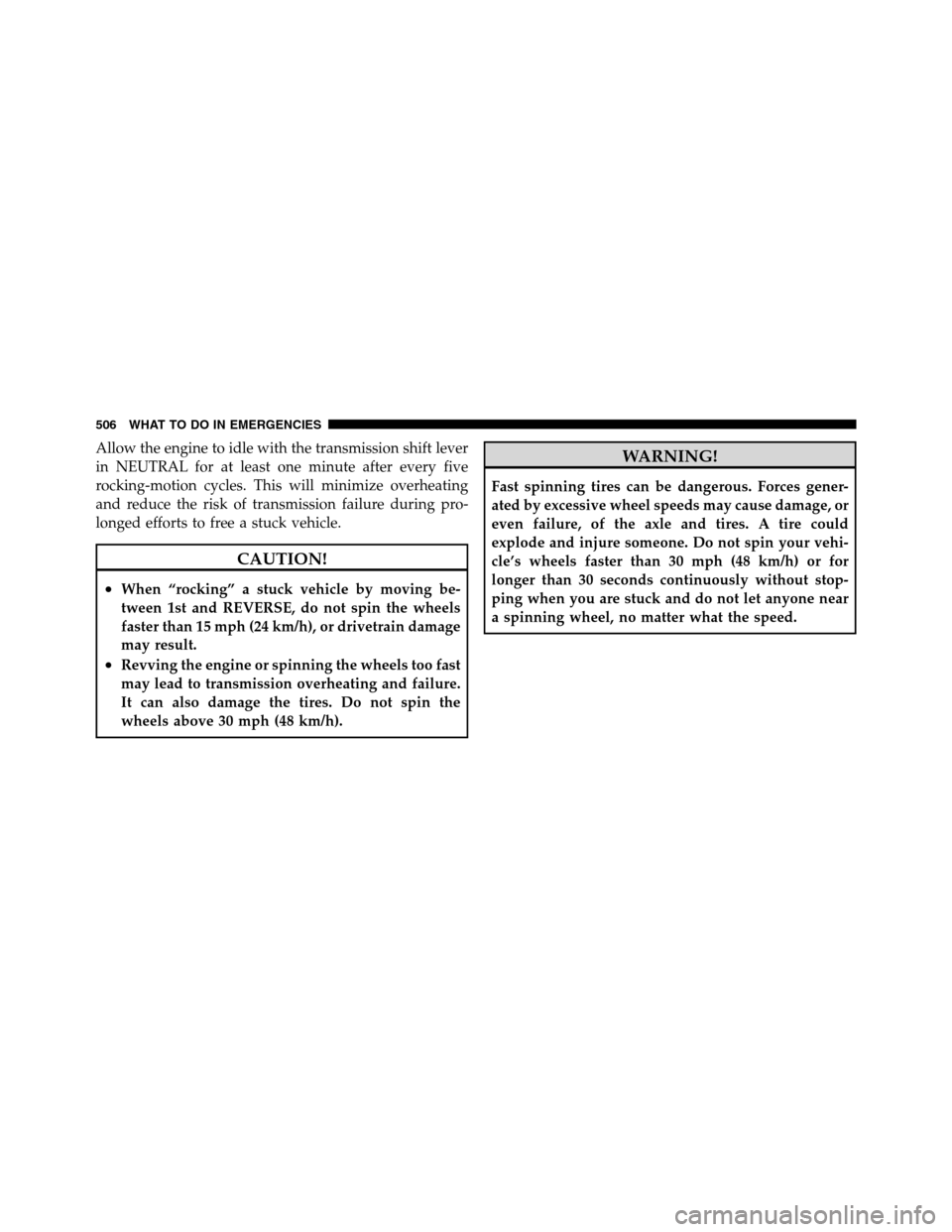
Allow the engine to idle with the transmission shift lever
in NEUTRAL for at least one minute after every five
rocking-motion cycles. This will minimize overheating
and reduce the risk of transmission failure during pro-
longed efforts to free a stuck vehicle.
CAUTION!
•When “rocking” a stuck vehicle by moving be-
tween 1st and REVERSE, do not spin the wheels
faster than 15 mph (24 km/h), or drivetrain damage
may result.
•Revving the engine or spinning the wheels too fast
may lead to transmission overheating and failure.
It can also damage the tires. Do not spin the
wheels above 30 mph (48 km/h).
WARNING!
Fast spinning tires can be dangerous. Forces gener-
ated by excessive wheel speeds may cause damage, or
even failure, of the axle and tires. A tire could
explode and injure someone. Do not spin your vehi-
cle’s wheels faster than 30 mph (48 km/h) or for
longer than 30 seconds continuously without stop-
ping when you are stuck and do not let anyone near
a spinning wheel, no matter what the speed.
506 WHAT TO DO IN EMERGENCIES
Page 509 of 622
TOWING A DISABLED VEHICLE
This section describes procedures for towing a disabled vehicle using a commercial wrecker service. If the
transmission and drivetrain are operable, disabled vehicles may also be towed as described under “Recreational
Towing” in the “Starting and Operating” section.
Towing ConditionWheels OFF
the Ground2WD Models 4WD Models
Flat Tow NONEIf transmission is operable:
•Trans inNEUTRAL
•30 mphmax(48 km/h)
•15 miles (24 km)maxdistanceSee instructions in “Recreational Tow-
ing” under “Starting and Operating”
•Auto Trans inPARK
•Manual Trans in gear (NOTNeutral
•T/case inNEUTRAL
•To w i nforwarddirection
Wheel Lift or Dolly
To wFrontNOT ALLOWED
Rear OKNOT ALLOWED
FlatbedALL BEST METHOD BEST METHOD
508 WHAT TO DO IN EMERGENCIES
Page 511 of 622

Two-Wheel Drive Models
The manufacturer recommends towing your vehicle with
all four wheelsOFFthe ground using a flatbed.
If flatbed equipment is not available, and the transmis-
sion is operable, the vehicle may be towed (with rear
wheels on the ground) with the transmission inNEU-
TRAL. Speed must not exceed 30 mph (48 km/h) and the
distance must not exceed 15 miles (24 km).
CAUTION!
Towing faster than 30 mph (48 km/h) or farther than
15 miles (24 km) with rear wheels on the ground can
cause severe damage to the transmission. Such dam-
age is not covered by the New Vehicle Limited
Warranty.
If the transmission is not operable, or the vehicle must be
towed faster than 30 mph (48 km/h) or farther than15 miles (24 km), tow with the rear wheelsOFFthe
ground. Acceptable methods are to tow the vehicle on a
flatbed, or with the rear wheels raised using a wheel lift
or towing dolly.
Four-Wheel Drive Vehicles
The manufacturer recommends towing with all wheels
OFFthe ground. Acceptable methods are to tow the
vehicle on a flatbed or with one end of vehicle raised and
the opposite end on a towing dolly.
If flatbed equipment is not available, and the transfer
case is operable, the vehicle may be towed (in the
forward direction, withALLwheels on the ground),IF
the transfer case is in NEUTRAL and the transmission is
inPARK(for automatic transmissions) or in gear (NOT
in Neutral, for manual transmissions). Refer to “Recre-
ational Towing” in “Starting and Operating” for further
information.
510 WHAT TO DO IN EMERGENCIES
Page 514 of 622
MAINTAINING YOUR VEHICLE
CONTENTS
�Engine Compartment — 3.7L............. 516
�Engine Compartment — 4.7L............. 517
�Engine Compartment — 5.7L............. 518
�Onboard Diagnostic System (OBD II)....... 519
▫Loose Fuel Filler Cap Message........... 519
�Emissions Inspection And Maintenance
Programs............................ 520
�Replacement Parts..................... 521
�Dealer Service........................ 522�Maintenance Procedures................. 522
▫Engine Oil......................... 523
▫Engine Oil Filter..................... 525
▫Engine Air Cleaner Filter............... 526
▫Maintenance-Free Battery.............. 526
▫Air Conditioner Maintenance............ 528
▫Front Driveshaft Lubrication – 2500/3500
(Four-Wheel Drive) Models (Ram Trucks
Only)............................. 529
7
Page 530 of 622

Refrigerant Recovery and Recycling
R-134a Air Conditioning Refrigerant is a hydrofluoro-
carbon (HFC) that is endorsed by the Environmental
Protection Agency (EPA) and is an ozone-saving product.
However, the manufacturer recommends that air condi-
tioning service be performed by authorized dealers or
other service facilities using recovery and recycling
equipment.
Front Driveshaft Lubrication – 2500/3500
(Four-Wheel Drive) Models (Ram Trucks Only)
Lubricate the front driveshaft grease fitting at each oil
change. Refer to “Maintenance Schedule” for further
information. Use MOPAR�Type MS-6560 (lithium-based
grease), or equivalent.
Body Lubrication
Locks and all body pivot points, including such items as
seat tracks, door hinge pivot points and rollers, liftgate,tailgate, sliding doors and hood hinges, should be lubri-
cated periodically with a lithium based grease, such as
MOPAR�Spray White Lube or equivalent, to assure
quiet, easy operation and to protect against rust and
wear. Prior to the application of any lubricant, the parts
concerned should be wiped clean to remove dust and
grit. After lubricating, excess oil and grease should be
removed. Particular attention should also be given to
hood latching components to ensure proper function.
When performing other underhood services, the hood
latch, release mechanism and safety catch should be
cleaned and lubricated.
The external lock cylinders should be lubricated twice a
year, preferably in the Fall and Spring. Apply a small
amount of a high quality lubricant, such as MOPAR�
Lock Cylinder Lubricant or equivalent directly into the
lock cylinder.
7
MAINTAINING YOUR VEHICLE 529
Page 573 of 622
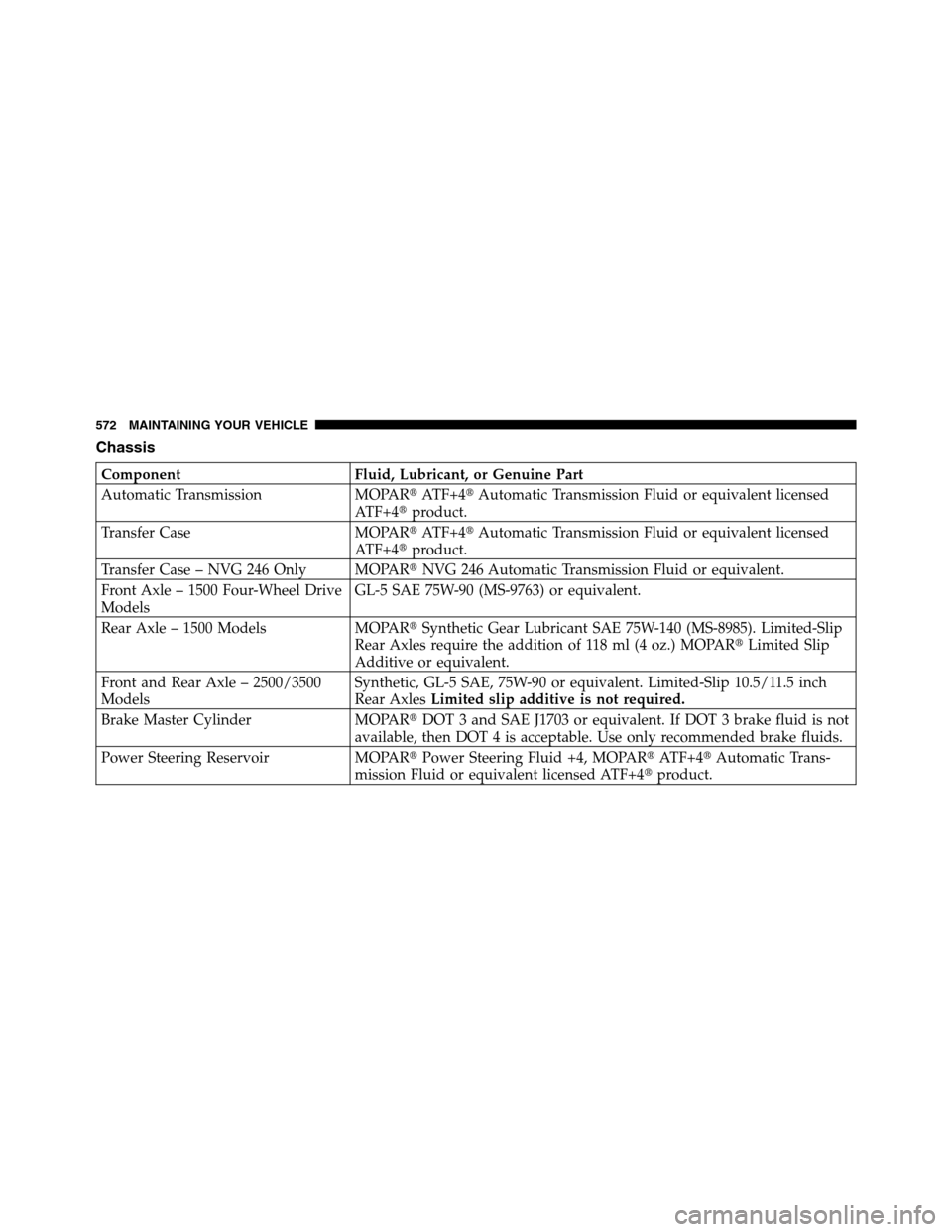
Chassis
Component Fluid, Lubricant, or Genuine Part
Automatic Transmission MOPAR�ATF+4�Automatic Transmission Fluid or equivalent licensed
ATF+4�product.
Transfer Case MOPAR�ATF+4�Automatic Transmission Fluid or equivalent licensed
ATF+4�product.
Transfer Case – NVG 246 Only MOPAR�NVG 246 Automatic Transmission Fluid or equivalent.
Front Axle – 1500 Four-Wheel Drive
ModelsGL-5 SAE 75W-90 (MS-9763) or equivalent.
Rear Axle – 1500 Models MOPAR�Synthetic Gear Lubricant SAE 75W-140 (MS-8985). Limited-Slip
Rear Axles require the addition of 118 ml (4 oz.) MOPAR�Limited Slip
Additive or equivalent.
Front and Rear Axle – 2500/3500
ModelsSynthetic, GL-5 SAE, 75W-90 or equivalent. Limited-Slip 10.5/11.5 inch
Rear AxlesLimited slip additive is not required.
Brake Master Cylinder MOPAR�DOT 3 and SAE J1703 or equivalent. If DOT 3 brake fluid is not
available, then DOT 4 is acceptable. Use only recommended brake fluids.
Power Steering Reservoir MOPAR�Power Steering Fluid +4, MOPAR�ATF+4�Automatic Trans-
mission Fluid or equivalent licensed ATF+4�product.
572 MAINTAINING YOUR VEHICLE
Page 579 of 622

24,000 Miles (39,000 km) or
18 Months Maintenance
Service Schedule
❏Change the engine oil and engine oil
filter.
❏Rotate the tires, rotate at the first sign of
irregular wear, even if it occurs before
24,000 miles (39 000 km).
❏Lube the front drive shaft fitting
(2500/3500 (4x4) models only).
❏Inspect the CV joints.
❏Inspect exhaust system.
❏Inspect the front and rear axle fluid,
change if using your vehicle for police,
taxi, fleet, off-road or frequent trailer
towing.
Odometer Reading Date
Repair Order # Dealer Code
Signature Authorized Chrysler Dealer
32,000 Miles (52,000 km) or 24 Months Maintenance Service
Schedule
❏Change the engine oil and engine oil filter.
❏Rotate the tires, rotate at the first sign of irregular wear, even if it occurs before
32,000 miles (52 000 km).
❏Replace the engine air cleaner filter.
❏Replace the spark plugs (3.7L and 5.7L Engines).
❏Lube the front drive shaft fitting (2500/3500 (4x4) models only).
❏Adjust parking brake on vehicles equipped with four-wheel disc brakes.
❏Inspect the transfer case fluid.
❏Inspect the brake linings, replace if necessary.
❏Inspect the front suspension, tie rod ends and boot seals for cracks or leaks and all parts for
damage, wear, improper looseness or end play; replace if necessary.
Odometer Reading Date
Repair Order # Dealer Code
Signature Authorized Chrysler Dealer
8
M
A
I
N
T
E
N
A
N
C
E
S
C
H
E
D
U
L
E
S578 MAINTENANCE SCHEDULES

