Page 296 of 636

Recirculation Control
Press this button to choose between
outside air intake or recirculation of
the air inside the vehicle. A LED will
illuminate when you are in Recircula-
tion mode. Only use the Recirculation
mode to temporarily block out any
outside odors, smoke, or dust, and to
cool the interior rapidly upon initial start-up in very hot
or humid weather.
NOTE:
•If the RECIRCULATION button is pressed when the
system is in Mix or Defrost mode the Recirculation
LED indicator will flash three times and then turn off
to indicate Recirculation mode is not allowed.
•Continuous use of the Recirculation mode may make
the inside air stuffy and window fogging may occur.
Extended use of this mode is not recommended.
•In cold or damp weather, the use of the Recirculation
mode will cause windows to fog on the inside because
of moisture buildup inside the vehicle. For maximum
defogging, select the outside air position.
•The A/C can be deselected manually without disturb-
ing the mode control selection by pressing the A/C
button.
Air Outlets
The airflow from each of the instrument panel outlets can
be adjusted for direction, and turned on or off to control
airflow.
NOTE: For maximum airflow to the rear, the center
instrument panel outlets can be directed toward the rear
seat passengers.
294 UNDERSTANDING YOUR INSTRUMENT PANEL
Page 297 of 636
Economy Mode
If ECONOMY mode is desired, press the A/C button to
turn off the LED indicator and the A/C compressor.
Rotate the temperature control knob to the desired
temperature.
Air Conditioning Operation
Push this button to engage the Air
Conditioning (A/C). A LED will illu-
minate when the A/C system is
engaged.
MAX A/C
For maximum cooling, when MAX
A/C is selected the A/C is turned on
automatically and the air is recircu-
lated.
NOTE: A/C cannot be deselected when in MAX A/C
position. The LED will blink three times if the A/C
button is pushed.
Automatic Temperature Control (ATC) — If
Equipped
•
The Automatic Temperature Control (ATC) allows
both driver and front passenger seat occupants to
select individual comfort settings.
4
UNDERSTANDING YOUR INSTRUMENT PANEL 295
Page 311 of 636

STARTING PROCEDURES
Before starting your vehicle, adjust your seat, adjust both
inside and outside mirrors, and fasten your seat belt.
The starter should not be operated for more than 15-
second intervals. Waiting a few seconds between such
intervals will protect the starter from overheating.
WARNING!
Never leave children alone in a vehicle. Leaving
unattended children in a vehicle is dangerous for a
number of reasons. A child or others could be seri-
ously or fatally injured. Do not leave the key fob in
the ignition. A child could operate power windows,
other controls, or move the vehicle.
Normal Starting
Normal starting of either a warm or cold engine is
obtained without pumping or pressing the acceleratorpedal. Turn the key fob to the START position and release
when the engine starts. If the engine fails to start within
10 seconds, turn the key fob to the OFF position, wait five
seconds, then repeat the “Normal Starting” procedure.
Automatic Transmission
Start the engine with the shift lever in the NEUTRAL or
PARK position. Apply the brake before shifting into any
driving range.
NOTE: This vehicle is equipped with a transmission
shift interlocking system. The brake pedal must be
pressed to shift out of PARK.
Tip Start Feature
Do not
press the accelerator. Turn the ignition switch
briefly to the START position and release it. The starter
motor will continue to run but will automatically disen-
gage when the engine is running.
5
STARTING AND OPERATING 309
Page 351 of 636

your vehicle’s steering, handling and traction. Control-
ling your vehicle is one of the keys to successful off-road
driving, so always keep a firm grip on the steering wheel
and maintain a good driving posture. Avoid sudden
accelerations, turns or braking. In most cases there are no
road signs, posted speed limits or signal lights. Therefore
you will need to use your own good judgment on what is
safe and what isn’t. When on a trail you should always be
looking ahead for surface obstacles and changes in
terrain. The key is to plan your future driving route while
remembering what you are currently driving over.
CAUTION!
Never park your vehicle over dry grass or other
combustible materials. The heat from your vehicle
exhaust system could cause a fire.
WARNING!
Always wear your seat belt and firmly tie down
cargo. Unsecured cargo can become projectiles in an
off-road situation.
When To Use Low Range
When driving off-road, shift into 4L (Low Range) for
additional traction or to improve handling and control on
slippery or difficult terrain. Due to the lower gearing, low
range will allow the engine to operate in a higher power
range. This will allow you to idle over obstacles and
down hills, with improved control and less effort. Also,
use 4L (Low Range) in rain, ice, snow, mud, sand, to get
heavy loads rolling, improve traction, or whenever 4H
(High Range) traction will not do the job.
5
STARTING AND OPERATING 349
Page 361 of 636

downstream out of control if the water is deep enough
to push on the large surface area of the vehicle’s body.
Before you proceed determine the speed of the current,
the water’s depth, approach angle, bottom condition
and if there are any obstacles, then cross at an angle
heading slightly upstream using the low and slow
technique.
WARNING!
Never drive through fast moving deep water. It can
push your vehicle downstream, sweeping it out of
control. This could put you and your passengers at
risk of injury or drowning.
Airing Down For Off-Road Driving
Running lower tire pressure off-road can improve your
ride comfort and vehicle traction. Reducing the tire air
pressure allows the tire to bulge slightly, improving its
surface area for better flotation and ability to mold orform to the ground contour. Different terrain, tires, and
vehicles require different tire pressure. Hard surfaces like
rock and heavier vehicles require higher pressures than
softer surfaces such as sand and lighter vehicles. You will
need to experiment to determine what is right for your
situation. It is easier and faster to let air out than it is to
replace it so, start high and lower it as required. Remem-
ber you must return the tires to normal air pressure
before driving on road or at highway conditions. Be sure
you have a way to return the tires to their normal on road
air pressure.
CAUTION!
Reduced tire pressure increases the risk of tire dam-
age and may cause tire unseating with total loss of air
pressure. To reduce the risk of tire unseating, while at
a reduced tire pressure, drive at slower speeds and
avoid sharp turns or abrupt maneuvers.
5
STARTING AND OPERATING 359
Page 567 of 636
Cavity CartridgeFuseMini
Fuse Description
J03 30 Amp Pink Diesel Powertrain
Control Module – If
Equipped
J04 25 Amp Natural Driver Door Node
J05 25 Amp Natural Passenger Door
Node
J06 40 Amp Green Antilock Brakes
Pump/Stability
Control System
J07 30 Amp Pink Antilock Brakes
Valve/Stability
Control System
J08 40 Amp Green Power Seat
J11 30 Amp Pink Drivetrain Control
ModuleCavity Cartridge
FuseMini
Fuse Description
J13 60 Amp Yellow Main Ignition Off
Draw (IOD) Fuse
J14 20 Amp Blue Trailer Tow
Lamps/Park Lamps
J15 30 Amp Pink Rear Defroster
J17 40 Amp Green Starter Motor Sole-
noid
J18 20 Amp Blue Powertrain Control
Module Transmis-
sion Range
J19 60 Amp Yellow Rad Fan Motor HI/
Rad Fan Motor
Low
J20 30 Amp Pink Front Wiper
Ground/Low/High
7
MAINTAINING YOUR VEHICLE 565
Page 568 of 636
Cavity CartridgeFuseMini
Fuse Description
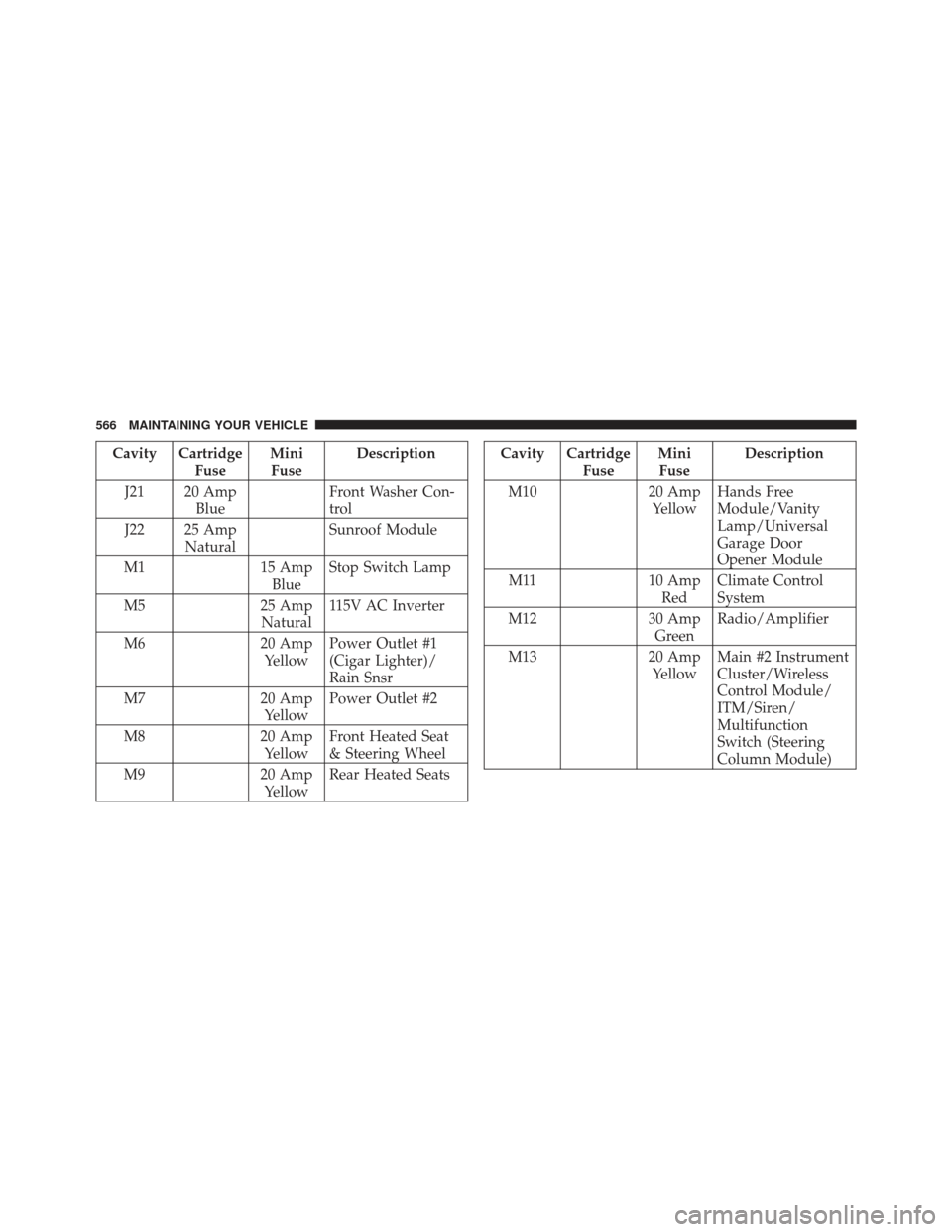
J21 20 Amp Blue Front Washer Con-
trol
J22 25 Amp Natural Sunroof Module
M1 15 Amp
Blue Stop Switch Lamp
M5 25 Amp
Natural 115V AC Inverter
M6 20 Amp
Yellow Power Outlet #1
(Cigar Lighter)/
Rain Snsr
M7 20 Amp
Yellow Power Outlet #2
M8 20 Amp
Yellow Front Heated Seat
& Steering Wheel
M9 20 Amp
Yellow Rear Heated SeatsCavity Cartridge
FuseMini
Fuse Description
M10 20 Amp
Yellow Hands Free
Module/Vanity
Lamp/Universal
Garage Door
Opener Module
M11 10 Amp
Red Climate Control
System
M12 30 Amp
Green Radio/Amplifier
M13 20 Amp
Yellow Main #2 Instrument
Cluster/Wireless
Control Module/
ITM/Siren/
Multifunction
Switch (Steering
Column Module)
566 MAINTAINING YOUR VEHICLE
Page 569 of 636
Cavity CartridgeFuseMini
Fuse Description
M14 20 Amp
Yellow Back Up Camera
(Domestic Only)
M15 20 Amp
Yellow Power Seat
Module(s)/Audio
Telematics/Daytime
Running Lights
Relay/Instrument
Cluster/Transfer
Case Module
M16 10 Amp
Red Airbag Module
M19 25 Amp
Natural Automatic Shut-
down 1 and 2
M20 15 Amp
Blue Instrument Cluster
Interior Lighting
/Sw Steering
Wheel/Sw BankCavity Cartridge
FuseMini
Fuse Description
M21 20 Amp
Yellow Automatic Shut-
down 3
M22 10 Amp
Red Horns (Low/High)
– Right
M23 10 Amp
Red Horns (Low/High)
– Left
M25 20 Amp
Yellow Fuel Pump Motor/
Diesel Lift Pump –
If Equipped
M26 10 Amp
Red Spare
M27 10 Amp
Red Ignition Switch
M28 15 Amp
Blue Powertrain Control
Module
M29 10 Amp
Red Tire Pressure Moni-
tor
7
MAINTAINING YOUR VEHICLE 567