2011 Peugeot Partner Tepee remove
[x] Cancel search: removePage 94 of 232
92
Practical information
Automatic switching on/off
The front courtesy light comes on
when the key is removed from the
ignition, when the vehicle is unlocked,
when one of the front doors is opened
and for location of the vehicle using the
remote control.
It switches off gradually after the
ignition is switched on and when the
vehicle is locked. Front seats: comes on when
one of the front doors is
opened. These are switched on and off by
means of a manual switch, with
the ignition on.
Rear seats: comes on when
one of the rear doors is
opened.
If the doors remain open for
a few minutes, the courtesy
lights are switched off.
Permanently off. Permanently on, ignition on.
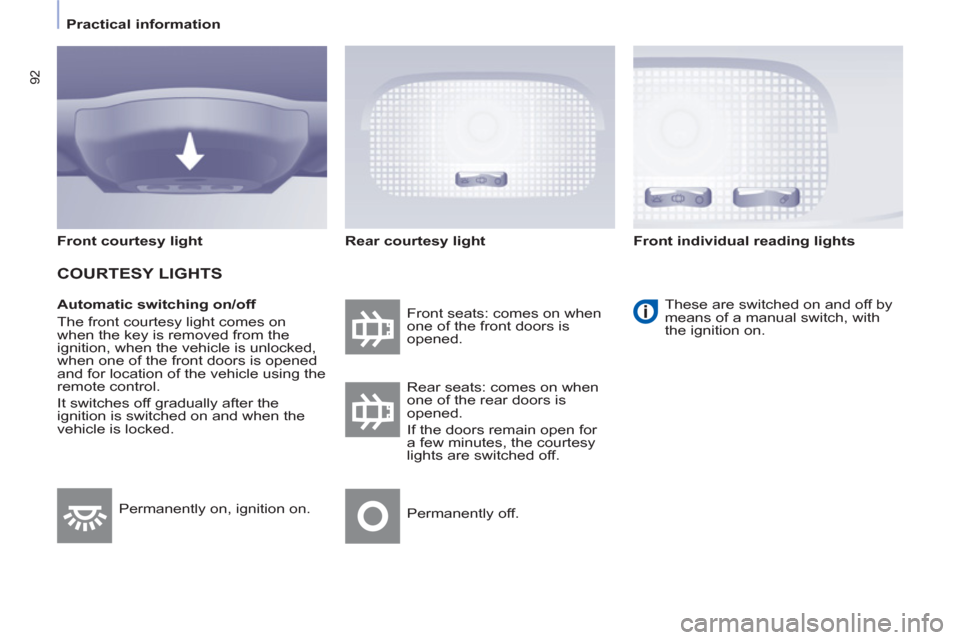
Front courtesy light
COURTESY LIGHTS
Rear courtesy light
Front individual reading lights
Page 95 of 232
93
EASE OF USE
andCOMFOR
T
3
Practical information
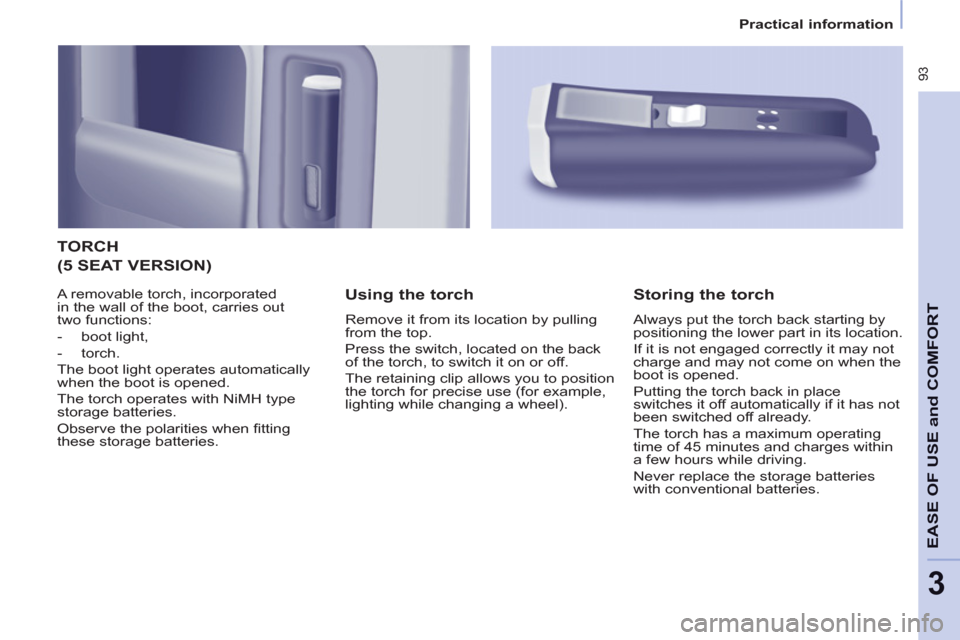
TORCH
Using the torch
Remove it from its location by pulling
from the top.
Press the switch, located on the back
of the torch, to switch it on or off.
The retaining clip allows you to position
the torch for precise use (for example,
lighting while changing a wheel).
Storing the torch
Always put the torch back starting by
positioning the lower part in its location.
If it is not engaged correctly it may not
charge and may not come on when the
boot is opened.
Putting the torch back in place
switches it off automatically if it has not
been switched off already.
The torch has a maximum operating
time of 45 minutes and charges within
a few hours while driving.
Never replace the storage batteries
with conventional batteries.
(5 SEAT VERSION)
A removable torch, incorporated
in the wall of the boot, carries out
two functions:
- boot light,
- torch.
The boot light operates automatically
when the boot is opened.
The torch operates with NiMH type
storage batteries.
Observe the polarities when fi tting
these storage batteries.
Page 96 of 232
94
Practical information
LOAD SPACE COVER (5 SEAT VERSION)
This rigid shelf conceals the objects
stored in the boot.
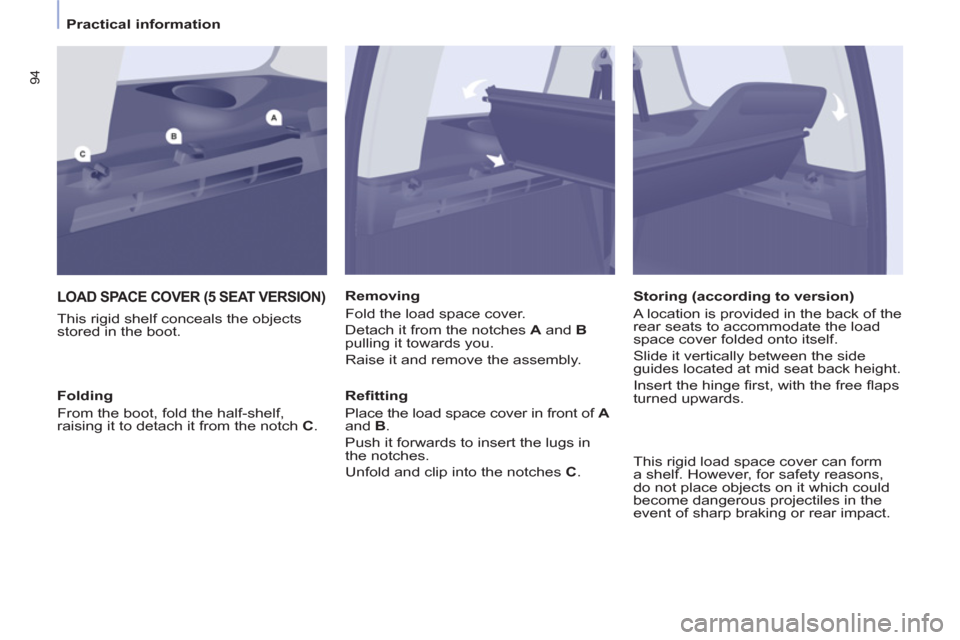
Removing
Fold the load space cover.
Detach it from the notches A and B
pulling it towards you.
Raise it and remove the assembly.
Refi tting
Place the load space cover in front of A
and B .
Push it forwards to insert the lugs in
the notches.
Unfold and clip into the notches C .
Folding
From the boot, fold the half-shelf,
raising it to detach it from the notch C .
Storing (according to version)
A location is provided in the back of the
rear seats to accommodate the load
space cover folded onto itself.
Slide it vertically between the side
guides located at mid seat back height.
Insert the hinge fi rst, with the free fl aps
turned upwards.
This rigid load space cover can form
a shelf. However, for safety reasons,
do not place objects on it which could
become dangerous projectiles in the
event of sharp braking or rear impact.
Page 101 of 232
99
EASE OF USE
andCOMFOR
T
3
Practical information
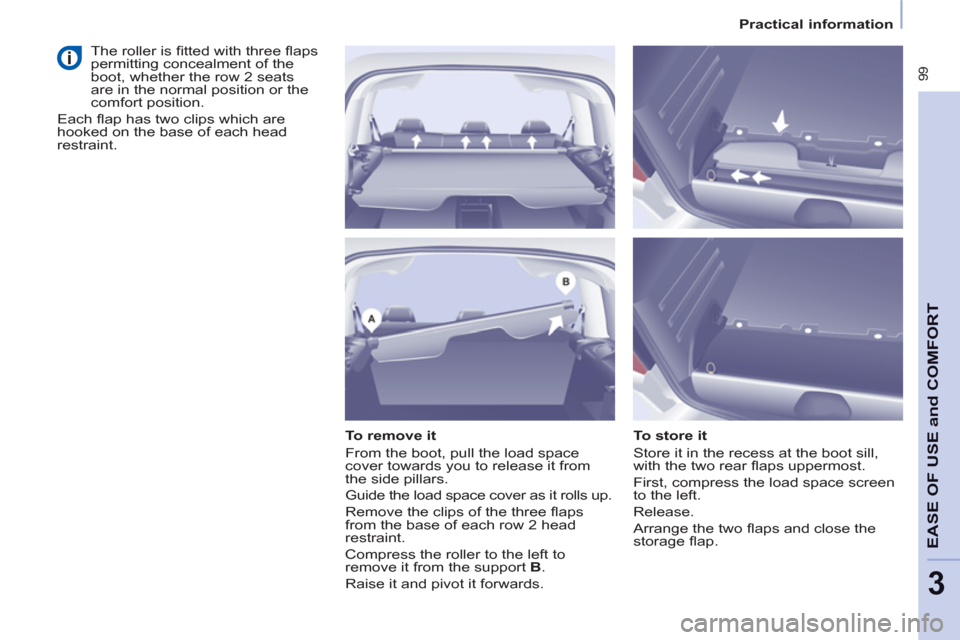
To remove it
From the boot, pull the load space
cover towards you to release it from
the side pillars.
Guide the load space cover as it rolls up.
Remove the clips of the three fl aps
from the base of each row 2 head
restraint.
Compress the roller to the left to
remove it from the support B .
Raise it and pivot it forwards.
To store it
Store it in the recess at the boot sill,
with the two rear fl aps uppermost.
First, compress the load space screen
to the left.
Release.
Arrange the two fl aps and close the
storage fl ap.
The roller is fi tted with three fl aps
permitting concealment of the
boot, whether the row 2 seats
are in the normal position or the
comfort position.
Each fl ap has two clips which are
hooked on the base of each head
restraint.
Page 103 of 232
101
EASE OF USE
andCOMFOR
T
3
Practical information
The interior rack is not compatible
with the Zenith roof.
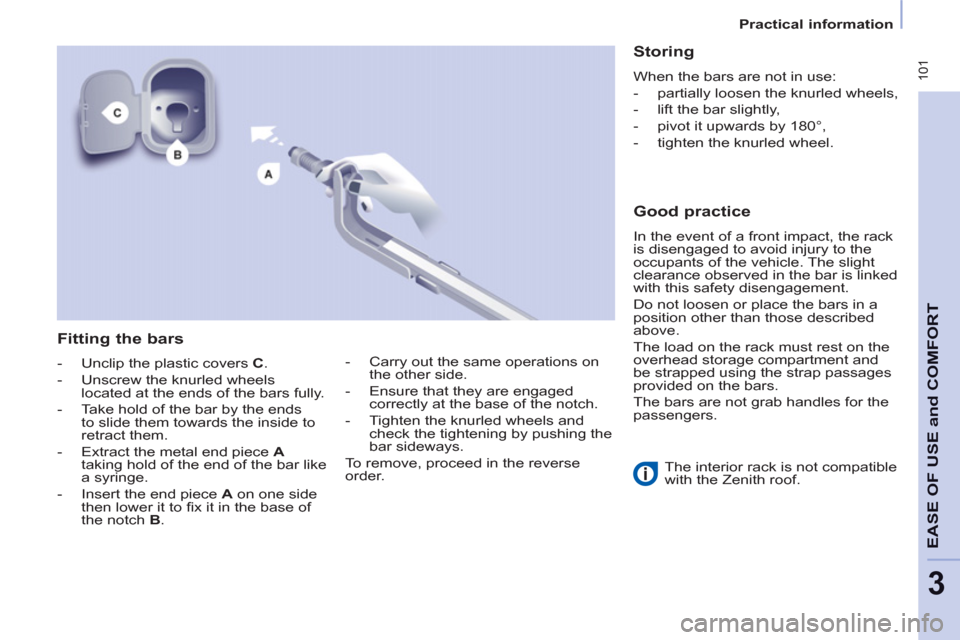
Fitting the bars
- Unclip the plastic covers C .
- Unscrew the knurled wheels
located at the ends of the bars fully.
- Take hold of the bar by the ends
to slide them towards the inside to
retract them.
- Extract the metal end piece A
taking hold of the end of the bar like
a syringe.
- Insert the end piece A on one side
then lower it to fi x it in the base of
the notch B .
Storing
When the bars are not in use:
- partially loosen the knurled wheels,
- lift the bar slightly,
- pivot it upwards by 180°,
- tighten the knurled wheel.
Good practice
In the event of a front impact, the rack
is disengaged to avoid injury to the
occupants of the vehicle. The slight
clearance observed in the bar is linked
with this safety disengagement.
Do not loosen or place the bars in a
position other than those described
above.
The load on the rack must rest on the
overhead storage compartment and
be strapped using the strap passages
provided on the bars.
The bars are not grab handles for the
passengers.
- Carry out the same operations on
the other side.
- Ensure that they are engaged
correctly at the base of the notch.
- Tighten the knurled wheels and
check the tightening by pushing the
bar sideways.
To remove, proceed in the reverse
order.
Page 119 of 232
11 7
SAFETY
4
11 7
Airbags
Good practice
Sit in a normal upright position.
Wear a correctly adjusted seat belt.
Do not leave anything between the
occupants and the airbags (a child,
pet, object...). This could hamper the
operation of the airbags or injure the
occupants.
After an accident or if the vehicle has
been stolen or broken into, have the
airbag systems checked.
All work on the airbag system is strictly
forbidden unless it is carried out by
qualifi ed personnel of the PEUGEOT
network.
Even if all of the precautions
mentioned are observed, a risk of
injury or of minor burns to the head,
chest or arms when an airbag is
triggered cannot be ruled out. In fact,
the bag infl ates almost instantly (within
a few milliseconds) then defl ates within
the same time discharging the hot gas
via openings provided for this purpose.
Side airbags
Only put recommended covers on the
seats. These will not hinder infl ation of
the side airbags. Consult a PEUGEOT
dealer.
Do not fi x or glue anything to the seat
backs. This could cause injury to the
chest or arms when the side airbag
infl ates.
Do not sit with the upper part of the
body any nearer to the door than
necessary.
Front airbags
Do not drive holding the steering wheel
by its spokes or resting your hands on
the centre part of the wheel.
Do not allow passengers to place their
feet on the fascia, they risk serious
injury if the airbag is triggered.
Smoke as little as possible as
deployment of the airbags can cause
burns or the risk of injury from a
cigarette or pipe.
Never remove or pierce the steering
wheel or hit it violently.
Airbags only operate when the
ignition is switched on.
This equipment only operates once.
If a second impact occurs (during the
same or a subsequent accident), the
airbag will not operate.
The triggering of an airbag or airbags
is accompanied by a slight discharge
of harmless smoke and a noise, due
to the activation of the pyrotechnic
cartridge incorporated in the system.
This smoke is not harmful, but
sensitive individuals may experience
some irritation.
The noise of the detonation may result
in a slight loss of hearing for a short
time.
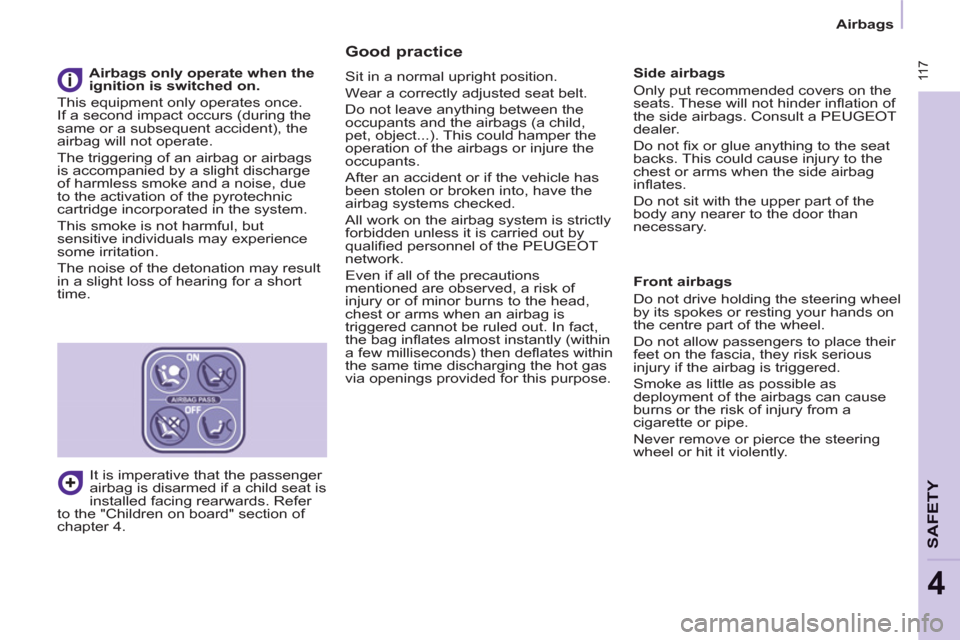
It is imperative that the passenger
airbag is disarmed if a child seat is
installed facing rearwards. Refer
to the "Children on board" section of
chapter 4.
Page 121 of 232

11 9
SAFETY
4
11 9
Airbags
Front airbags
The front airbags are incorporated in
the centre of the steering wheel for the
driver and in the fascia for the front
passenger.
Activation
They are deployed simultaneously,
unless the passenger's front airbag
has been disarmed, in the event of a
serious front impact applied to all or
part of the front impact zone A in the
longitudinal centreline of the vehicle
on a horizontal plane directed from the
front towards the rear of the vehicle.
The front airbag infl ates between
the front occupant of the vehicle and
the fascia to cushion his forward
movement.
Disarming
The passenger's front airbag alone can
be disarmed:
- With the ignition switched off
,
insert the key into the passenger
airbag disarming switch,
- turn it to the "OFF" position,
- then remove the key keeping the
slot in this position.
The airbag warning light on the
instrument panel is lit throughout
the period of disarming.
If the two airbag warning lights
are lit continuously, do not install
a rear-facing child seat. Consult a
PEUGEOT dealer.
Front airbag fault
To ensure the safety of your
child, it is essential to disarm the
passenger airbag when you install
a rear-facing child seat on the front
passenger seat. Otherwise, the child
would risk being killed or seriously
injured if the airbag were to infl ate.
Reactivation
In the "OFF" position, the passenger
airbag will not be triggered in the event
of an impact.
As soon as the child seat is removed,
turn the airbag slot to the "ON"
position to re-activate the airbag
and thus ensure the safety of your
passenger in the event of an impact.
If this warning light comes on,
accompanied by an audible
signal and a message on the
display, consult a PEUGEOT
dealer to have the system
checked.
Page 123 of 232

121
4
121
Child safety
Refer to chapter 4, "Airbags" section.
The child seats function and
the passenger airbag disarming
function are common to the entire
PEUGEOT range.
If the passenger airbag is not
disarmed, the installation of a
"rearwards-facing" child seat in the
front is strictly prohibited.
CHILD SEATS RECOMMENDED BY PEUGEOT
PEUGEOT offers a complete range of recommended child seats which are
secured using a three point seat belt
:
Group 0: from birth to 10 kg
Group 0+: from birth to 13 kg
Groups 1, 2 and 3: from 9 to 36 kg
L1
"ROMER Baby-
Safe Plus"
Installed in
the rear-facing
position
.
L2
"KIDDY Life"
Use of the
restraining cushion
is compulsory for
the transportation
of young children
(from 9 to 18 kg).
Groups 2 and 3: from 15 to 36 kg
L3
"RECARO Start''
.
L4
"KLIPPAN Optima"
From the age
of 6 years
(approximately
22 kg), the booster
is used on its own.
L5
"RÖMER KIDFIX"
Can be fi xed on the vehicle's ISOFIX mountings.
The child is restrained by the seat belt.
L3: to install this seat in row 2, remove the head restraints.