2011 Peugeot Partner stop start
[x] Cancel search: stop startPage 4 of 200
2
Contents
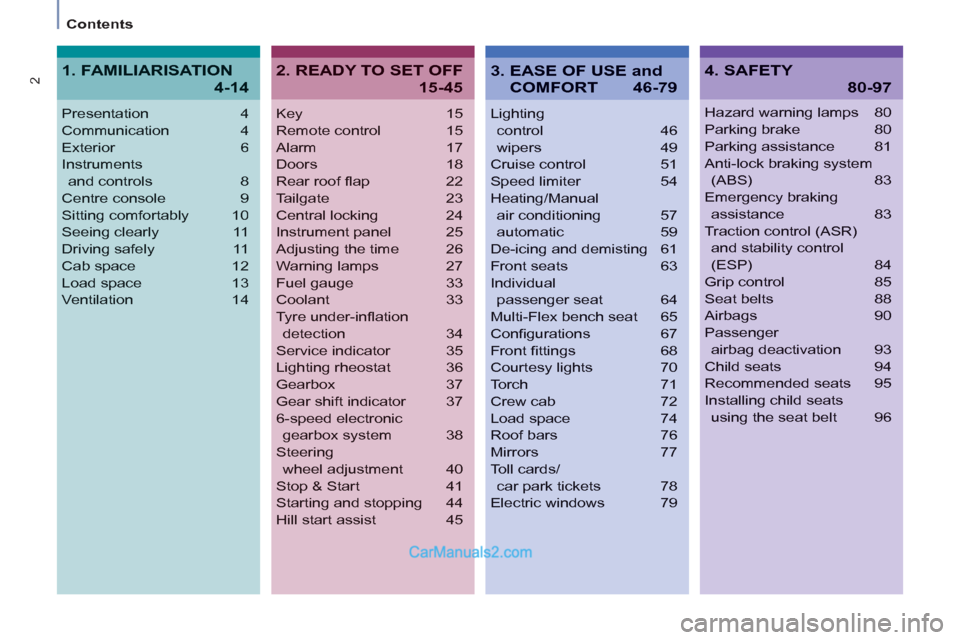
Key 15
Remote control 15
Alarm 17
Doors 18
Rear roof fl ap 22
Tailgate 23
Central locking 24
Instrument panel 25
Adjusting the time 26
Warning lamps 27
Fuel gauge 33
Coolant 33
Tyre under-infl ation
detection 34
Service indicator 35
Lighting rheostat 36
Gearbox 37
Gear shift indicator 37
6-speed electronic
gearbox system 38
Steering
wheel adjustment 40
Stop & Start 41
Starting and stopping 44
Hill start assist 45
Lighting
control 46
wipers 49
Cruise control 51
Speed limiter 54
Heating/Manual
air conditioning 57
automatic 59
De-icing and demisting 61
Front seats 63
Individual
passenger seat 64
Multi-Flex bench seat 65
Confi gurations 67
Front fi ttings 68
Courtesy lights 70
Torch 71
Crew cab 72
Load space 74
Roof bars 76
Mirrors 77
Toll cards/
car park tickets 78
Electric windows 79
Presentation4
Communication4
Exterior 6
Instruments
and controls8
Centre console9
Sitting comfortably 10
Seeing clearly 11
Driving safely 11
Cab space 12
Load space 13
Ventilation 14
Hazard warning lamps 80
Parking brake 80
Parking assistance 81
Anti-lock braking system
(ABS) 83
Emergency braking
assistance 83
Traction control (ASR)
and stability control
(ESP) 84
Grip control 85
Seat belts 88
Airbags 90
Passenger
airbag deactivation 93
Child seats 94
Recommended seats 95
Installing child seats
using the seat belt 96
2. READY TO SET OFF
15-45
4. SAFETY
80-97
1. FAMILIARISATION
4-14
3. EASE OF USE and
COMFORT 46-79
Page 10 of 200
8
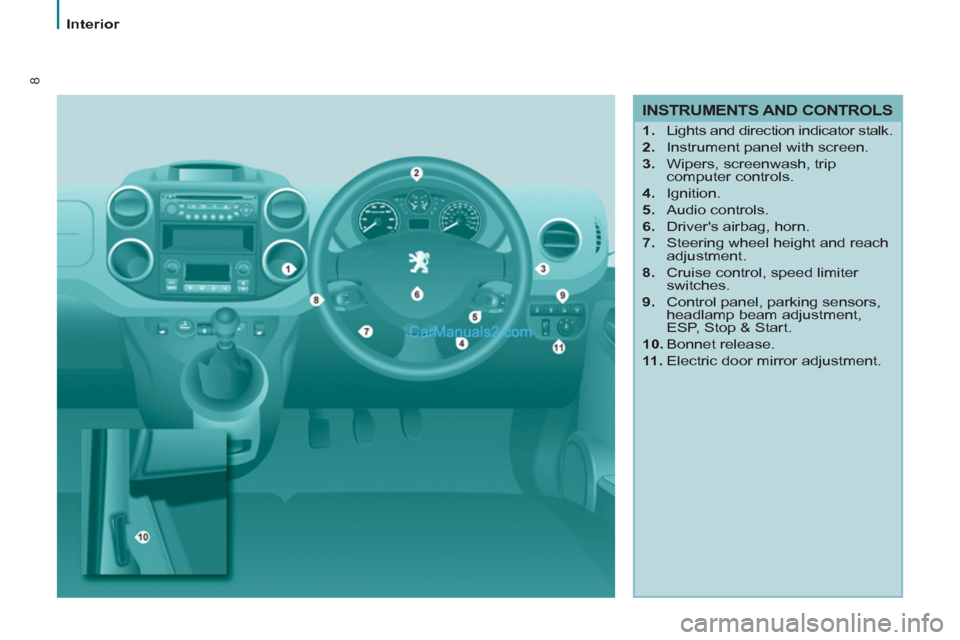
INSTRUMENTS AND CONTROLS
1.
Lights and direction indicator stalk.
2.
Instrument panel with screen.
3.
Wipers, screenwash, trip
computer controls.
4.
Ignition.
5.
Audio controls.
6.
Driver's airbag, horn.
7.
Steering wheel height and reach
adjustment.
8.
Cruise control, speed limiter
switches.
9.
Control panel, parking sensors,
headlamp beam adjustment,
ESP, Stop & Start.
10.
Bonnet release.
11 .
Electric door mirror adjustment.
Interior
Page 29 of 200
27
READY TO SET OFF
22
Instruments and controls
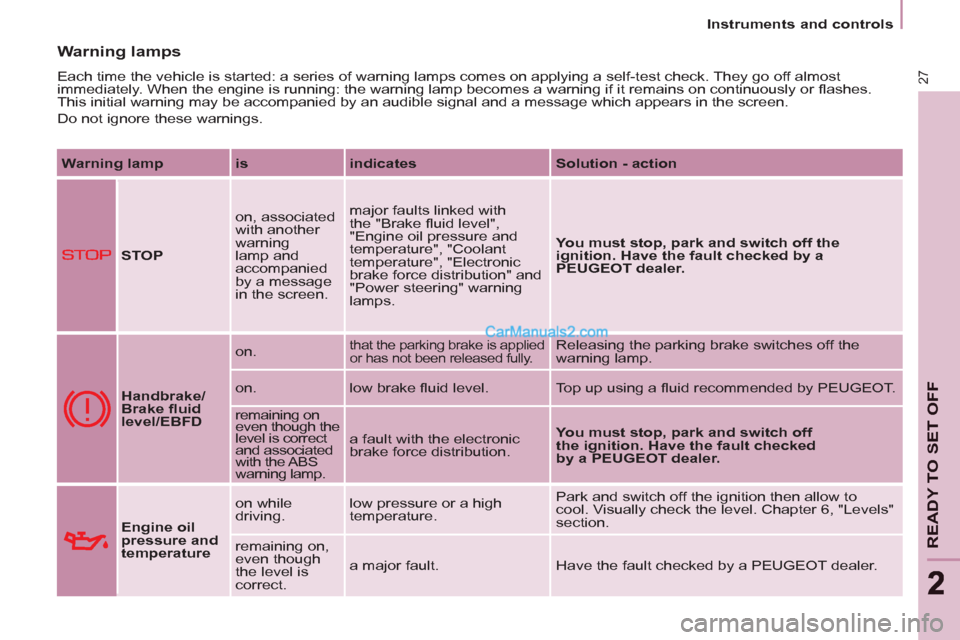
Warning lamps
Each time the vehicle is started: a series of warning lamps comes on applying a self-test check. They go off almost
immediately. When the engine is running: the warning lamp becomes a warning if it remains on continuously or fl ashes.
This initial warning may be accompanied by an audible signal and a message which appears in the screen.
Do not ignore these warnings.
Warning lamp
is
indicates
Solution - action
STOP
on, associated
with another
warning
lamp and
accompanied
by a message
in the screen. major faults linked with
the "Brake fl uid level",
"Engine oil pressure and
temperature", "Coolant
temperature", "Electronic
brake force distribution" and
"Power steering" warning
lamps.
You must stop, park and switch off the
ignition. Have the fault checked by a
PEUGEOT dealer.
Handbrake/
Brake fl uid
level/EBFD
on.
that the parking brake is applied
or has not been released fully. Releasing the parking brake switches off the
warning lamp.
on. low brake fl uid level. Top up using a fl uid recommended by PEUGEOT.
remaining on
even though the
level is correct
and associated
with the ABS
warning lamp. a fault with the electronic
brake force distribution.
You must stop, park and switch off
the ignition. Have the fault checked
by a PEUGEOT dealer.
Engine oil
pressure and
temperature
on while
driving. low pressure or a high
temperature. Park and switch off the ignition then allow to
cool. Visually check the level. Chapter 6, "Levels"
section.
remaining on,
even though
the level is
correct. a major fault. Have the fault checked by a PEUGEOT dealer.
Page 30 of 200
28
Instruments and controls
Warning lamp
is
indicates
Solution - action
Coolant
temperature
and level
on with needle
in the red
zone. an abnormal increase
in temperature. Park and switch off the ignition then allow to cool.
Visually check the level.
fl ashing. a drop in the coolant level. Chapter 6, "Levels" section. Consult a PEUGEOT
dealer.
Service
on temporarily. minor faults or warnings. Consult the alert log in the display or screen. If
your vehicle is equipped with a trip computer or
a screen: refer to the "Audio equipment - Trip
computer" section of chapter 9. Consult
a PEUGEOT dealer. remaining on. major faults.
Driver's
seat belt not
fastened
on then
fl ashing. the driver has not fastened
their seat belt. Pull the strap then insert the tongue in the buckle.
accompanied
by an audible
signal then
remains on. the vehicle is moving with
the driver's seat belt not
fastened. Check that the seat belt is fastened by pulling
the strap. Chapter 4, "Seat belts" section.
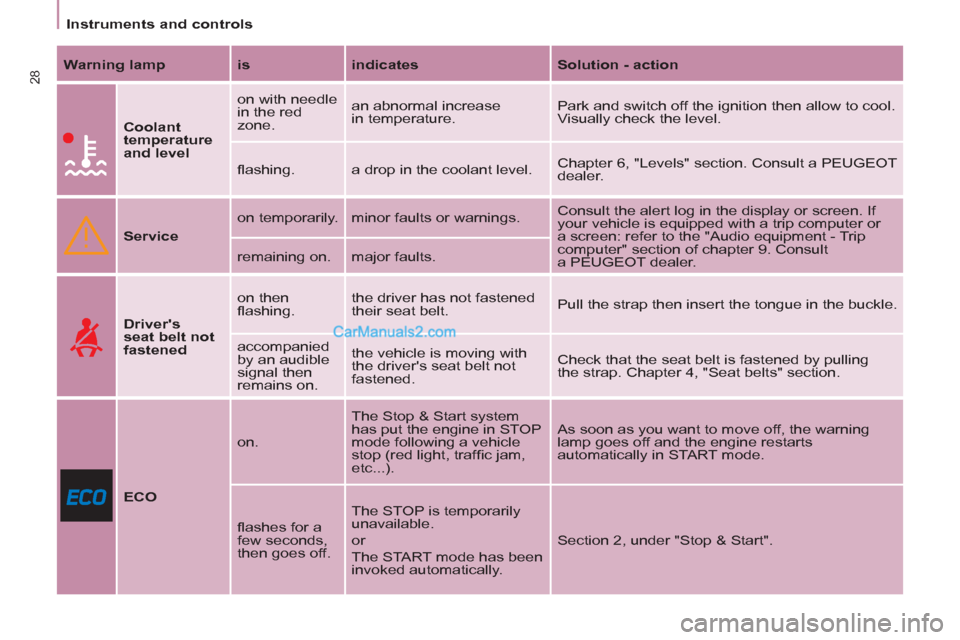
ECO
on. The Stop & Start system
has put the engine in STOP
mode following a vehicle
stop (red light, traffi c jam,
etc...). As soon as you want to move off, the warning
lamp goes off and the engine restarts
automatically in START mode.
fl ashes for a
few seconds,
then goes off. The STOP is temporarily
unavailable.
or
The START mode has been
invoked automatically. Section 2, under "Stop & Start".
Page 43 of 200
41
Stop & Start
READY TO SET OFF
2
STOP & START
The Stop & Start system puts the
engine temporarily on standby - STOP
mode - during stops in the traffi c (red
lights, traffi c jams, or other...). The
engine restarts automatically - START
mode - as soon as you want to move
off. The restart takes place instantly,
quickly and silently.
Perfect for urban use, the Stop & Start
system reduces fuel consumption and
exhaust emissions as well as the noise
level when stationary.
Operation
Going into engine STOP mode
The "ECO"
warning lamp
comes on in the instrument
panel and the engine goes
into standby:
- with a manual gearbox
, at speeds
below 12 mph (20 km/h), when you
put the gear lever into neutral and
release the clutch pedal,
- with the 6-speed electronic
gearbox system
, at a speed below
5 mph (8 km/h), when you press
the brake pedal or put the gear
lever into position N
. If your vehicle is fi tted with the system,
a time counter calculates the sum of
the periods in STOP mode during a
journey. It rests itself to zero every time
the ignition is switched on with the key.
With the automatic gearbox
system, for your comfort during
parking maoeuvres, STOP mode
is not available for a few seconds after
coming out of reverse gear.
STOP mode does not affect the
functionality of the vehicle, such as
braking, power steering, for example.
Never refuel with the engine in
STOP mode; you must switch off
the ignition with the key.
Special cases: STOP mode
unavailable
STOP mode is not invoked when:
- the driver's door is open,
- the driver's seat belt is not
fastened,
- the vehicle has not exceeded 6 mph
(10 km/h) since the last engine start
using the key,
- the parking brake is applied or
being applied,
- the engine is needed to maintain
a comfortable temperature in the
passenger compartment,
- demisting is active,
- some special conditions (battery
charge, engine temperature, braking
assistance, ambient temperature...)
where the engine is needed to
assure control of a system.
In this case, the "ECO"
warning lamp fl ashes for a
few seconds, then goes off.
This operation is perfectly normal.
Page 44 of 200
Stop & Start
Going into engine START mode
The "ECO"
warning lamp
goes off and the engine
starts:
- with a manual gearbox
, when you
depress the clutch pedal,
- with the 6-speed electronic
gearbox system
:
●
gear lever in position A
or M
,
when you release the brake
pedal,
●
or gear lever in position N
and
the brake pedal released, when
you move the gear lever to
position A
or M
,
●
or when you engage reverse
gear.
Special cases: START invoked
automatically
START is invoked automatically when:
- you open the driver's door,
- you unfasten the driver's seat belt,
- the speed of the vehicle exceeds
15 mph (25 km/h) with a manual
gearbox or 7 mph (11 km/h) with
the 6-speed electronic gearbox
system,
- the parking brake is being applied,
- some special conditions (battery
charge, engine temperature,
braking assistance, ambient
temperature...) where the engine
is needed to assure control of a
system.
In this case the "ECO"
warning lamp fl ashes for
few seconds, then goes off.
This operation is perfectly normal.
With a manual gearbox in STOP
mode, if a gear is engaged without
fully depressing the clutch pedal, a
warning lamp comes on or a message
is displayed asking you to depress the
clutch pedal to restart the engine.
Deactivation
At any time, press the "ECO
OFF"
switch to deactivate the
system.
This is confi rmed by the switch warning
lamp coming on accompanied by a
message on the screen.
If the system has been deactivated
in STOP mode, the engine restarts
immediately.
Page 45 of 200
43
Stop & Start
READY TO SET OFF
2
Reactivation
Press the "ECO OFF"
switch again.
The system is active again; this is
confi rmed by the switch warning
lamp going off and a message in the
instrument panel.
The system is reactivated
automatically at every new start
using the key.
Operating fault
In the event of a malfunction
with the system, the "ECO
OFF"
switch warning lamp
fl ashes, then comes on
continuously.
Have it checked by a PEUGEOT
dealer or a qualifi ed workshop.
In the event of a fault in STOP
mode, the vehicle may stall. It is then
necessary to switch off the ignition and
start the engine again using the key.
Maintenance
Before working under the bonnet,
deactivate the Stop & Start system
to avoid any risk of injury resulting
from automatic operation of START
mode.
This system requires a specifi c
battery with a special specifi cation
and technology (reference numbers
available from a PEUGEOT dealer or a
qualifi ed workshop).
Fitting a battery not listed by
PEUGEOT introduces the risk of
malfunction of the system.
The Stop & Start system makes
use of advanced technology. All
work on this type of battery must
be done only by a PEUGEOT dealer or
a qualifi ed workshop.
Page 46 of 200
Starting and stopping
Good practice when stopping
Good practice when starting
Diesel pre-heating warning
light
If the temperature is high
enough, the warning light
comes on for less than
one second, you can start
without waiting.
In cold weather, wait for this warning
light to switch off then operate the
starter (Starting position) until the
engine starts.
Door or bonnet open
warning light
If this comes on, a door or the
bonnet is not closed correctly, check!
Minimise engine and gearbox wear
When switching off the ignition, let the
engine run for a few seconds to allow
the turbocharger (Diesel engine) to
return to idle.
Do not press the accelerator when
switching off the ignition.
There is no need to engage a gear
after parking the vehicle.
STARTING AND STOPPING
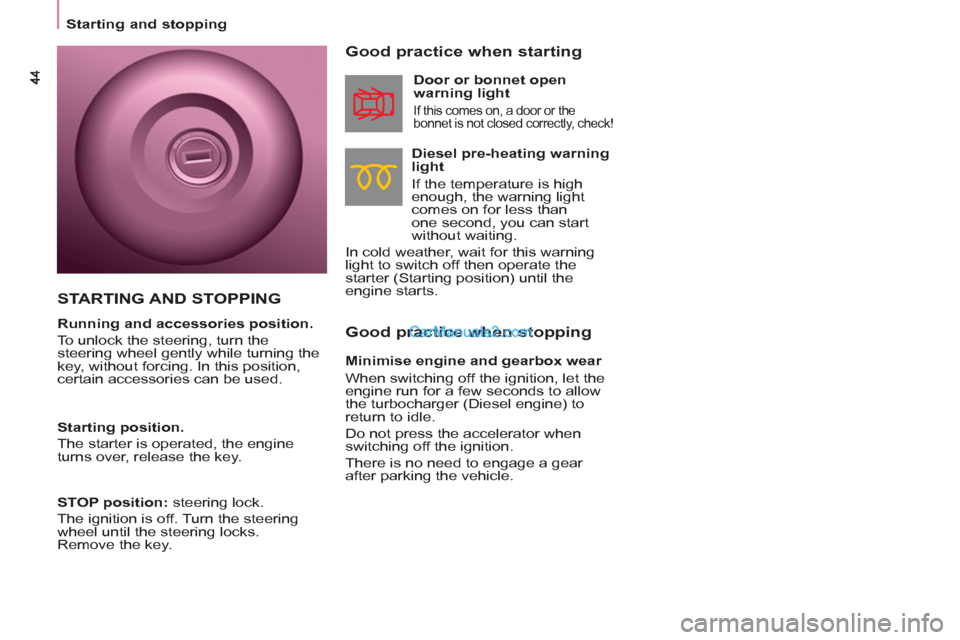
Running and accessories position.
To unlock the steering, turn the
steering wheel gently while turning the
key, without forcing. In this position,
certain accessories can be used.
Starting position.
The starter is operated, the engine
turns over, release the key.
STOP position:
steering lock.
The ignition is off. Turn the steering
wheel until the steering locks.
Remove the key.