2011 NISSAN ALTIMA HYBRID tire pressure
[x] Cancel search: tire pressurePage 22 of 422
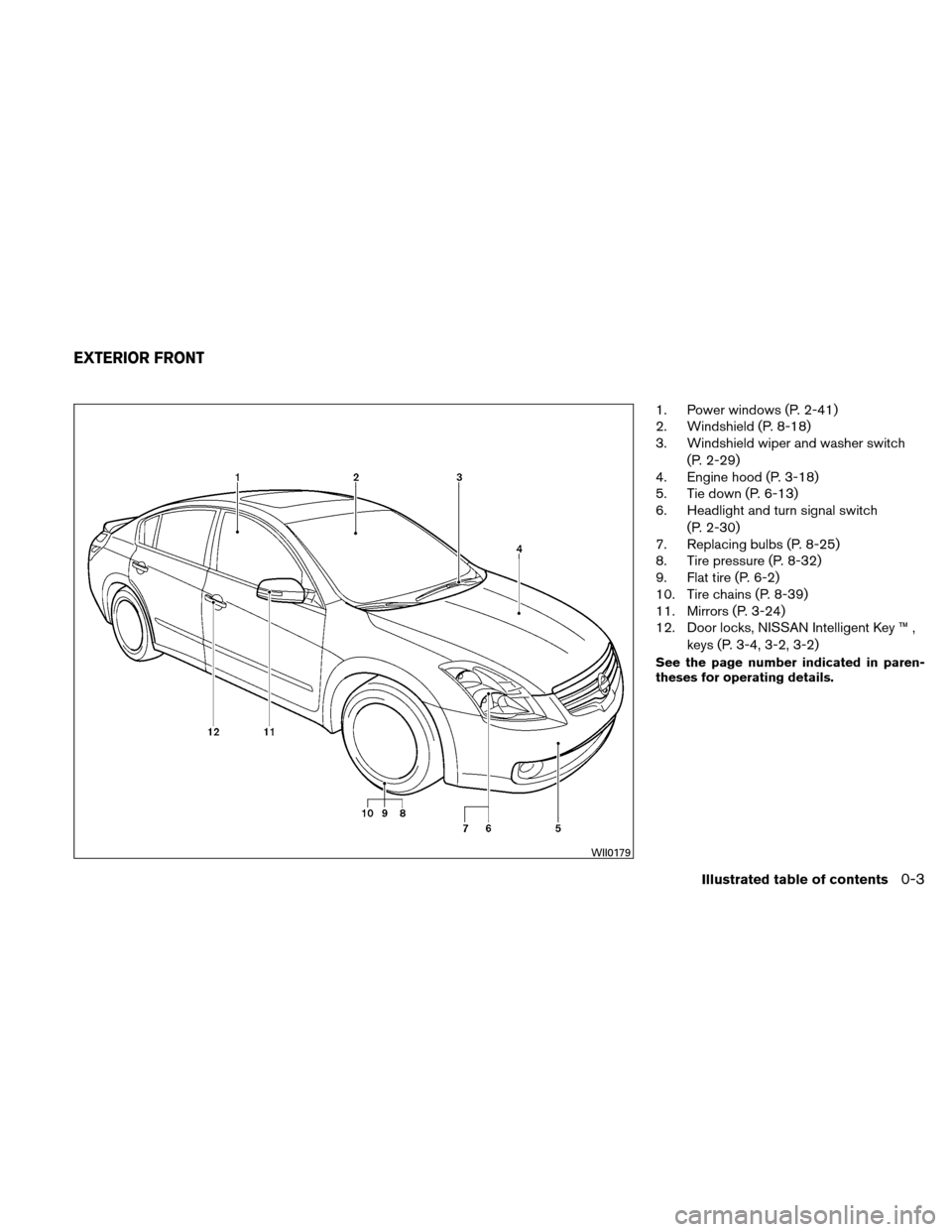
1. Power windows (P. 2-41)
2. Windshield (P. 8-18)
3. Windshield wiper and washer switch(P. 2-29)
4. Engine hood (P. 3-18)
5. Tie down (P. 6-13)
6. Headlight and turn signal switch
(P. 2-30)
7. Replacing bulbs (P. 8-25)
8. Tire pressure (P. 8-32)
9. Flat tire (P. 6-2)
10. Tire chains (P. 8-39)
11. Mirrors (P. 3-24)
12. Door locks, NISSAN Intelligent Key ™ ,
keys (P. 3-4, 3-2, 3-2)
See the page number indicated in paren-
theses for operating details.
WII0179
EXTERIOR FRONT
Illustrated table of contents0-3
Page 27 of 422
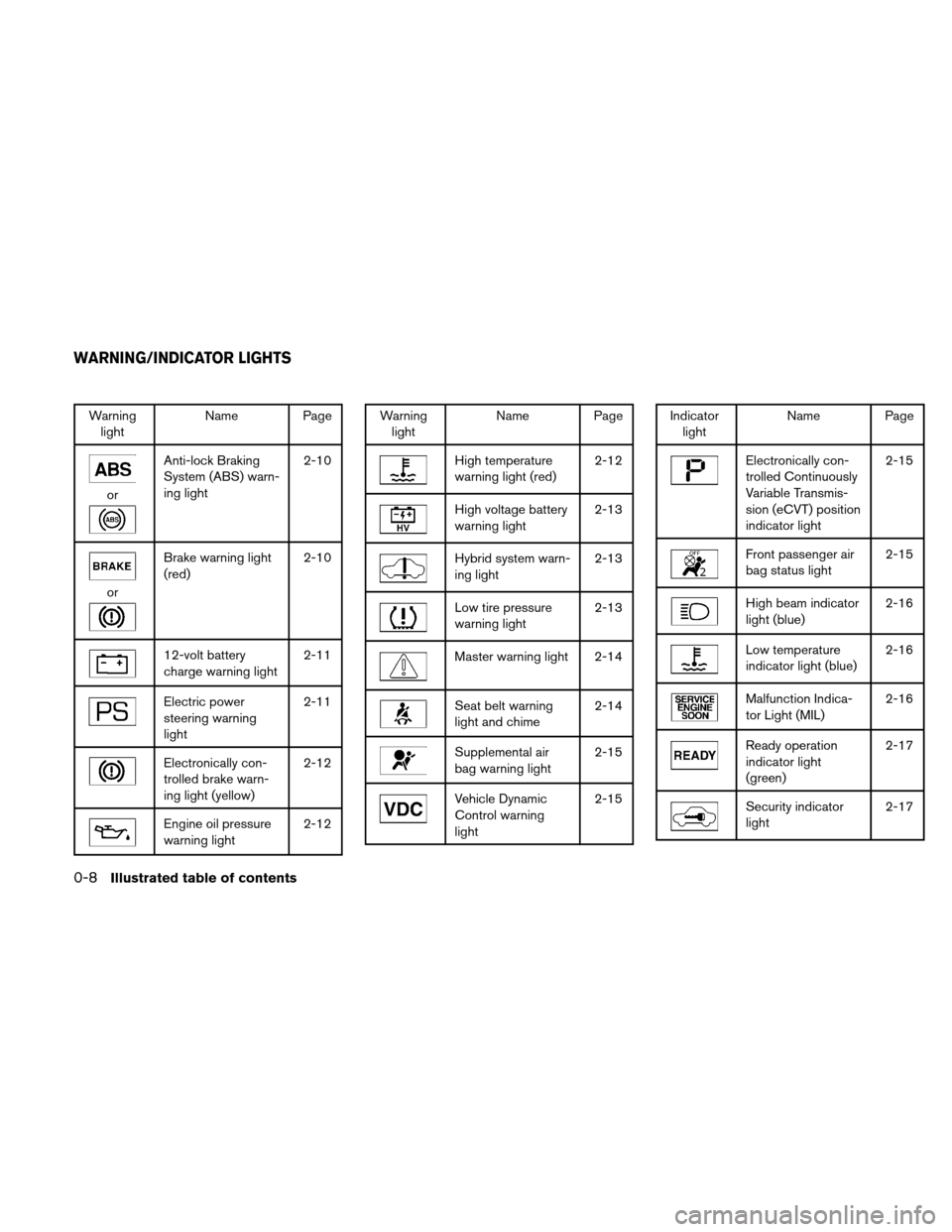
Warninglight Name Page
or
Anti-lock Braking
System (ABS) warn-
ing light 2-10
or
Brake warning light
(red)
2-10
12-volt battery
charge warning light2-11
Electric power
steering warning
light2-11
Electronically con-
trolled brake warn-
ing light (yellow)2-12
Engine oil pressure
warning light
2-12
Warning
light Name Page
High temperature
warning light (red) 2-12
High voltage battery
warning light2-13
Hybrid system warn-
ing light2-13
Low tire pressure
warning light2-13
Master warning light 2-14
Seat belt warning
light and chime2-14
Supplemental air
bag warning light2-15
Vehicle Dynamic
Control warning
light2-15
Indicator
light Name Page
Electronically con-
trolled Continuously
Variable Transmis-
sion (eCVT) position
indicator light 2-15
Front passenger air
bag status light
2-15
High beam indicator
light (blue)2-16
Low temperature
indicator light (blue)2-16
Malfunction Indica-
tor Light (MIL)2-16
Ready operation
indicator light
(green)2-17
Security indicator
light
2-17
WARNING/INDICATOR LIGHTS
0-8Illustrated table of contents
Page 90 of 422
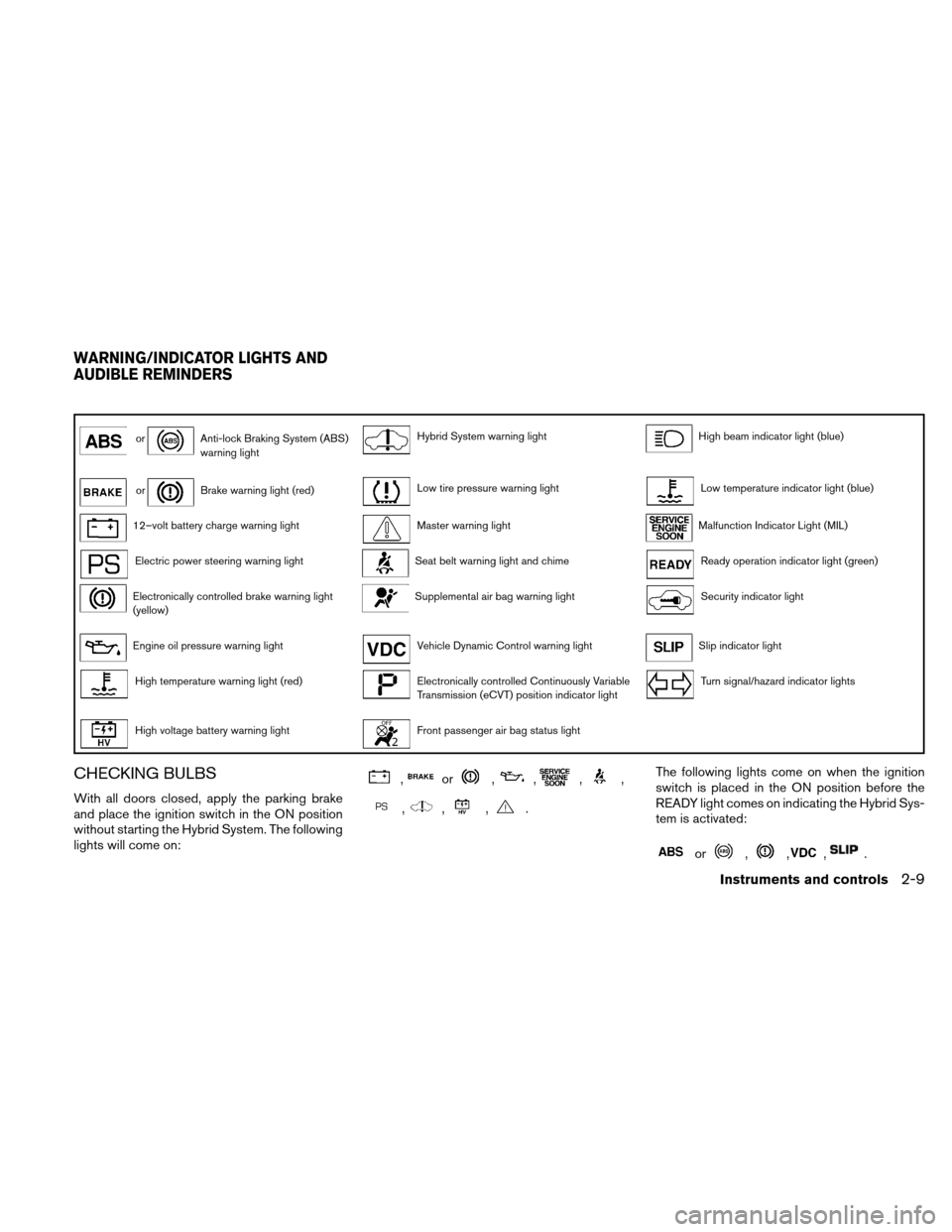
orAnti-lock Braking System (ABS)
warning lightHybrid System warning lightHigh beam indicator light (blue)
orBrake warning light (red)Low tire pressure warning lightLow temperature indicator light (blue)
12–volt battery charge warning lightMaster warning lightMalfunction Indicator Light (MIL)
Electric power steering warning lightSeat belt warning light and chimeReady operation indicator light (green)
Electronically controlled brake warning light
(yellow)Supplemental air bag warning lightSecurity indicator light
Engine oil pressure warning lightVehicle Dynamic Control warning lightSlip indicator light
High temperature warning light (red)Electronically controlled Continuously Variable
Transmission (eCVT) position indicator lightTurn signal/hazard indicator lights
High voltage battery warning lightFront passenger air bag status light
CHECKING BULBS
With all doors closed, apply the parking brake
and place the ignition switch in the ON position
without starting the Hybrid System. The following
lights will come on:
,or,,,,
,,,.The following lights come on when the ignition
switch is placed in the ON position before the
READY light comes on indicating the Hybrid Sys-
tem is activated:
or,,,.
WARNING/INDICATOR LIGHTS AND
AUDIBLE REMINDERS
Instruments and controls2-9
Page 94 of 422
CAUTION
If the high temperature warning light illu-
minates while the engine is running, it
may indicate the engine temperature is
extremely high. Stop the vehicle safely as
soon as possible. If the vehicle is over-
heated, continuing vehicle operation may
seriously damage the engine. See “If your
vehicle overheats” in the “In case of emer-
gency” section.
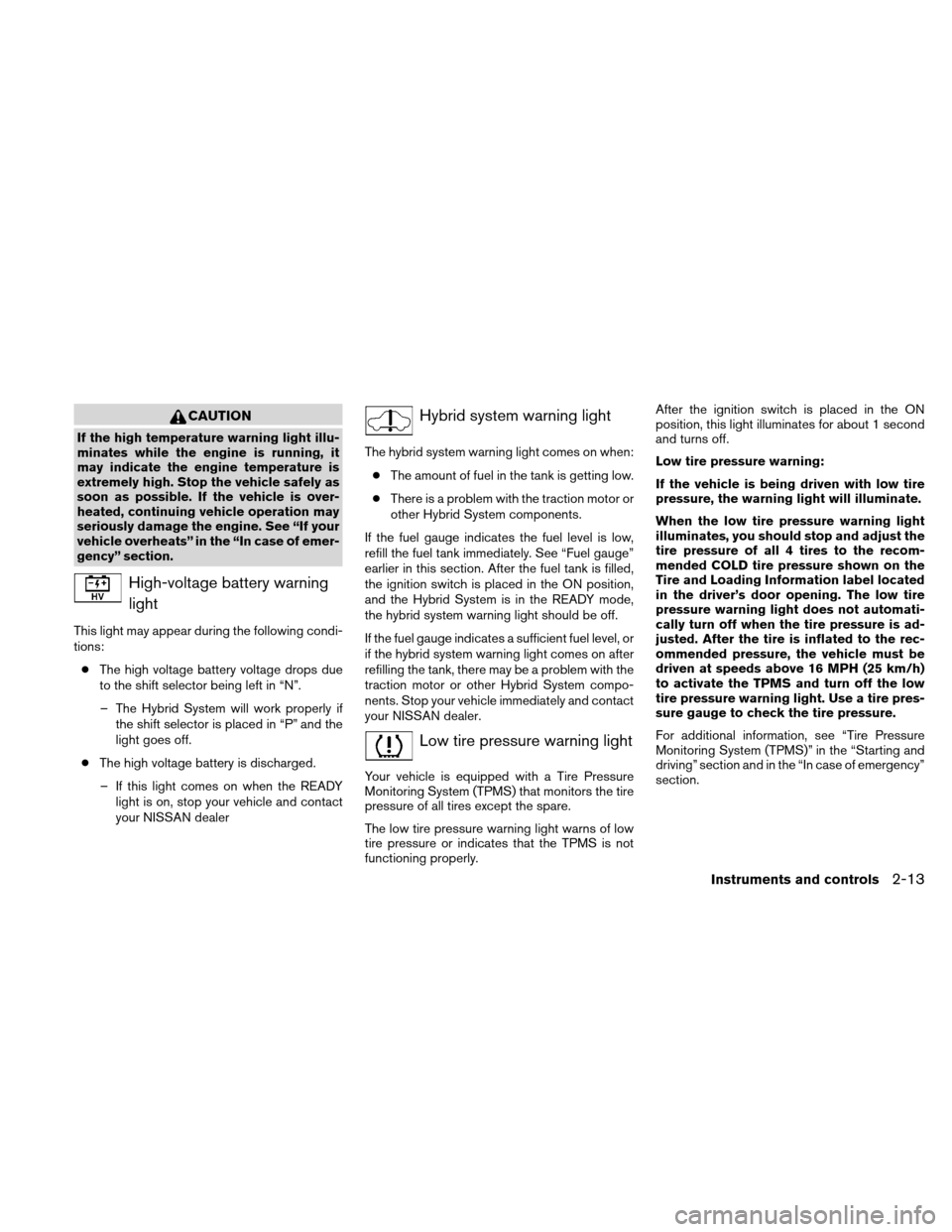
High-voltage battery warninglight
This light may appear during the following condi-
tions:
● The high voltage battery voltage drops due
to the shift selector being left in “N”.
– The Hybrid System will work properly if the shift selector is placed in “P” and the
light goes off.
● The high voltage battery is discharged.
– If this light comes on when the READY light is on, stop your vehicle and contact
your NISSAN dealer
Hybrid system warning light
The hybrid system warning light comes on when:
● The amount of fuel in the tank is getting low.
● There is a problem with the traction motor or
other Hybrid System components.
If the fuel gauge indicates the fuel level is low,
refill the fuel tank immediately. See “Fuel gauge”
earlier in this section. After the fuel tank is filled,
the ignition switch is placed in the ON position,
and the Hybrid System is in the READY mode,
the hybrid system warning light should be off.
If the fuel gauge indicates a sufficient fuel level, or
if the hybrid system warning light comes on after
refilling the tank, there may be a problem with the
traction motor or other Hybrid System compo-
nents. Stop your vehicle immediately and contact
your NISSAN dealer.
Low tire pressure warning light
Your vehicle is equipped with a Tire Pressure
Monitoring System (TPMS) that monitors the tire
pressure of all tires except the spare.
The low tire pressure warning light warns of low
tire pressure or indicates that the TPMS is not
functioning properly. After the ignition switch is placed in the ON
position, this light illuminates for about 1 second
and turns off.
Low tire pressure warning:
If the vehicle is being driven with low tire
pressure, the warning light will illuminate.
When the low tire pressure warning light
illuminates, you should stop and adjust the
tire pressure of all 4 tires to the recom-
mended COLD tire pressure shown on the
Tire and Loading Information label located
in the driver’s door opening. The low tire
pressure warning light does not automati-
cally turn off when the tire pressure is ad-
justed. After the tire is inflated to the rec-
ommended pressure, the vehicle must be
driven at speeds above 16 MPH (25 km/h)
to activate the TPMS and turn off the low
tire pressure warning light. Use a tire pres-
sure gauge to check the tire pressure.
For additional information, see “Tire Pressure
Monitoring System (TPMS)” in the “Starting and
driving” section and in the “In case of emergency”
section.
Instruments and controls2-13
Page 95 of 422
TPMS malfunction:
If the TPMS is not functioning properly, the low
tire pressure warning light will flash for approxi-
mately 1 minute when the ignition switch is
placed in the ON position. The light will remain on
after the 1 minute. The CHECK TIRE PRES-
SURE warning is not displayed if the low tire
pressure warning light illuminates to indicate a
TPMS malfunction. Have the system checked by
a NISSAN dealer.
For additional information, see “Tire Pressure
Monitoring System (TPMS)” in the “Starting and
driving” section and “Tire pressure” in the “Main-
tenance and do-it-yourself” section.
WARNING
●If the light does not illuminate with the
ignition switch placed in the ON posi-
tion, have the vehicle checked by a
NISSAN dealer as soon as possible.
● If the light illuminates while driving,
avoid sudden steering maneuvers or
abrupt braking, reduce vehicle speed,
pull off the road to a safe location and
stop the vehicle as soon as possible.
Driving with under-inflated tires may permanently damage the tires and in-
crease the likelihood of tire failure. Se-
rious vehicle damage could occur and
may lead to an accident and could re-
sult in serious personal injury. Check
the tire pressure for all four tires. Adjust
the tire pressure to the recommended
COLD tire pressure shown on the Tire
and Loading Information label located
in the driver’s door opening to turn the
low tire pressure warning light OFF. If
the light still comes on while driving
after adjusting the tire pressure, a tire
may be flat. If you have a flat tire, re-
place it with a spare tire as soon as
possible.
● When a spare tire is mounted or a wheel
is replaced the TPMS will not function
and the low tire pressure warning light
will flash for approximately 1 minute.
The light will remain on after 1 minute.
Contact your NISSAN dealer as soon as
possible for tire replacement and/or
system resetting.
● Replacing tires with those not originally
specified by NISSAN could affect the
proper operation of the TPMS.
CAUTION
● The TPMS is not a substitute for the
regular tire pressure check. Be sure to
check the tire pressure regularly.
● If the vehicle is being driven at speeds
of less than 16 MPH (25 km/h) , the
TPMS may not operate correctly.
● Be sure to install the specified size of
tires to the 4 wheels correctly.
Master warning light
This light comes on when various vehicle infor-
mation display warnings appear.
Seat belt warning light and
chime
The light and chime remind you to fasten your
seat belts. The light illuminates whenever the
ignition switch is placed in the ON or START
position and remains illuminated until the driver’s
seat belt is fastened. At the same time, the chime
sounds for about 6 seconds unless the driver’s
seat belt is securely fastened.
The seat belt warning light may also illuminate if
the front passenger’s seat belt is not fastened
when the front passenger’s seat is occupied. For
7 seconds after the ignition switch is placed in
2-14Instruments and controls
Page 104 of 422
Indicators for maintenance
1. Engine oil replacement indicatorThis indicator appears when the customer
set distance comes for changing the engine
oil. You can set or reset the distance for
changing the engine oil. See “Maintenance
mode” earlier in this section.
2. Oil filter replacement indicator This indicator appears when the customer
set distance comes for replacing the oil filter.
You can set or reset the distance for replac-
ing the oil filter. See “Maintenance mode”
earlier in this section.
3. Tire replacement indicator This indicator appears when the customer
set distance comes for replacing tires. You
can set or reset the distance for replacing
tires. See “Maintenance mode” earlier in this
section.
WARNING
The tire replacement indicator is not a
substitute for regular tire checks, includ-
ing tire pressure checks. See “Changing
Wheels and Tires” in “Maintenance & Do-
It-Yourself” section. Many factors includ-
ing tire inflation, alignment, driving habits
and road conditions affect tire wear and
when tires should be replaced. Setting the
tire replacement indicator for a certain
driving distance does not mean your tires
will last that long. Use the tire replace-
ment indicator as a guide only and always
perform regular tire checks. Failure to per-
form regular tire checks, including tire
pressure checks could result in tire fail-
ure. Serious vehicle damage could occur
and may lead to a collision, which could
result in serious personal injury or death. 4. “OTHER” indicator
This indicator appears when the customer
set distance comes for checking or replac-
ing maintenance items other than the engine
oil, oil filter and tires. Other maintenance
items can include such things as air filter or
tire rotation. You can set or reset the dis-
tance for checking or replacing the items.
See “Maintenance mode” earlier in this sec-
tion. For scheduled maintenance items and
intervals, see your “NISSAN Service and
Maintenance Guide.”
Instruments and controls2-23
Page 294 of 422
5 Starting and driving
Precautions when starting and driving................5-2
Exhaust gas (carbon monoxide) ..................5-2
Three-way catalyst ..............................5-3
Tire Pressure Monitoring System (TPMS) ..........5-3
Avoiding collision and rollover ....................5-5
Off-road recovery ...............................5-6
Rapid air pressure loss ..........................5-6
Drinking alcohol/drugs and driving ................5-7
Push-Button Ignition Switch ........................5-7
Push-button ignition switch positions .............5-8
Emergency engine shut off ......................5-9
NISSAN Intelligent Key™ battery discharge ........5-9
NISSAN vehicle immobilizer system .............5-10
Before starting the Hybrid System ..................5-10
Starting the Hybrid System ........................5-11
Driving the vehicle ................................ 5-11
Electronically controlled Continuously
Variable Transmission (eCVT) . ..................5-11
Parking brake .................................... 5-14
Cruise control .................................... 5-15Precautions on cruise control
...................5-15
Cruise control operations .......................5-15
Break-in schedule ................................ 5-17
Increasing fuel economy ........................... 5-17
Parking/parking on hills ............................ 5-18
Power steering ................................... 5-19
Brake system .................................... 5-19
Brake precautions ............................. 5-19
Anti-lock Braking System (ABS) .................5-21
Traction Control System (TCS) .....................5-22
Vehicle Dynamic Control (VDC) system .............5-23
Cold weather driving .............................. 5-24
Freeing a frozen door lock ......................5-24
Anti-freeze .................................... 5-24
Draining of coolant water .......................5-24
Tire equipment ................................ 5-24
Special winter equipment .......................5-24
Driving on snow or ice ......................... 5-24
Engine block heater (if so equipped) .............5-25
Page 296 of 422
c. You notice a change in the sound ofthe exhaust system.
d. You have had an accident involving damage to the exhaust system, un-
derbody, or rear of the vehicle.
THREE-WAY CATALYST
The three-way catalyst is an emission control
device installed in the exhaust system. Exhaust
gases in the three-way catalyst are burned at
high temperatures to help reduce pollutants.
WARNING
●The exhaust gas and the exhaust sys-
tem are very hot. Keep people, animals
or flammable materials away from the
exhaust system components.
● Do not stop or park the vehicle over
flammable materials such as dry grass,
waste paper or rags. They may ignite
and cause a fire.
CAUTION
● Do not use leaded gasoline. Deposits
from leaded gasoline will seriously re-
duce the three-way catalyst’s ability to
help reduce exhaust pollutants. ●
Keep your engine tuned up. Malfunc-
tions in the ignition, fuel injection, or
electrical systems can cause overrich
fuel flow into the three-way catalyst,
causing it to overheat. Do not keep driv-
ing if the engine misfires, or if notice-
able loss of performance or other un-
usual operating conditions are
detected. Have the vehicle inspected
promptly by a NISSAN dealer.
● Avoid driving with an extremely low fuel
level. Running out of fuel could cause
the engine to misfire, damaging the
three-way catalyst.
● Do not race the engine while warming it
up.
● Do not push or tow your vehicle to start
the engine.
TIRE PRESSURE MONITORING
SYSTEM (TPMS)
Each tire, including the spare (if provided) ,
should be checked monthly when cold and in-
flated to the inflation pressure recommended by
the vehicle manufacturer on the vehicle placard
or tire inflation pressure label, located in the
driver’s door opening. (If your vehicle has tires of a different size than the
size indicated on the vehicle placard or tire infla-
tion pressure label, you should determine the
proper tire inflation pressure for those tires.)
As an added safety feature, your vehicle has been
equipped with a Tire Pressure Monitoring System
(TPMS) that illuminates a low tire pressure telltale
when one or more of your tires is significantly
under-inflated. Accordingly, when the low tire
pressure telltale illuminates, you should stop and
check all 4 tires as soon as possible, and inflate
them to the proper pressure. Driving on a signifi-
cantly under-inflated tire causes the tire to over-
heat and can lead to tire failure. Under-inflation
also reduces fuel efficiency and tire tread life, and
may affect the vehicle’s handling and stopping
ability.
Please note that the TPMS is not a substitute for
proper tire maintenance, and it is the driver’s
responsibility to maintain correct tire pressure,
even if under-inflation has not reached the level to
trigger illumination of the TPMS low tire pressure
telltale.
Your vehicle has also been equipped with a
TPMS malfunction indicator to indicate when the
system is not operating properly. The TPMS mal-
function indicator is combined with the low tire
pressure telltale. When the system detects a
malfunction, the telltale will flash for approxi-
Starting and driving5-3