2011 NISSAN ALTIMA HYBRID towing
[x] Cancel search: towingPage 10 of 422
WARNING
●Pull your vehicle off the road, put the
transmission in the P (Park) position,
apply the parking brake and turn the
Hybrid System off.
● Check to see if there are exposed high
voltage parts and cables. Never touch
the parts and cables. See “High voltage
components”, later in this section for
the locations of the high voltage parts
and cables.
● To avoid personal injury, do not touch
high voltage wiring, connectors and
high voltage parts (inverter unit, high
voltage battery etc.) .
● If exposed electric wires are visible in-
side or outside of your vehicle, an elec-
tric shock may occur. Never touch the
electric wires.
● Inspect the ground under the vehicle. If
liquid has leaked onto the ground, the
fuel system may have been damaged.
Leave the vehicle as soon as possible. ●
Never touch fluid leaks inside or out-
side the vehicle. The leak may be strong
alkaline electrolyte from the high volt-
age battery. If it contacts your skin or
eyes, wash it off immediately with a
large amount of water or if possible,
boric acid solution. Get immediate
medical attention to help avoid serious
injury.
● If a fire occurs in the hybrid vehicle,
leave the vehicle as soon as possible.
Never use a fire extinguisher that is not
meant for use on electric fires. Using
even a small amount of water may be
also dangerous.
● If your vehicle needs to be towed, do it
with the front wheels raised. If the front
wheels are on the ground when towing,
the traction motor may generate elec-
tricity. This may damage the Hybrid Sys-
tem components and cause a fire.
EMERGENCY SHUT OFF SYSTEM
The emergency shut off system automatically
turns off the high voltage current in certain frontal
collisions. This is to minimize the risk of electrical
short circuits. If the system activates, your vehicle
will not restart. To restart the Hybrid System,
contact a NISSAN dealer. The Hybrid System monitors the status of power
being sent to the traction motor and the battery
state of charge. The status is shown on the hybrid
power meter and high voltage battery status me-
ter. System status can also be shown on the
navigation system display (if so equipped) when
the screen is in the Energy Flow mode or
energy/fuel history mode.
ROAD ACCIDENT CAUTIONS
ENERGY MONITORS
HEV OverviewHEV-3
Page 307 of 422
Shift lock release
If the battery charge is low or discharged, the
shift selector may not be moved from the P (Park)
position even with the brake pedal depressed
and the shift selector button pushed.
It will be necessary to jump start or have your
battery charged, see “Jump starting” in the “In
case of emergency” section. Contact your
NISSAN dealer or a professional towing service.
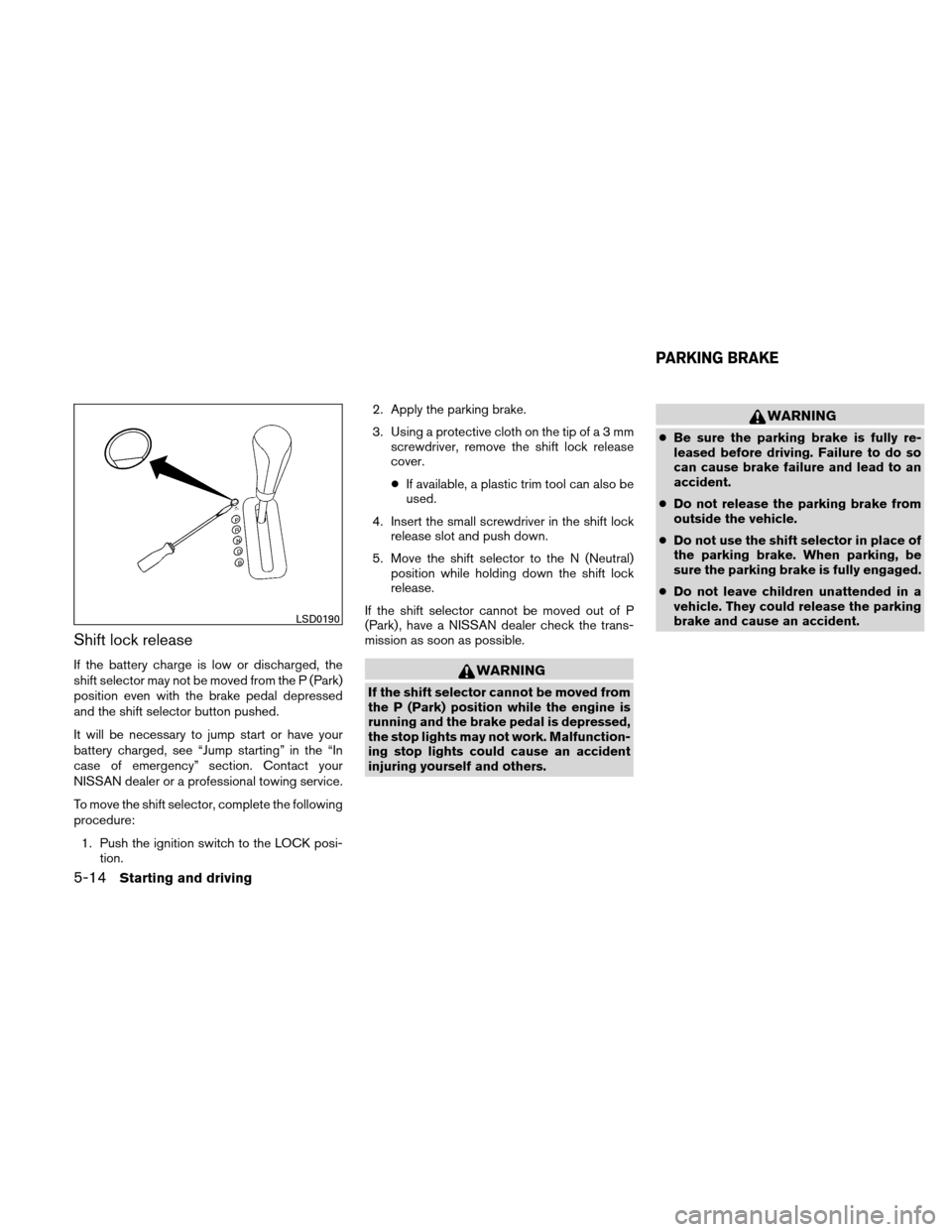
To move the shift selector, complete the following
procedure:1. Push the ignition switch to the LOCK posi- tion. 2. Apply the parking brake.
3. Using a protective cloth on the tip ofa3mm
screwdriver, remove the shift lock release
cover.
● If available, a plastic trim tool can also be
used.
4. Insert the small screwdriver in the shift lock release slot and push down.
5. Move the shift selector to the N (Neutral) position while holding down the shift lock
release.
If the shift selector cannot be moved out of P
(Park) , have a NISSAN dealer check the trans-
mission as soon as possible.WARNING
If the shift selector cannot be moved from
the P (Park) position while the engine is
running and the brake pedal is depressed,
the stop lights may not work. Malfunction-
ing stop lights could cause an accident
injuring yourself and others.
WARNING
● Be sure the parking brake is fully re-
leased before driving. Failure to do so
can cause brake failure and lead to an
accident.
● Do not release the parking brake from
outside the vehicle.
● Do not use the shift selector in place of
the parking brake. When parking, be
sure the parking brake is fully engaged.
● Do not leave children unattended in a
vehicle. They could release the parking
brake and cause an accident.
LSD0190
PARKING BRAKE
5-14Starting and driving
Page 320 of 422
6 In case of emergency
Emergency engine shut off.........................6-2
Flat tire ...........................................6-2
Tire Pressure Monitoring System (TPMS) ..........6-2
Changing a flat tire .............................6-3
Hybrid system stops operating while driving ..........6-7
Vehicle does not start ..............................6-7
Confirm battery is discharged . ...................6-7 Emergency Start
...............................6-7
Jump starting .....................................6-8
Push starting ..................................... 6-10
If your vehicle overheats ........................... 6-10
Towing your vehicle ............................... 6-11
Towing recommended by NISSAN ..............6-12
Vehicle recovery (freeing a stuck vehicle) .........6-13
Page 330 of 422
3. Get out of the vehicle. Look and listen forsteam or coolant escaping from the radiator
before opening the hood. (If steam or cool-
ant is escaping, turn the Hybrid System off.)
Do not open the hood further until no steam
or coolant can be seen.
4. Open the engine hood.
WARNING
If steam or water is coming from the en-
gine and/or inverter, stand clear to pre-
vent getting burned.
5. Visually check drive belts for damage or looseness. Also check if the cooling fan is
running. The radiator hoses and radiator
should not leak water. If coolant is leaking,
the water pump belt is missing or loose, or
the cooling fan does not run, turn the Hybrid
System off.
WARNING
Be careful not to allow your hands, hair,
jewelry or clothing to come into contact
with, or get caught in, engine belts or the
engine cooling fan. The engine or engine
cooling fan can start at any time. 6. After the engine and inverter cools down,
check the coolant level in the engine and
inverter coolant reservoir tank with the en-
gine running. Add coolant to the engine and
inverter coolant reservoir tank if necessary.
Have your vehicle repaired at a NISSAN
dealer. When towing your vehicle, all State (Provincial in
Canada) and local regulations for towing must be
followed. Incorrect towing equipment could dam-
age your vehicle. Towing instructions are avail-
able from a NISSAN dealer. Local service opera-
tors are generally familiar with the applicable laws
and procedures for towing. To assure proper
towing and to prevent accidental damage to your
vehicle, NISSAN recommends having a service
operator tow your vehicle. It is advisable to have
the service operator carefully read the following
precautions:
WARNING
●
Never ride in a vehicle that is being
towed.
● Never get under your vehicle after it has
been lifted by a tow truck.
CAUTION
● When towing, make sure that the trans-
mission, axles, steering system and
powertrain are in working condition. If
any of these conditions apply, dollies or
a flatbed tow truck must be used.
● Always attach safety chains before
towing.
TOWING YOUR VEHICLE
In case of emergency6-11
Page 331 of 422
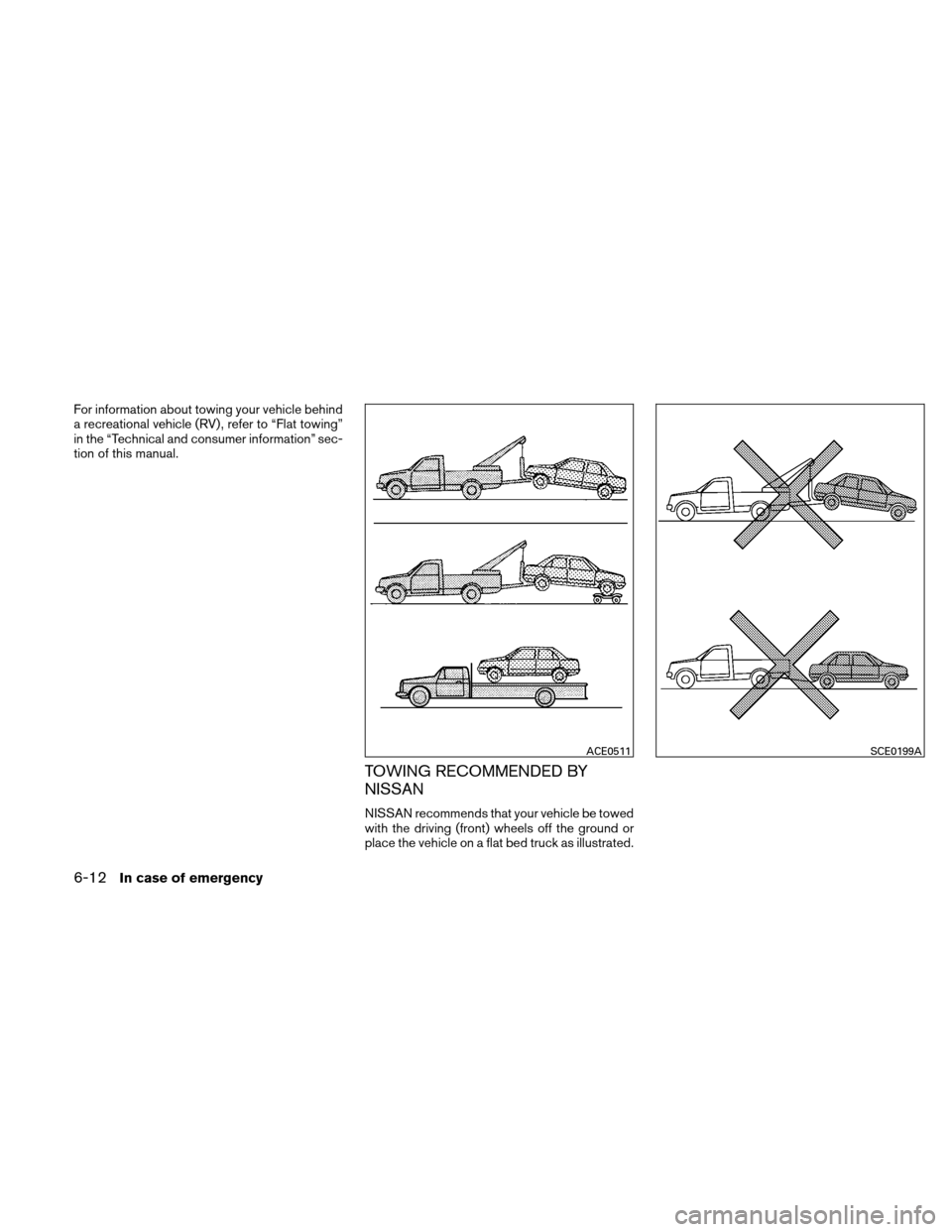
For information about towing your vehicle behind
a recreational vehicle (RV) , refer to “Flat towing”
in the “Technical and consumer information” sec-
tion of this manual.
TOWING RECOMMENDED BY
NISSAN
NISSAN recommends that your vehicle be towed
with the driving (front) wheels off the ground or
place the vehicle on a flat bed truck as illustrated.
ACE0511SCE0199A
6-12In case of emergency
Page 332 of 422
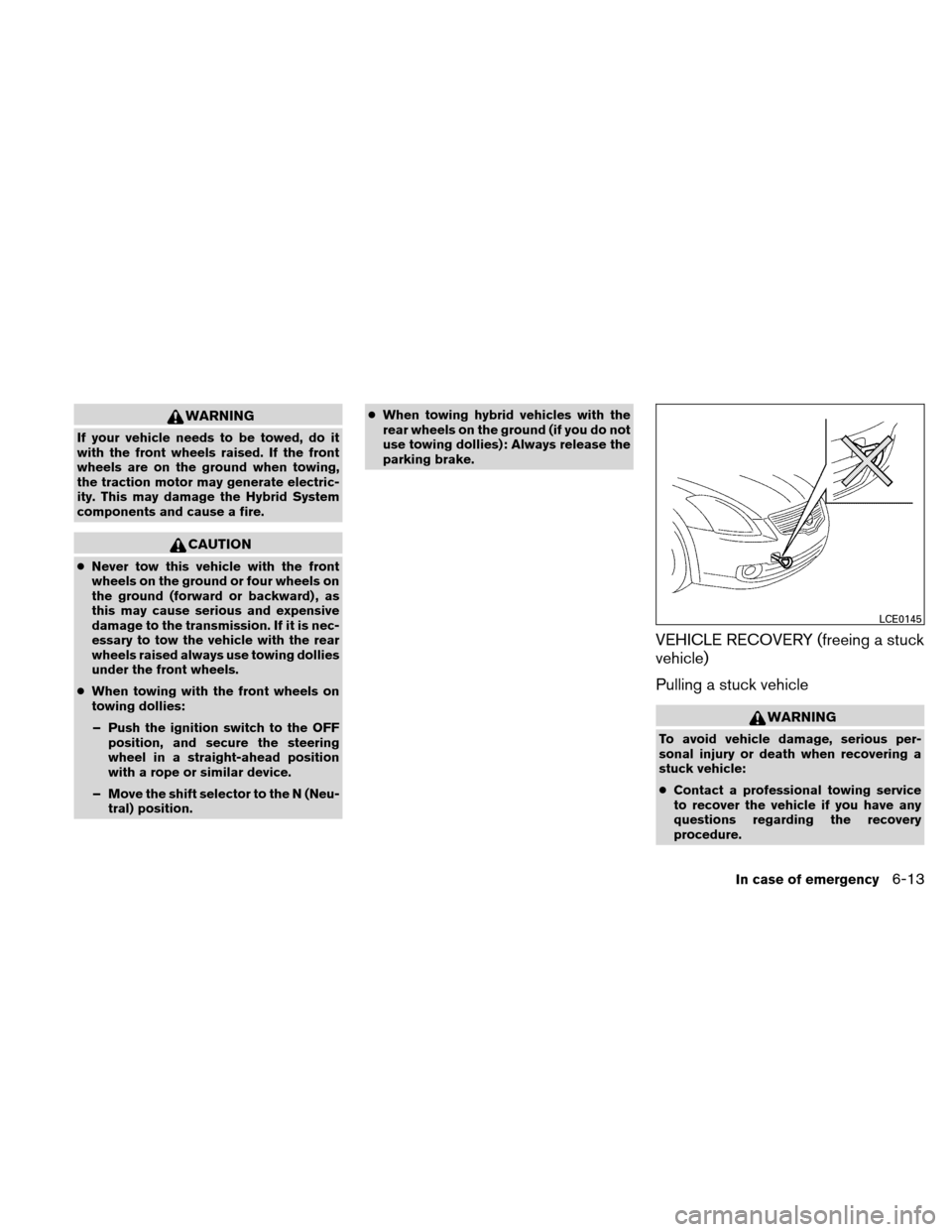
WARNING
If your vehicle needs to be towed, do it
with the front wheels raised. If the front
wheels are on the ground when towing,
the traction motor may generate electric-
ity. This may damage the Hybrid System
components and cause a fire.
CAUTION
●Never tow this vehicle with the front
wheels on the ground or four wheels on
the ground (forward or backward) , as
this may cause serious and expensive
damage to the transmission. If it is nec-
essary to tow the vehicle with the rear
wheels raised always use towing dollies
under the front wheels.
● When towing with the front wheels on
towing dollies:
– Push the ignition switch to the OFF position, and secure the steering
wheel in a straight-ahead position
with a rope or similar device.
– Move the shift selector to the N (Neu- tral) position. ●
When towing hybrid vehicles with the
rear wheels on the ground (if you do not
use towing dollies): Always release the
parking brake.
VEHICLE RECOVERY (freeing a stuck
vehicle)
Pulling a stuck vehicle
WARNING
To avoid vehicle damage, serious per-
sonal injury or death when recovering a
stuck vehicle:
● Contact a professional towing service
to recover the vehicle if you have any
questions regarding the recovery
procedure.
LCE0145
In case of emergency6-13
Page 333 of 422
●Do not use the vehicle tie-downs to tow
or free a stuck vehicle.
● Only use devices specifically designed
for vehicle recovery and follow the
manufacturer’s instructions.
● Always pull the recovery device straight
out from the front of the vehicle. Never
pull at an angle.
● Route recovery devices so they do not
touch any part of the vehicle except the
attachment point.
If your vehicle is stuck in sand, snow, mud, etc.,
use a tow strap or other device designed specifi-
cally for vehicle recovery. Always follow the
manufacturer’s instructions for the recovery de-
vice.
Do not use the tie-down hooks for towing or
vehicle recovery.Rocking a stuck vehicle
WARNING
● Stand clear of a stuck vehicle.
● Do not spin your tires at high speed.
This could cause them to explode and
result in serious injury. Parts of your
vehicle could also overheat and be
damaged.
If your vehicle is stuck in sand, snow, mud, etc.,
use the following procedure: 1. Make sure the area in front and behind the vehicle is clear of obstructions.
2. Turn the steering wheel right and left to clear an area around the front tires.
3. Slowly rock the vehicle forward and back- ward.
● Shift back and forth between R (Reverse)
and D (Drive) .
● Apply the accelerator as little as possible
to maintain the rocking motion.
● Release the accelerator pedal before
shifting between R (Reverse) and D
(Drive) . ●
Do not spin the tires above 35 mph (55
km/h) .
4. If the vehicle cannot be freed after a few tries, contact a professional towing service
to remove the vehicle.
6-14In case of emergency
Page 386 of 422
9 Technical and consumer information
Capacities and recommended fuel/lubricants.........9-2
Fuel recommendation . . .........................9-3
Engine oil and oil filter recommendations ..........9-5
Air conditioner system refrigerant and oil
recommendations ..............................9-6
Specifications .....................................9-7
Engine ........................................9-7
Wheels and tires ...............................9-8
Dimensions and weights ........................9-8
When traveling or registering your vehicle in
another country ...................................9-9
Vehicle identification ...............................9-9
Vehicle identification number (VIN) plate ..........9-9
Vehicle identification number
(chassis number) ...............................9-9
Engine serial number ........................... 9-10
F.M.V.S.S./C.M.V.S.S. certification label ..........9-10
Emission control information label ...............9-10
Tire and loading information label ................9-11Air conditioner specification label
................9-11
Installing front license plate ........................9-12
Vehicle loading information ........................9-12
Terms ........................................ 9-12
Vehicle load capacity .......................... 9-13
Loading tips .................................. 9-15
Measurement of weights .......................9-15
Towing a trailer ................................... 9-16
Maximum load limits ........................... 9-16
Towing load/specification .......................9-19
Towing safety ................................. 9-19
Flat towing .................................... 9-22
Uniform tire quality grading ........................9-23
Emission control system warranty ..................9-24
Reporting safety defects .......................... 9-24
Readiness for inspection/maintenance (I/M) test .....9-25
Event Data Recorders (EDR) .......................9-26
Owner’s Manual/Service Manual order information . . . 9-26 In the event of a collision .......................9-27