2011 MITSUBISHI TRITON Spare
[x] Cancel search: SparePage 18 of 369
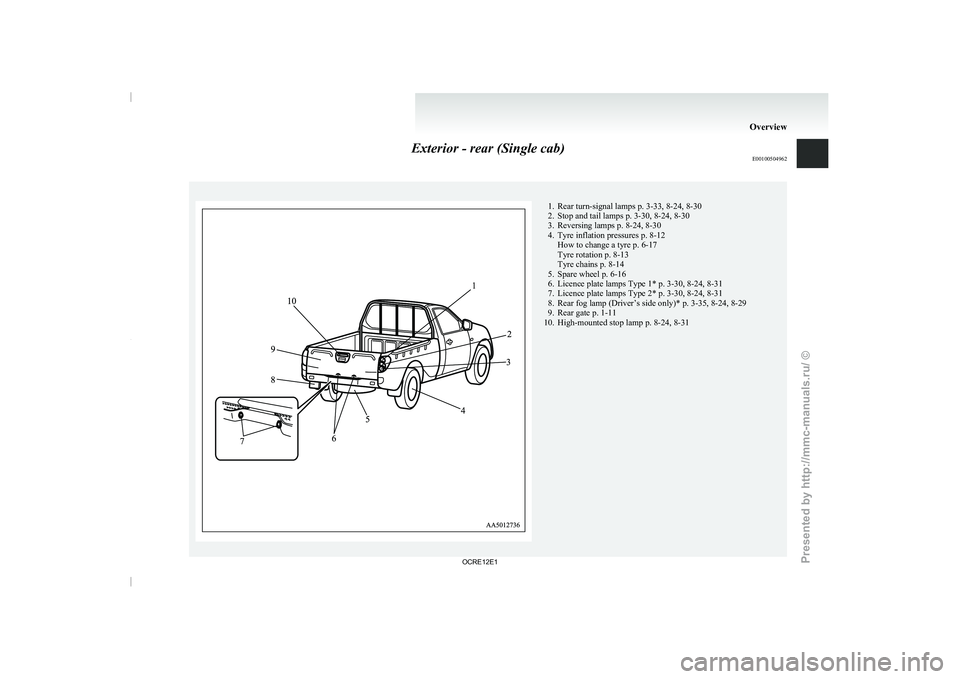
Exterior - rear (Single cab)
E00100504962 1. Rear turn-signal lamps p. 3-33, 8-24, 8-30
2. Stop and tail lamps p. 3-30, 8-24, 8-30
3. Reversing lamps p. 8-24, 8-30
4.
Tyre inflation pressures p. 8-12
How to change a tyre p. 6-17
Tyre rotation p. 8-13
Tyre chains p. 8-14
5.
Spare wheel p. 6-16
6. Licence plate lamps Type 1* p. 3-30, 8-24, 8-31
7. Licence plate lamps Type 2* p. 3-30, 8-24, 8-31
8. Rear fog lamp (Driver’s side only)* p. 3-35, 8-24, 8-29
9. Rear gate p. 1-11
10. High-mounted stop lamp p. 8-24, 8-31 Overview
OCRE12E1
Presented by http://mmc-manuals.ru/ \251
Page 20 of 369
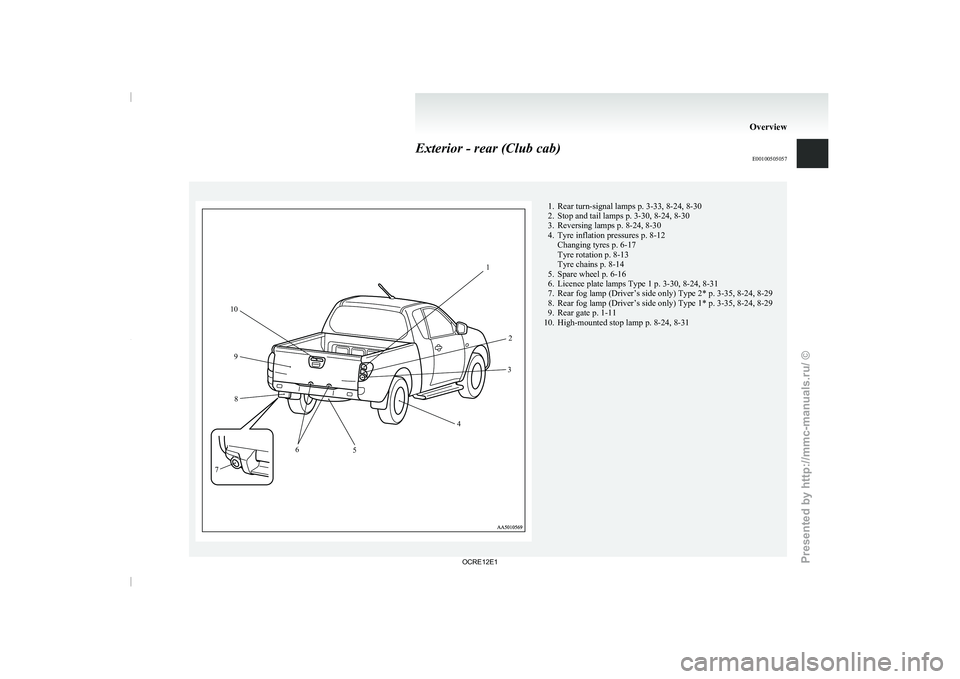
Exterior - rear (Club cab)
E00100505057 1. Rear turn-signal lamps p. 3-33, 8-24, 8-30
2. Stop and tail lamps p. 3-30, 8-24, 8-30
3. Reversing lamps p. 8-24, 8-30
4.
Tyre inflation pressures p. 8-12
Changing tyres p. 6-17
Tyre rotation p. 8-13
Tyre chains p. 8-14
5.
Spare wheel p. 6-16
6. Licence plate lamps Type 1 p. 3-30, 8-24, 8-31
7. Rear fog lamp (Driver’s side only) Type 2* p. 3-35, 8-24, 8-29
8. Rear fog lamp (Driver’s side only) Type 1* p. 3-35, 8-24, 8-29
9. Rear gate p. 1-11
10. High-mounted stop lamp p. 8-24, 8-31 Overview1
2
3
4
5
6
7 8
9
10
OCRE12E1
Presented by http://mmc-manuals.ru/ \251
Page 22 of 369
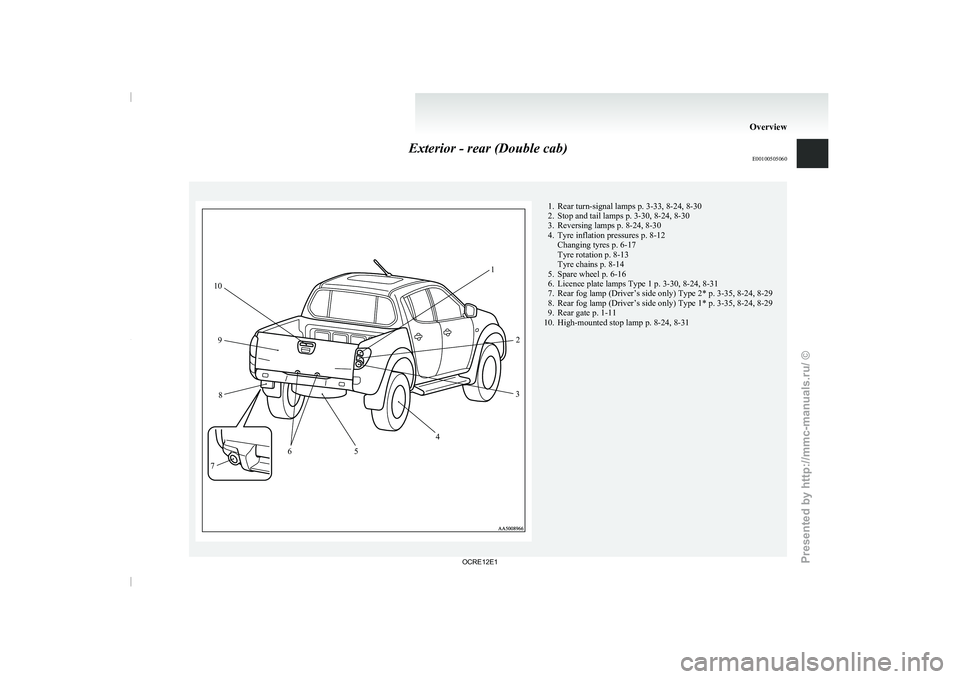
Exterior - rear (Double cab)
E00100505060 1. Rear turn-signal lamps p. 3-33, 8-24, 8-30
2. Stop and tail lamps p. 3-30, 8-24, 8-30
3. Reversing lamps p. 8-24, 8-30
4.
Tyre inflation pressures p. 8-12
Changing tyres p. 6-17
Tyre rotation p. 8-13
Tyre chains p. 8-14
5.
Spare wheel p. 6-16
6. Licence plate lamps Type 1 p. 3-30, 8-24, 8-31
7. Rear fog lamp (Driver’s side only) Type 2* p. 3-35, 8-24, 8-29
8. Rear fog lamp (Driver’s side only) Type 1* p. 3-35, 8-24, 8-29
9. Rear gate p. 1-11
10. High-mounted stop lamp p. 8-24, 8-31 Overview1
2
3
4
5
6
7 8
9
10
OCRE12E1
Presented by http://mmc-manuals.ru/ \251
Page 31 of 369

Keys
E00300101608
Two keys are provided. The key fits all locks.
Keep one in a safe place as a spare key.Type 1
Type 2 WARNING
l When taking a key on
flights, do not
press any switches on the key while on
the plane. If a switch is pressed on the
plane, the key emits electromagnetic
waves, which could adversely affect the
plane’s flight operation.
When carrying a key in a bag, be careful
that no switches on the key can be easily
pressed by mistake.
NOTE l The
key number is stamped
on the tag as in-
dicated in the illustration.
Make a record of the key number and store
the key and key number tag in separate pla-
ces, so that you can order a key in the event
the original keys are lost.
l The key is a precision electronic device with
a built-in signal transmitter. Please observe
the following in order to prevent a malfunc-
tion.
• Do not leave in a place that is exposed todirect sunlight, for example on the dash-
board.
• Do not disassemble or modify.
• Do not excessively bend the key or sub- ject it to strong impacts.
• Do not expose to water.
• Keep away from magnetic key holders.
• Keep away from audio systems, personal computers, TVs, and other equipment
that generates a magnetic field.
• Do not clean with ultrasonic cleaners or similar equipment. • Do
not leave the key where it may be ex-
posed to high temperature
or high humid-
ity.
l The engine is designed so that it will not
start if the ID code registered in the immobil-
izer computer and the key’s ID code do not
match. Refer to the “Electronic immobilizer”
section for details and key usage. Locking and unlocking
1-02
1
OCRE12E1
Presented by http://mmc-manuals.ru/ \251
Page 32 of 369

Electronic immobilizer (Anti-
theft starting system) E00300200921
The electronic immobilizer is designed to
signifi-
cantly reduce the possibility of vehicle theft. The
purpose of the system is to immobilize the vehicle
if an invalid start is attempted. A valid start attempt
can only be achieved (subject to certain conditions)
using a keyless operation system “registered” to
the immobilizer system.
NOTE
l In the following cases, the vehicle may not
be able to receive the registered ID code
from the key. This means the engine will not
start even when the registered key is turned
to the “START” position.
• When the key contacts a key ring or othermetallic or magnetic object (Type A)
• When the key grip contacts metal of an- other key (Type B)
• When the key contacts or is close to other immobilizing keys (including keys of oth-
er vehicles) (Type C)
In cases like these, remove the object or
additional key from the vehicle key and
turn the key back to the “ACC” or
“LOCK” position. Then try again to start
the engine. If the engine does not start, we recom-
mend
you to contact your MITSUBISHI
MOTORS Authorized Service Point. l
Two keys are provided.
If you lose one of
them,
order a replacement
as soon as possible.
To obtain a key, take your vehicle and all re-
maining keys to a MITSUBISHI MOTORS
Authorized Service Point.
If you need an extra spare key, take your ve-
hicle and all the keys to a MITSUBISHI
MOTORS Authorized Service Point. All the
keys have to be re-registered in the immobil-
izer computer unit. The immobilizer allows
up to 8 different ID codes to be registered;
you can register a maximum of 8 keys for use. CAUTION
l
Don’t make any alterations or
additions
to
the immobilizer system; alterations or
additions could cause failure of the immo-
bilizer. Locking and unlocking
1-03 1
OCRE12E1
Presented by http://mmc-manuals.ru/ \251
Page 266 of 369

If the vehicle breaks down
............................................................ 6-02
Emergency starting ....................................................................... 6-02
Engine overheating ....................................................................... 6-04
Bleeding the fuel system...............................................................6-05 Removal of water from the fuel filter ...........................................6-06
Tools, jack and jack handle .......................................................... 6-07
Jacking up the vehicle...................................................................6-13
Spare wheel................................................................................... 6-16
How to change a tyre .................................................................... 6-17
Towing .......................................................................................... 6-20
Operation under adverse driving conditions .................................6-24For emergencies
6
OCRE12E1
Presented by http://mmc-manuals.ru/ \251
Page 278 of 369

Jacking up the vehicle
E00801001436
1. Park the vehicle on level and stable ground.
2. Set the parking brake firmly.
3. On vehicles
with manual transmission, turn
the ignition key to the “LOCK” position,
move the gearshift lever to the “R” (Reverse)
position.
On vehicles with automatic transmission,
move the selector lever to the “P” (PARK) po-
sition, turn the ignition key to the “LOCK”
position.
4. Turn on the hazard warning flashers and set up a warning triangle, flashing signal lamp,
etc., at an adequate distance from the vehi-
cle, and have all your passengers leave the ve-
hicle.
5. To prevent the vehicle from rolling when it is raised on the jack, place chocks or blocks
(A) at the tyre that is diagonally opposite
from the tyre (B) you are changing. WARNING
l Be sure to apply chocks
or blocks to the
correct tyre when jacking up the vehicle.
If the vehicle moves while jacked up, the
jack could slip out of position, leading to
an accident.
NOTE l The
chocks shown in the
illustration do not
come with your vehicle. It is recommended
that you keep one in the vehicle for use if nee-
ded.
l If chocks are not available, use stones or any
other objects that are large enough to hold
the wheel in position.
6. Get the spare wheel, jack and jack handle ready.
7. Place the jack under one of the jacking points shown in the illustration. Use the jack-
ing point closest to the tyre you wish to
change. 2WD vehicles with 15 inch wheels C- Front jacking point (2WD vehicles with 15
inch wheels)
2WD vehicles with 16 inch wheels and 4WD ve-
hicles D- Front jacking point (2WD vehicles 16 inch
wheels and 4WD vehicles) For emergencies
6-13 6
OCRE12E1
Presented by http://mmc-manuals.ru/ \251
Page 281 of 369
Spare wheel
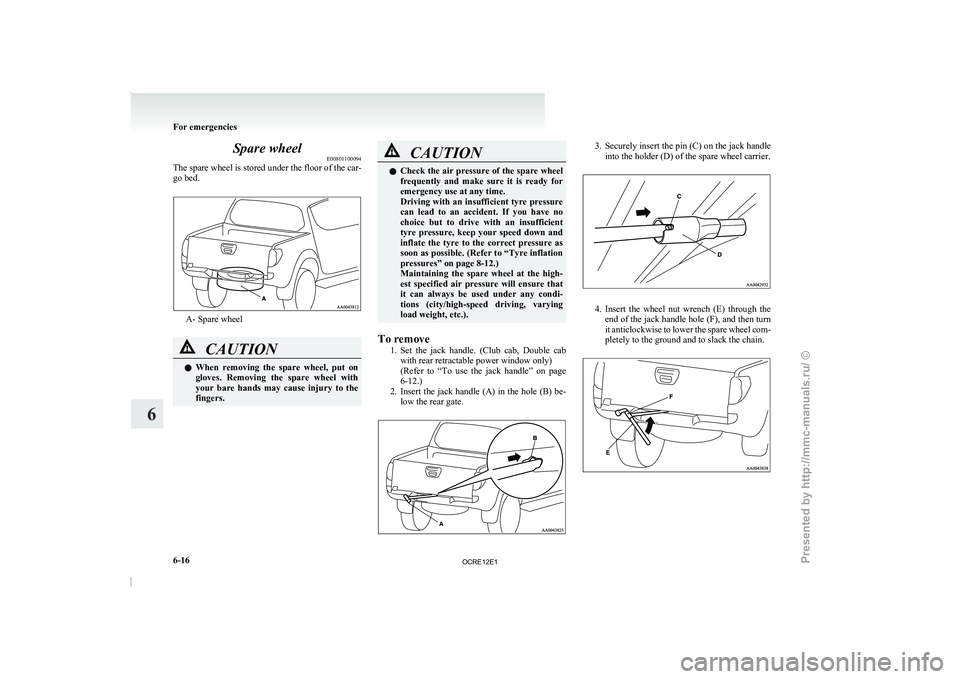
E00801100094
The spare wheel is stored
under the floor of the car-
go bed. A- Spare wheel
CAUTION
l
When removing the spare
wheel,
put on
gloves. Removing the spare wheel with
your bare hands may cause injury to the
fingers. CAUTION
l
Check the air pressure of
the spare wheel
frequently and make sure it is ready for
emergency use at any time.
Driving with an insufficient tyre pressure
can lead to an accident. If you have no
choice but to drive with an insufficient
tyre pressure, keep your speed down and
inflate the tyre to the correct pressure as
soon as possible. (Refer to “Tyre inflation
pressures” on page 8-12.)
Maintaining the spare wheel at the high-
est specified air pressure will ensure that
it can always be used under any condi-
tions (city/high-speed driving, varying
load weight, etc.).
To remove 1. Set the jack handle. (Club
cab, Double cab
with rear retractable power window only)
(Refer to “To use the jack handle” on page
6-12.)
2. Insert the jack handle (A) in the hole (B) be- low the rear gate. 3. Securely insert the pin (C) on the jack handle
into the holder (D) of the spare wheel carrier. 4. Insert the wheel nut wrench (E) through the
end of the jack
handle hole (F), and then turn
it anticlockwise to lower the spare wheel com-
pletely to the ground and to slack the chain. For emergencies
6-16
6
OCRE12E1
Presented by http://mmc-manuals.ru/ \251