2011 MITSUBISHI TRITON warning
[x] Cancel search: warningPage 55 of 369

NOTE
l You
can check if the
belt locks by pulling it
forward quickly.
To fasten 1. Pull the seat belt out slowly while holdingthe latch plate.
NOTE l When the seat belts cannot be pulled out in a
locked condition, pull the belts once forceful-
ly and then return them. After that, pull the
belts out slowly once again.
2. Insert the latch plate into the buckle until a “click” is heard. WARNING
l Never wear the lap
portion
of the belt
across your abdomen. During accidents it
can press sharply against the abdomen
and increase the risk of injury. WARNING
l The seat belts must not
be twisted when
worn.
3. Pull the belt slightly to adjust slackness as de-
sired.
To unfasten
Hold the
latch plate
and push the button on the buck-
le. NOTE
l As
the belt retracts automatically,
keep hold-
ing the latch plate while retracting so that the
belt stows slowly. Failure to do this could
damage the vehicle.
Seat belt reminder/warning lamp E00409800790
A tone and warning lamp are used to remind the
driver and front passenger to fasten the seat belt. NOTE
l For
the front passenger seat,
the warning func-
tion works only while a person is sitting on
the seat. When the ignition key is turned to the “ON” posi-
tion, the warning lamp will
come on and a tone
will sound for about 6 seconds. If the front seat belt
remains unfastened approximately 1 minute later,
the warning lamp will flash and the tone sound in-
termittently (each 12 times) when the vehicle is driv-
en. If the passenger subsequently unfastens the seat
belt while driving, the warning lamp and tone will
issue further warnings. And if the seat belt remains
unfastened, the warning lamp and tone will issue
further warnings each time the vehicle starts mov-
ing from a stop. When the seat belt is fastened, the
warnings will stop. Seat and seat belts
2-10
2
OCRE12E1
Presented by http://mmc-manuals.ru/ \251
Page 56 of 369

WARNING
l In order to reduce the risk of serious or fa-
tal injury in an accident, always wear
your own seat belt. Do not allow anyone
to ride in your vehicle unless he or she is
also seated and wearing a seat belt. Chil-
dren should additionally be restrained in
a secure child restraint system.
NOTE l When
luggage is placed on
the front passen-
ger seat, a sensor in the seat cushion may, de-
pending on the weight and position of the lug-
gage, cause the warning tone to sound and
the warning lamp to come on (Double cab).
Adjustable seat belt anchor (front
seats)* E00405000299
The seat belt anchor height can be adjusted.
Move the seat belt anchor
down with the lock knob
(A) depressed. To move the anchor up, slide it with-
out depressing the lock knob (A).
Anchor down Anchor up WARNING
l When adjusting the seat belt
anchor, set
it at a position that is sufficiently high so
that the belt will make full contact with
your shoulder but will not touch your neck.
Lap belts* E00405100128
The lap belts should be adjusted by holding the belt
and latch plate
at right
angles to each other, and
then pulling the belt as shown in the illustration to
a snug fit around the occupant. 1- Tighten
2- Loosen
While holding the latch
plate, insert the latch plate
into the buckle until a “click” is heard. Pregnant women restraint
E00405600064 WARNING
l Seat belts work for
everyone,
including
pregnant women. Pregnant women
should use the available seat belts. This
will reduce the likelihood of injury to
both the woman and the unborn child.
The lap belt should be worn across the
thighs and as snug against the hips as pos-
sible, but not across the waist. Consult
your doctor if you have any additional
questions or concerns. Seat and seat belts
2-11 2
OCRE12E1
Presented by http://mmc-manuals.ru/ \251
Page 57 of 369

Seat belt pretensioner system and
force limiter system* E00405700283
The driver’s and front passenger’s
seat equipped
with an airbag has a pretensioner seat belt.
Pretensioner system E00405801089
The pretensioner system will retract their respec-
tive seat belts instantaneously, thus
maximizing the
seat belt’s effectiveness, if there is a frontal impact
severe enough to injure the driver and/or front pas-
senger and the ignition switch is in the “ON” or
“START” position.
The seat belt pretensioner includes the following
components: 1- Front impact sensors
2- Seat belt pretensioners
3- Airbag control unit WARNING
l To obtain the best results
from your pre-
tensioner seat belt, make sure you have ad-
justed your seat correctly and wear your
seat belt properly. CAUTION
l
Installation
of audio
equipment or
re-
pairs in the vicinity of the pretensioner
seat belts or floor console must be per-
formed in line with MITSUBISHI
MOTORS guidelines. It is important to
do so because the work could affect the
pretensioner systems.
l If you need to scrap the vehicle, please con-
sult a MITSUBISHI MOTORS Author-
ized Service Point. It is important to do
so because unexpected activation of the
pretensioner seat belts could cause inju-
ries.
NOTE l The
pretensioner seat belts will
be activated
if the vehicle suffers a severe frontal impact,
even if the seat belts are not worn.
l The pretensioner seat belts are designed to
work only once. After the pretensioner seat
belts have been activated, we recommend
you have them replaced by a MITSUBISHI
MOTORS Authorized Service Point.
SRS warning lamp E00405900126
This warning lamp is shared by the SRS airbags
and the pretensioner seat belts. Refer to “SRS warning lamp” on page 2-38.
Force limiter system
E00406000078
In the event of a collision, each force limiter sys-
tem will effectively absorb the
load applied to the
seat belt so as to minimize the impact to the passen-
ger. Seat and seat belts
2-12
2
OCRE12E1
Presented by http://mmc-manuals.ru/ \251
Page 58 of 369
Child restraint
E00406401297
When transporting children in your
vehicle, some
type of child restraint system should always be
used according to the size of the child. This is re-
quired by law in most countries.
The regulations concerning driving with children in
the front seat may differ from country to country.
You are advised to comply with the relevant regula-
tions. WARNING
l When possible, put children
in
the rear
seat. Accident statistics indicate that chil-
dren of all sizes and ages are safer when
properly restrained in the rear seat rath-
er than in the front seat. (Double cab and
Club cab)
l Holding a child in your arms is no substi-
tute for a restraint system. Failure to use
a proper restraint system can result in se-
vere or fatal injury to the child.
l Each child restraint device or fixing is to
be used only by one child.
l When attaching a child restraint to the
rear seat, place the front seatbacks in the
upright position.
Otherwise, the child could be seriously in-
jured in the event of hard braking or a col-
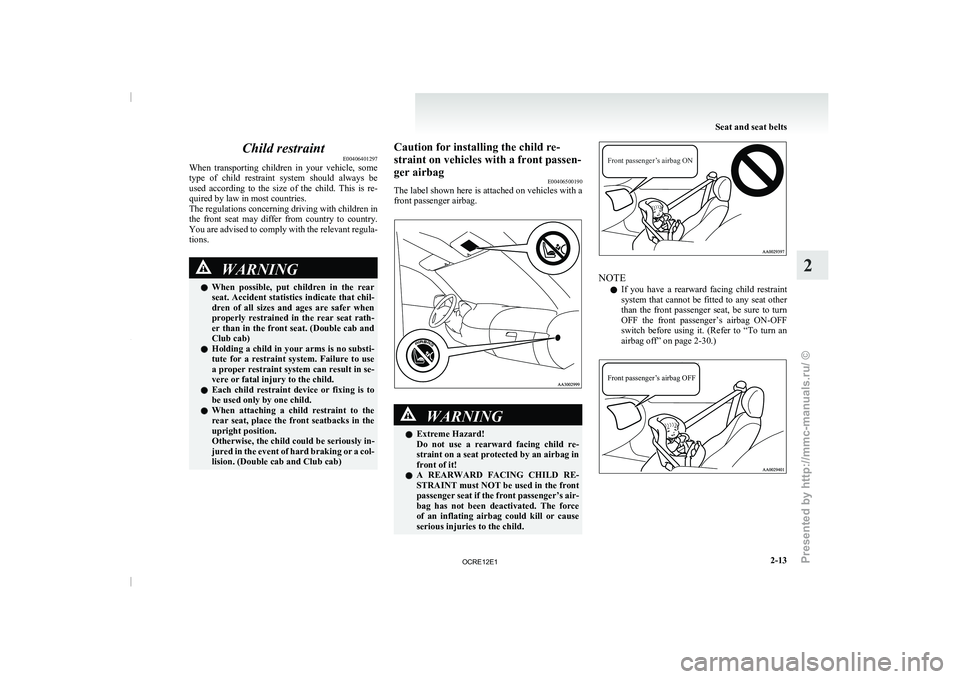
lision. (Double cab and Club cab) Caution for installing the child re-
straint on vehicles with a front passen-
ger airbag
E00406500190
The label shown here is
attached on vehicles with a
front passenger airbag. WARNING
l Extreme Hazard!
Do not use a
rearward
facing child re-
straint on a seat protected by an airbag in
front of it!
l A REARWARD FACING CHILD RE-
STRAINT must NOT be used in the front
passenger seat if the front passenger’s air-
bag has not been deactivated. The force
of an inflating airbag could kill or cause
serious injuries to the child.
Front passenger’s airbag ON NOTE
l If
you have a rearward
facing child restraint
system that cannot be fitted to any seat other
than the front passenger seat, be sure to turn
OFF the front passenger’s airbag ON-OFF
switch before using it. (Refer to “To turn an
airbag off” on page 2-30.)
Front passenger’s airbag OFF Seat and seat belts
2-13 2
OCRE12E1
Presented by http://mmc-manuals.ru/ \251
Page 59 of 369
WARNING
l A FORWARD FACING CHILD RE-
STRAINT should not be used in the front
passenger seat whenever possible; if used
in the front passenger seat, adjust the
seat to the most rearward position. Infants and small children
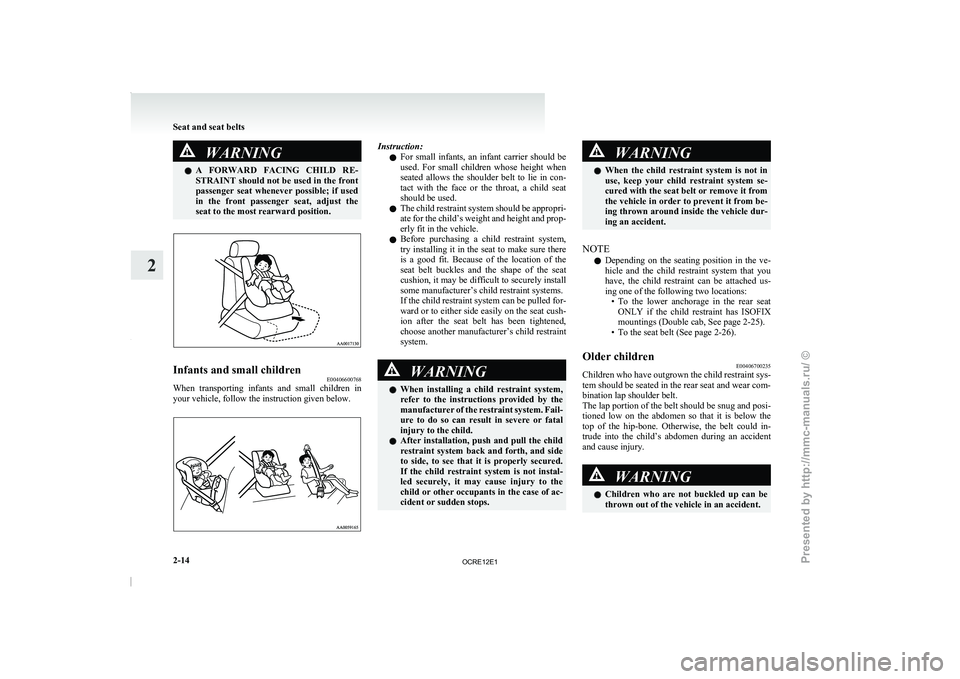
E00406600768
When transporting infants and small children in
your vehicle, follow the instruction given below. Instruction:
l For small infants, an infant
carrier should be
used. For small children whose height when
seated allows the shoulder belt to lie in con-
tact with the face or the throat, a child seat
should be used.
l The child restraint system should be appropri-
ate for the child’s weight and height and prop-
erly fit in the vehicle.
l Before purchasing a child restraint system,
try installing it in the seat to make sure there
is a good fit. Because of the location of the
seat belt buckles and the shape of the seat
cushion, it may be difficult to securely install
some manufacturer’s child restraint systems.
If the child restraint system can be pulled for-
ward or to either side easily on the seat cush-
ion after the seat belt has been tightened,
choose another manufacturer’s child restraint
system. WARNING
l When installing a child
restraint
system,
refer to the instructions provided by the
manufacturer of the restraint system. Fail-
ure to do so can result in severe or fatal
injury to the child.
l After installation, push and pull the child
restraint system back and forth, and side
to side, to see that it is properly secured.
If the child restraint system is not instal-
led securely, it may cause injury to the
child or other occupants in the case of ac-
cident or sudden stops. WARNING
l When the child restraint system
is not in
use, keep your child restraint system se-
cured with the seat belt or remove it from
the vehicle in order to prevent it from be-
ing thrown around inside the vehicle dur-
ing an accident.
NOTE l Depending
on the seating position
in the ve-
hicle and the child restraint system that you
have, the child restraint can be attached us-
ing one of the following two locations: • To the lower anchorage in the rear seatONLY if the child restraint has ISOFIX
mountings (Double cab, See page 2-25).
• To the seat belt (See page 2-26).
Older children E00406700235
Children who have outgrown the child restraint sys-
tem should be seated in the rear seat and wear com-
bination lap shoulder belt.
The lap portion of the belt should be snug and posi-
tioned low on the abdomen
so that it is below the
top of the hip-bone. Otherwise, the belt could in-
trude into the child’s abdomen during an accident
and cause injury. WARNING
l Children who are not
buckled
up can be
thrown out of the vehicle in an accident. Seat and seat belts
2-14
2
OCRE12E1
Presented by http://mmc-manuals.ru/ \251
Page 60 of 369
WARNING
l Children who are not buckled up can
strike other people in the vehicle in an ac-
cident.
l A child should never be left unattended
in your vehicle. When you leave the vehi-
cle, take the child with you. Seat and seat belts
2-15 2
OCRE12E1
Presented by http://mmc-manuals.ru/ \251
Page 69 of 369

Child restraint anchorage points (Dou-
ble cab)*
E00406900354
Anchorage locations
There are 2 child restraint
anchorage points on the
floor, located behind the rear seat. These are for se-
curing a child restraint system tether strap to each
of the 2 rear seating positions in your vehicle. *: Rear of the vehicle
CAUTION
l
The anchorages are only
applicable
for
child restraints fitted in the rear seat. Tether anchorage strap installation WARNING
l Child restraint anchorages are
designed
to
withstand only those loads imposed by
correctly fitted child restraints. Under no
circumstances are they to be used for
adult seat belts, harnesses, or for attach-
ing other items or equipment to the vehicle.
1. Remove the head restraint from the location
in which you wish to install a child restraint.
2. Drop
the child
restraint’s tether strap (A)
down the back of the rear seatback. 3. Tip the armrest forward. Open the fastener
(B) that is located
in the space where the arm-
rest was stowed. 4. Put your hand in the opening of the fastener,
attach the tether strap’s hook (C) to the tether
anchorage (D), and securely
tighten the teth-
er strap. Seat and seat belts
2-24
2
OCRE12E1
Presented by http://mmc-manuals.ru/ \251
Page 70 of 369
Installing a child restraint system to
the lower anchorage (ISOFIX child re-
straint mountings)*
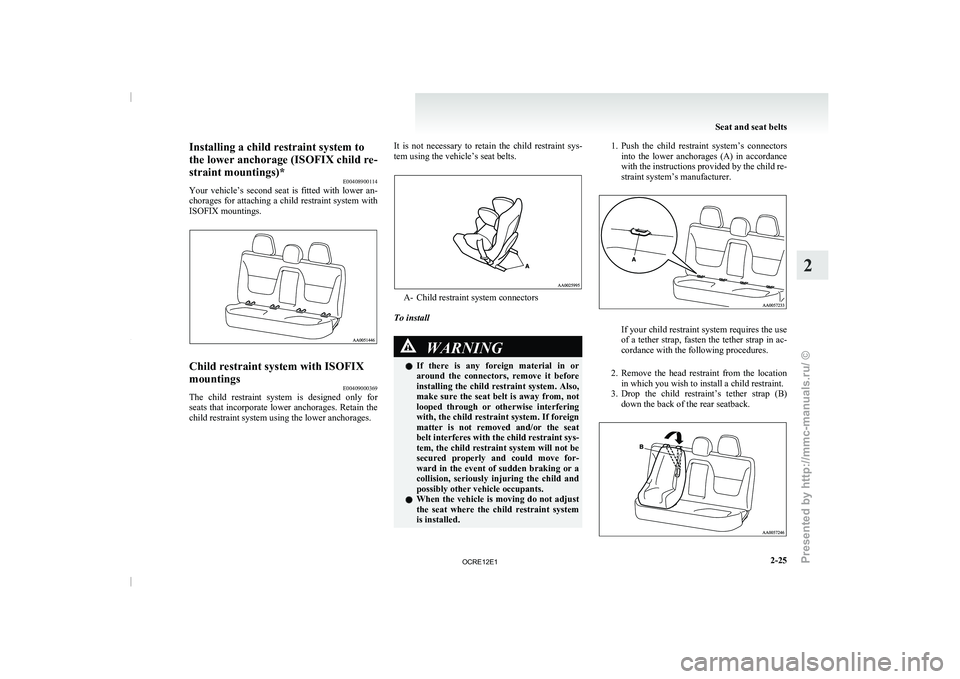
E00408900114
Your vehicle’s second seat is
fitted with lower an-
chorages for attaching a child restraint system with
ISOFIX mountings. Child restraint system with ISOFIX
mountings
E00409000369
The child restraint system is designed only for
seats that incorporate lower anchorages.
Retain the
child restraint system using the lower anchorages. It is not necessary to retain the child restraint sys-
tem using the vehicle’s seat belts. A- Child restraint system connectors
To install WARNING
l If there is any
foreign
material in or
around the connectors, remove it before
installing the child restraint system. Also,
make sure the seat belt is away from, not
looped through or otherwise interfering
with, the child restraint system. If foreign
matter is not removed and/or the seat
belt interferes with the child restraint sys-
tem, the child restraint system will not be
secured properly and could move for-
ward in the event of sudden braking or a
collision, seriously injuring the child and
possibly other vehicle occupants.
l When the vehicle is moving do not adjust
the seat where the child restraint system
is installed. 1. Push the child restraint system’s connectors
into the lower anchorages
(A) in accordance
with the instructions provided by the child re-
straint system’s manufacturer. If your child restraint system requires the use
of a tether strap,
fasten
the tether strap in ac-
cordance with the following procedures.
2. Remove the head restraint from the location in which you wish to install a child restraint.
3. Drop the child restraint’s tether strap (B) down the back of the rear seatback. Seat and seat belts
2-25 2
OCRE12E1
Presented by http://mmc-manuals.ru/ \251