2011 MITSUBISHI TRITON parking brake
[x] Cancel search: parking brakePage 282 of 369

5. Remove the hanger disc (G) from the spare
wheel. To install
1. Install the hanger disc (A) in the wheel disc
hole. 2. Turn the wheel nut wrench (B) clockwise to
wind up the chain. NOTE
l Confirm
that the hanger disc
is securely fit-
ted in the wheel disc hole when the wheel is
just lifted off the ground.
3. After winding up the spare wheel sufficient- ly, make sure it is not loose (the tightening
torque should be approximately 40 Nm) then
withdraw the jack handle, taking care not to
turn it in the reverse direction. CAUTION
l
The spare wheel should
always
be secure-
ly in position.
If a flat tyre is changed, put the flat tyre
in the spare wheel mounting position
with the wheel outer surface upward, and
use the wheel nut wrench to secure it firm-
ly. How to change a tyre
E00801202653
Before changing a tyre, first
stop your vehicle in a
safe, flat location. 1. Park the vehicle on level and stable ground.
2. Set the parking brake firmly.
3. On vehicles with manual transmission, turnthe ignition key to the “LOCK” position,
move the gearshift lever to the “R” (Reverse)
position.
On vehicles with automatic transmission,
move the selector lever to the “P” (PARK) po-
sition, turn the ignition key to the “LOCK”
position.
4. Turn on the hazard warning flashers and set up a warning triangle, flashing signal lamp,
etc., at an adequate distance from the vehi-
cle, and have all your passengers leave the ve-
hicle.
5. To prevent the vehicle from rolling when it is raised on the jack, place chocks or blocks
(A) at the tyre that is diagonally opposite
from the tyre (B) you are changing. For emergencies
6-17 6
OCRE12E1
Presented by http://mmc-manuals.ru/ \251
Page 286 of 369

The regulations concerning towing may differ from
country to country. It is
recommended that you
obey the regulations of the area where you are driv-
ing your vehicle. Towing the vehicle by a tow truck
CAUTION
l
This vehicle must not
be
towed by a tow
truck using sling lift type equipment
(Type A) as illustrated. Using a sling lift
will damage the bumper and front end.
l On 4WD vehicles, be sure to shift the trans-
fer shift lever to “2H” position and trans-
port the vehicle with the driving wheels
on a carriage (Type C, D or E) as illustra-
ted. Never try to tow with the transfer
shift lever in “4H” or “4L” position (easy
select 4WD), “4H”, “4HLc” or “4LLc” po-
sition (super select 4WD) and with the
front or rear wheels on the ground (Type
B or C) as illustrated. This could result in
driving system damage or the vehicle
may jump at the carriage. If you cannot
shift the transfer shift lever to the “2H”
position or the transmission is malfunc-
tioning or damaged, transport the vehicle
with all wheels on a carriage (Type D or
E) as illustrated.
l If your vehicle equipped with the Active
Stability & Traction Control system
(ASTC), if the vehicle is towed with the ig-
nition switch in the “ON” position and on-
ly the front wheels or only the rear
wheels raised off the ground, the active
Traction Control System may operate, re-
sulting in an accident.
l On 2WD vehicles, if the transmission is
malfunctioning or damaged, transport
the vehicle with the driving wheels on a
carriage (Type C, D or E) as illustrated. CAUTION
l
If you tow a vehicle
with automatic trans-
mission with the driving wheels on the
ground (Type B) as illustrated, make sure
that the towing speed and distance given
below are never exceeded, causing dam-
age to the transmission.
Towing speed: 50 km/h (30 mph)
Towing distance: 50 km (30 miles)
For the towing speed and the towing dis-
tance, follow the local driving laws and
regulations.
Towing with front wheels off the ground (Type B)
Place the gearshift lever in
the “N” (Neutral) posi-
tion (manual transmission) or the selector lever in
the “N” (NEUTRAL) position (automatic transmis-
sion).
Release the parking brake. CAUTION
l
Never tow an automatic
transmission
ve-
hicle with the front wheels up (and the
rear wheels on the ground) (Type B)
when the automatic transmission fluid lev-
el is low. This may cause serious and ex-
pensive damage to the transmission. For emergencies
6-21 6
OCRE12E1
Presented by http://mmc-manuals.ru/ \251
Page 289 of 369

Operation under adverse driving
conditions E00801702140
If your vehicle becomes stuck in sand,
mud or snow
If the vehicle becomes stuck
in snow, sand, or
mud, it can often be moved with a rocking motion.
Move the selector lever alternately between the
“L” (LOW) and “R” (REVERSE) position (with
manual transmission, between 1 st
and Reverse),
while applying slight pressure to the accelerator ped-
al.
Avoid racing the engine or spinning the wheels. Pro-
longed efforts to free a stuck vehicle may result in
overheating and transmission failure. Allow the en-
gine to idle for a few minutes to let the transmis-
sion cool between rocking attempts.
If the vehicle remains stuck after several rocking at-
tempts, seek other assistance. WARNING
l When attempting to rock your vehicle out
of a stuck position,
be
sure that the area
around the vehicle is clear of people and
physical objects. The rocking motion may
cause the vehicle to suddenly launch for-
ward or backward, causing injury or dam-
age to nearby people or objects.
On 2WD vehicles, it is recommended to start the ve-
hicle with parking
brake partially,
but not complete-
ly, applied by slightly pulling the parking brake lev-
er.
After the vehicle has become free, do not forget to
release the parking brake. NOTE
l Depress the accelerator pedal gradually when
starting the vehicle.
On a flooded road l Avoid
flooded roads.
Water could
enter the
brake discs, resulting in temporarily ineffec-
tive brakes. In such cases, lightly depress the
brake pedal to see if the brakes operate prop-
erly. If they do not, lightly depress the pedal
several times while driving in order to dry
the brake pads.
l When driving in rain or on a road with many
puddles a layer of water may form between
the tyres and the road surface.
This reduces a tyre’s frictional resistance on
the road, resulting in loss of steering stability
and braking capability.
To cope with this, observe the following items:
(a) Drive your vehicle at slow speed.
(b) Do not drive on worn tyres. Always maintain the specified tyre inflation
pressures.
On a snow-covered or frozen road l When
driving on a snow-covered
or frozen
road, it is recommended that you use snow
tyres or tyre chains.
Refer to the “Snow tyres” and “Tyre chains”
sections.
l Avoid high-speed operation, sudden acceler-
ation, abrupt brake application and sharp cor-
nering. l
Depressing the brake pedal
during
travel on
snowy or icy roads may cause tyre slippage
and skidding. When traction between the
tyres and the road is reduced the wheels may
skid and the vehicle cannot readily be
brought to a stop by conventional braking
techniques. Braking will differ, depending
upon whether you have anti-lock brake sys-
tem (ABS). If you do have ABS, brake by
pressing the brake system pedal hard, and
keeping it pressed. If you do not have ABS,
pump the brake pedal with short rapid jabs,
each time fully applying and fully releasing
for greatest effect.
l Allow extra distance between your vehicle
and the vehicle in front of you, and avoid sud-
den braking.
l Accumulation of ice on the braking system
can cause the wheels to lock. Pull away from
a standstill slowly after confirming safety
around the vehicle. CAUTION
l
Do not press the
accelerator
pedal rapid-
ly. If the wheels break free of the ice, the
vehicle could suddenly start moving and
possibly cause an accident.
On a bumpy or rutted road l Drive
as slow as possible
when driving on
bumpy or rutted roads. For emergencies
6-24
6
OCRE12E1
Presented by http://mmc-manuals.ru/ \251
Page 298 of 369

Service precautions
....................................................................... 8-02
Catalytic converter ........................................................................ 8-02
Bonnet...........................................................................................8-03
Engine oil ......................................................................................8-04
Engine coolant .............................................................................. 8-06
Automatic transmission fluid*......................................................8-07 Washer fluid ................................................................................. 8-08
Brake fluid .................................................................................... 8-08
Clutch fluid* ................................................................................. 8-09
Power steering fluid ...................................................................... 8-09
Battery .......................................................................................... 8-10
Tyres............................................................................................. 8-11
Clutch pedal free play* ................................................................. 8-15
Brake pedal free play .................................................................... 8-16
Parking brake lever stroke ............................................................ 8-16
Wiper blades ................................................................................. 8-17
General maintenance .................................................................... 8-18
For cold and snowy weather ......................................................... 8-19
Fusible links
.................................................................................. 8-19
Fuses............................................................................................. 8-20
Replacement of lamp bulbs .......................................................... 8-23Maintenance
8
OCRE12E1
Presented by http://mmc-manuals.ru/ \251
Page 304 of 369

CAUTION
l
Do not use alcohol or methanol anti-
freeze or any engine coolants mixed with
alcohol or methanol anti-freeze. The use
of an improper anti-freeze can cause cor-
rosion of the aluminium components.
l For effective anti-corrosion and anti-
freeze performance, keep the anti-freeze
concentration within the range of 30 to
60 %.
Concentrations exceeding 60 % will re-
sult in a reduction of both the anti-freeze
and cooling performance thus adversely
affecting the engine.
l Do not top up with water only.
Water by itself reduces the rust-protec-
tive and anti-freeze qualities of the cool-
ant and has a lower boiling point. It can
also cause damage to the cooling system if
it should freeze. Do not use tapwater, as it
can cause corrosion and rust formation.
During cold weather
If the temperatures in your
area drop below freez-
ing, there is the danger that the coolant in the en-
gine or radiator could freeze and cause severe dam-
age to the engine and/or radiator. The concentra-
tion should be checked before the start of cold weath-
er and anti-freeze added to the system if necessary.
Add a sufficient amount of anti-freeze to the cool-
ant to prevent it from freezing.
The concentration should be checked before the
start of cold weather and anti-freeze added to the
system if necessary. Automatic transmission fluid*
E01000600974
The proper amount of automatic
transmission fluid
is essential to the life and operation of the automat-
ic transmission. Either insufficient fluid or exces-
sive fluid could cause transmission trouble. The
transmission fluid filler port cap is equipped with a
dipstick. Use the following procedure to check the
fluid level.
Procedure for checking the fluid level
1. Check the fluid level after the vehicle hasbeen driven enough to warm up the transmis-
sion fluid.
2. Park the vehicle on a flat, level surface and apply the parking brake.
3. With the engine idling and the brake pedal fully depressed, move the transmission selec-
tor lever through all the positions from the
"P” (PARK) to “L” (LOW) (with 4A/T), the
“P” (PARK) to “D” (DRIVE) (with 5A/T),
stopping momentarily at each position.
4. Move the selector lever to the “P” (PARK) position.
5. Remove the dipstick and wipe it with a clean lint-free cloth.
6. Reinsert the dipstick as far as it goes. 7. Remove dipstick and read the automatic trans-
mission fluid level.
The fluid level should
always be between the
two marks on the dipstick. WARNING
l Do not spill the
fluid
onto a hot exhaust
manifold during topping up or inspec-
tion, or a fire may occur.
Fluid type
Use only “DIA QUEEN ATF
SP III” transmission
fluid to ensure optimum transmission performance. Maintenance
8-07 8
OCRE12E1
Presented by http://mmc-manuals.ru/ \251
Page 313 of 369

Brake pedal free play
E01002300281
Stop the engine, depress the
brake pedal several
times, and press down the pedal with your fingers
until initial resistance is felt. This distance should
be within the specified range. A- Free play: 3 to 8 mm
If the brake pedal free
play is not within the stand-
ard range, we recommend you to have it checked. Parking brake lever stroke
E01002400527
Pull the parking brake lever
up to check the num-
ber of “clicks” that the ratchet makes. One click rep-
resents a lever movement of one notch. The lever
should move the specified number of notches for
normal brake application.
Type 1
A
Type 2 (LHD)
Type 2 (RHD) A- Parking brake lever stroke
Type 1 8 to 9 notches
Type 2 11 to 13 notches
(Parking brake adjustment when pulled
with
the force of 200 N)
If the parking brake lever stroke is out of the stand-
ard range, we recommend you to have it checked. WARNING
l Continued operation of the
vehicle
with
the parking brake lever out of adjust-
ment may result in the vehicle moving
when unattended. Maintenance
8-16
8
OCRE12E1
Presented by http://mmc-manuals.ru/ \251
Page 350 of 369
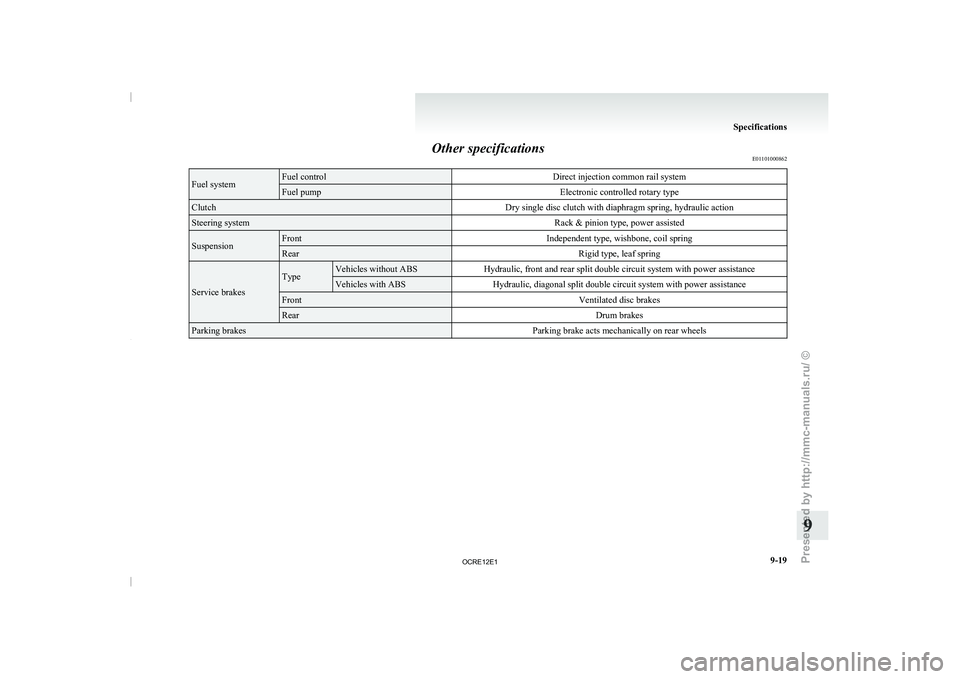
Other specifications
E01101000862Fuel system Fuel control
Direct injection common rail systemFuel pump
Electronic controlled rotary typeClutch
Dry single disc clutch with diaphragm spring, hydraulic actionSteering system
Rack & pinion type, power assistedSuspension Front
Independent type, wishbone, coil springRear
Rigid type, leaf springService brakes Type Vehicles without ABS
Hydraulic, front and rear split double circuit system with power assistance Vehicles with ABS
Hydraulic, diagonal split double circuit system with power assistanceFront
Ventilated disc brakesRear
Drum brakesParking brakes
Parking brake acts mechanically on rear wheels Specifications
9-19 9
OCRE12E1
Presented by http://mmc-manuals.ru/ \251
Page 356 of 369

4
4-wheel drive operation 4-39
AAccessory (Installation) 04
Accessory socket 5-72
Active Stability & Traction Control (ASTC) 4-47
Additional equipment 8-19
Air conditioning
Automatic air conditioning 5-08
Important operation tips for the air condition-
ing 5-12
Manual air conditioning 5-03
Air purifier 5-12
Airbag 2-27
Antenna 5-50
Anti-lock brake system (ABS) 4-44 Warning lamp 4-45
Armrest (Double cab) 2-07
Ashtray 5-70
Audio Audio system anti-theft feature
5-48
Error codes 5-42
Handling of compact discs 5-48
LW/MW/FM electronic tuning radio with CD
player 5-13
Steering wheel remote control switch 5-40
Automatic air conditioning 5-08
Automatic transmission 4A/T 4-17 Fluid 8-07,9-22
Overdrive control switch 4-18
Selector lever operation 4-17,4-21
Selector lever position 4-18
Selector lever position indicator 4-17
Automatic transmission Sports Mode 5A/T 4-21 Fluid 8-07,9-22 Selector lever operation 4-21
Selector lever position indicator 4-22
Selector lever positions 4-22 Sports mode 4-23
Sports mode indicator 4-23
B Battery 8-10
Discharged battery (Emergency starting) 6-02
Specification 9-17
Bleeding the fuel system 6-05
Bluetooth® 2.0 interface 5-51
Bonnet 8-03
Bottle holder 5-79
Brake Anti-lock brake 4-44
Brake assist system 4-44
Braking 4-43
Fluid 8-08,9-22
Parking brake 4-07
Parking brake lever stroke
8-16
Pedal free play 8-16
Warning lamp 3-08
C Cargo loads 4-54
Catalytic converter 8-02
Cautions on handling of 4-wheel drive vehi-
cles 4-41
Central door locks 1-07
Centre console downlight 5-75
Bulb capacity 8-24
Replacement 8-34
Centre information display
3-10
Changing a fuse 8-22
Changing gears 4-15
Check engine warning lamp 3-08 Child restraint 2-13
Child-protection rear doors 1-08
Cigarette lighter 5-71
Cleaning
Exterior of your vehicle 7-03
Genuine leather 7-02
Interior of your vehicle
7-02
Plastic, vinyl leather, etc 7-02
Sunroof 7-05
Waxing 7-04
Clock 3-19,5-73
Clutch Fluid 8-09,9-22
Pedal free play 8-15
Coat hook 5-80
Combination headlamps and dipper switch 3-30
Convenient hook 5-80
Coolant (engine) 8-06,9-22
Cruise control 4-50 Switch 4-50
Cup holder 5-78
Curtain airbag system 2-35
D Demister (rear window) 3-40
Diesel particulate filter (DPF) 4-14
Differential oil 9-22
Digital clock 3-19,5-73
Dimensions 9-03
Dipper (High/Low beam change)
3-31
Door courtesy lamps 5-75 Replacement
8-33
Doors Central door locks 1-07
Child-protection 1-08
Lock and unlock 1-06
Driving, alcohol and drugs 4-02 Alphabetical index
1
OCRE12E1
Presented by http://mmc-manuals.ru/ \251