2011 MITSUBISHI TRITON fuel consumption
[x] Cancel search: fuel consumptionPage 164 of 369

4-wheel drive operation
E00606600920
By selecting 4-wheel drive, both
axles of the vehi-
cle are rigidly connected with each other. This im-
proves the traction characteristics. When turning
sharp corners or moving forward and backward re-
peatedly, however, the drive line is stressed, which
is felt as a braking effect. A 4-wheel drive vehicle
can accelerate more quickly and smoothly.
However, note that the braking distance is not short-
er than that of a rear-wheel drive vehicle.
When using 4-wheel drive on rough roads (snow,
mud, sand, etc.), it is important to operate the vehi-
cle correctly.
NOTE
l The driving posture should be more upright
and closer to the wheel than usual; adjust the
seat to a good position for easy steering and
pedal operation. Be sure to wear the seat belt.
l After driving on rough roads, check each
part of the vehicle and wash it thoroughly
with water. Refer to the “Vehicle care” sec-
tion and “Inspection and maintenance follow-
ing rough road operation” on page 4-41.
Driving on dry paved road and highway
Select “2H” position (easy select 4WD), “2H” or
“4H” position (super select 4WD) to drive on the
dry paved road. Especially on dry highway, never
select the “4H” or “4L” position (easy select
4WD), “4HLc” or “4LLc” position (super select
4WD). CAUTION
l
Selecting “4H” or “4L” position
(easy se-
lect 4WD), “4HLc” or “4LLc” position (su-
per select 4WD) to drive on dry paved
road will increase the fuel consumption
with possible noise generation and early
tyre wear.
It may also increase the differential oil
temperature, resulting in possible dam-
age to the driving system.
Further, the drive train will be subjected
to excessive loading, possibly leading to
oil leakage, component seizure, or other
serious faults.
Driving on snowy or icy roads
Set the transfer shift lever
to “4H” or “4L” position
(easy select 4WD), “4H” or “4HLc” position (su-
per select 4WD) in accordance with the road condi-
tions, and then gradually depress the accelerator ped-
al for a smooth start.
NOTE
l The use of snow tyres and/or tyre chains is
recommended.
l Maintain a safe distance between vehicles,
avoid sudden braking, and use engine brak-
ing (downshifting). CAUTION
l
Avoid sudden braking, sudden accelera-
tion,
and sharp turning; such operations
could cause skidding and spinouts. Driving on sandy or muddy roads
Set the transfer shift
lever
to “4H” or “4L” position
(easy select 4WD), “4HLc” or “4LLc” position (su-
per select 4WD) and then gradually depress the ac-
celerator pedal for a smooth start. Keep the pres-
sure on the accelerator pedal as constant as possi-
ble, and drive at low speed. CAUTION
l
Do not force the
vehicle
or drive reckless-
ly on sandy surfaces. In comparison with
normal road surfaces, the engine and oth-
er drive-system components are put un-
der excessive strain when driving on such
a surface, and this could lead to accidents.
l If any of following conditions occur while
the vehicle is being driven, immediately
park your vehicle in a safe place and fol-
low these procedures:
• The needle in the temperature gaugeapproaches the overheating zone.
Refer to “Engine overheating” on
page 6-04.
• Automatic transmission fluid temper- ature warning lamp comes on.
Refer to “When the A/T (automatic
transmission) fluid temperature warn-
ing lamp comes on” on pages 4-19,
4-24. Starting and driving
4-39 4
OCRE12E1
Presented by http://mmc-manuals.ru/ \251
Page 181 of 369
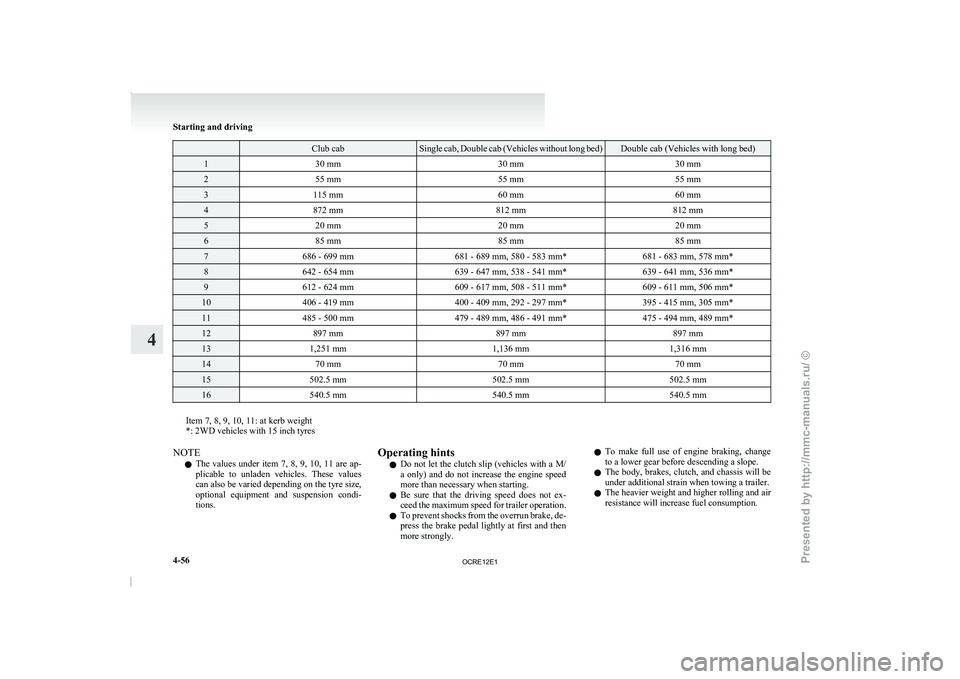
Club cab Single cab, Double cab (Vehicles without long bed) Double cab (Vehicles with long bed)
1
30 mm 30 mm30 mm2
55 mm 55 mm55 mm3
115 mm 60 mm60 mm4
872 mm 812 mm812 mm5
20 mm 20 mm20 mm6
85 mm 85 mm85 mm7
686 - 699 mm 681 - 689 mm, 580 - 583 mm* 681 - 683 mm, 578 mm*8
642 - 654 mm 639 - 647 mm, 538 - 541 mm* 639 - 641 mm, 536 mm*9
612 - 624 mm 609 - 617 mm, 508 - 511 mm* 609 - 611 mm, 506 mm*10
406 - 419 mm 400 - 409 mm, 292 - 297 mm* 395 - 415 mm, 305 mm*11
485 - 500 mm 479 - 489 mm, 486 - 491 mm* 475 - 494 mm, 489 mm*12
897 mm 897 mm897 mm13
1,251 mm 1,136 mm1,316 mm14
70 mm 70 mm70 mm15
502.5 mm 502.5 mm502.5 mm16
540.5 mm 540.5 mm540.5 mmItem 7, 8, 9, 10, 11: at kerb weight
*: 2WD vehicles with 15 inch tyres
NOTE
l The
values under item 7,
8, 9, 10, 11 are ap-
plicable to unladen vehicles. These values
can also be varied depending on the tyre size,
optional equipment and suspension condi-
tions. Operating hints
l Do
not let the
clutch
slip (vehicles with a M/
a only) and do not increase the engine speed
more than necessary when starting.
l Be sure that the driving speed does not ex-
ceed the maximum speed for trailer operation.
l To prevent shocks from the overrun brake, de-
press the brake pedal lightly at first and then
more strongly. l
To make full use
of engine braking, change
to a lower gear before descending a slope.
l The body, brakes, clutch, and chassis will be
under additional strain when towing a trailer.
l The heavier weight and higher rolling and air
resistance will increase fuel consumption. Starting and driving
4-56
4
OCRE12E1
Presented by http://mmc-manuals.ru/ \251
Page 332 of 369

Vehicle labeling
............................................................................ 9-02
Vehicle dimensions....................................................................... 9-03
Vehicle performance.....................................................................9-09
Vehicle weight .............................................................................. 9-10
Engine specifications .................................................................... 9-15
Transmission specifications .......................................................... 9-16
Electrical system ........................................................................... 9-17
Tyres and wheels.......................................................................... 9-18
Other specifications ...................................................................... 9-19
Fuel consumption ......................................................................... 9-20
Refill capacities ............................................................................ 9-22Specifications
9
OCRE12E1
Presented by http://mmc-manuals.ru/ \251
Page 351 of 369
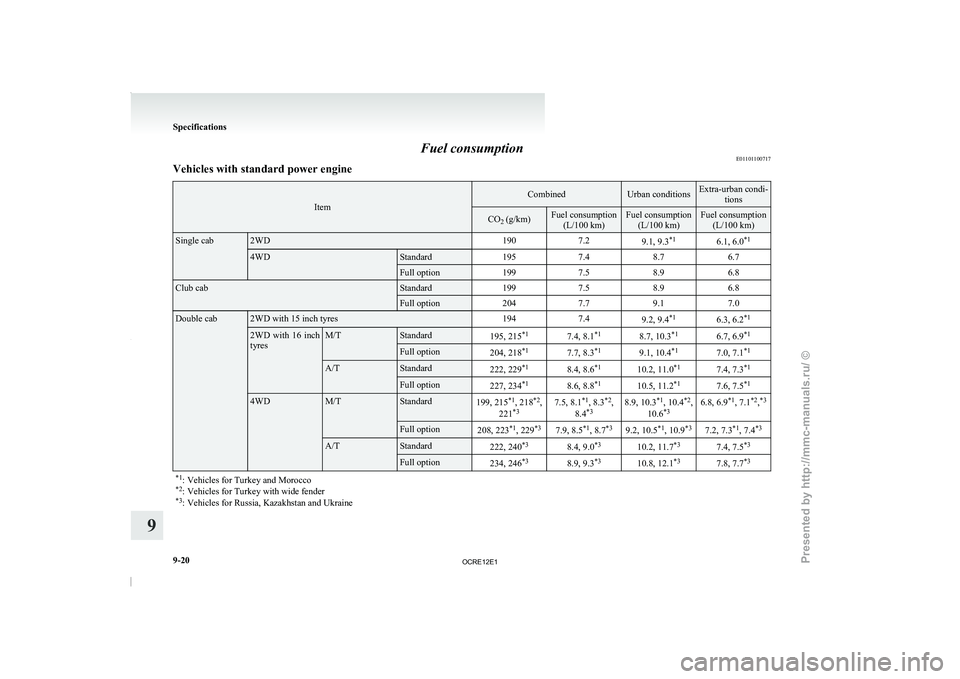
Fuel consumption
E01101100717
Vehicles with standard power engine Item Combined Urban conditions Extra-urban condi-
tions CO
2 (g/km) Fuel consumption
(L/100 km) Fuel consumption
(L/100 km) Fuel consumption
(L/100 km) Single cab 2WD
1907.2
9.1, 9.3*1
6.1, 6.0*1 4WD Standard
1957.48.76.7 Full option
1997.58.96.8Club cab Standard
1997.58.96.8 Full option
2047.79.17.0Double cab 2WD with 15 inch tyres
1947.4
9.2, 9.4*1
6.3, 6.2*1 2WD with 16 inch
tyres M/T Standard
195, 215*1
7.4, 8.1*1
8.7, 10.3*1
6.7, 6.9*1 Full option
204, 218*1
7.7, 8.3*1
9.1, 10.4*1
7.0, 7.1*1 A/T Standard
222, 229*1
8.4, 8.6*1
10.2, 11.0*1
7.4, 7.3*1 Full option
227, 234*1
8.6, 8.8*1
10.5, 11.2*1
7.6, 7.5*1 4WD M/T Standard
199, 215*1
, 218 *2
,
221 *3 7.5, 8.1
*1
, 8.3 *2
,
8.4 *3 8.9, 10.3
*1
, 10.4 *2
,
10.6 *3 6.8, 6.9
*1
, 7.1 *2
,*3 Full option
208, 223*1
, 229 *3
7.9, 8.5 *1
, 8.7 *3
9.2, 10.5 *1
, 10.9 *3
7.2, 7.3 *1
, 7.4 *3 A/T Standard
222, 240*3
8.4, 9.0*3
10.2, 11.7*3
7.4, 7.5*3 Full option
234, 246*3
8.9, 9.3*3
10.8, 12.1*3
7.8, 7.7*3
*1 : Vehicles for Turkey and Morocco
*2 : Vehicles for Turkey with wide fender
*3 : Vehicles for Russia, Kazakhstan and Ukraine Specifications
9-20
9
OCRE12E1
Presented by http://mmc-manuals.ru/ \251
Page 352 of 369
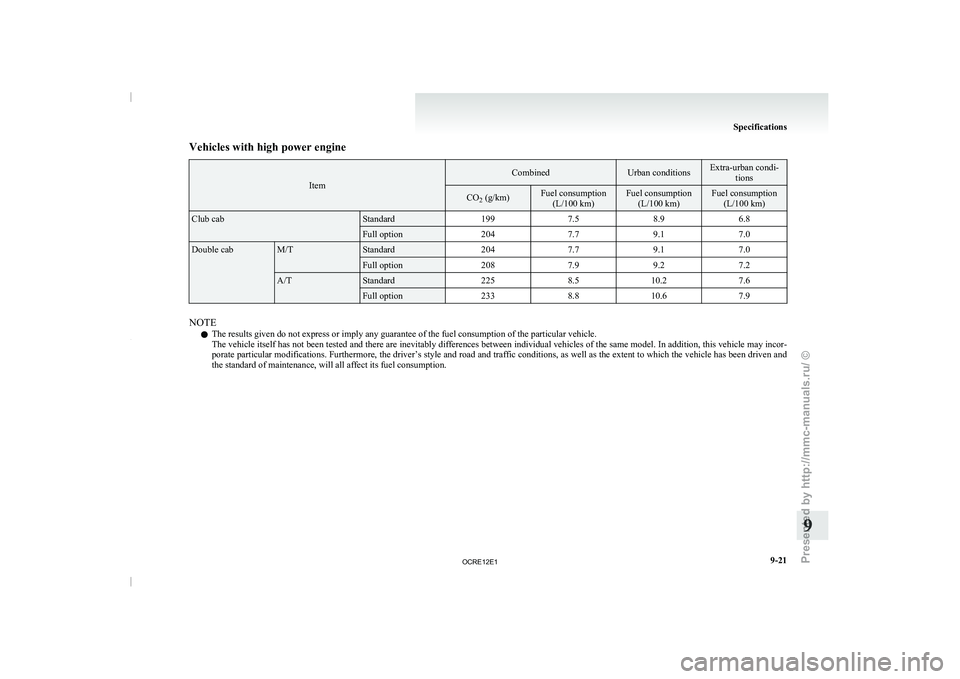
Vehicles with high power engine
Item Combined Urban conditions Extra-urban condi-
tions CO
2 (g/km) Fuel consumption
(L/100 km) Fuel consumption
(L/100 km) Fuel consumption
(L/100 km) Club cab Standard
1997.58.96.8 Full option
2047.79.17.0Double cab M/T Standard
2047.79.17.0 Full option
2087.99.27.2 A/T Standard
2258.510.2 7.6 Full option
2338.810.6 7.9NOTE
l The results given do not express or imply any guarantee of the fuel consumption of the particular vehicle.
The
vehicle itself has not
been tested and there are inevitably differences between individual vehicles of the same model. In addition, this vehicle may incor-
porate particular modifications. Furthermore, the driver’s style and road and traffic conditions, as well as the extent to which the vehicle has been driven and
the standard of maintenance, will all affect its fuel consumption. Specifications
9-21 9
OCRE12E1
Presented by http://mmc-manuals.ru/ \251
Page 357 of 369

E
Easy select 4WD 4-26
Economical driving 4-02
Electric window control 1-08 Switch 1-08
Electrical system 9-17 Electronic immobilizer (Anti-theft starting sys-
tem) 1-03
Emergency starting 6-02
Engine specifications
9-15
Engine Coolant 8-06,9-22
Number 9-02
Oil 8-04,9-22
Overheating 6-04
Specifications 9-15
Used engine oils safety instructions and disposal
information 05
Water temperature gauge 3-05
Error codes 5-42
Exterior and interior lamp operation 8-18
FFirst-aid kit and warning triangle band for secur-
ing 5-80
Floor console box 5-76
Fluid
Automatic transmission fluid 8-07,9-22Brake fluid 8-08,9-22
Clutch fluid 8-09,9-22
Engine coolant 8-06,9-22
Power steering fluid 8-09,9-22
Washer fluid 8-08,9-22
For cold and snowy weather 8-19
Front console box 5-76
Front fog lamps Bulb capacity 8-24
Indication lamp
3-07
Replacement
8-28
Switch 3-34
Front room lamp Bulb capacity 8-25
Replacement 8-32
Front seat 2-03
Front turn-signal lamps Bulb capacity
8-24
Replacement 8-27
Fuel consumption 9-20
Fuel Filling the fuel tank 02
Fuel filter indication lamp 3-07
Fuel gauge 3-04
Fuel selection 02
Low fuel warning lamp 3-04
Modification/alterations to the electrical or fuel
systems 04
Tank capacity 02
Fuses 8-20
Fusible links 8-19
G Gauges 3-02
General maintenance 8-18
General vehicle data 9-03
Genuine parts 05
Glove box 5-76
Glove box lamp
Bulb capacity 8-24
Replacement 8-34
H Handling of compact discs 5-48
Hazard warning flasher switch 3-34Hazard warning indication lamps 3-07
Head restraints 2-08
Headlamp levelling switch 3-32
Headlamps
Bulb capacity 8-24
Headlamp flasher 3-31
Replacement 8-25
Switch 3-30
Washer switch 3-39
Heated mirror 4-11
Heated seats 2-06
Heater 5-03
High-mounted stop lamp Bulb capacity 8-24
Replacement
8-31
Hinges and latches lubrication 8-19
Hooks Coat hook 5-80
Convenient hook 5-80
Horn switch 3-40
I If the vehicle breaks down 6-02
Ignition switch 4-11
Indication and warning lamps 3-06
Indication lamps 3-07
Inside rear-view mirror 4-09
Inspection and maintenance following rough road
operation 4-41
Installation of accessories 04
Instruments 3-02
Interior lamps 5-73
J Jack handle 6-12
Storage 6-07
Jacking up the vehicle 6-13 Alphabetical index
2
OCRE12E1
Presented by http://mmc-manuals.ru/ \251