2011 MITSUBISHI TRITON warning
[x] Cancel search: warningPage 288 of 369
WARNING
l To prevent entry of exhaust gas from the
towing vehicle, set your air selection lever
to the recirculation position.
l Avoid sudden braking, sudden accelera-
tion and sharp turning; such operation
could cause damage to the towing hooks
or the tow rope.
People in the vicinity could be injured as
a result.
l When towing or being towed down a long
slope, the brakes may overheat reducing
the effectiveness. In this situation, have
your vehicle transported by a tow truck.
l When the vehicle with automatic trans-
mission is to be towed by another vehicle
with all the wheels on the ground, make
sure that the towing speed and distance
given below are never exceeded, causing
damage to the transmission.
Towing speed: 50 km/h (30 mph)
Towing distance: 50 km (30 miles)
For the towing speed and the towing dis-
tance, follow the local driving laws and
regulations.
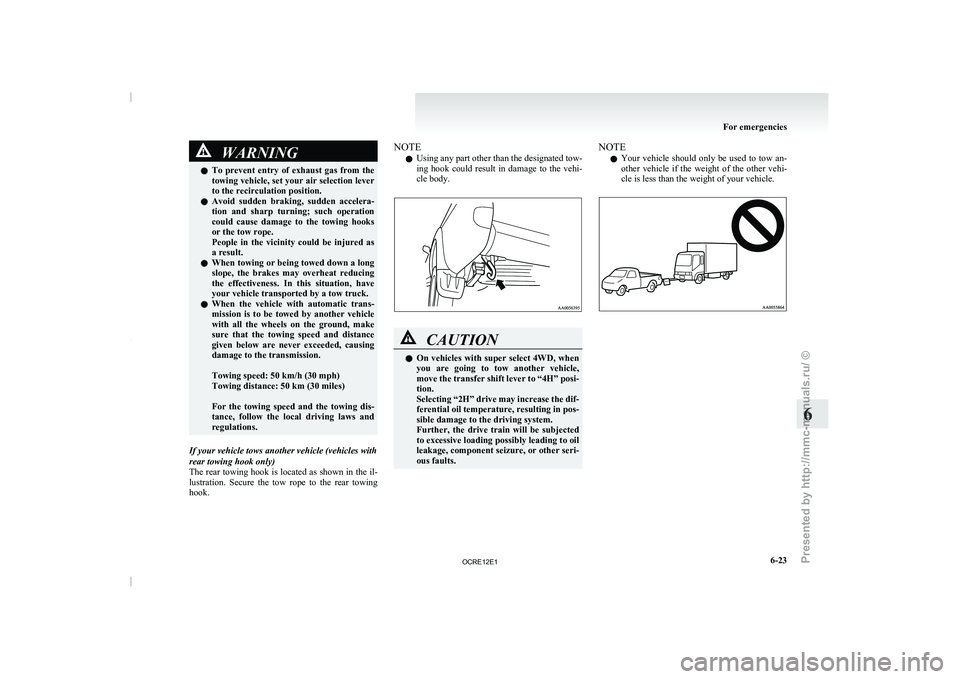
If your vehicle tows another vehicle (vehicles with
rear towing hook only)
The rear towing hook is
located as shown in the il-
lustration. Secure the tow rope to the rear towing
hook. NOTE
l Using
any part
other than
the designated tow-
ing hook could result in damage to the vehi-
cle body. CAUTION
l
On
vehicles with
super select
4WD, when
you are going to tow another vehicle,
move the transfer shift lever to “4H” posi-
tion.
Selecting “2H” drive may increase the dif-
ferential oil temperature, resulting in pos-
sible damage to the driving system.
Further, the drive train will be subjected
to excessive loading possibly leading to oil
leakage, component seizure, or other seri-
ous faults. NOTE
l Your
vehicle should only be
used to tow an-
other vehicle if the weight of the other vehi-
cle is less than the weight of your vehicle. For emergencies
6-23 6
OCRE12E1
Presented by http://mmc-manuals.ru/ \251
Page 289 of 369

Operation under adverse driving
conditions E00801702140
If your vehicle becomes stuck in sand,
mud or snow
If the vehicle becomes stuck
in snow, sand, or
mud, it can often be moved with a rocking motion.
Move the selector lever alternately between the
“L” (LOW) and “R” (REVERSE) position (with
manual transmission, between 1 st
and Reverse),
while applying slight pressure to the accelerator ped-
al.
Avoid racing the engine or spinning the wheels. Pro-
longed efforts to free a stuck vehicle may result in
overheating and transmission failure. Allow the en-
gine to idle for a few minutes to let the transmis-
sion cool between rocking attempts.
If the vehicle remains stuck after several rocking at-
tempts, seek other assistance. WARNING
l When attempting to rock your vehicle out
of a stuck position,
be
sure that the area
around the vehicle is clear of people and
physical objects. The rocking motion may
cause the vehicle to suddenly launch for-
ward or backward, causing injury or dam-
age to nearby people or objects.
On 2WD vehicles, it is recommended to start the ve-
hicle with parking
brake partially,
but not complete-
ly, applied by slightly pulling the parking brake lev-
er.
After the vehicle has become free, do not forget to
release the parking brake. NOTE
l Depress the accelerator pedal gradually when
starting the vehicle.
On a flooded road l Avoid
flooded roads.
Water could
enter the
brake discs, resulting in temporarily ineffec-
tive brakes. In such cases, lightly depress the
brake pedal to see if the brakes operate prop-
erly. If they do not, lightly depress the pedal
several times while driving in order to dry
the brake pads.
l When driving in rain or on a road with many
puddles a layer of water may form between
the tyres and the road surface.
This reduces a tyre’s frictional resistance on
the road, resulting in loss of steering stability
and braking capability.
To cope with this, observe the following items:
(a) Drive your vehicle at slow speed.
(b) Do not drive on worn tyres. Always maintain the specified tyre inflation
pressures.
On a snow-covered or frozen road l When
driving on a snow-covered
or frozen
road, it is recommended that you use snow
tyres or tyre chains.
Refer to the “Snow tyres” and “Tyre chains”
sections.
l Avoid high-speed operation, sudden acceler-
ation, abrupt brake application and sharp cor-
nering. l
Depressing the brake pedal
during
travel on
snowy or icy roads may cause tyre slippage
and skidding. When traction between the
tyres and the road is reduced the wheels may
skid and the vehicle cannot readily be
brought to a stop by conventional braking
techniques. Braking will differ, depending
upon whether you have anti-lock brake sys-
tem (ABS). If you do have ABS, brake by
pressing the brake system pedal hard, and
keeping it pressed. If you do not have ABS,
pump the brake pedal with short rapid jabs,
each time fully applying and fully releasing
for greatest effect.
l Allow extra distance between your vehicle
and the vehicle in front of you, and avoid sud-
den braking.
l Accumulation of ice on the braking system
can cause the wheels to lock. Pull away from
a standstill slowly after confirming safety
around the vehicle. CAUTION
l
Do not press the
accelerator
pedal rapid-
ly. If the wheels break free of the ice, the
vehicle could suddenly start moving and
possibly cause an accident.
On a bumpy or rutted road l Drive
as slow as possible
when driving on
bumpy or rutted roads. For emergencies
6-24
6
OCRE12E1
Presented by http://mmc-manuals.ru/ \251
Page 299 of 369
Service precautions
E01000100706
Adequate care of your vehicle
at regular intervals
serves to preserve the value and appearance as long
as possible.
Maintenance items as described in this owner’s man-
ual can be performed by the owner.
We recommend you to have the periodic inspection
and maintenance performed by a MITSUBISHI
MOTORS Authorized Service Point or another spe-
cialist.
In the event a malfunction or other problem is dis-
covered, we recommend you to have it checked
and repaired. This section contains information on
inspection maintenance procedures that you can do
yourself. Follow the instructions and cautions for
each of the various procedures. WARNING
l When checking or servicing
the
inside of
the engine compartment, make sure the
engine is switched off and has had a
chance to cool down.
l If it is necessary to do work in the engine
compartment with the engine running, be
especially careful that your clothing, hair,
etc., does not become caught by the fans,
drive belts, or other moving parts.
l For vehicle with air conditioning, the fan
may turn on automatically even if the en-
gine is not running; turn the ignition key
to “LOCK” position and remove the key
to ensure safety while you work in the en-
gine compartment. WARNING
l Do not smoke, cause sparks
or allow open
flames around fuel or battery. The fumes
are flammable.
l Be extremely cautious when working
around the battery. It contains poisonous
and corrosive sulphuric acid.
l Do not get under your vehicle with just
the body jack supporting it. Always use
automotive jack stands.
l Improper handling of components and
materials used in the vehicle can endan-
ger your personal safety. We recommend
you to consult a specialist for necessary in-
formation. Catalytic converter
E01000200925
For ordinary use, there are
no particular precautions.
The exhaust gas scavenging devices used with the
catalytic converter are extremely efficient for the re-
duction of noxious gases. The catalytic converter is
installed in the exhaust system.
It is important to keep the engine properly tuned to
ensure proper catalyst operation and prevent possi-
ble catalyst damage. CAUTION
l
Damage to the catalytic
converter
can re-
sult if your vehicle is not kept in proper
operating condition. In the event of an en-
gine malfunction particularly involving
engine misfire or other apparent loss of
performance, have your vehicle serviced
promptly.
Continued operation of your vehicle with
a severe overheated condition may result
in possible damage to the converter and
vehicle. WARNING
l As with any vehicle, do
not park or oper-
ate this vehicle in areas where combusti-
ble materials such as dry grass or leaves
can come in contact with a hot exhaust
since a fire could occur.
l Paint should not be applied to the catalyt-
ic converter. Maintenance
8-02
8
OCRE12E1
Presented by http://mmc-manuals.ru/ \251
Page 303 of 369

NOTE
l Use
of additives is not
recommended since
they may reduce the effectiveness of addi-
tives already included in the engine oil. It
may result in failure of the mechanical assem-
bly. Engine coolant
E01000501202
To check the coolant level
A translucent coolant reserve
tank
is located in the
engine compartment.
The coolant level in this tank should be kept be-
tween the “LOW” and “FULL” marks when meas-
ured while the engine is cold. To add coolant
The
cooling
system is
a
closed system and normal-
ly the loss of coolant should be very slight. A no-
ticeable drop in the coolant level could indicate leak-
age. If this occurs, we recommend you to have the
system checked as soon as possible.
If the level should drop below the “LOW” level on
the reserve tank, open the lid and add coolant.
Also, if the reserve tank is completely empty, re-
move the radiator cap and add coolant until the lev-
el reaches the filler neck. WARNING
l Do not open the radiator
cap while the en-
gine is hot.
The coolant system is under pressure and
any hot coolant escaping could cause se-
vere burns.
Anti-freeze
The engine coolant contains an
ethylene glycol anti-
corrosion agent. The cylinder head and water pump
housing are cast aluminium alloy, and periodic
changing of the engine coolant is necessary to pre-
vent corrosion of these parts.
Use “DIA QUEEN SUPER LONG LIFE COOL-
ANT” or equivalent.
MITSUBISHI Genuine Coolant has excellent pro-
tection against corrosion and rust formation of all
metals including aluminium and can avoid block-
ages in the radiator, heater, cylinder head, engine
block, etc.
Because of the necessity of this anti-corrosion
agent, the coolant must not be replaced with plain
water even in summer. The required concentration
of anti-freeze differs depending on the expected am-
bient temperature. Ambient
temperature
(minimum) °C -15 -20 -25
-30
-35 -50 Anti-freeze
concentra- tion % 30 35 40 45 50 60Maintenance
8-06
8
OCRE12E1
Presented by http://mmc-manuals.ru/ \251
Page 304 of 369

CAUTION
l
Do not use alcohol or methanol anti-
freeze or any engine coolants mixed with
alcohol or methanol anti-freeze. The use
of an improper anti-freeze can cause cor-
rosion of the aluminium components.
l For effective anti-corrosion and anti-
freeze performance, keep the anti-freeze
concentration within the range of 30 to
60 %.
Concentrations exceeding 60 % will re-
sult in a reduction of both the anti-freeze
and cooling performance thus adversely
affecting the engine.
l Do not top up with water only.
Water by itself reduces the rust-protec-
tive and anti-freeze qualities of the cool-
ant and has a lower boiling point. It can
also cause damage to the cooling system if
it should freeze. Do not use tapwater, as it
can cause corrosion and rust formation.
During cold weather
If the temperatures in your
area drop below freez-
ing, there is the danger that the coolant in the en-
gine or radiator could freeze and cause severe dam-
age to the engine and/or radiator. The concentra-
tion should be checked before the start of cold weath-
er and anti-freeze added to the system if necessary.
Add a sufficient amount of anti-freeze to the cool-
ant to prevent it from freezing.
The concentration should be checked before the
start of cold weather and anti-freeze added to the
system if necessary. Automatic transmission fluid*
E01000600974
The proper amount of automatic
transmission fluid
is essential to the life and operation of the automat-
ic transmission. Either insufficient fluid or exces-
sive fluid could cause transmission trouble. The
transmission fluid filler port cap is equipped with a
dipstick. Use the following procedure to check the
fluid level.
Procedure for checking the fluid level
1. Check the fluid level after the vehicle hasbeen driven enough to warm up the transmis-
sion fluid.
2. Park the vehicle on a flat, level surface and apply the parking brake.
3. With the engine idling and the brake pedal fully depressed, move the transmission selec-
tor lever through all the positions from the
"P” (PARK) to “L” (LOW) (with 4A/T), the
“P” (PARK) to “D” (DRIVE) (with 5A/T),
stopping momentarily at each position.
4. Move the selector lever to the “P” (PARK) position.
5. Remove the dipstick and wipe it with a clean lint-free cloth.
6. Reinsert the dipstick as far as it goes. 7. Remove dipstick and read the automatic trans-
mission fluid level.
The fluid level should
always be between the
two marks on the dipstick. WARNING
l Do not spill the
fluid
onto a hot exhaust
manifold during topping up or inspec-
tion, or a fire may occur.
Fluid type
Use only “DIA QUEEN ATF
SP III” transmission
fluid to ensure optimum transmission performance. Maintenance
8-07 8
OCRE12E1
Presented by http://mmc-manuals.ru/ \251
Page 305 of 369

Washer fluid
E01000700672
The windscreen washer fluid reservoir
is in the en-
gine compartment.
Check the washer fluid level at regular intervals
and add washer fluid to reservoir if necessary. NOTE
l The
washer fluid container serves
the wind-
screen and headlamps (if so equipped).
During cold weather
To ensure proper operation of the washers at low
temperatures, use a fluid containing an anti-freez-
ing agent. Brake fluid
E01000900687
To check the fluid level
Check the brake fluid level in the reservoir.
The brake fluid level must
be between the “MAX”
and “MIN” marks on the reservoir. The brake fluid level is monitored by a float. When
the brake fluid level
falls
below the “MIN” mark,
the brake fluid warning lamp lights up.
The fluid level falls slightly with wear of the brake
pads, but this does not indicate any abnormality.
If the brake fluid level falls markedly in a short
length of time, it indicates leaks from the brake sys-
tem.
If this occurs, we recommend you to have the vehi-
cle checked.
Fluid type
Use brake fluid conforming to DOT3 or DOT4.
The brake fluid is hygroscopic. Too much moisture
in the brake fluid will adversely affect the brake sys-
tem, reducing the brake performance. In addition, the brake fluid reservoir is equipped
with a special cap
to
prevent the entrance of air,
and this cap should not be removed. CAUTION
l
Take care in handling
brake
fluid as it is
harmful to the eyes, may irritate your
skin and also damage painted surfaces.
l Use only the specified brake fluid.
Do not mix or add different brands of
brake fluid to prevent chemical reactions.
Do not let any petroleum-based fluid
touch, mix with, or get into the brake fluid.
This will damage the seals.
l Keep the reservoir tank cap closed to pre-
vent the brake fluid from deteriorating ex-
cept maintenance.
l Clean the filler cap before removing and
close the cap securely after maintenance. Maintenance
8-08
8
OCRE12E1
Presented by http://mmc-manuals.ru/ \251
Page 306 of 369
Clutch fluid*
E01001000281
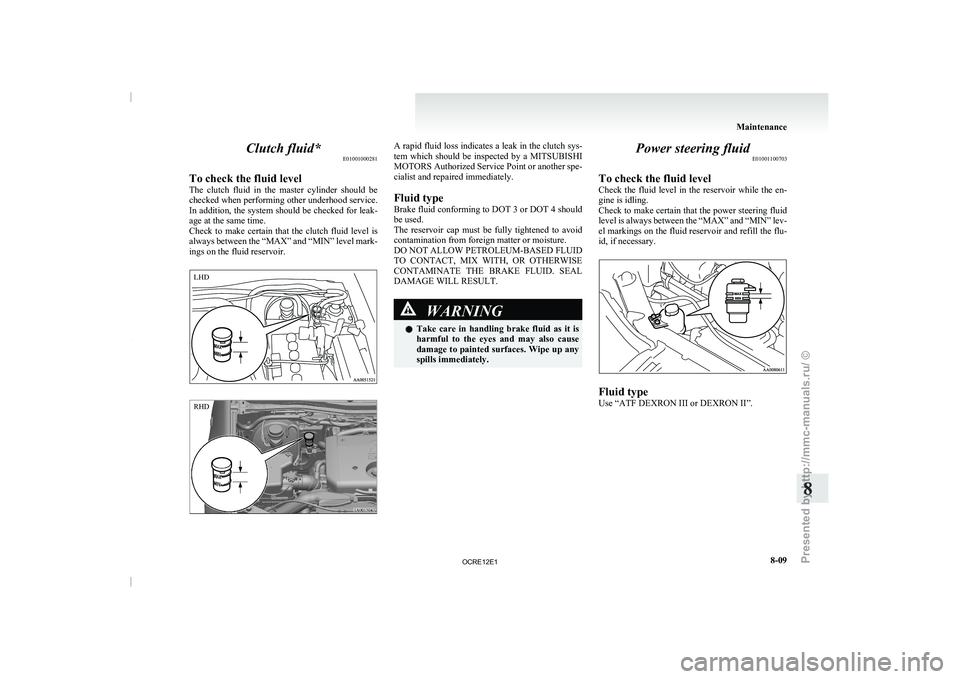
To check the fluid level
The clutch fluid in the
master cylinder should be
checked when performing other underhood service.
In addition, the system should be checked for leak-
age at the same time.
Check to make certain that the clutch fluid level is
always between the “MAX” and “MIN” level mark-
ings on the fluid reservoir. A rapid fluid loss indicates a leak in the clutch sys-
tem which should be inspected
by a MITSUBISHI
MOTORS Authorized Service Point or another spe-
cialist and repaired immediately.
Fluid type
Brake fluid conforming to DOT 3 or DOT 4 should
be used.
The reservoir cap must be fully tightened to avoid
contamination from foreign matter or moisture.
DO NOT ALLOW PETROLEUM-BASED FLUID
TO CONTACT, MIX WITH, OR OTHERWISE
CONTAMINATE THE BRAKE FLUID. SEAL
DAMAGE WILL RESULT. WARNING
l Take
care
in handling
brake
fluid as it is
harmful to the eyes and may also cause
damage to painted surfaces. Wipe up any
spills immediately. Power steering fluid
E01001100703
To check the fluid level
Check the fluid level in
the reservoir while the en-
gine is idling.
Check to make certain that the power steering fluid
level is always between the “MAX” and “MIN” lev-
el markings on the fluid reservoir and refill the flu-
id, if necessary. Fluid type
Use “ATF DEXRON III or DEXRON II”. Maintenance
8-09 8
LHD RHD
OCRE12E1
Presented by http://mmc-manuals.ru/ \251
Page 307 of 369

Battery
E01001202144
The condition of the battery
is very important for
quick starting of the engine and proper functioning
of the vehicle’s electrical system. Regular inspec-
tion and care are especially important in cold weath-
er.
NOTE
l On vehicles equipped with 2 batteries, when
the batteries are replaced, the 2 batteries
should be replaced at the same time.
If only a battery is replaced, it will cause short-
ening the batteries life.
Checking battery electrolyte level The electrolyte level must be between the specified
limit
on
the outside
of
the battery. Replenish with
distilled water as necessary.
The inside of the battery is divided into several com-
partments; remove the cap from each compartment
and fill to the upper mark. Do not top up beyond
the upper mark because spillage during driving
could cause damage. Check the electrolyte level at least once every 4
weeks, depending on the operating conditions.
If
the
battery is
not
used, it will discharge by itself
with time.
Check it once every 4 weeks and charge with low
current as necessary.
During cold weather
The capacity of the battery is reduced at low tem-
peratures. This is an inevitable result of its chemi-
cal and physical properties.
This is why a very cold battery, particularly one
that is not fully charged, will only deliver a fraction
of the starter current which is normally available.
We recommend you to have the battery checked be-
fore the start of cold weather and, if necessary,
have it charged or replaced.
This does not only ensure reliable starting, but a bat-
tery which is kept fully charged also has a longer life.
Disconnection and connection
To disconnect the battery cable, stop the engine,
first disconnect the negative (-) terminal and then
the positive (+) terminal.
When connecting the battery, first connect the posi-
tive (+) terminal and then the negative (-) terminal.
NOTE
l Open the terminal cover (A) before discon-
necting or connecting the positive (+) termi-
nal of the battery.Type 1
Type 2 WARNING
l Keep sparks, cigarettes, and
flames
away
from the battery because the battery
could explode. Maintenance
8-10
8
OCRE12E1
Presented by http://mmc-manuals.ru/ \251