2011 MITSUBISHI TRITON warning
[x] Cancel search: warningPage 269 of 369

CAUTION
l
Do not attempt to start the engine by pull-
ing or pushing the vehicle.
It could damage your vehicle.
l Always wear protective eye goggles when
working near the battery.
l Keep the battery out of the reach of chil-
dren.
NOTE l On
vehicles with anti-lock brake
system, if
the vehicle is put in motion without fully
charging the battery, it might cause the loss
of smooth engine operation and the antilock
brake warning lamp to illuminate.
Refer to “Anti-lock brake system (ABS)” on
page 4-44. Engine overheating
E00800601985
If the water temperature gauge
indication remains
in the overheating zone for a long time, the engine
may be overheating. If this occurs, take the follow-
ing corrective measures: 1. Stop the vehicle in a safe place.
2. Check whether steam is coming from the en-gine compartment.
[If steam does not come from the engine com-
partment]
With the engine still running, raise the bon-
net to ventilate the engine compartment.
[If steam is coming from the engine compart-
ment]
Stop the engine, and when the steam stops,
raise the bonnet to ventilate the engine com-
partment. Restart the engine. WARNING
l Do not open the
bonnet
while steam is com-
ing from the engine compartment. It
could cause steam or hot water to spurt
out, causing burns. Hot water could spurt
out even when there is no steam coming
out, and some parts will be very hot. Be
very careful when opening the bonnet.
l Be careful of hot steam, which could be
blowing off the reserve tank cap.
l Do not attempt to remove the radiator
cap while the engine is hot. 3. Confirm that the cooling fan is turning. If the
fan is not turning, stop the engine immediate-
ly and have it checked. A- Radiator cap
B- Cooling fan
C- Reserve tank
*: if so equipped WARNING
l Be careful not to
get your hands or
clothes caught in the cooling fan. For emergencies
6-04
6
OCRE12E1
Presented by http://mmc-manuals.ru/ \251
Page 270 of 369

4. After the engine coolant temperature has drop-
ped to the normal temperature, stop the engine.5. Check the coolant level in the reserve tank.
WARNING
l If
there
is none,
make
sure that the en-
gine has cooled down before removing
the radiator cap, because hot steam or boil-
ing water otherwise will gush from the fill-
er port and may scald you. 6. Add
coolant to the radiator and/or reserve
tank if
necessary (refer
to the “Maintenance”
section.) CAUTION
l
Do not add coolant
while
the engine is
hot. Suddenly adding cold coolant could
damage the engine. Wait for the engine to
cool down, then add coolant a little at a
time.
7. Examine the radiator hoses for coolant leak-
age and
the drive
belt for looseness or damage.
If there is anything wrong with the cooling
system or drive belt, we recommend you to
have it checked and repaired. Bleeding the fuel system
E00800700312
The fuel system should be bled to remove air as de-
scribed below if the fuel supply is exhausted during
travel.
Type 1
1. Loosen the
air plug
(A)
at the top of the fuel
filter. For emergencies
6-05 6
OCRE12E1
Presented by http://mmc-manuals.ru/ \251
Page 278 of 369

Jacking up the vehicle
E00801001436
1. Park the vehicle on level and stable ground.
2. Set the parking brake firmly.
3. On vehicles
with manual transmission, turn
the ignition key to the “LOCK” position,
move the gearshift lever to the “R” (Reverse)
position.
On vehicles with automatic transmission,
move the selector lever to the “P” (PARK) po-
sition, turn the ignition key to the “LOCK”
position.
4. Turn on the hazard warning flashers and set up a warning triangle, flashing signal lamp,
etc., at an adequate distance from the vehi-
cle, and have all your passengers leave the ve-
hicle.
5. To prevent the vehicle from rolling when it is raised on the jack, place chocks or blocks
(A) at the tyre that is diagonally opposite
from the tyre (B) you are changing. WARNING
l Be sure to apply chocks
or blocks to the
correct tyre when jacking up the vehicle.
If the vehicle moves while jacked up, the
jack could slip out of position, leading to
an accident.
NOTE l The
chocks shown in the
illustration do not
come with your vehicle. It is recommended
that you keep one in the vehicle for use if nee-
ded.
l If chocks are not available, use stones or any
other objects that are large enough to hold
the wheel in position.
6. Get the spare wheel, jack and jack handle ready.
7. Place the jack under one of the jacking points shown in the illustration. Use the jack-
ing point closest to the tyre you wish to
change. 2WD vehicles with 15 inch wheels C- Front jacking point (2WD vehicles with 15
inch wheels)
2WD vehicles with 16 inch wheels and 4WD ve-
hicles D- Front jacking point (2WD vehicles 16 inch
wheels and 4WD vehicles) For emergencies
6-13 6
OCRE12E1
Presented by http://mmc-manuals.ru/ \251
Page 279 of 369

E- Rear jacking point
WARNING
l Set the jack only at the positions shown
here. If the jack is set at a wrong position,
it could dent your vehicle or the jack
might fall over and cause personal injury.
l Do not use the jack on a tilted or soft sur-
face. Otherwise, the jack might slip and
cause personal injury. Always use the
jack on a flat, hard surface. Before set-
ting the jack, make sure there are no
sand or pebbles under the jack base.
NOTE l When
jacking up the rear
of the vehicle, turn
the tip of the jack so that the grooved portion
(F) properly meets the designated point. To raise the vehicle
1. Using the jack handle, turn
the release valve
(G) clockwise until it stops. 2. Insert the jack handle in the bracket of the
jack and hook the
notch (H) on the jack han-
dle end to the claw (I) of the bracket. 3. Move the jack handle up and down to raise
the ram until just
before the jack contacts the
jacking point of the vehicle. Ensure that the
jack will properly contact the vehicle jacking
point.
Move the jack handle up and down to raise
the vehicle. NOTE
l This jack is a 2 stage expansion type.
To lower the vehicle 1. Put the notch (J) provided
on the jack handle
end on the valve (K) of the jack. For emergencies
6-14
6
OCRE12E1
Presented by http://mmc-manuals.ru/ \251
Page 280 of 369

2. Using the jack handle, turn the release valve
anticlockwise slowly to lower the ram and re-
move the jack. 3. Press the piston down all the way, and turn
the release valve clockwise as far as possible.
4. Store jack, jack handle and chocks. WARNING
l Be sure to open
the
release valve slowly.
If it is opened quickly, the vehicle will
drop abruptly and the jack may come out
of position, causing a serious accident. CAUTION
l
If the release valve
is
loosened too much
(2 or more turns) in the anticlockwise di-
rection, the jack’s oil will leak and the
jack cannot be used. CAUTION
l
Close the release valve slowly
when lower-
ing the vehicle, or the valve may be dam-
aged.
NOTE l Occasionally
when the vehicle is
jacked up,
the grooved portion of the designated point
will not come off. When this happens, rock
the vehicle to lower the ram.
l If the jack is difficult to remove by hand, in-
sert the jack handle (L) into the bracket (M).
Then using the handle, remove the jack. WARNING
l Stop jacking up the
vehicle
as soon as the
tyre is raised off the ground. It is danger-
ous to raise the vehicle any higher.
l Do not get under your vehicle while using
the jack. WARNING
l Do not bump the raised
vehicle or leave it
sitting on the jack for a long time. Both
are very dangerous.
l Do not use a jack except the one that
came with your vehicle.
l The jack should not be used for any pur-
pose other than to change a tyre.
l No one should be in your vehicle when us-
ing the jack.
l Do not start or run the engine while your
vehicle is on the jack.
l Do not turn the raised wheel. The tyres
still on the ground could turn and make
your vehicle fall off the jack. For emergencies
6-15 6
OCRE12E1
Presented by http://mmc-manuals.ru/ \251
Page 282 of 369

5. Remove the hanger disc (G) from the spare
wheel. To install
1. Install the hanger disc (A) in the wheel disc
hole. 2. Turn the wheel nut wrench (B) clockwise to
wind up the chain. NOTE
l Confirm
that the hanger disc
is securely fit-
ted in the wheel disc hole when the wheel is
just lifted off the ground.
3. After winding up the spare wheel sufficient- ly, make sure it is not loose (the tightening
torque should be approximately 40 Nm) then
withdraw the jack handle, taking care not to
turn it in the reverse direction. CAUTION
l
The spare wheel should
always
be secure-
ly in position.
If a flat tyre is changed, put the flat tyre
in the spare wheel mounting position
with the wheel outer surface upward, and
use the wheel nut wrench to secure it firm-
ly. How to change a tyre
E00801202653
Before changing a tyre, first
stop your vehicle in a
safe, flat location. 1. Park the vehicle on level and stable ground.
2. Set the parking brake firmly.
3. On vehicles with manual transmission, turnthe ignition key to the “LOCK” position,
move the gearshift lever to the “R” (Reverse)
position.
On vehicles with automatic transmission,
move the selector lever to the “P” (PARK) po-
sition, turn the ignition key to the “LOCK”
position.
4. Turn on the hazard warning flashers and set up a warning triangle, flashing signal lamp,
etc., at an adequate distance from the vehi-
cle, and have all your passengers leave the ve-
hicle.
5. To prevent the vehicle from rolling when it is raised on the jack, place chocks or blocks
(A) at the tyre that is diagonally opposite
from the tyre (B) you are changing. For emergencies
6-17 6
OCRE12E1
Presented by http://mmc-manuals.ru/ \251
Page 283 of 369

WARNING
l Be sure to apply chocks or blocks to the
correct tyre when jacking up the vehicle.
If the vehicle moves while jacked up, the
jack could slip out of position, leading to
an accident.
NOTE l The
chocks shown in the
illustration do not
come with your vehicle. It is recommended
that you keep one in the vehicle for use if nee-
ded.
l If chocks are not available, use stones or any
other objects that are large enough to hold
the wheel in position.
6. Get the spare wheel, jack, jack handle and wheel nut wrench ready. NOTE
l Put
the spare wheel under
the vehicle body
near the flat tyre. This makes it safer if the
jack slips out of position. 7. Loosen
the wheel nuts with the wheel nut
wrench. Do not remove the wheel nuts yet.
Five wheel nuts
Six wheel nuts 8. Find the closest jacking point to the flat tyre
(refer to “Jacking up
the vehicle” on page
6-13). Then position the jack and raise the ve-
hicle until the tyre is slightly off the ground.
9. Remove the wheel nuts with the wheel nut wrench, then take the wheel off. CAUTION
l
Handle the wheel carefully when
chang-
ing the tyre, to avoid scratching the wheel
surface.
10. Clean out any mud, etc. on the hub surface
(C), hub
bolts (D)
or in the installation holes
(E) in the wheel, and then mount the spare
wheel. WARNING
l Mount the spare wheel with
the valve
stem (F) facing outboard. If you cannot
see the valve stem (F), you have installed
the wheel backwards.
Operating the vehicle with the spare
wheel installed backwards can cause vehi-
cle damage and result in an accident. For emergencies
6-18
6
OCRE12E1
Presented by http://mmc-manuals.ru/ \251
Page 287 of 369
Towing with rear wheels off the ground (Type C)
Place the gearshift lever in
the “N” (Neutral) posi-
tion (manual transmission) or the selector lever in
the “N” (NEUTRAL) position (automatic transmis-
sion). Turn the ignition key to the “ACC” position
and secure the steering wheel in a straight ahead po-
sition with a rope or tie-down strap. Never place
the ignition switch in the “LOCK” position when
towing.
Emergency towing
If towing service is not available in an emergency,
your vehicle may be temporarily towed by a cable
or chain secured to the towing hook.
If your vehicle is to be towed by another vehicle,
pay careful attention to the following points.
If your vehicle is to be towed by anoth-
er vehicle
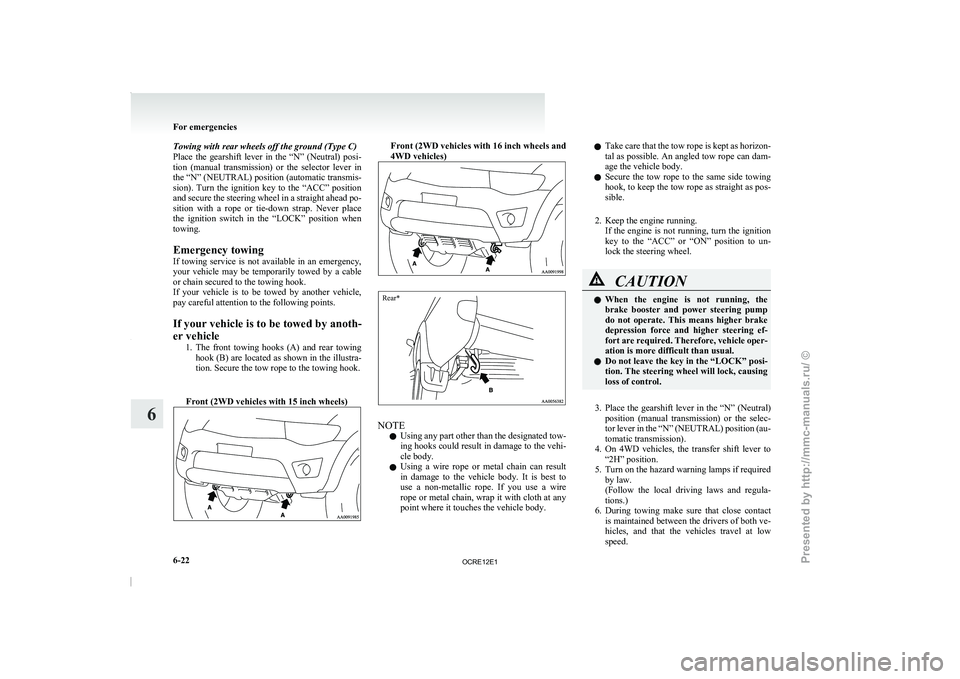
1. The front towing hooks (A) and rear towinghook (B) are located as shown in the illustra-
tion. Secure the tow rope to the towing hook.
Front (2WD vehicles with 15 inch wheels) Front (2WD vehicles with 16 inch wheels and
4WD vehicles)
Rear*
NOTE
l Using
any part other than
the designated tow-
ing hooks could result in damage to the vehi-
cle body.
l Using a wire rope or metal chain can result
in damage to the vehicle body. It is best to
use a non-metallic rope. If you use a wire
rope or metal chain, wrap it with cloth at any
point where it touches the vehicle body. l
Take
care
that the
tow
rope is kept as horizon-
tal as possible. An angled tow rope can dam-
age the vehicle body.
l Secure the tow rope to the same side towing
hook, to keep the tow rope as straight as pos-
sible.
2. Keep the engine running. If the engine is not running, turn the ignition
key to the “ACC” or “ON” position to un-
lock the steering wheel. CAUTION
l
When the engine is
not
running, the
brake booster and power steering pump
do not operate. This means higher brake
depression force and higher steering ef-
fort are required. Therefore, vehicle oper-
ation is more difficult than usual.
l Do not leave the key in the “LOCK” posi-
tion. The steering wheel will lock, causing
loss of control.
3. Place the gearshift lever in the “N” (Neutral)
position (manual
transmission) or
the selec-
tor lever in the “N” (NEUTRAL) position (au-
tomatic transmission).
4. On 4WD vehicles, the transfer shift lever to “2H” position.
5. Turn on the hazard warning lamps if required by law.
(Follow the local driving laws and regula-
tions.)
6. During towing make sure that close contact is maintained between the drivers of both ve-
hicles, and that the vehicles travel at low
speed. For emergencies
6-22
6
OCRE12E1
Presented by http://mmc-manuals.ru/ \251