2011 MITSUBISHI PAJERO IV wiper fluid
[x] Cancel search: wiper fluidPage 29 of 377

(Since the ignition switch is in the “LOCK”
position, washer fluid will not be sprayed.)
4. After approximately 10 seconds, the buzzer
will make
a sound. Keep the windscreen wip-
er and washer switch pulled towards you.
(If the windscreen wiper and washer switch
was released, the setting change mode would
be cancelled. To start over, perform the pro-
cedure again from step 3.)
5. When the buzzer stops, with the windscreen wiper and washer switch still pulled towards
you, press the UNLOCK switch (A) on the
keyless entry switch to select the security
alarm settings mode. The settings mode can be toggled by press-
ing the
UNLOCK
switch. The mode can be
confirmed from the number of times the buz-
zer sounds. Number of times
the buzzer sounds Security alarm settings mode
1 Alarm inactive
3 Alarm active 6. Any of the following operations can be used
to terminate
the system settings change mode.
• Releasing the windscreen wiper and washer switch.
• Closing the driver’s door.
• Inserting the key into the ignition switch.
• Placing the lamp switch in any posi- tion other than “OFF”.
• Allowing 30 seconds to pass without making any changes to the settings. NOTE
l If
anything with
regard to making changes to
the security alarm system settings is hard to
understand, please consult a MITSUBISHI
MOTORS Authorized Service Point.
l Avoid leaving valuable items inside the vehi-
cle even when the security alarm system has
been set to the “active” mode.
Setting the system E00301700503
Once the security alarm system has been set to the
“active” mode, follow
the procedure below to set
the system to the system armed mode. 1. Remove the key from the ignition switch.
2. Exit the vehicle and close all of the doors (in-cluding the backdoor) and the bonnet.
3. Press the LOCK switch (A) on the keyless en- try switch in order to lock all the doors (in-
cluding the backdoor). By locking the vehicle using the keyless en-
try system,
the
system preparation mode is ac-
tivated. The buzzer sounds intermittently for Locking and unlocking
1-12
1
OBKE12E1
Page 118 of 377

Wiper and washer switch
E00507101191CAUTION
l
If the
washer is used in cold weather, the
washer fluid sprayed against the glass
may freeze, which may hinder visibility.
Warm the glass with the defroster or rear
window demister before using the washer.
Windscreen wipers E00516900273
Except for vehicles with rain sensor
The windscreen wipers can be operated with the ig-
nition switch in the “ON” or “ACC” position. If the blades are frozen to the windscreen or rear
window, do
not
operate the wipers until the ice has
melted and the blades are freed, otherwise the wip-
er motor may be damaged. MIST- Misting function
The wipers will operate once.
OFF- Off INT- Intermittent (Speed sensitive) LO- SlowHI- Fast To adjust intermittent intervals
With the lever
in the “INT” (speed-sensitive) posi-
tion, the intermittent intervals can be adjusted by
turning the knob (A). 1- Fast
2- Slow
NOTE l The speed-sensitive-operation function of the
windscreen wipers can be deactivated.
For
further
information, we recommend you
to consult a MITSUBISHI MOTORS Author-
ized Service Point.
Misting function
The misting function can be used when the ignition
switch is in the “ON” or “ACC” position. Instruments and controls
3-37 3
OBKE12E1
Page 121 of 377

The wipers will operate once if the lever is raised
to the “MIST”
position and released when the igni-
tion switch is in the “ON” or “ACC” position. The
wipers will continue to operate while the lever is
held in the “MIST” position. With the ignition switch in the “ON” position, if
the lever is
moved to the AUTO position and
pulled towards you a little, the wipers operate once. The wipers will operate once if the lever is moved
to the “AUTO”
position and the knob (A) is turned
in the “+” direction when the ignition switch is in
the “ON” position. Windscreen washer
E00507200528
The washer fluid will be sprayed onto the wind-
screen by pulling
the lever towards you. The wip-
ers operate automatically several times while the
washer fluid is being sprayed. On a vehicle equipped with the headlamp washer,
the headlamp washer
operates together with the
windscreen washer the first time the windscreen
washer is used if the headlamps are on. CAUTION
l
If the washer
is used in cold weather, the
washer fluid sprayed against the glass
may freeze resulting in poor visibility.
Heat the glass with the defroster or demis-
ter before using the washer. Instruments and controls
3-40
3
OBKE12E1
Page 122 of 377
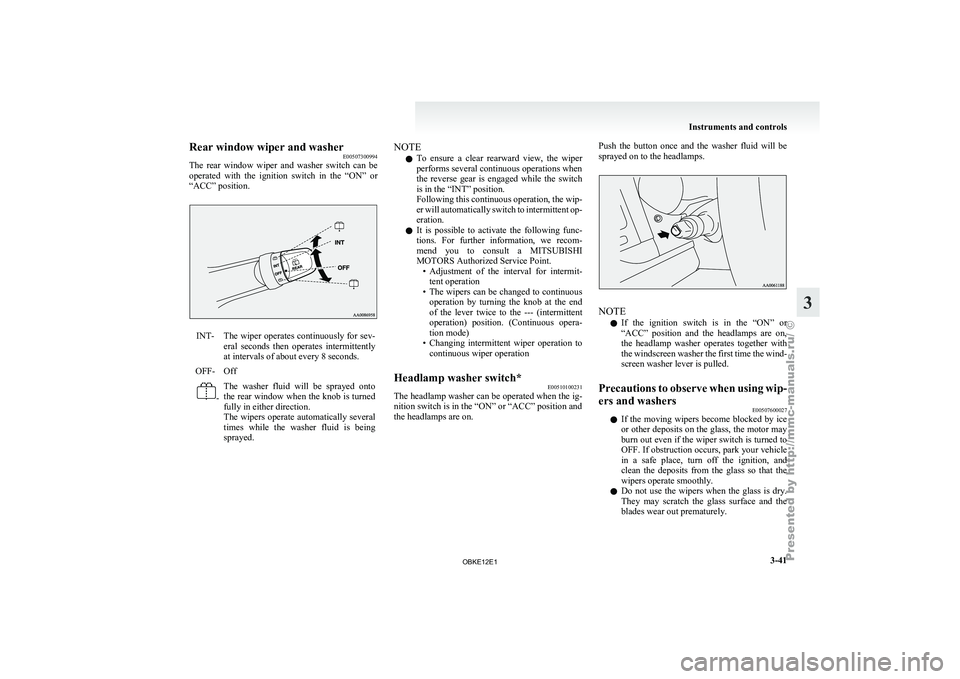
Rear window wiper and washer
E00507300994
The rear window
wiper and washer switch can be
operated with the ignition switch in the “ON” or
“ACC” position. INT- The wiper operates continuously for sev-
eral seconds then
operates intermittently
at intervals of about every 8 seconds.
OFF- Off -
The washer fluid will be sprayed onto
the
rear window
when the knob is turned
fully in either direction.
The wipers operate automatically several
times while the washer fluid is being
sprayed. NOTE
l To
ensure a
clear rearward view, the wiper
performs several continuous operations when
the reverse gear is engaged while the switch
is in the “INT” position.
Following this continuous operation, the wip-
er will automatically switch to intermittent op-
eration.
l It is possible to activate the following func-
tions. For further information, we recom-
mend you to consult a MITSUBISHI
MOTORS Authorized Service Point.
• Adjustment of the interval for intermit-tent operation
• The wipers can be changed to continuous operation by turning the knob at the end
of the lever twice to the --- (intermittent
operation) position. (Continuous opera-
tion mode)
• Changing intermittent wiper operation to continuous wiper operation
Headlamp washer switch* E00510100231
The headlamp washer can be operated when the ig-
nition switch is in the “ON” or “ACC” position and
the headlamps are on. Push the button once and the washer fluid will be
sprayed on to the headlamps.
NOTE
l If
the ignition
switch is in the “ON” or
“ACC” position and the headlamps are on,
the headlamp washer operates together with
the windscreen washer the first time the wind-
screen washer lever is pulled.
Precautions to observe when using wip-
ers and washers E00507600027
l If the
moving
wipers become blocked by ice
or other deposits on the glass, the motor may
burn out even if the wiper switch is turned to
OFF. If obstruction occurs, park your vehicle
in a safe place, turn off the ignition, and
clean the deposits from the glass so that the
wipers operate smoothly.
l Do not use the wipers when the glass is dry.
They may scratch the glass surface and the
blades wear out prematurely. Instruments and controls
3-41 3
OBKE12E1
Page 123 of 377

l
Before using
the wipers in cold weather,
check that the wiper blades are not frozen on-
to the glass. The motor may burn out if the
wipers are used with the blades frozen onto
the glass.
l Avoid using the washer continuously for
more than 20 seconds. Do not operate the
washer when the fluid reservoir is empty.
Otherwise, the motor may burn out.
l Periodically check the level of washer fluid
in the reservoir and refill if required.
During cold weather, add a recommended
washer solution that will not freeze in the
washer reservoir. Failure to do so could re-
sult in loss of washer function and frost dam-
age to the system components. Wiper de-icer switch*
E00507700103
The wiper de-icer
switch can be operated with the
ignition switch in the “ON” position.
When the front wipers have frozen to the wind-
screen at the parked positions, turning on this
switch will heat the windscreen to make the wipers
operable. Press the switch and the deicer will oper-
ate and turn on the indication lamp (A). NOTE
l The
switch is
automatically turned off after
operating for approximately 20 minutes. To
turn off the switch while it is operating, press
the switch again. Rear window demister switch
E00507901030
The rear window
demister switch can be operated
with the ignition switch in the “ON” position.
Push the switch to turn on the rear window demis-
ter. It will be turned off automatically in about
20 minutes. To turn off the demister within
20 minutes, push the switch again.
The indication lamp (A) will illuminate while the
demister is on. NOTE
l If
your vehicle
is equipped with wiper de-
icer, when the rear window demister switch
is pushed, the window glass becomes warm
and the wipers become operable. Refer to
“Wiper de-icer switch” on page 3-42.
l If your vehicle is equipped with heated mir-
rors, when the rear window demister switch
is pressed, the outside rear-view mirrors are
defogged or defrosted. Refer to “Heated mir-
ror” on page 4-11.
l The demister switch is not to melt snow but
to clear mist. Remove snow before use of the
demister switch. Instruments and controls
3-42
3
OBKE12E1
Page 306 of 377

CAUTION
l
Do not use a scrubbing brush or other
hard tools as they may damage the plastic
part surface.
l Do not use wax containing compound (pol-
ishing powder) which may damage the
plastic part surface.
l Do not bring the plastic parts into contact
with petrol, light oil, brake fluids, engine
oils, greases, paint thinners, and sulphu-
ric acid (battery electrolyte) which may
crack, stain or discolour the plastic parts.
If they touch the plastic parts, wipe them
off with soft cloth, chamois or the like
and an aqueous solution of neutral deter-
gent then immediately rinse the affected
parts with water.
Chrome parts E00901400115
In order to prevent spots and corrosion of chrome
parts, wash with
water, dry thoroughly, and apply a
special protective coating. This should be done
more frequently in winter.
Aluminium wheels* E00901500321
1. Remove dirt using a sponge while sprinkling
water on the wheel.
2. Use
neutral detergent on any dirt that cannot
be removed easily with water.
Rinse off the neutral detergent after washing
the wheel.
3. Dry the vehicle thoroughly using a chamois leather or a soft cloth. CAUTION
l
Do not use
a brush or other hard imple-
ment on the wheels.
Doing so could scratch the wheels.
l Do not use any cleaner that contains an
abrasive substance or is acidic or alka-
line. Doing so could cause the coating on
the wheels to peel or become discoloured
or stained.
l Do not directly apply hot water using a
steam cleaner or by any other means.
l Contact with seawater and road deicer
can cause corrosion. Rinse off such sub-
stances as soon as possible.
Window glass E00901600032
The window glass can normally be cleaned using
only a sponge and water.
Glass cleaner can
be used to remove oil, grease,
dead insects, etc. After washing the glass, wipe dry
with a clean, dry, soft cloth. Never use the same
cloth to wipe the window glass as would be used to
wipe the paintwork; wax from the painted surfaces
could adhere to the glass and reduce its transparen-
cy and visibility.
NOTE
l To clean the inside of the backdoor window,
always use a soft cloth and wipe the window
glass along the demister heater element so as
not to cause damage. Wiper blades
E00901700059
Use a soft cloth and glass cleaner to remove grease,
dead insects, etc.,
from the wiper blades. Replace
the wiper blades when they no longer wipe proper-
ly. (Refer to page 8-17.)
Cleaning the sunroof* E00901800180
Clean the inside of the sunroof with a soft cloth.
Hard deposits should
be wiped away with a cloth
dipped in warm, neutral detergent solution. Wipe
away the solution with a sponge dipped in fresh wa-
ter.
NOTE
l The surface treatment on the inside of the
glass may be removed if hard cloth or organ-
ic solvent (benzine, kerosene, thinner, etc.) is
used.
Engine compartment E00902100311
Clean the engine compartment at the beginning and
end of winter.
Pay particular attention to flanges,
crevices and peripheral parts where dust containing
road chemicals and other corrosive materials might
collect.
If salt and other chemicals are used on the roads in
your area, clean the engine compartment at least ev-
ery three months.
Never spray or splash water on the electrical com-
ponents in the engine compartment, as this may
cause damage.
Do not bring the nearby parts, the plastic parts and
so on into contact with sulphuric acid (battery elec-
trolyte) which may crack, stain or discolour them. Vehicle care
7-05 7
OBKE12E1
Page 308 of 377

Service precautions
....................................................................... 8-02
Catalytic converter ........................................................................ 8-02
Bonnet...........................................................................................8-03
Engine oil ......................................................................................8-04
Engine coolant .............................................................................. 8-06
Washer fluid ................................................................................. 8-07
Brake fluid .................................................................................... 8-08
Clutch fluid* ................................................................................. 8-09
Power steering fluid ...................................................................... 8-10
Battery .......................................................................................... 8-10
Tyres............................................................................................. 8-12
Parking brake break-in.................................................................. 8-16
Wiper blade rubber replacement ...................................................
8-17
General maintenance .................................................................... 8-18
For cold and snowy weather......................................................... 8-19
Fusible links.................................................................................. 8-19
Fuses............................................................................................. 8-19
Replacement of lamp bulbs .......................................................... 8-23Maintenance
8
OBKE12E1
Page 360 of 377

L
Labeling 9-02
Lamp monitor buzzer 3-32
Lamps
(headlamps,
fog lamp, etc.) auto-cutout func-
tion 3-32
Leakage (Fuel, engine coolant, oil and exhaust
gas) 8-18
Licence plate lamps Bulb capacity 8-24
Replacement 8-28
Link System 5-67
Low fuel warning lamp 3-05
Lubricants 9-15
Luggage compartment lamp 5-89 Bulb capacity 8-24
Replacement 8-30
Luggage floor box 5-93
Luggage hooks 5-97
LW/MW/FM electronic tuning radio with CD au-
tochanger 5-26
LW/MW/FM electronic tuning radio with CD play-
er 5-12
MMaking a flat seat 2-18
Making a luggage area 2-12
Manual transmission 4-16
Oil 9-15
Mirror Inside rear-view mirror 4-08
Outside rear-view mirrors 4-10
MIVEC engine 4-14
Modification/alterations to
the electrical or fuel sys-
tems 05 OOdometer 3-02
Oil pressure warning lamp 3-10
Oil
Differential oil 9-15
Engine oil 8-04
Manual transmission oil 9-15
Transfer oil 9-15
Operation under adverse driving conditions 6-18
Outside rear-view mirrors 4-10
Overheating 6-04
P Parking 4-07
Parking brake 4-06
Position lamps Bulb capacity 8-24
Indication lamp 3-08
Replacement
8-25
Power brakes 4-37
Power steering Fluid 8-10,9-15
System 4-41
Precautions to observe when using wipers and wash-
ers 3-41
Pregnant women restraint 2-22
Puncture (Tyre changing) 6-09
R Radio
LW/MW/FM electronic tuning
radio with CD au-
tochanger 5-26
LW/MW/FM electronic tuning radio with CD
player 5-12
Rear air conditioning 5-10 Rear combination lamps
Bulb capacity 8-24
Replacement 8-27
Rear differential lock
4-29
Rear fog lamp Bulb capacity 8-24
Indication lamp 3-08
Replacement 8-28
Switch 3-36
Rear personal lamp Bulb capacity 8-24
Replacement 8-29
Rear personal lamps 5-89
Rear shelf (3-door models) 5-95
Rear side/quarter window 1-17
Rear turn-signal lamps Bulb capacity 8-24
Replacement 8-27
Rear window demister switch 3-42
Rear-view camera 4-52
Rear-view mirror Inside 4-08
Outside 4-10
Refill capacities 9-15
Removal of water from the fuel filter 6-06
Replacement of lamp bulbs 8-23
Reversing lamps Bulb capacity 8-24
Replacement 8-27
Reversing sensor system 4-49
Roof carrier precaution 4-56
Room & map lamps 5-88 Bulb capacity 8-24
Replacement 8-29
Running-in recommendations 4-04
S Safe driving techniques 4-03 Alphabetical index
3
OBKE12E1