2011 MITSUBISHI PAJERO IV roof load
[x] Cancel search: roof loadPage 127 of 377

Economical driving
E00600100561
For economical driving,
there are some technical re-
quirements that have to be met. The prerequisite
for low fuel consumption is a properly adjusted en-
gine. In order to achieve longer life of the vehicle
and the most economical operation, we recommend
you to have the vehicle checked at regular intervals
in accordance with the service standards.
Fuel economy and generation of exhaust gas and
noise are highly influenced by personal driving hab-
its as well as the particular operating conditions.
The following points should be observed in order
to minimize wear of brakes, tyres and engine as
well as to reduce environmental pollution.
Starting
Avoid rapid acceleration and sudden starts; such op-
eration will result in higher fuel consumption.
Shifting
Shift only at an appropriate speed and engine
speed. Always use the highest gear possible.
The transfer shift lever should be set to “2H” when
driving on normal roads and express ways to obtain
best possible fuel economy.
City traffic
Frequent starting and stopping increases the aver-
age fuel consumption. Use roads with smooth traf-
fic flow whenever possible. When driving on con-
gested roads, avoid use of a low gear at high en-
gine speeds.
Idling
The vehicle consumes fuel even during idling.
Avoid extended idling whenever possible. Speed
At higher
vehicle
speed, more fuel is consumed.
Avoid driving at full speed. Even a slight release of
the accelerator pedal will save a significant amount
of fuel.
Tyre inflation pressure
Check the tyre inflation pressures at regular inter-
vals. Low tyre inflation pressure increases road re-
sistance and fuel consumption. In addition, low
tyre pressures adversely affect tyre wear and driv-
ing stability.
Load
Do not drive with unnecessary articles in the lug-
gage compartment. Especially during city driving
where frequent starting and stopping is necessary,
the increased weight of the vehicle will greatly af-
fect fuel consumption. Also avoid driving with un-
necessary luggage or carriers, etc., on the roof; the
increased air resistance will increase fuel consump-
tion.
Cold engine starting
Starting of a cold engine consumes more fuel.
Unnecessary fuel consumption is also caused by
keeping a hot engine running. After the engine is
started, commence driving as soon as possible.
Air conditioning
The use of the air conditioning will increase the
fuel consumption. Driving, alcohol and drugs
E00600200067
Driving after drinking
alcohol is one of the most fre-
quent causes of accidents.
Your driving ability can be seriously impaired even
with blood alcohol levels far below the legal mini-
mum. If you have been drinking, don’t drive. Ride
with a designated non-drinking driver, call a cab or
a friend, or use public transportation. Drinking cof-
fee or taking a cold shower will not make you sober.
Similarly, prescription and nonprescription drugs af-
fect your alertness, perception and reaction time.
Consult with your doctor or pharmacist before driv-
ing while under the influence of any of these medi-
cations. WARNING
l NEVER DRINK AND DRIVE.
Your perceptions
are
less accurate, your
reflexes are slower and your judgment is
impaired. Starting and driving
4-02
4
OBKE12E1
Page 181 of 377

Cargo loads
E00609901224
Cargo loads precautions CAUTION
l
When
loading
luggage, be careful to the
following. • Stow cargo and luggage in the luggagecompartment whenever possible.
• Distribute cargo or luggage evenly not to be unbalanced in weight.
• Do not place cargo or luggage on the instrument panel.
Also, do not stack up cargo or luggage
on the front passenger’s seat or the
rear seats.
Having the driver’s vision blocked,
and your cargo being thrown inside
the cabin if you suddenly have to
brake can cause a serious accident or
injury.
Loading a roof carrier CAUTION
l
Use a
roof
carrier that properly fits your
vehicle.
Do not load luggage directly onto the roof.
For installation, refer to the instruction
manual accompanying the roof carrier. Roof carrier mounting brackets*
3-door models
5-door models
When installing the roof carrier, use the brackets
(A). The
brackets
(A) are located under each roof
drip moulding (B).
NOTE
l We recommend you to use a genuine
MITSUBISHI roof carrier, since the brackets
to be used have a special shape. For details,
we recommend you to consult a
MITSUBISHI MOTORS Authorized Service
Point. Roof carrier precaution CAUTION
l
Make sure
that
the weight of the luggage
does not exceed the allowable roof load.
If the allowable roof load is exceeded, this
may cause damage to the vehicle.
The roof load is the total allowable load
on the roof (the weight of the roof carrier
plus the weight of luggage placed on the
roof carrier).
For specific figures, please refer to “Max-
imum roof load” on page 9-07 .
l When luggage is loaded onto the vehicle,
please make sure to drive slowly and
avoid excessive manoeuvres such as sud-
den braking or quick turning.
In addition, place the luggage on the car-
rier so that its weight is distributed even-
ly with the heaviest items on the bottom.
Do not load items that are wider than the
roof carrier.
The additional weight on the roof could
raise the vehicle’s centre of gravity and af-
fect vehicle handling characteristics.
As a result, driving errors or emergency
manoeuvres could lead to a loss of control
and result in an accident.
l Before driving and after travelling a
short distance, always check the load to
make sure it is securely fastened to the
roof carrier.
Check periodically during your travel
that the load remains secure. Starting and driving
4-56
4
OBKE12E1
Page 182 of 377

NOTE
l To
prevent wind
noise or reduction in fuel
economy, remove the roof carrier when not
in use.
l Before using an automatic car wash, remove
the roof carrier.
l Be sure that adequate clearance is main-
tained for raising the sunroof (if so equip-
ped) when installing a roof carrier. Trailer towing
E00610000550
In order
to
tow a trailer with your vehicle, when hav-
ing a trailer towing device mounted that meets all
relevant regulations in your area, consult a
MITSUBISHI MOTORS Authorized Service Point.
The regulations concerning the towing of a trailer
may differ from country to country. You are ad-
vised to obey the regulations in each area. CAUTION
l
Danger of Accident!
A towing
bar
should be fitted according
to MITSUBISHI MOTORS guidelines.
When you are going to tow a trailer,
move the transfer shift lever to “4H” posi-
tion.
Selecting the “2H” drive may increase the
differential oil temperature, resulting in
possible damage to the driving system.
Further, the drive train will be subjected
to excessive loading possibly leading to oil
leakage, component seizure, or other seri-
ous faults.
Maximum towable weight with brake
and maximum trailer-nose weight
Never exceed the
maximum towable weight with
brake and the maximum trailer-nose weight as lis-
ted in the specifications. (Refer to “Vehicle
weight” on page 9-07 .)
If you tow a trailer at an altitude of more than
1,000 m above sea-level, reduce your weight by
10 % of the gross combination weight for every in-
crease of 1,000 m above sea-level, as the engine out-
put is lowered owing to decrease in atmospheric
pressure. Towing bar mounting specifications
See
the following
table for fixing points (A) for the
towing bar. Starting and driving
4-57 4
OBKE12E1
Page 327 of 377

Engine compartment
In the engine
compartment, the fuse blocks are lo-
cated as shown in the illustration.
Type A Type BFuse load capacity
E01007700105
The fuse capacity and the name of the electrical sys-
tems protected by
the fuses are indicated on the in-
side of the lid located at the driver’s leg area and
on the inside of the fuse block cover for fuses loca-
ted in the engine compartment.
Passenger compartment fuse location table E01007900703
NOTE l Spare
fuses are
contained in the fuse block
lid. Always use a fuse of the same capacity
for replacement.
Passenger compartment fuse location No. Symbol Electrical sys-
tem Capacity
1 Ignition coil
10 A
2 Gauge 7.5 A
3 Reversing lamp
7.5 A
4 — — 7.5 A
5 Relay
7.5 A
6 Heated door
mirror 7.5 A
7 — — 30 A No. Symbol Electrical sys-
tem Capacity
8 Engine control 7.5 A
9 Cigarette lighter
15 A
10 — — —
11 Outside rear-
view mirrors 7.5 A
12 Engine control
7.5 A
13 — — —
14 Rear window
wiper 15 A
15 Central door
locks 15 A
16 Rear fog lamp
10 A
17 — — —
18 — — —
19 Heater
30 A
20 Rear window
demister 30 A
21 Sunroof
20 A
22 Anti-lock brake
system 10 A
23 Heated seat
20 A
24 Approach lamps
10 A
25 Transfer control
10 A
26 ENG/POWER
10 AMaintenance
8-20
8
OBKE12E1
Page 346 of 377
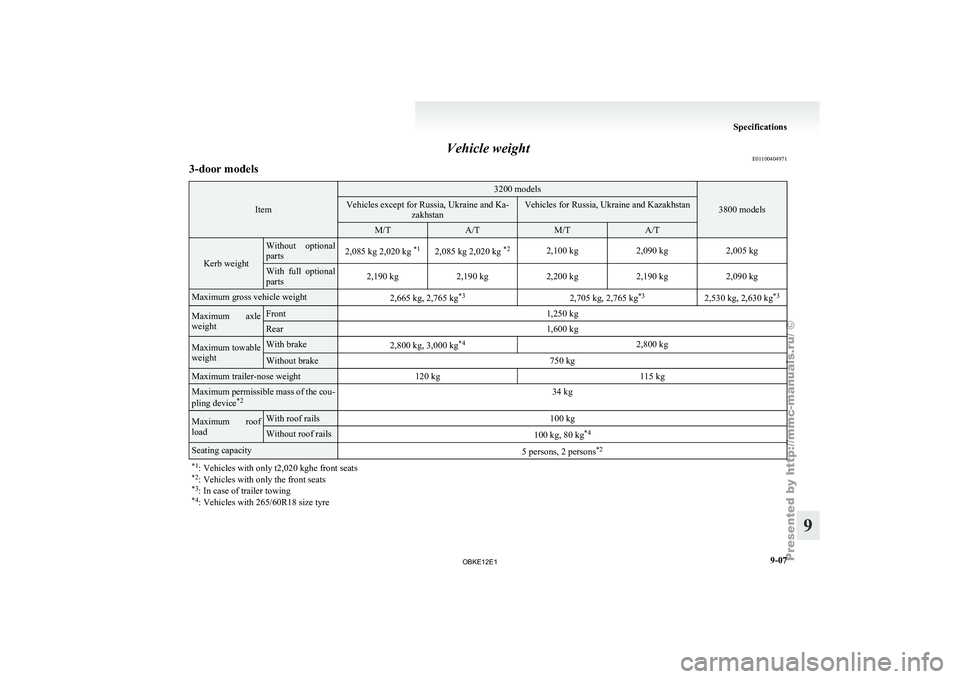
Vehicle weight
E01100404971
3-door models Item 3200 models
3800 modelsVehicles except for Russia, Ukraine and Ka-
zakhstan Vehicles for Russia, Ukraine and Kazakhstan
M/T A/T M/T A/T
Kerb weight Without optional
parts
2,085 kg 2,020 kg
*1
2,085 kg 2,020 kg *2
2,100 kg 2,090 kg2,005 kg With full optional
parts
2,190 kg
2,190 kg2,200 kg2,190 kg2,090 kgMaximum gross vehicle weight
2,665 kg, 2,765 kg*3
2,705 kg, 2,765 kg*3
2,530 kg, 2,630 kg *3Maximum axle
weight Front
1,250 kgRear
1,600 kgMaximum towable
weight With brake
2,800 kg, 3,000 kg*4
2,800 kgWithout brake
750 kgMaximum trailer-nose weight
120 kg 115 kgMaximum permissible mass of the cou-
pling device
*2 34 kgMaximum roof
load With roof rails
100 kgWithout roof rails
100 kg, 80 kg*4 Seating capacity
5 persons, 2 persons*2
*1 : Vehicles with only t2,020 kghe front seats
*2 : Vehicles with only the front seats
*3 : In case of trailer towing
*4 : Vehicles with 265/60R18 size tyre Specifications
9-07 9
OBKE12E1
Page 347 of 377

NOTE
l Trailer specifications indicate the manufacturer’s recommendation.
5-door models Item 3000 models 3200 models
3800 modelsVehicles except for Russia, Uk-
raine and Kazakhstan Vehicles for Russia, Ukraine and
Kazakhstan M/T A/T M/T A/T M/T A/T
Kerb weight Without optional
parts
2,100 kg 2,110 kg 2,280 kg,
2,185 kg *1 2,265 kg,
2,170 kg *1
2,265 kg 2,255 kg 2,160 kg With full optional
parts
2,200 kg 2,210 kg 2,395 kg,
2,300 kg *1 2,380 kg,
2,285 kg *1
2,390 kg 2,380 kg 2,270 kgMaximum gross vehicle weight
2,810 kg, 2,835 kg*2
3,030 kg, 3,130 kg*2 2,910 kg,
3,010 kg *2 Maximum axle
weight Front
1,250 kg 1,330 kg1,300 kgRear
1,650 kg, 1,765 kg*2
1,780 kg, 1,925 kg*2Maximum towable
weight With brake
1,800 kg
3,300 kg*3
, 3,500 kg *4
3,300 kgWithout brake
750 kgMaximum trailer-nose weight
75 kg140 kg 135 kgMaximum permissible mass of the cou-
pling device
*1 34 kgMaximum roof
load With roof rails
100 kgWithout roof rails
100 kg*3
, 80 kg *4 Seating capacity
7 persons, 2 persons*1
*1 : Vehicles with only the front seats
*2 : In case of trailer towing
*3 : Vehicles with 265/65R17 size tyre
*4 : Vehicles with 265/60R18 size tyre Specifications
9-08
9
OBKE12E1
Page 358 of 377

A
Accessory (Installation) 04
Accessory socket 5-86
Active stability & traction control (ASTC) 4-41
Additional equipment
8-19
Air conditioning Front automatic air conditioning
5-03
Important operation tips for the air condition-
ing 5-11
Rear air conditioning 5-10
Air purifier (with deodorizing function) 5-12
Airbag 2-33
Antenna 5-66
Anti-lock brake system (ABS) 4-39 Warning lamp 4-40
Approach lamps 1-08
Armrest 2-08,2-10
Ashtray 5-85
Audio Error codes 5-59
Handling of compact discs 5-65
LW/MW/FM electronic tuning radio with CD au-
tochanger 5-26
LW/MW/FM electronic tuning radio with CD
player 5-12
Steering wheel remote control switch 5-57
Auto-cutout function 5-91
Automatic headlamp levelling 3-34
Automatic transmission Fluid 9-15
Selector lever operation 4-19
Selector lever position 4-20
Sports mode 4-21
BBackdoor 1-09 Battery 8-10
Charge warning display 3-10
Discharged battery (Emergency starting) 6-02
Specification 9-11
Bleeding the fuel system
6-06
Bluetooth® 2.0 interface 5-67
Bonnet 8-03
Brake Anti-lock brake 4-39
Brake assist system 4-38
Braking 4-37
Fluid 8-08,9-15
Parking brake 4-06
Power brakes 4-37
Warning lamp 3-09
Bulb capacity 8-24
C Card holder 5-84,5-93
Cargo loads 4-56
Catalytic converter 8-02
Cautions on handling of 4-wheel drive vehi-
cles 4-35
Central door locks 1-07
Centre console box 5-92
Centre information display
3-11
Changing a fuse 8-22
Charge warning display 3-10
Check engine warning lamp
3-10
Child restraint 2-23
Child-protection rear doors 1-08
Cigarette lighter 5-86
Cleaning Aluminium wheels 7-05
Chrome parts 7-05
Exterior of your vehicle 7-03
Genuine leather 7-02
Interior of your vehicle 7-02 Plastic, vinyl leather, etc 7-02
Polishing 7-04
Sunroof 7-05
Washing 7-03
Waxing 7-04
Clutch Fluid 8-09,9-15
Coat hooks 5-97
Combination headlamps and dipper switch 3-31
Convenient hook 5-96
Coolant (engine) 8-06,9-15
Cruise control 4-45
Cup holder 5-94
Curtain airbag system 2-40
D Daytime dipper button 3-06
Daytime running lamp 3-32
Demister (rear window) 3-42
Diesel particulate filter (DPF)
4-15
Diesel preheat indication lamp
3-08
Dimensions 9-04
Dipper (High/Low beam change) 3-32
Door ajar warning lamp 3-11
Door courtesy lamps 5-91,8-24 Replacement 8-30
Doors Central door locks 1-07
Child-protection 1-08
Lock and unlock 1-06
Driving, alcohol and drugs 4-02
E Economical driving 4-02
Electric window control 1-15
Switch 1-15
Timer function 1-16 Alphabetical index
1
OBKE12E1