Page 623 of 706
7-44 Vehicle care and maintenance
7
Fuel system (tank, pipe line and connection, and
fuel tank filler cap)
N00941300186
Check these regularly for damage or leaks in the fuel lines and
connections. Check the fuel tank filler cap for damage or loose-
ness. Pay special attention to the fuel lines closest to high heat
sources such as the exhaust manifold.Evaporative emission control system (except
evaporative emission canister)
N00941400116
If the fuel-vapor vent line is clogged or damaged, the fuel-
vapor mixture will escape, polluting the air.
Have the system checked at an authorized Mitsubishi Motors
dealer at the mileage specified in the “WARRANTY AND
MAINTENANCE MANUAL”.
General maintenance
N00941500159
The next pages list the maintenance service recommended by
Mitsubishi Motors Corporation. In addition to the general
maintenance that needs to be performed at the times listed,
there are other parts which do not usually need regular mainte-
nance.
But, if any of these parts stops working properly, your vehicle
performance could suffer. Have these items checked if you
notice a problem with them.
See your authorized Mitsubishi Motors dealer for assistance, if
you have any questions.Disc brake pads
N00941600075
Good brakes are essential to safe driving. Check the brake pads
for wear. For good braking performance, replace the brake pads
with the same type pads as the originals.Brake hoses
N00941700047
Brake hoses and tubing should be checked for:
�Severe surface cracking, scuffing or worn spots. If the
fabric casing of the hose is showing through any cracks or
worn spots in the rubber hose cover, the hose should be
replaced. The brakes can fail if the hose wears through.
�Improper installation may cause twisting, or wheel, tire or
chassis interference.
WA R N I N G
!�If you see a fuel leak or if you smell fuel, do not run
the engine. Any spark (including from the ignition),
flame or smoking material could cause an explosion
or fire. Call an authorized Mitsubishi Motors dealer
or a repair facility of your choice for assistance.
BK0125300US.book 44 ページ 2010年5月18日 火曜日 午後1時53分
Page 624 of 706
Vehicle care and maintenance
7-45
7
Ball joint, steering linkage seals and drive shaft
boots
N00941800077
Check the following parts for damage and grease leaks:
�Ball joint boots of the front suspension and steering link-
age
�Bellows on both ends of the drive shaft
Drive belt (for generator, power steering pump,
air conditioning compressor)
N00941900313
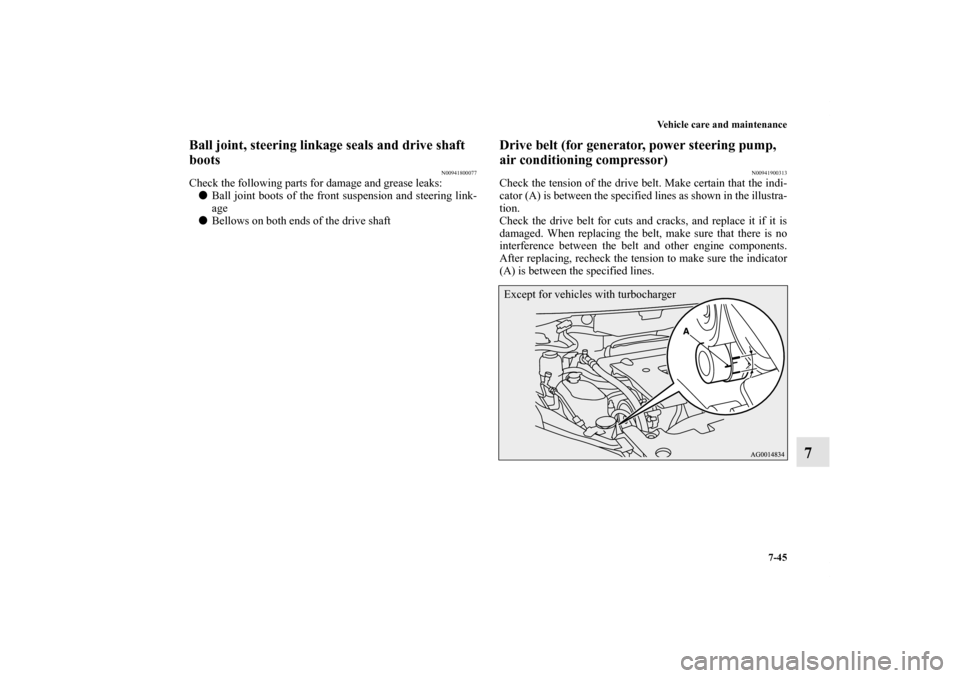
Check the tension of the drive belt. Make certain that the indi-
cator (A) is between the specified lines as shown in the illustra-
tion.
Check the drive belt for cuts and cracks, and replace it if it is
damaged. When replacing the belt, make sure that there is no
interference between the belt and other engine components.
After replacing, recheck the tension to make sure the indicator
(A) is between the specified lines.Except for vehicles with turbocharger
BK0125300US.book 45 ページ 2010年5月18日 火曜日 午後1時53分
Page 625 of 706
7-46 Vehicle care and maintenance
7
Exhaust system
N00942200108
The best way to keep carbon monoxide gas from entering
inside your vehicle is to have the engine exhaust system prop-
erly serviced.
Have a competent mechanic inspect the complete exhaust sys-
tem and nearby body areas for broken, damaged, deteriorated,
or mispositioned parts if you notice any of the following:
�A change in the sound of the exhaust system
�The smell of exhaust fumes inside the vehicle
�The underside or rear of the vehicle is damaged
Also check the exhaust system each time the vehicle is raised
for lubrication, oil changes, or required service. Any open
seams or loose connections could let dangerous exhaust fumes
seep into the luggage compartment and passenger compart-
ments. Check for any of the following conditions: �Check for holes or exhaust gas leaks caused by corrosion
or damage.
�Check the joints and connections for looseness or exhaust
gas leaks.
�Check the rubber hangers and brackets for damage.
WA R N I N G
!�Do not check or touch the drive belt with the engine
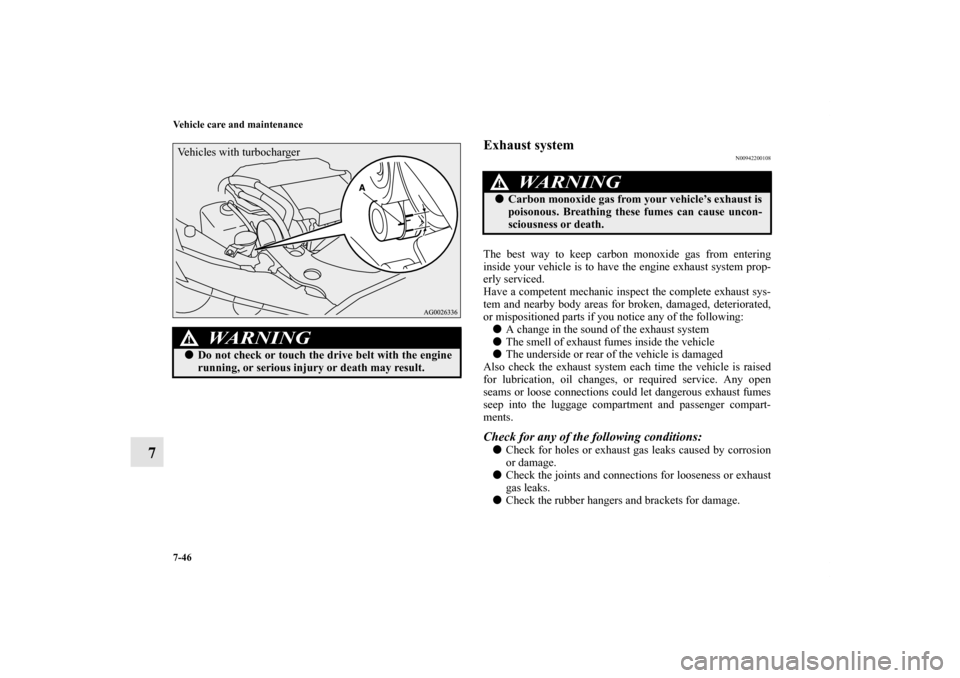
running, or serious injury or death may result.Vehicles with turbocharger
WA R N I N G
!�Carbon monoxide gas from your vehicle’s exhaust is
poisonous. Breathing these fumes can cause uncon-
sciousness or death.
BK0125300US.book 46 ページ 2010年5月18日 火曜日 午後1時53分
Page 626 of 706
Vehicle care and maintenance
7-47
7
Hood lock release mechanism and safety catch
N00942500114
The hood lock release mechanism and hood safety catch should
be checked, cleaned, and oiled when needed for easy move-
ment and to stop rust and wear. Use Multipurpose Grease
NLGI Grade 2 sparingly for all sliding parts of the hood latch
and release lever. Work the grease into the hood lock mecha-
nism until all the movable surfaces are covered.
Also, put a light coat of the same grease on the safety catch
wherever moving parts touch.
For cold and snowy weather
N00942600102
Ventilation slotsThe ventilation slots in front of the windshield should be
brushed clear after a heavy snowfall so that the operation of the
heating and ventilation systems will not be impaired.WeatherstrippingTo prevent freezing of the weatherstripping on the doors,
engine hood, etc., they should be treated with silicone grease.Additional equipment (For regions where snow is
encountered)It is a good idea to carry a shovel or a short-handled spade in
the vehicle during the winter so that you can clear away snow
if you get stranded. A small hand-brush for sweeping snow off
the vehicle and a plastic scraper for the windshield, side and
rear window are also useful.
BK0125300US.book 47 ページ 2010年5月18日 火曜日 午後1時53分
Page 676 of 706
Vehicle care and maintenance
7-97
7
Polishing
N00946100059
If painted surfaces have been severely damaged and lost their
original luster and color tone, polish the surface lightly with a
fine polishing compound. Avoid limiting your polishing to the
damaged surface only; polish a somewhat wider area, moving
the polishing cloth in one direction. After polishing, flush the
compound from the surface and apply a coat of wax to regain a
beautiful luster.Damaged paint
N00946200063
Small cracks and scratches in the paint coat should be touched
up as soon as possible with touch-up paint to prevent corrosion.
Check body areas facing the road or the tires carefully for dam-
age to the paint caused by flying stones, etc. The paint code
number for your vehicle can be found on the vehicle informa-
tion code plate in the engine compartment.
Cleaning plastic parts
N00946300178
Use a sponge or chamois to clean these parts.
If a vehicle wax sticks to a gray or black rough surface of the
bumper, molding or lights, the surface may appear white in
color. In this case, wipe it off using lukewarm water and a soft
cloth or chamois. Chrome parts
N00946400065
To prevent spots and corrosion of chrome parts, wash with
water, dry thoroughly, and apply a nonabrasive automotive
wax. If the chrome is severely damaged or pitted, use a com-
mercially available chrome polish.
�Do not put wax on the areas having black matte
coating because it can cause uneven discoloration,
patches, blurs, etc. If these get wax on them, wipe
the wax off right away with a soft cloth and warm
water.�On vehicles equipped with sunroof, be careful not to
apply any wax on the weatherstrip (black rubber)
when waxing the area around the sunroof opening.
If stained with wax, the weatherstrip cannot main-
tain a weatherproof seal with the sunroof.
CAUTION
!
CAUTION
!�Do not use a scrubbing brush or other rough scrub-
ber as these may damage the plastic surface. �Do not use wax containing compounds (polishing
powder) which may damage the plastic surface. �Do not let the plastic parts get soiled with gasoline,
oil, brake fluids, engine oils, greases, paint thinner,
and sulfuric acid (battery electrolyte). These fluids,
etc., may crack, stain or discolor the plastic parts.
If any of these get on the plastic parts, wipe them up
with a soft cloth or chamois and a mild solution of
soap and water. Then rinse them immediately with
water.
BK0125300US.book 97 ページ 2010年5月18日 火曜日 午後1時53分