Page 601 of 706
7-22 Vehicle care and maintenance
7
Fluid typeUse brake fluid conforming to DOT 3 or DOT 4. The reservoir
cap must be tightly sealed to keep dirt and water out.
Power steering fluid
(if so equipped)
N00939000375
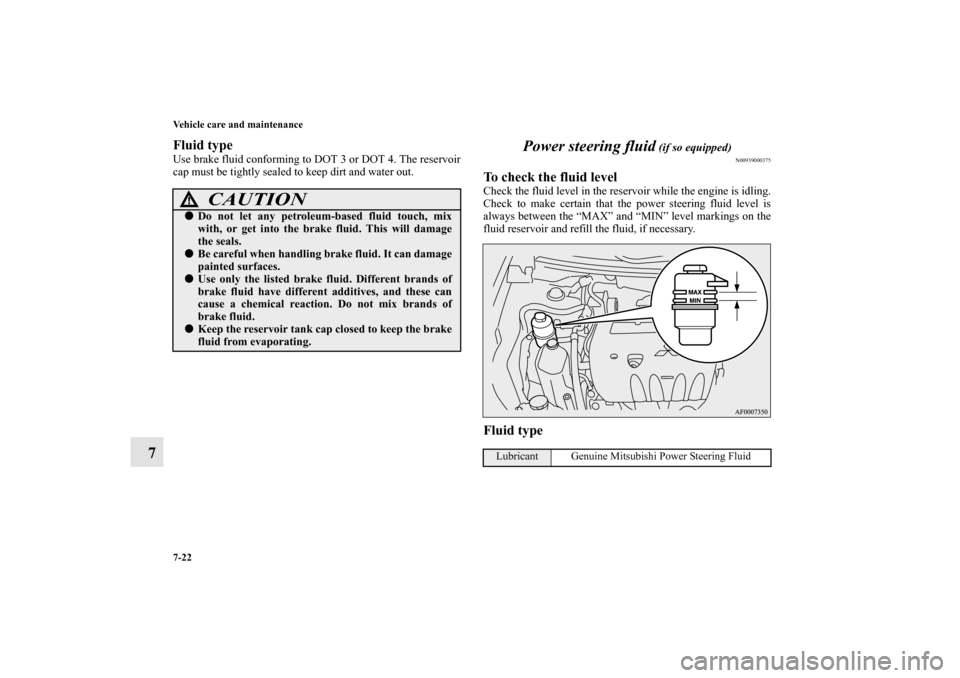
To check the fluid levelCheck the fluid level in the reservoir while the engine is idling.
Check to make certain that the power steering fluid level is
always between the “MAX” and “MIN” level markings on the
fluid reservoir and refill the fluid, if necessary.Fluid type
CAUTION
!�Do not let any petroleum-based fluid touch, mix
with, or get into the brake fluid. This will damage
the seals.�Be careful when handling brake fluid. It can damage
painted surfaces.�Use only the listed brake fluid. Different brands of
brake fluid have different additives, and these can
cause a chemical reaction. Do not mix brands of
brake fluid.�Keep the reservoir tank cap closed to keep the brake
fluid from evaporating.
Lubricant Genuine Mitsubishi Power Steering Fluid
BK0125300US.book 22 ページ 2010年5月18日 火曜日 午後1時53分
Page 602 of 706
Vehicle care and maintenance
7-23
7 Battery
N00939100826
The condition of the battery is very important for quick starting
and to keep the vehicle’s electrical system working properly.
Check the battery regularly. Removing and installing the battery upper cover
(vehicles equipped with turbocharger)
N00901300025
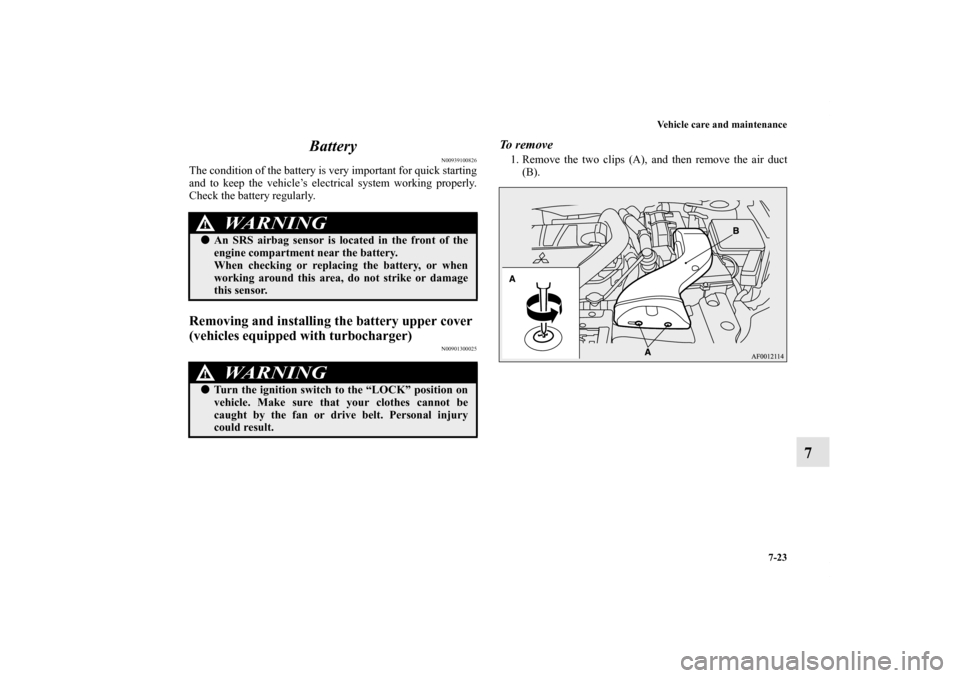
To r e m o v e1. Remove the two clips (A), and then remove the air duct
(B).
WA R N I N G
!�An SRS airbag sensor is located in the front of the
engine compartment near the battery.
When checking or replacing the battery, or when
working around this area, do not strike or damage
this sensor.
WA R N I N G
!�Turn the ignition switch to the “LOCK” position on
vehicle. Make sure that your clothes cannot be
caught by the fan or drive belt. Personal injury
could result.
BK0125300US.book 23 ページ 2010年5月18日 火曜日 午後1時53分
Page 604 of 706
Vehicle care and maintenance
7-25
7
To check the battery indicator
N00901400042
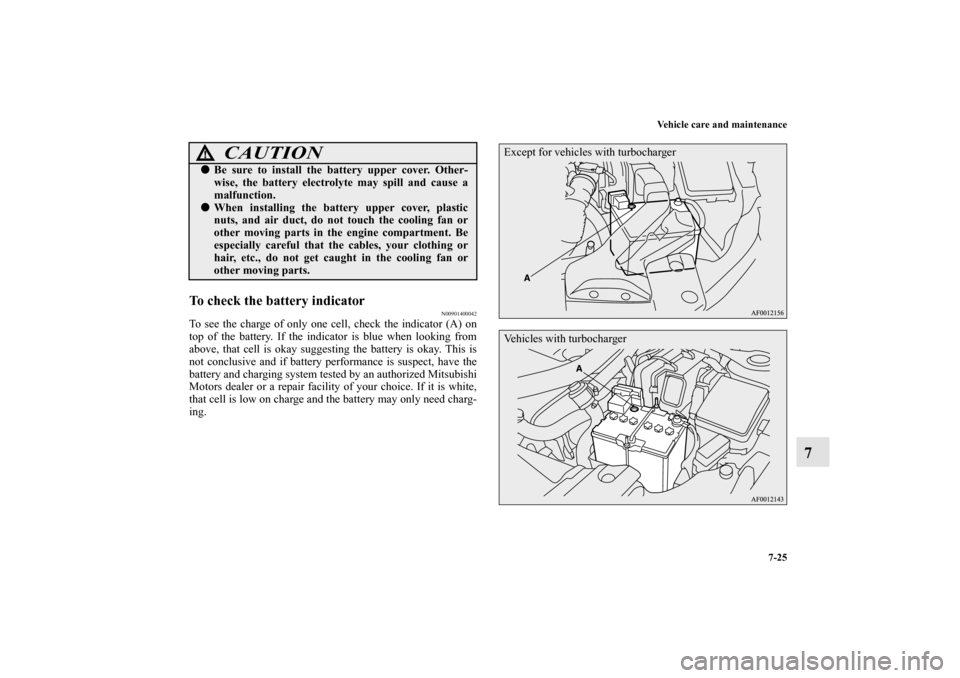
To see the charge of only one cell, check the indicator (A) on
top of the battery. If the indicator is blue when looking from
above, that cell is okay suggesting the battery is okay. This is
not conclusive and if battery performance is suspect, have the
battery and charging system tested by an authorized Mitsubishi
Motors dealer or a repair facility of your choice. If it is white,
that cell is low on charge and the battery may only need charg-
ing.
CAUTION
!�Be sure to install the battery upper cover. Other-
wise, the battery electrolyte may spill and cause a
malfunction.�When installing the battery upper cover, plastic
nuts, and air duct, do not touch the cooling fan or
other moving parts in the engine compartment. Be
especially careful that the cables, your clothing or
hair, etc., do not get caught in the cooling fan or
other moving parts.
Except for vehicles with turbochargerVehicles with turbocharger
BK0125300US.book 25 ページ 2010年5月18日 火曜日 午後1時53分
Page 606 of 706
Vehicle care and maintenance
7-27
7
During cold weather
N00901600028
The battery is weaker in cold temperatures. This has to do with
its chemical and physical properties and is why a very cold bat-
tery, especially one with a low charge, will have a hard time
starting your vehicle.
It is recommended that you have your battery and charging sys-
tem checked by an authorized Mitsubishi Motors dealer or a
repair facility of your choice before the start of cold weather. If
necessary, have it charged. This will guarantee more reliable
starting, and longer battery life.
Disconnection and connection
N00901700029
To disconnect the battery cable, stop the engine. Disconnect the
negative (-) terminal first, then the positive (+) terminal. To
reconnect the battery, first connect the positive (+) terminal and
then the negative (-) terminal, before starting the vehicle. NOTE�For vehicles equipped with turbocharger, remove the bat-
tery upper cover before disconnecting the terminal of bat-
tery. Refer to “Removing and installing the battery upper
cover” on page 7-23.
BK0125300US.book 27 ページ 2010年5月18日 火曜日 午後1時53分
Page 618 of 706

Vehicle care and maintenance
7-39
7
Snow tires
N00940000359
In some areas of the country, snow tires are required for winter
driving. If snow tires are required in your area, you must
choose snow tires of the same size and type as the original tires
provided with your vehicle. Snow tires should also be installed
on all four wheels. Otherwise your safety and vehicle handling
can be reduced.
Even where laws may permit it, snow tires should not be oper-
ated at sustained speeds over 75 mph (120 km/h).Tire chains
N00940100129
Clutch pedal free play
(if so equipped)
N00940200061
To check the clutch pedal free play (A), turn off the engine and
press the pedal until you feel resistance.
Clutch pedal free play:
.2 to .4 inch (4 to 9 mm)
CAUTION
!�If flange nuts are used on your vehicle, change to
tapered nuts when using snow tires with steel
wheels. �Only Mitsubishi Motors genuine wheels should be
used, because your vehicle is equipped with a tire
pressure monitoring system.
Use of another type of wheel risks air leaks and sen-
sor damage, as it will not be possible to install the
tire pressure sensor properly.
CAUTION
!�Tire chains cannot be used on your vehicle. The
clearance between the chains and the body is not
sufficient to allow proper clearance, and the vehicle
body might be damaged.
BK0125300US.book 39 ページ 2010年5月18日 火曜日 午後1時53分
Page 619 of 706
7-40 Vehicle care and maintenance
7Brake pedal free play
N00940300176
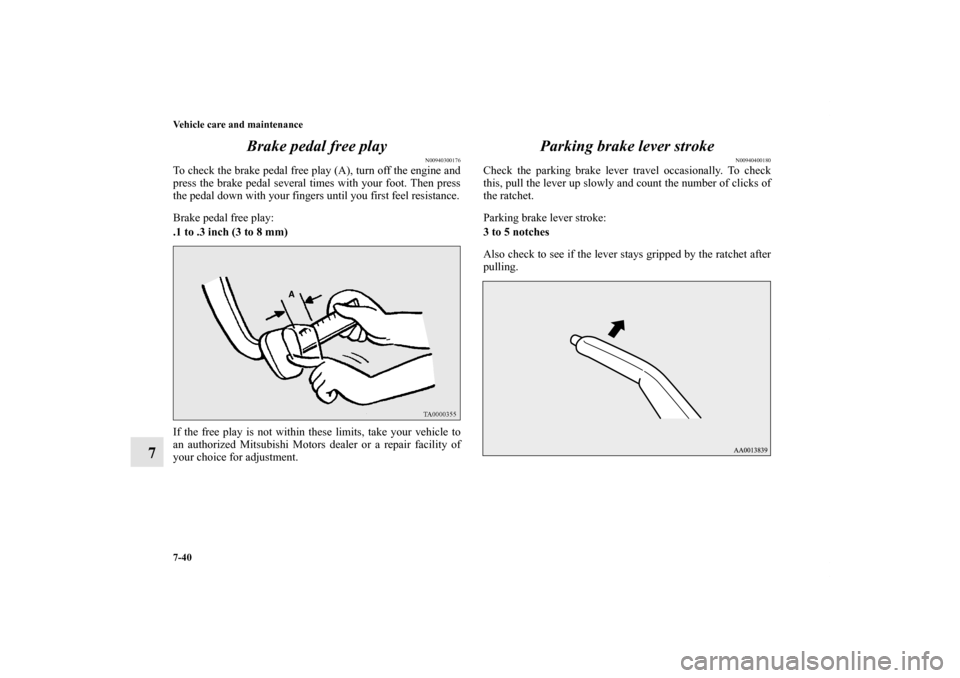
To check the brake pedal free play (A), turn off the engine and
press the brake pedal several times with your foot. Then press
the pedal down with your fingers until you first feel resistance.
Brake pedal free play:
.1 to .3 inch (3 to 8 mm)
If the free play is not within these limits, take your vehicle to
an authorized Mitsubishi Motors dealer or a repair facility of
your choice for adjustment.
Parking brake lever stroke
N00940400180
Check the parking brake lever travel occasionally. To check
this, pull the lever up slowly and count the number of clicks of
the ratchet.
Parking brake lever stroke:
3 to 5 notches
Also check to see if the lever stays gripped by the ratchet after
pulling.
BK0125300US.book 40 ページ 2010年5月18日 火曜日 午後1時53分
Page 621 of 706
7-42 Vehicle care and maintenance
7Emission-control system maintenance
N00940800201
Your vehicle is equipped with an emission-control system that
meets all the requirements of the U.S. Environmental Protec-
tion Agency and Environment Canada. The emission-control
system is made of:
�a positive crankcase ventilation system
�an evaporative emission-control system
�an exhaust emission-control system
The maintenance services listed in the “WARRANTY AND
MAINTENANCE MANUAL” must be performed at the times
or mileages listed to keep the emission-control system working
properly. These, and all the other “general” maintenance ser-
vices listed in this manual, need to be performed to keep your
vehicle running properly and reliably.
You may need more frequent maintenance if you drive your
vehicle in harsh conditions such as dusty areas or do a lot of
start-and-stop driving.
To be sure the emission-control system works properly, have
your vehicle inspected and maintained by an authorized Mit-
subishi Motors dealer or a repair facility of your choice follow-
ing the schedule in the “WARRANTY AND MAINTENANCE
MANUAL”.
You should also have an inspection and service any time you
suspect a malfunction.
NOTE�To meet government regulations and promote cleaner air,
your vehicle is equipped with an onboard diagnostic sys-
tem (OBD). The engine electronic control module that
controls OBD functions stores various data (especially
about the exhaust emissions). This data will be erased if
the battery cable is disconnected, which could make a
rapid diagnosis difficult. Do not disconnect the battery
cable when the engine malfunction indicator (“SERVICE
ENGINE SOON” or “Check engine light”) is on.
BK0125300US.book 42 ページ 2010年5月18日 火曜日 午後1時53分
Page 622 of 706
Vehicle care and maintenance
7-43
7
Spark plugs
N00940900257
Spark plugs must fire properly for good engine performance
and emission-control.
Do not reuse them by cleaning or regapping. Change them at
the mileage listed in the “WARRANTY AND MAINTE-
NANCE MANUAL”. NOTE�Use the spark plugs listed under “Engine specifications”
on page 9-8 or plugs that are exactly the same. Other
plugs could cause engine damage, performance problems
or radio noise.
Fuel hoses
N00941000037
Check the hose surfaces for any heat and mechanical damage,
hard and brittle rubber, cracking, tears, cuts and abrasions. Pay
special attention to the hoses closest to high heat sources such
as the exhaust manifold. Check all the hose connections, such
as clamps and couplings, to make sure they are secure and that
there are no leaks. If you see any wear or damage, replace the
hoses immediately.Intake valve clearance
N00950100050
Have the valve clearance checked at an authorized Mitsubishi
Motors dealer at the mileage specified in the “WARRANTY
AND MAINTENANCE MANUAL”.
If the engine sounds abnormally loud, have adjustments made
by an authorized Mitsubishi Motors dealer.
BK0125300US.book 43 ページ 2010年5月18日 火曜日 午後1時53分