Page 358 of 424
Vehicle care and maintenance
7-23
7
Tire inflation pressures
N00939300798
Proper tire inflation pressure is essential for the safe and satis-
factory operation of your vehicle. The wrong tire pressure will
cause problems in three major areas:
�Safety
Too little pressure increases flexing in the tire and can
cause tire failure. Too much pressure can cause a tire to
lose its ability to cushion shock. Objects on the road and
potholes could then cause tire damage that may result in
tire failure.
�Economy
The wrong tire pressure can cause uneven wear patterns in
the tire tread. These abnormal wear patterns will reduce
the tread life, and the tire will have to be replaced sooner.
Too little pressure also makes it harder for the tire to roll,
and this uses up more fuel.
�Ride comfort and vehicle stability
The superior riding experience built into your vehicle
partly depends on the correct tire pressure. Too much
pressure gives an uncomfortable and jarring ride. Too lit-
tle pressure feels as if your vehicle is slow to respond.
Unequal tire pressures can make steering your vehicle
uneven and unpredictable.
The correct tire pressure for your vehicle is listed on the plac-
ard attached to the sill of the driver’s door.
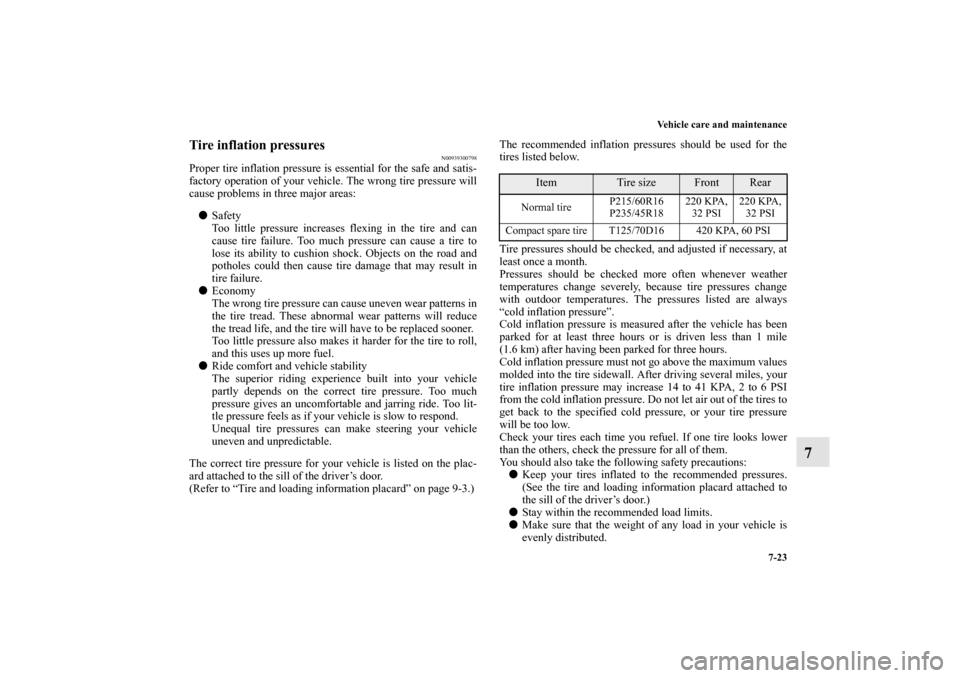
(Refer to “Tire and loading information placard” on page 9-3.)The recommended inflation pressures should be used for the
tires listed below.
Tire pressures should be checked, and adjusted if necessary, at
least once a month.
Pressures should be checked more often whenever weather
temperatures change severely, because tire pressures change
with outdoor temperatures. The pressures listed are always
“cold inflation pressure”.
Cold inflation pressure is measured after the vehicle has been
parked for at least three hours or is driven less than 1 mile
(1.6 km) after having been parked for three hours.
Cold inflation pressure must not go above the maximum values
molded into the tire sidewall. After driving several miles, your
tire inflation pressure may increase 14 to 41 KPA, 2 to 6 PSI
from the cold inflation pressure. Do not let air out of the tires to
get back to the specified cold pressure, or your tire pressure
will be too low.
Check your tires each time you refuel. If one tire looks lower
than the others, check the pressure for all of them.
You should also take the following safety precautions:
�Keep your tires inflated to the recommended pressures.
(See the tire and loading information placard attached to
the sill of the driver’s door.)
�Stay within the recommended load limits.
�Make sure that the weight of any load in your vehicle is
evenly distributed.
Item
Tire size
Front
Rear
Normal tireP215/60R16
P235/45R18220 KPA,
32 PSI220 KPA,
32 PSI
Compact spare tire T125/70D16 420 KPA, 60 PSI
BK0121200US.book 23 ページ 2010年4月14日 水曜日 午前11時24分
Page 375 of 424
7-40 Vehicle care and maintenance
7
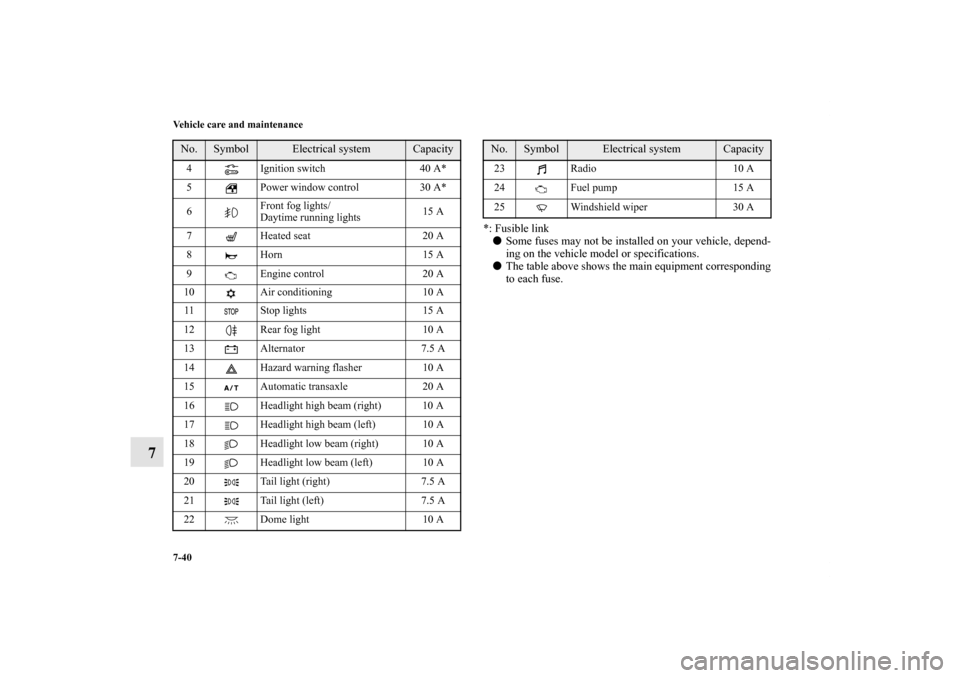
*: Fusible link
�Some fuses may not be installed on your vehicle, depend-
ing on the vehicle model or specifications.
�The table above shows the main equipment corresponding
to each fuse.
4 Ignition switch 40 A*
5 Power window control 30 A*
6Front fog lights/
Daytime running lights15 A
7 Heated seat 20 A
8 Horn 15 A
9 Engine control 20 A
10 Air conditioning 10 A
11 Stop lights 15 A
12 Rear fog light 10 A
13 Alternator 7.5 A
14 Hazard warning flasher 10 A
15 Automatic transaxle 20 A
16 Headlight high beam (right) 10 A
17 Headlight high beam (left) 10 A
18 Headlight low beam (right) 10 A
19 Headlight low beam (left) 10 A
20 Tail light (right) 7.5 A
21 Tail light (left) 7.5 A
22 Dome light 10 A No.
Symbol
Electrical system
Capacity
23 Radio 10 A
24
Fuel pump 15 A
25 Windshield wiper 30 A No.
Symbol
Electrical system
Capacity
BK0121200US.book 40 ページ 2010年4月14日 水曜日 午前11時24分
Page 418 of 424

Alphabetical index
3
Oil and oil filter 7-6
,9-8
Overheating 6-5
Serial number 9-2
Specifications 9-6
Error codes 5-64
,5-66
Exhaust system 7-33
F
Filling the fuel tank 1-4
Floor console box 3-132
Fluid
Automatic transaxle fluid 7-12
,9-8
Brake fluid 7-14
,9-8
Engine coolant 7-9,9-8
Power steering fluid 7-15
,9-8
Washer fluid 7-13
,9-8
Fluid capacities and lubricants 9-8
Fog lights
Indicator 3-78
Switch 3-86
For cold and snowy weather 7-34
Front fog light
Capacity 7-45
Front fog lights
Replacement 7-51
Front seats 2-4
Front side-marker lights
Capacity 7-45
Front turn-signal lightsCapacity 7-45
Fuel
Fuel economy 4-2
Fuel gauge 3-75
Fuel hoses 7-30
Low-fuel warning light 3-75
Modification/alterations to the electrical or fuel systems 1-8
Tank capacity 9-8
Fuel selection 1-2
Fuse links 7-34
Fuses 7-35
Block location 7-35
Identification 7-42
Load capacities 7-37
Replacement 7-42
G
Gauges 3-72
General maintenance 7-31
General vehicle data 9-4
Genuine parts 1-8
Glove compartment 3-131
Glove compartment light
Replacement 7-59
H
Hands-free Bluetooth
® cellular phone interface system with
voice recognition 3-92
Hazard warning flasher switch 3-85
BK0121200US.book 3 ページ 2010年4月14日 水曜日 午前11時24分
Page 419 of 424
Alphabetical index
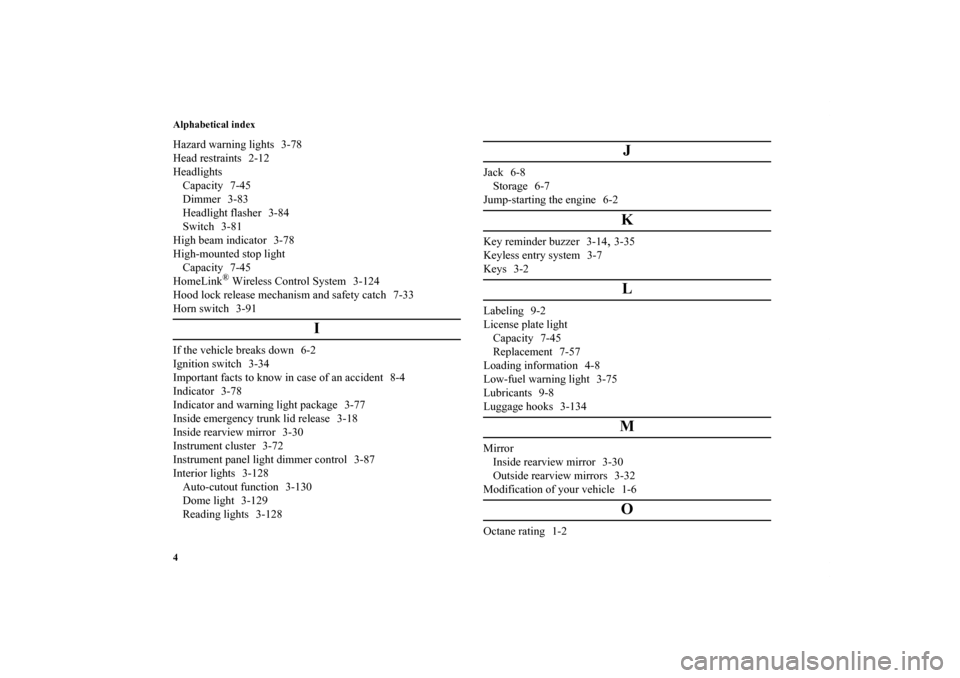
4Hazard warning lights 3-78
Head restraints 2-12
Headlights
Capacity 7-45
Dimmer 3-83
Headlight flasher 3-84
Switch 3-81
High beam indicator 3-78
High-mounted stop light
Capacity 7-45
HomeLink
® Wireless Control System 3-124
Hood lock release mechanism and safety catch 7-33
Horn switch 3-91
I
If the vehicle breaks down 6-2
Ignition switch 3-34
Important facts to know in case of an accident 8-4
Indicator 3-78
Indicator and warning light package 3-77
Inside emergency trunk lid release 3-18
Inside rearview mirror 3-30
Instrument cluster 3-72
Instrument panel light dimmer control 3-87
Interior lights 3-128
Auto-cutout function 3-130
Dome light 3-129
Reading lights 3-128
J
Jack 6-8
Storage 6-7
Jump-starting the engine 6-2
K
Key reminder buzzer 3-14
,3-35
Keyless entry system 3-7
Keys 3-2L
Labeling 9-2
License plate light
Capacity 7-45
Replacement 7-57
Loading information 4-8
Low-fuel warning light 3-75
Lubricants 9-8
Luggage hooks 3-134
M
Mirror
Inside rearview mirror 3-30
Outside rearview mirrors 3-32
Modification of your vehicle 1-6
O
Octane rating 1-2
BK0121200US.book 4 ページ 2010年4月14日 水曜日 午前11時24分
Page 423 of 424
How to calculate your gasoline mileage
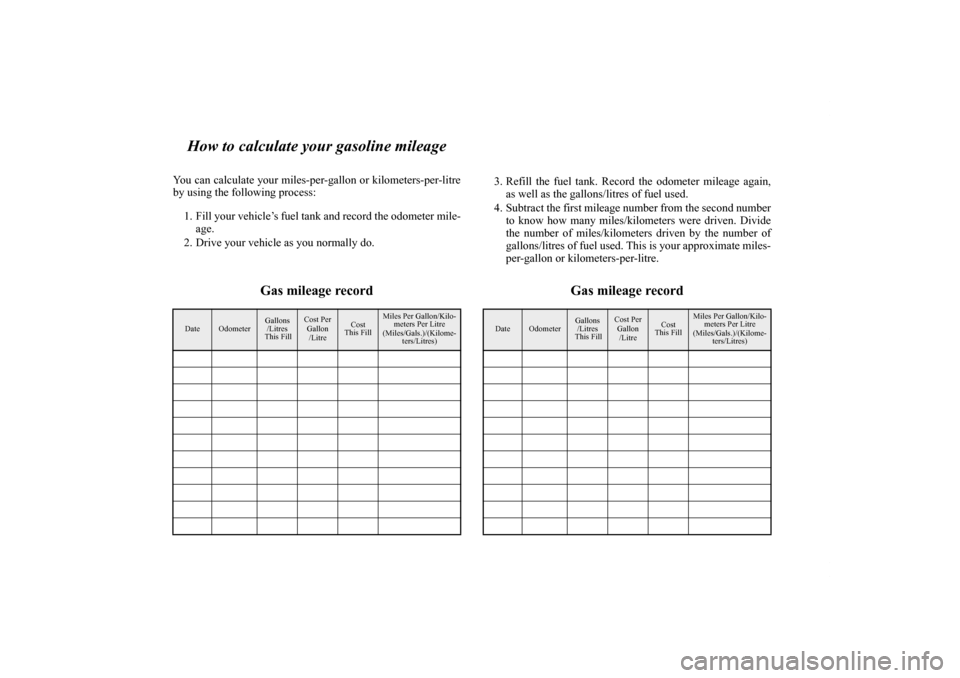
You can calculate your miles-per-gallon or kilometers-per-litre
by using the following process:
1. Fill your vehicle’s fuel tank and record the odometer mile-
age.
2. Drive your vehicle as you normally do.3. Refill the fuel tank. Record the odometer mileage again,
as well as the gallons/litres of fuel used.
4. Subtract the first mileage number from the second number
to know how many miles/kilometers were driven. Divide
the number of miles/kilometers driven by the number of
gallons/litres of fuel used. This is your approximate miles-
per-gallon or kilometers-per-litre.
Gas mileage record Gas mileage record
Date
Odometer
Gallons
/Litres
This Fill
Cost Per
Gallon
/Litre
Cost
This Fill
Miles Per Gallon/Kilo-
meters Per Litre
(Miles/Gals.)/(Kilome-
ters/Litres)
Date
Odometer
Gallons
/Litres
This Fill
Cost Per
Gallon
/Litre
Cost
This Fill
Miles Per Gallon/Kilo-
meters Per Litre
(Miles/Gals.)/(Kilome-
ters/Litres)
MMNA_本文最終ページ.fm 1 ページ 2005年12月15日 木曜日 午後2時58分
Page:
< prev 1-8 9-16 17-24