2011 MERCEDES-BENZ B-CLASS HATCHBACK warning light
[x] Cancel search: warning lightPage 274 of 329

Cleaning the exhaust pipe
!
Do no tclean the exhaust pipe with alka-
line-based cleaning agents, such as wheel
cleaner.
X Clean the exhaust pipe with a chrome care
produc ttested and approved by Mercedes-
Benz.
Impurities combined with the effects of road
grit and corrosive environmental factors may
cause flash rust to form on the surface. You
can restore the original shine of the exhaust
pipe by cleaning it regularly, especially in win-
ter and after washing.
Cleaning the trailer tow hitch H
Environmental note
Dispose of oily and greasy cloths in an envi-
ronmentally-responsible manner.
! Do not clean the ball coupling with a high-
pressure cleaner. Do not use solvents.
! Observe the note on care provided by the
trailer manufacturer. X
Remove rust, e.g. with a wire brush.
X Remove dirt with a clean, lint-free cloth or
a brush.
X After cleaning, lightly oil or grease ball cou-
pling :.
X Check that the vehicle's trailer tow hitch is
working properly.
i Maintenance of the ball coupling and
trailer tow hitch can also be performed at a qualified specialist workshop, e.g. a
Mercedes-Benz Service Centre. Interior care
Cleaning the display !
For cleaning, do not use any of the fol-
lowing:
R alcohol-based thinner or petrol
R abrasive cleaning agents
R commercially-available household clean-
ing agents
These may damage the display surface. Do
not put pressure on the display surface
when cleaning. This could lead to irrepara-
ble damage to the display.
X Before cleaning the display, make sure that
it is switched off and has cooled down.
X Clean the display surface using a commer-
cially available microfibre cloth and TFT/
LCD display cleaner.
X Dry the display surface using a dry micro-
fibre cloth.
Cleaning the plastic trim G
WARNING
When cleaning the steering wheel boss and
dashboard, do not use cockpit sprays or
cleaning agents containing solvents. Cleaning
agents containing solvents cause the surface
to become porous, and as aresult plastic
parts may break away and be thrown around
the interior when an airbag is deployed, which
may result in severe injuries.
! Do not affix the following to plastic surfa-
ces:
R stickers
R films
R scented oil bottles or similar items
You could otherwise damage the plastic. Care
271Maintenance and care Z
Page 299 of 329

R
Check the tyre for foreign objects.
R Chec kwhether the wheel is losing air or the
valve is leaking.
If you are unable to rectify the damage, con-
tact a qualified specialist workshop. H
Environmental note
Check the tyre pressure regularly, at least
every 14 days.
You will find a table of tyre pressures for var-
ious operating conditions on the inside of
your vehicle's fuel filler flap.
Operation with a trailer: the applicable
value for the rear tyres is the maximum tyre
pressure value stated in the table inside the
fuel filler flap.
The table inside the fuel filler flap may state
tyre pressures for different load conditions.
These are defined in the table as different
numbers of passengers and amounts of lug-
gage. The actual number of seats may vary –
for more information, please refer to the vehi-
cle's registration documents.
If tyre sizes are not specified, the tyre pres-
sures stated on the tyre pressure information
label apply for all tyres approved for this vehi-
cle. If a tyre size precedes a tyre pressure, the tyre
pressure information following is only valid
for that tyre size.
Use a suitable pressure gauge to check the
tyre pressure. The outer appearance of a tyre
does not permit any reliable conclusion about
the tyre pressure. If possible, only correct tyre pressures when
the tyres are cold.
The tyres are cold:
R
if the vehicle has been parked with the tyres
out of direct sunlight for at least three
hours and
R if the vehicle has not been driven further
than 1.6 km
Depending on the ambient temperature, the
speed you are driving at and the load on the
tyres, the tyre temperature may change and
thereby the tyre pressure: 10 kPa (0.1 bar/
1.5 psi) per 10 †. Take this into account
when checking the pressure of warm tyres.
Only correct the tyre pressure if it is too low
for the current operating conditions.
Driving with tyre pressure that is too high or
too low can:
R shorten the service life of the tyres
R cause increased tyre damage
R have a negative effect on handling charac-
teristics and thus the driving safety (e.g.
aquaplaning)
i The tyre pressure values given for low
loads are minimum values which offer you
good ride comfort characteristics.
However, you can also use the values given
for higher loads. These are permissible and
will not adversely affect the running of the
vehicle. Tyre pressure loss warning system
Important safety notes While the vehicle is in motion, the tyre pres-
sure loss warning system monitors the set
tyre pressure using the rotational speed of
the wheels. This enables the system to detect
significant pressure loss in a tyre. If the speed
of rotation of a wheel changes as a result of
a loss of pressure, a corresponding warning
message will appearint he multifunction dis-
play. 296
Tyre pressureWheels and tyres
Page 302 of 329

X
Secure the vehicle to prevent it from rolling
away.
i Apart from some country-specific var-
iants, vehicles are not equipped with tyre-
changing tools. For more information on
which tools are required to perfor mawheel
change on your vehicle, consult a
Mercedes-Benz Service Centre.
Required tyre-changing tools could be, for
example:
R jack
R wheel chock
R wheel wrench
Securing the vehicle to prevent it from
rolling away If your vehicle is equipped with a wheel chock,
it can be found in th evehicle tool kit
(Y page 275).
The folding wheel choc kis an additional
securing measure to prevent the vehicle from
rolling away, for example when changing a
wheel.
X Fold both plates upwards :.
X Fold out lower plate ;.
X Guide the lugs on the lower plate fully into
the openings in base plate =. Securing the vehicle on level ground
X
On level ground: place wheel chocks or
other suitable items under the front and
rear of the wheel that is diagonally opposite
the wheel you wish to change. Securing the vehicle on slight downhill gradients
X
On downhill gradients: place wheel
chocks or other suitable items in front of
the wheels of the front and rear axle.
Raising the vehicle G
WARNING
If you do not position the jack correctly at the
appropriate jacking point of the vehicle, the
jack could tip over with the vehicle raised.
There is a risk of injury.
Only position the jack at the appropriate jack-
ing point of the vehicle. The base of the jack
must be positioned vertically, directly under
the jacking point of the vehicle. Changing
awheel
299Wheels and tyres Z
Page 307 of 329
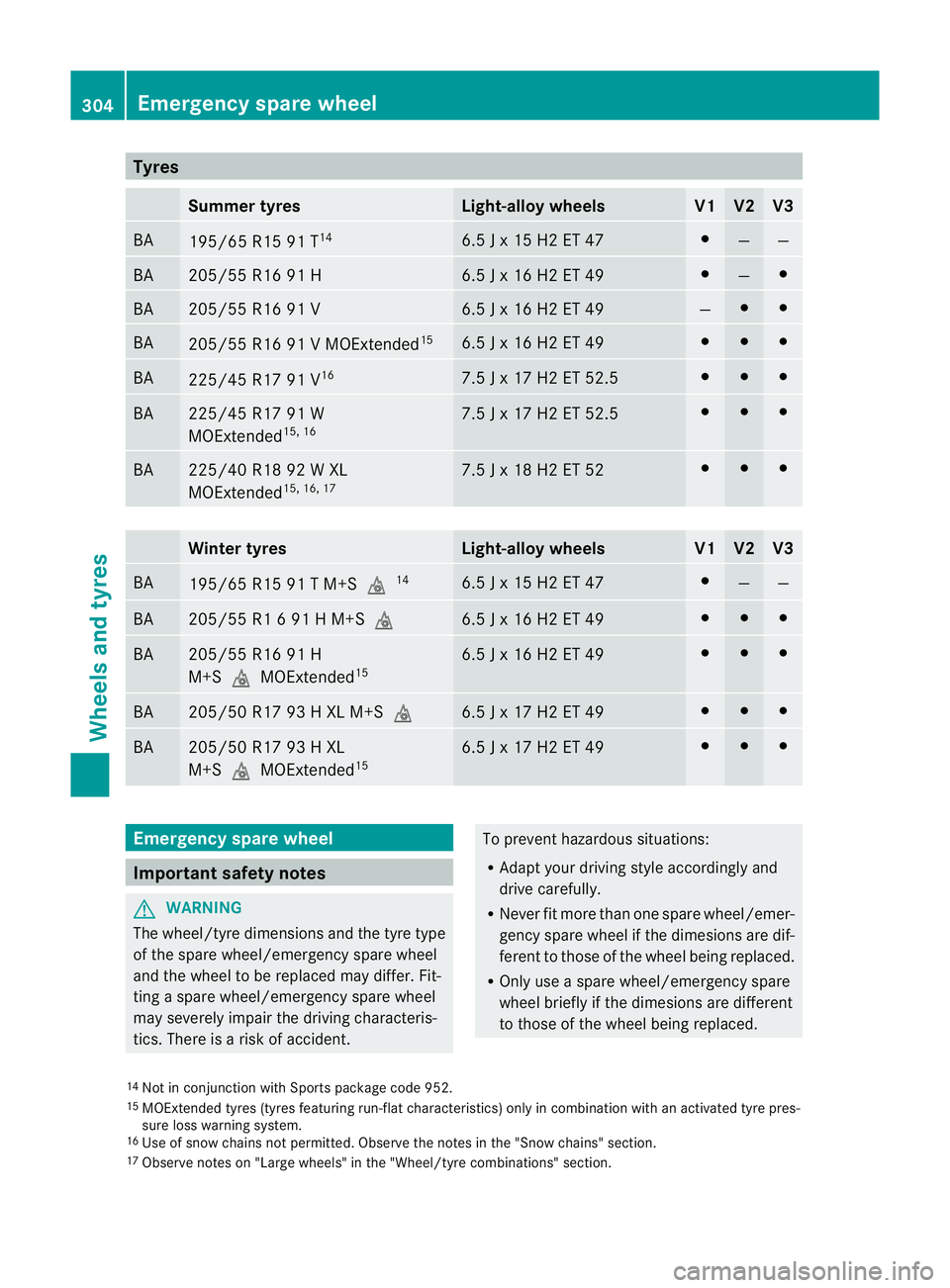
Tyres
Summer tyres Light-alloy wheels V1 V2 V3
BA
195/6
5 R15 91 T 14 6.5 J
x 15 H2 ET 47 #
— —
BA 205/55 R16 91 H 6.5 J x 16 H2 ET 49 #
— #
BA 205/55 R16 91 V 6.5 J x 16 H2 ET 49 — # #
BA
205/55 R16 91 V MOExtended
15 6.5 J x 16 H2 ET 49 # # #
BA
225/45 R17 91 V
16 7.5 J x 17 H2 ET 52.5 # # #
BA 225/45 R17 91 W
MOExtended
15, 16 7.5 J x 17 H2 ET 52.5 # # #
BA 225/40 R18 92 W XL
MOExtended
15, 16, 17 7.5 J x 18 H2 ET 52 # # #
Winter tyres Light-alloy wheels V1 V2 V3
BA
195/65 R15 91 T M+S
i14 6.5 J x 15 H2 ET 47 #
— —
BA 205/55 R1 6 91 H M+S
i 6.5 J x 16 H2 ET 49 # # #
BA 205/55 R16 91 H
M+S
iMOExtended 15 6.5 J x 16 H2 ET 49 # # #
BA 205/50 R17 93 H XL M+S
i 6.5 J x 17 H2 ET 49 # # #
BA 205/50 R17 93 H XL
M+S
iMOExtended 15 6.5 J x 17 H2 ET 49 # # #
Emergenc
yspare wheel Important safety notes
G
WARNING
The wheel/tyre dimensions and the tyre type
of the spare wheel/emergency spare wheel
and the wheel to be replaced may differ .Fit-
ting a spare wheel/emergency spare wheel
may severely impair the driving characteris-
tics. There is a risk of accident. To prevent hazardous situations:
R
Adapt your driving style accordingly and
drive carefully.
R Never fit more than one spare wheel/emer-
gency spare wheel if the dimesions are dif-
ferent to those of the wheel being replaced.
R Only use a spare wheel/emergency spare
wheel briefly if the dimesions are different
to those of the wheel being replaced.
14 Not in conjunction with Sports package code 952.
15 MOExtended tyres (tyres featuring run-flat characteristics) only in combination with an activated tyre pres-
sure loss warning system.
16 Use of snow chains not permitted. Observe the notes in the "Snow chains" section.
17 Observe notes on "Large wheels" in the "Wheel/tyre combinations" section. 304
Emergency spare wheelWheels and tyres