Page 182 of 821
109
1
1-7. Safety information
Before driving
SRS airbags
The SRS airbags inflate when the vehicle is subjected to certain types of
severe impacts that may cause significant injury to the occupants. They
work together with the seat belts to help reduce the risk of death or serious
injury.
SRS front airbags
SRS driver airbag/front passenger airbag
Can help protect the head and chest of the driver and front passen-
ger from impact with interior components
SRS knee airbags
Can help provide driver and front passenger protection
Page 184 of 821
111
1-7. Safety information
1
Before driving
SRS airbag system components
Your vehicle is equipped with ADVANCED AIRBAGS designed based
on US motor vehicle safety standards (FMVSS208). The airbag system
controls airbag deployment power for the driver and front passenger. The
driver airbag system consists of the driver’s seat position sensor etc. The
front passenger’s airbag system consists of the front passenger occupant
classification sensor etc.
Knee airbags
Front passenger airbag
Curtain shield airbags
Front side airbags
Occupant detection system
(ECU and sensors)
“AIR BAG ON” and “AIR BAG
OFF” indicator lights
Rear side airbags
SRS warning light
Driver airbag
Curtain shield airbag sensors
Side and curtain shield airbag
sensors
Driver's seat belt buckle
switch
Driver's seat position sensor
Airbag sensor assembly
Front airbag sensors
Front passenger’s seat belt
buckle switch
Page 186 of 821
113
1-7. Safety information
1
Before driving
nSRS airbag deployment conditions (SRS front airbags)
lThe SRS front airbags will deploy in the event of an impact that exceeds the
set threshold level (the level of force corresponding to an approximately 12 -
18 mph [20 - 30 km/h] frontal collision with a fixed wall that does not move or
deform).
However, this threshold velocity will be considerably higher if the vehicle strikes
an object, such as a parked vehicle or sign pole, which can move or deform on
impact, or if the vehicle is involved in an underride collision (e.g. a collision in
which the front of the vehicle “underrides”, or goes under, the bed of a truck, etc.).
lIt is possible that in some collisions where the forward deceleration of the vehi-
cle is very close to the designed threshold level, the SRS front airbags and the
seat belt pretensioners may not activate together.
lThe SRS front passenger airbag will not activate if there is no passenger sitting
in the front passenger seat. However, the SRS front passenger airbag may
deploy if luggage is put in the seat, or the seat belt is fastened, even if the seat is
unoccupied. (→P. 7 5 )
nSRS airbag deployment conditions (SRS side airbags and curtain shield airbags)
The SRS side airbags and curtain shield airbags will deploy in the event of an impact
that exceeds the set threshold level (the level of force corresponding to the impact
force produced by an approximately 3300 lb. [1500 kg] vehicle colliding with the
vehicle cabin from a direction perpendicular to the vehicle orientation at an
approximate speed of 12 - 18 mph [20 - 30
km/h
]).
Page 190 of 821
117
1-7. Safety information
1
Before driving
CAUTION
nSRS airbag precautions
Observe the following precautions regarding the SRS airbags.
Failure to do so may cause death or serious injury.
lThe driver and all passengers in the vehicle must wear their seat belts properly.
The SRS airbags are supplemental devices to be used with the seat belts.
lThe SRS driver airbag deploys with considerable force, and can cause death or
serious injury especially if the driver is very close to the airbag. The National
Highway Traffic Safety Administration (“NHTSA”) advises:
Since the risk zone for driver’s airbag is the first 2 - 3 in. (50 - 75 mm) of inflation,
placing yourself 10 in. (250 mm) from your driver airbag provides you with a
clear margin of safety. This distance is measured from the center of the steering
wheel to your breastbone. If you sit less than 10 in. (250 mm) away now, you can
change your driving position in several ways:
Page 191 of 821
118
1-7. Safety information
CAUTION
nSRS airbag precautions
lThe SRS front passenger airbag also deploys with considerable force, and can
cause death or serious injury especially if the front passenger is very close to the
airbag. The front passenger seat should be as far from the airbag as possible with
the seatback adjusted, so the front passenger sits upright.
lImproperly seated and/or restrained infants and children can be killed or seri-
ously injured by a deploying airbag. An infant or child who is too small to use a
seat belt should be properly secured using a child restraint system. Lexus strongly
recommends that all infants and children be placed in the rear seats of the vehicle
and properly restrained. The rear seats are safer for infants and children than the
front passenger seat. (→P. 1 2 7 )
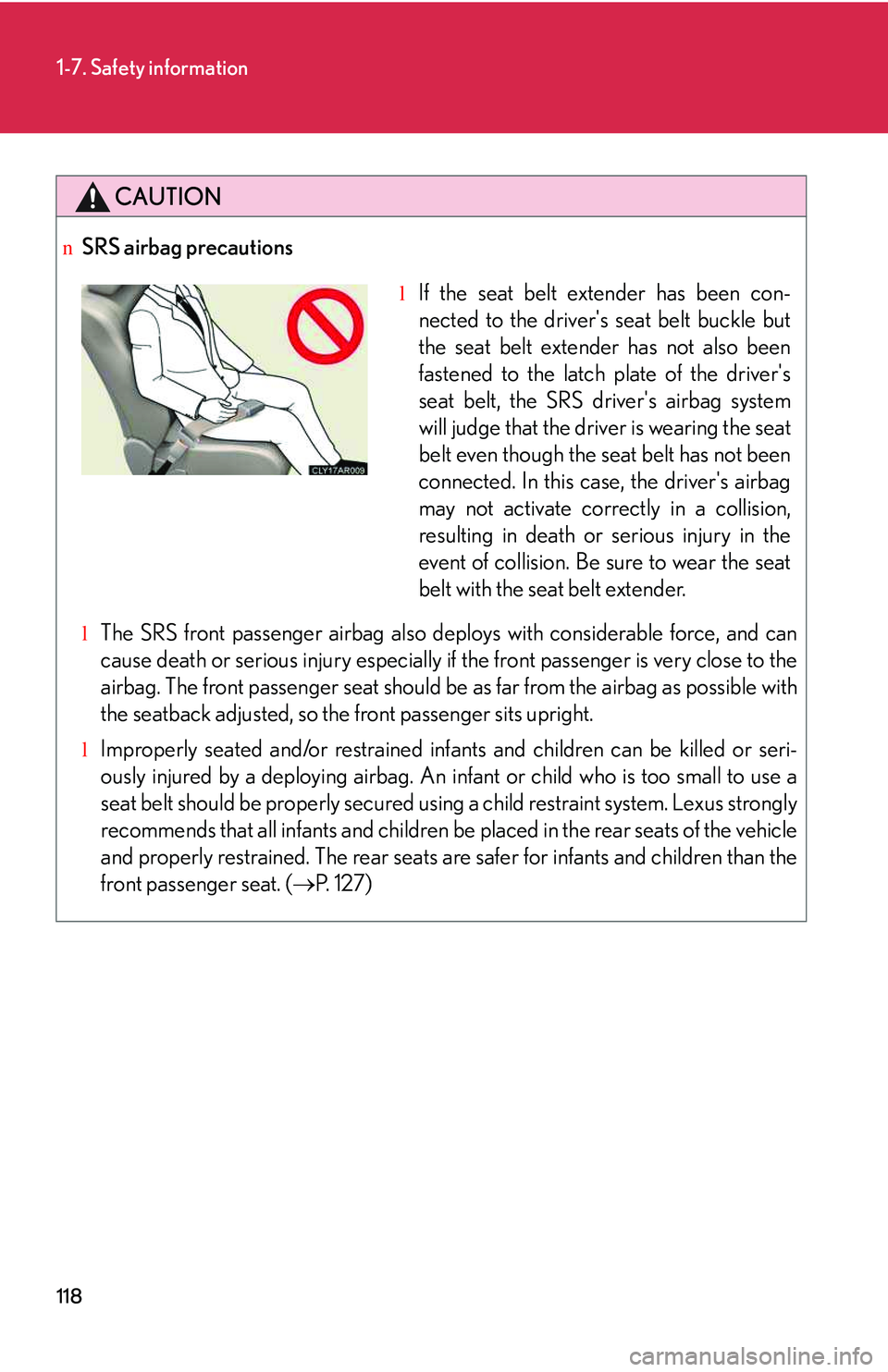
lIf the seat belt extender has been con-
nected to the driver's seat belt buckle but
the seat belt extender has not also been
fastened to the latch plate of the driver's
seat belt, the SRS driver's airbag system
will judge that the driver is wearing the seat
belt even though the seat belt has not been
connected. In this case, the driver's airbag
may not activate correctly in a collision,
resulting in death or serious injury in the
event of collision. Be sure to wear the seat
belt with the seat belt extender.
Page 195 of 821
122
1-7. Safety information
Front passenger occupant classification system
Your vehicle is equipped with a front passenger occupant classification sys-
tem. This system detects the conditions of the front passenger seat and
activates or deactivates the devices for the front passenger.
SRS warning light
“AIR BAG OFF” indicator light
“AIR BAG ON” indicator light
Front passenger’s seat belt reminder light
Without
navigation system
With navigation system
Page 196 of 821
123
1-7. Safety information
1
Before driving Condition and operation in the front passenger occupant classification system
nAdult*1
nChild *3 or child restraint system*4
Indicator/
warning light
“AIR BAG ON” and “AIR BAG OFF”
indicator lights
“A I R B A G
ON”
SRS warning lightOff
Front passenger’s seat belt reminder lightFlashing*2
Devices
Front passenger airbag
Activated
Side airbag on the front passenger seats
Curtain shield airbag in the front passenger side
Front passenger knee airbag
Front passenger’s seat belt pretensioner
Indicator/
warning light
“AIR BAG ON” and “AIR BAG OFF”
indicator lights
“A I R B A G
OFF”*5
SRS warning light Off
Front passenger’s seat belt reminder lightFlashing*2
Devices
Front passenger airbag Deactivated
Side airbag on the front passenger seatsActivated
Curtain shield airbag in the front passenger side
Front passenger knee airbag Deactivated
Front passenger’s seat belt pretensioner Activated
Page 197 of 821

124
1-7. Safety information
nUnoccupied
nThere is a malfunction in the system
*1:The system judges a person of adult size as an adult. When a smaller
adult sits in the front passenger seat, the system may recognize him/
her as a child depending on his/her physique and posture.
*2: In the event the front passenger does not wear a seat belt.
*3: When a larger child who has outgrown a child restraint system sits in
the front passenger seat, the system may recognize him/her as an
adult depending on his/her physique or posture.
Indicator/
warning light
“AIR BAG ON” and “AIR BAG OFF”
indicator lights
Not illuminated
SRS warning lightOffFront passenger’s seat belt reminder light
Devices
Front passenger airbag Deactivated
Side airbag on the front passenger seatsActivated
Curtain shield airbag in the front passenger side
Front passenger knee airbagDeactivatedFront passenger’s seat belt pretensioner
Indicator/
warning light
“AIR BAG ON” and “AIR BAG OFF”
indicator lights
“A I R B A G
OFF”
SRS warning lightOn
Front passenger’s seat belt reminder light Off
Devices
Front passenger airbag Deactivated
Side airbag on the front passenger seatsActivated
Curtain shield airbag in the front passenger side
Front passenger knee airbag Deactivated
Front passenger’s seat belt pretensioner Activated