Page 559 of 821

489
4-3. Do-it-yourself maintenance
4
Maintenance and care
nTire inflation pressure check interval
You should check tire inflation pressure every two weeks, or at least once a month.
Do not forget to check the spare.
nEffects of incorrect tire inflation pressure
Driving with incorrect tire inflation pressure may result in the following:
lReduced fuel efficiency
lReduced driving comfort and tire life
lReduced safety
lDamage to the drive train
If a tire needs frequent inflating, have it checked by your Lexus dealer.
nInstructions for checking tire pressure
When checking tire inflation pressure, observe the following:
lCheck only when the tires are cold.
If your vehicle has been parked for at least 3 hours and has not been driven for
more than 1 mile or 1.5 km, you will get an accurate cold tire inflation pressure
reading.
lAlways use a tire pressure gauge.
The appearance of the tire can be misleading. In addition, tire inflation pressures
that are even just a few pounds off can degrade ride and handling.
lDo not reduce tire inflation pressure after driving. It is normal for the tire infla-
tion pressure to be higher after driving.
lNever exceed the vehicle capacity weight.
Passengers and luggage weight should be placed so that the vehicle is bal-
anced.
Page 561 of 821

491
4-3. Do-it-yourself maintenance
4
Maintenance and care
Wheels
nWhen replacing wheels
The wheels of your vehicle are equipped with tire pressure warning valves and
transmitters that allow the tire pressure warning system to provide advanced warn-
ing in the event of a loss in tire inflation pressure. Whenever wheels are replaced,
tire pressure warning valves and transmitters must be installed. (→P. 4 7 9 )
If a wheel is bent, cracked or heavily corroded, it should be replaced.
Otherwise, the tire may separate from the wheel or cause a loss of han-
dling control.
nWheel selection
When replacing wheels, care should be taken to ensure that they
are equivalent to those removed in load capacity, diameter, rim
width, and inset*.
Replacement wheels are available at your Lexus dealer.
*: Conventionally referred to as “offset”.
Lexus does not recommend using the following:
lWheels of different sizes or types
lUsed wheels
lBent wheels that have been straightened
nAluminum wheel precautions
lUse only Lexus wheel nuts and wrenches designed for use with
your aluminum wheels.
lWhen rotating, repairing or changing your tires, check that the
wheel nuts are still tight after driving 1000 miles (1600 km).
lBe careful not to damage the aluminum wheels when using tire
chains.
lUse only Lexus genuine balance weights or equivalent and a
plastic or rubber hammer when balancing your wheels.
Page 664 of 821
594
6-1. Specifications
Maintenance data (fuel, oil level, etc.)
Dimensions and weights
*1:Unladen vehicles
*2: Vehicles without roof antenna and roof rails
*3: Vehicles with roof antenna but without roof rails
*4: Vehicles with roof rails
Overall length187.8 in. (4770 mm)
Overall width74.2 in. (1885 mm)
Overall height*166.3 in. (1685 mm)*2
66.7 in. (1695 mm)*3
67.9 in. (1725 mm)*4
Wheelbase107.9 in. (2740 mm)
Tr e a dFront64.1 in. (1630 mm)
Rear63.8 in. (1620 mm)
Vehicle capacity weight
(Occupants + luggage)885 lb. (400 kg)
To w i n g
capacity
(Trailer
weight +
cargo)
Without towing pack-
age2000 lb. (907 kg)
With towing package3500 lb. (1588 kg)
Page 685 of 821

615
6-1. Specifications
6
Vehicle specifications
Warning: The temperature grades for this tire are established for a tire that
is properly inflated and not overloaded.
Excessive speed, underinflation, or excessive loading, either separately or in
combination, can cause heat buildup and possible tire failure.
Glossary of tire terminology
Tire related termMeaning
Cold tire inflation pres-
sure
Tire pressure when the vehicle has been parked for
three hours or more, or has not been driven more
than 1 mile or 1.5 km under that condition
Maximum inflation pres-
sure
The maximum cold inflated pressure to which a tire
may be inflated, shown on the sidewall of the tire
Recommended inflation
pressure
Cold tire inflation pressure recommended by a man-
ufacturer
Accessory weight
The combined weight (in excess of those standard
items which may be replaced) of automatic transmis-
sion, power steering, power brakes, power windows,
power seats, radio and heater, to the extent that these
items are available as factory-installed equipment
(whether installed or not)
Curb weight
The weight of a motor vehicle with standard equip-
ment, including the maximum capacity of fuel, oil and
coolant, and if so equipped, air conditioning and
additional weight optional engine
Maximum loaded vehicle
weight
The sum of:
(a) Curb weight
(b) Accessory weight
(c) Vehicle capacity weight
(d) Production options weight
Normal occupant weight150 lb. (68 kg) times the number of occupants speci-
fied in the second column of Table 1* that follows
Page 686 of 821

616
6-1. Specifications
Tire related termMeaning
Occupant distributionDistribution of occupants in a vehicle as specified in
the third column of Table 1* below
Production options
weight
The combined weight of installed regular production
options weighing over 5 lb. (2.3 kg) in excess of the
standard items which they replace, not previously
considered in curb weight or accessory weight,
including heavy duty brakes, ride levelers, roof rack,
heavy duty battery, and special trim
RimA metal support for a tire or a tire and tube assembly
upon which the tire beads are seated
Rim diameter
(Wheel diameter)Nominal diameter of the bead seat
Rim size designationRim diameter and width
Rim type designationThe industry manufacturer's designation for a rim by
style or code
Rim widthNominal distance between rim flanges
Vehicle capacity weight
(Total load capacity)
The rated cargo and luggage load plus 150 lb. (68
kg) times the vehicle's designated seating capacity
Vehicle maximum load on
the tire
The load on an individual tire that is determined by
distributing to each axle its share of the maximum
loaded vehicle weight, and dividing by two
Vehicle normal load on
the tire
The load on an individual tire that is determined by
distributing to each axle its share of curb weight,
accessory weight, and normal occupant weight (dis-
tributed in accordance with Table 1* below), and
dividing by two
We a t h e r s i d eThe surface area of the rim not covered by the
inflated tire
Page 688 of 821

618
6-1. Specifications
Tire related termMeaning
Intended outboard side-
wall
(a) The sidewall that contains a whitewall, bears
white lettering, or bears manufacturer, brand,
and/or model name molding that is higher or
deeper than the same molding on the other side-
wall of the tire, or
(b) The outward facing sidewall of an asymmetrical
tire that has a particular side that must always
face outward when mounted on a vehicle
Light truck (LT) tire
A tire designated by its manufacturer as primarily
intended for use on lightweight trucks or multipur-
pose passenger vehicles
Load ratingThe maximum load that a tire is rated to carry for a
given inflation pressure
Maximum load ratingThe load rating for a tire at the maximum permissible
inflation pressure for that tire
Maximum permissible
inflation pressure
The maximum cold inflation pressure to which a tire
may be inflated
Measuring rimThe rim on which a tire is fitted for physical dimension
requirements
Open spliceAny parting at any junction of tread, sidewall, or
innerliner that extends to cord material
Outer diameterThe overall diameter of an inflated new tire
Overall width
The linear distance between the exteriors of the side-
walls of an inflated tire, including elevations due to
labeling, decorations, or protective bands or ribs
Passenger car tire
A tire intended for use on passenger cars, multipur-
pose passenger vehicles, and trucks, that have a
gross vehicle weight rating (GVWR) of 10,000 lb. or
less.
PlyA layer of rubber-coated parallel cords
Page 717 of 821
648
Abbreviation list
Abbreviation/Acronym list
ABBREVIATIONSMEANING
2WDTwo Wheel Drive
4WDFour Wheel Drive
A/CAir Conditioning
ABSAnti-lock Brake System
AFSAdaptive Front-lighting System
AI-SHIFTArtificial Intelligence Shift control
ALRAutomatic Locking Retractor
AW DAll Wheel Drive
CRSChild Restraint System
DISPDisplay
ECTElectronic Controlled Transmission
ECUElectronic Control Unit
EDREvent Data Recorder
ELREmergency Locking Retractor
EPSElectric Power Steering
GAWRGross Axle Weight Ratings
GCWRGross Combination Weight Rating
GVWRGross Vehicle Weight Rating
I/MEmission Inspection and Maintenance
LATCHLower Anchors and Tethers for Children
LEDLight Emitting Diode
MMTMethylcyclopentadienyl Manganese Tricarbonyl
M + SMud and Snow
Page 733 of 821
664
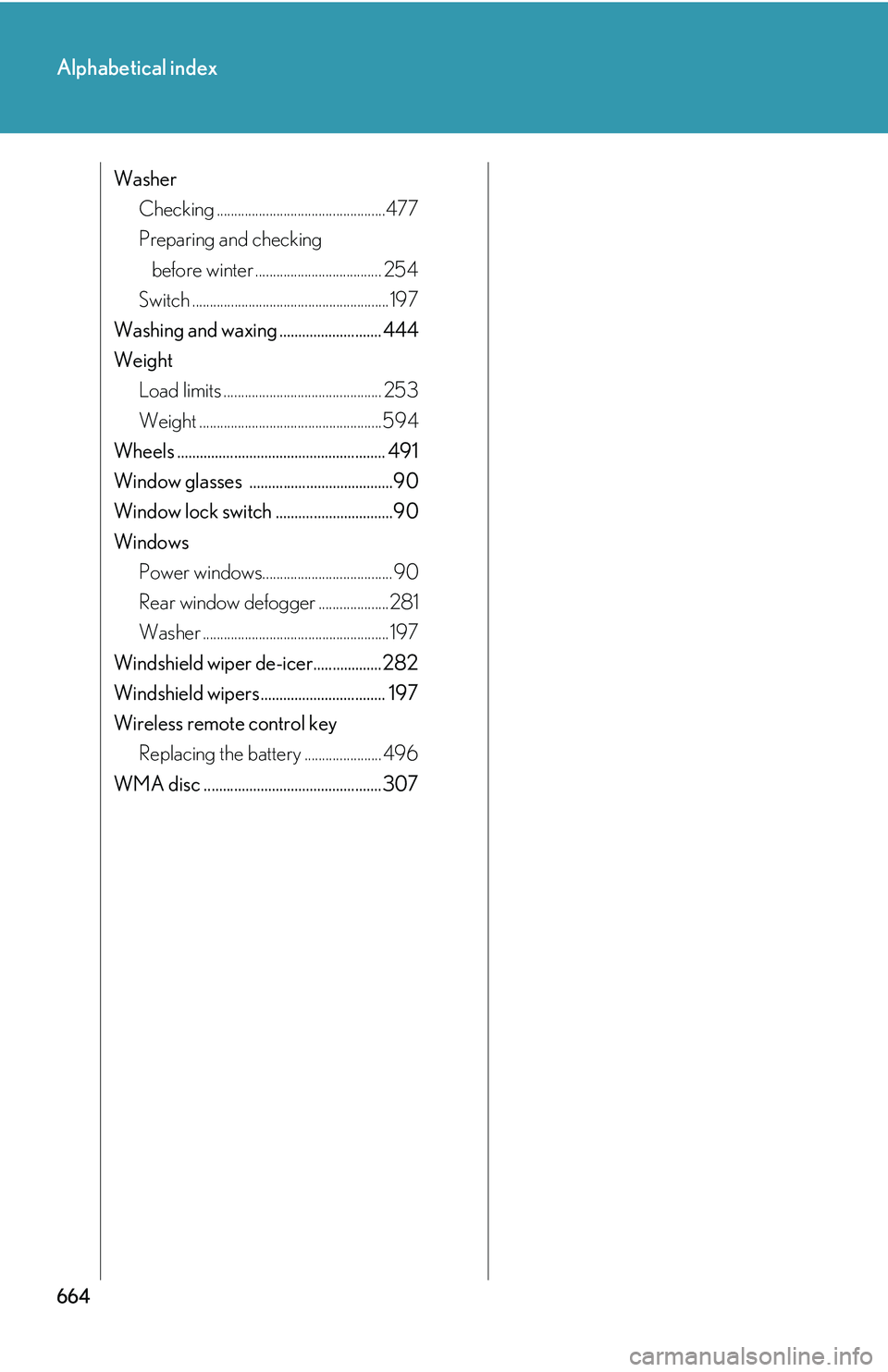
Alphabetical index
Washer
Checking................................................477
Preparing and checking
before winter .................................... 254
Switch ........................................................ 197
Washing and waxing ........................... 444
Weight
Load limits ............................................. 253
Weight ....................................................594
Wheels ....................................................... 491
Window glasses ......................................90
Window lock switch ...............................90
Windows
Power windows..................................... 90
Rear window defogger ....................281
Washer ..................................................... 197
Windshield wiper de-icer..................282
Windshield wipers................................. 197
Wireless remote control key
Replacing the battery ...................... 496
WMA disc ...............................................307
Page:
< prev 1-8 9-16 17-24

