Page 552 of 821
482
4-3. Do-it-yourself maintenance
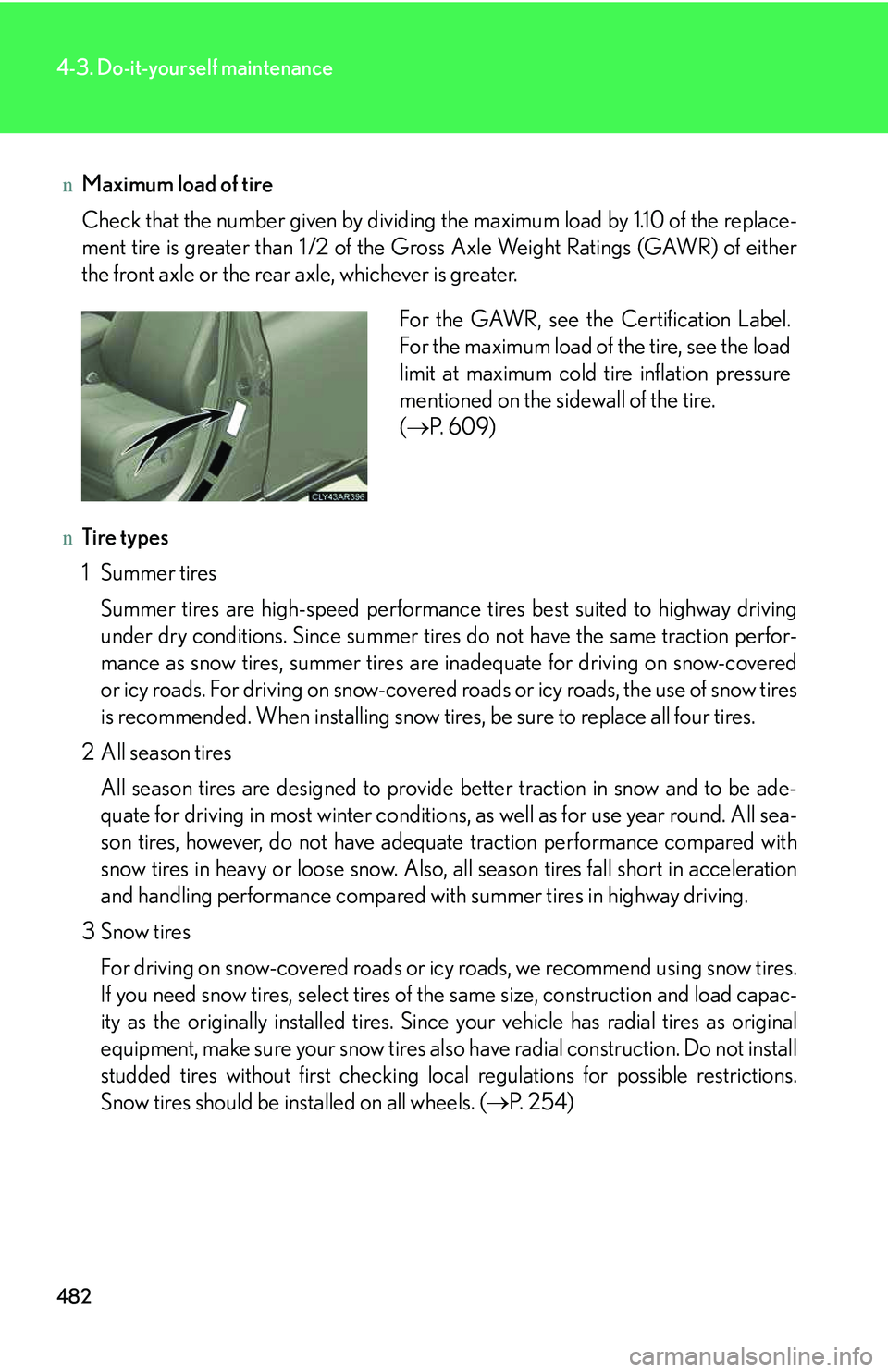
nMaximum load of tire
Check that the number given by dividing the maximum load by 1.10 of the replace-
ment tire is greater than 1 /2 of the Gross Axle Weight Ratings (GAWR) of either
the front axle or the rear axle, whichever is greater.
nTire types
1Summer tires
Summer tires are high-speed performance tires best suited to highway driving
under dry conditions. Since summer tires do not have the same traction perfor-
mance as snow tires, summer tires are inadequate for driving on snow-covered
or icy roads. For driving on snow-covered roads or icy roads, the use of snow tires
is recommended. When installing snow tires, be sure to replace all four tires.
2 All season tires
All season tires are designed to provide better traction in snow and to be ade-
quate for driving in most winter conditions, as well as for use year round. All sea-
son tires, however, do not have adequate traction performance compared with
snow tires in heavy or loose snow. Also, all season tires fall short in acceleration
and handling performance compared with summer tires in highway driving.
3Snow tires
For driving on snow-covered roads or icy roads, we recommend using snow tires.
If you need snow tires, select tires of the same size, construction and load capac-
ity as the originally installed tires. Since your vehicle has radial tires as original
equipment, make sure your snow tires also have radial construction. Do not install
studded tires without first checking local regulations for possible restrictions.
Snow tires should be installed on all wheels. (→P. 2 5 4 )
For the GAWR, see the Certification Label.
For the maximum load of the tire, see the load
limit at maximum cold tire inflation pressure
mentioned on the sidewall of the tire.
(→P. 6 0 9 )
Page 555 of 821

485
4-3. Do-it-yourself maintenance
4
Maintenance and care
CAUTION
nTire pressure warning system operation
The tire pressure warning system may not provide warning immediately if a tire
bursts or if sudden air leakage occurs.
nWhen inspecting or replacing tires
Observe the following precautions to prevent accidents. Failure to do so may cause
damage to parts of the drive train, as well as dangerous handling characteristics,
which may lead to an accident resulting in death or serious injury.
lDo not mix tires of different makes, models or tread patterns. Also, do not mix
tires of remarkably different treadwear.
lDo not use tire sizes other than those recommended by Lexus.
lDo not mix differently constructed tires (radial, bias-belted or bias-ply tires).
lDo not mix summer, all season and snow tires.
lDo not use tires that have been used on another vehicle.
Do not use tires if you do not know how they were used previously.
nWhen initializing the tire pressure warning system
Do not push the tire pressure warning reset switch without first adjusting the tire
inflation pressure to the specified level. Otherwise, the tire pressure warning light
may not come on even if the tire inflation pressure is low, or it may come on when
the tire inflation pressure is actually normal.
Page 556 of 821

486
4-3. Do-it-yourself maintenance
NOTICE
nRepairing or replacing tires, wheels, tire pressure warning valves, transmitters
and tire valve caps
lWhen removing or fitting the wheels, tires or the tire pressure warning valve and
transmitter, contact your Lexus dealer as the tire pressure warning valves and
transmitter may be damaged if not handled correctly.
lWhen replacing tire valve caps, do not use tire valve caps other than those speci-
fied. The cap may become stuck.
nTo avoid damage to the tire pressure warning valves and transmitters
When a tire is repaired with liquid sealants, the tire pressure warning valve and
transmitter may not operate properly. If a liquid sealant is used, contact your Lexus
dealer or other qualified service shop as soon as possible. Make sure to replace the
tire pressure warning valve and transmitter when replacing the tire. (→P. 4 7 9 )
nDriving on rough roads
Take particular care when driving on roads with loose surfaces or potholes.
These conditions may cause losses in tire inflation pressure, reducing the cushion-
ing ability of the tires. In addition, driving on rough roads may cause damage to the
tires themselves, as well as the vehicle’s wheels and body.
nIf tire inflation pressures become low while driving
Do not continue driving, or your tires and/or wheels may be ruined.
Page 559 of 821

489
4-3. Do-it-yourself maintenance
4
Maintenance and care
nTire inflation pressure check interval
You should check tire inflation pressure every two weeks, or at least once a month.
Do not forget to check the spare.
nEffects of incorrect tire inflation pressure
Driving with incorrect tire inflation pressure may result in the following:
lReduced fuel efficiency
lReduced driving comfort and tire life
lReduced safety
lDamage to the drive train
If a tire needs frequent inflating, have it checked by your Lexus dealer.
nInstructions for checking tire pressure
When checking tire inflation pressure, observe the following:
lCheck only when the tires are cold.
If your vehicle has been parked for at least 3 hours and has not been driven for
more than 1 mile or 1.5 km, you will get an accurate cold tire inflation pressure
reading.
lAlways use a tire pressure gauge.
The appearance of the tire can be misleading. In addition, tire inflation pressures
that are even just a few pounds off can degrade ride and handling.
lDo not reduce tire inflation pressure after driving. It is normal for the tire infla-
tion pressure to be higher after driving.
lNever exceed the vehicle capacity weight.
Passengers and luggage weight should be placed so that the vehicle is bal-
anced.
Page 560 of 821
490
4-3. Do-it-yourself maintenance
CAUTION
nProper inflation is critical to save tire performance
Keep your tires properly inflated. Otherwise, the following conditions may occur
and result in an accident causing death or serious injury:
lExcessive wear
lUneven wear
lPoor handling
lPossibility of blowouts resulting from overheated tires
lPoor sealing of the tire bead
lWheel deformation and/or tire separation
lA greater possibility of tire damage from road hazards
NOTICE
nWhen inspecting and adjusting tire inflation pressure
Be sure to put the tire valve caps back on.
Without the valve caps, dirt or moisture could get into the valve and cause air leak-
age, which could result in an accident. If the caps are lost, replace them as soon as
possible.
Page 561 of 821

491
4-3. Do-it-yourself maintenance
4
Maintenance and care
Wheels
nWhen replacing wheels
The wheels of your vehicle are equipped with tire pressure warning valves and
transmitters that allow the tire pressure warning system to provide advanced warn-
ing in the event of a loss in tire inflation pressure. Whenever wheels are replaced,
tire pressure warning valves and transmitters must be installed. (→P. 4 7 9 )
If a wheel is bent, cracked or heavily corroded, it should be replaced.
Otherwise, the tire may separate from the wheel or cause a loss of han-
dling control.
nWheel selection
When replacing wheels, care should be taken to ensure that they
are equivalent to those removed in load capacity, diameter, rim
width, and inset*.
Replacement wheels are available at your Lexus dealer.
*: Conventionally referred to as “offset”.
Lexus does not recommend using the following:
lWheels of different sizes or types
lUsed wheels
lBent wheels that have been straightened
nAluminum wheel precautions
lUse only Lexus wheel nuts and wrenches designed for use with
your aluminum wheels.
lWhen rotating, repairing or changing your tires, check that the
wheel nuts are still tight after driving 1000 miles (1600 km).
lBe careful not to damage the aluminum wheels when using tire
chains.
lUse only Lexus genuine balance weights or equivalent and a
plastic or rubber hammer when balancing your wheels.
Page 562 of 821
492
4-3. Do-it-yourself maintenance
CAUTION
nWhen replacing wheels
lDo not use wheels that are a different size from those recommended in the
Owner’s Manual, as this may result in a loss of handling control.
lNever use an inner tube in a leaking wheel which is designed for a tubeless tire.
Doing so may result in an accident, causing death or serious injury.
NOTICE
nReplacing tire pressure warning valves and transmitters
lBecause tire repair or replacement may affect the tire pressure warning valves
and transmitters, make sure to have tires serviced by your Lexus dealer or other
qualified service shop. In addition, make sure to purchase your tire pressure
warning valves and transmitters at your Lexus dealer.
lEnsure that only genuine Lexus wheels are used on your vehicle.
Tire pressure warning valves and transmitters may not work properly with non-
genuine wheels.
Page 600 of 821
5
When trouble arises
531
5-1. Essential information
If you think something is wrong
If you notice any of the following symptoms, your vehicle probably needs
adjustment or repair. Contact your Lexus dealer as soon as possible.
nVisible symptoms
lFluid leaks under the vehicle.
(Water dripping from the air conditioning after use is normal.)
lFlat-looking tires or uneven tire wear
lEngine coolant temperature gauge needle continually points
higher than normal.
nAudible symptoms
lChanges in exhaust sound
lExcessive tire squeal when cornering
lStrange noises related to the suspension system
lPinging or other noises related to the engine
nOperational symptoms
lEngine missing, stumbling or running rough
lAppreciable loss of power
lVehicle pulls heavily to one side when braking
lVehicle pulls heavily to one side when driving on a level road
lLoss of brake effectiveness, spongy feeling, pedal almost touches
the floor


