Page 526 of 821

456
4-2. Maintenance
Emission inspection and maintenance (I/M) programs
Some states have vehicle emission inspection programs which include
OBD (On Board Diagnostics) checks. The OBD system monitors the oper-
ation of the emission control system.
nIf the malfunction indicator lamp comes on
The OBD system determines that a problem exists somewhere in
the emission control system. Your vehicle may not pass the I/M test
and may need to be repaired. Contact your Lexus dealer to service
the vehicle.
nYour vehicle may not pass the I/M test in the following situations:
lWhen the battery is disconnected or discharged
Readiness codes that are set during ordinary driving are erased.
Also, depending on your driving habits, the readiness codes may
not be completely set.
lWhen the fuel tank cap is loose
The malfunction indicator lamp comes on indicating a temporary
malfunction and your vehicle may not pass the I/M test.
nWhen the malfunction indicator lamp still remains on after several
driving trips
The error code in the OBD system will not be cleared unless the
vehicle is driven 40 or more times.
nIf your vehicle does not pass the I/M test
Contact your Lexus dealer to prepare the vehicle for re-testing.
Page 559 of 821

489
4-3. Do-it-yourself maintenance
4
Maintenance and care
nTire inflation pressure check interval
You should check tire inflation pressure every two weeks, or at least once a month.
Do not forget to check the spare.
nEffects of incorrect tire inflation pressure
Driving with incorrect tire inflation pressure may result in the following:
lReduced fuel efficiency
lReduced driving comfort and tire life
lReduced safety
lDamage to the drive train
If a tire needs frequent inflating, have it checked by your Lexus dealer.
nInstructions for checking tire pressure
When checking tire inflation pressure, observe the following:
lCheck only when the tires are cold.
If your vehicle has been parked for at least 3 hours and has not been driven for
more than 1 mile or 1.5 km, you will get an accurate cold tire inflation pressure
reading.
lAlways use a tire pressure gauge.
The appearance of the tire can be misleading. In addition, tire inflation pressures
that are even just a few pounds off can degrade ride and handling.
lDo not reduce tire inflation pressure after driving. It is normal for the tire infla-
tion pressure to be higher after driving.
lNever exceed the vehicle capacity weight.
Passengers and luggage weight should be placed so that the vehicle is bal-
anced.
Page 608 of 821

5
When trouble arises
539
5-2. Steps to take in an emergency
nSRS warning light
This warning light system monitors the airbag sensor assembly, front airbag sensors,
side and curtain shield airbag sensors, curtain shield airbag sensors, driver's seat
position sensor, driver's seat belt buckle switch, front passenger occupant classifi-
cation system, “AIR BAG ON” indicator light, “AIR BAG OFF” indicator light, front
passenger's seat belt buckle switch, seat belt pretensioner assemblies, inflators,
interconnecting wiring and power sources. (→P. 1 0 9 )
nFront passenger detection sensor, passenger seat belt reminder and warning
buzzer
lIf luggage is placed on the front passenger seat, the front passenger detection
sensor may cause the warning light to flash and the warning buzzer to sound
even if a passenger is not sitting in the seat.
lIf a cushion is placed on the seat, the sensor may not detect a passenger, and the
warning light may not operate properly.
nElectric power steering system warning light
When the voltage is low or drops, the power steering warning light may come on.
nIf the malfunction indicator lamp comes on while driving
First check the following:
lIs the fuel tank empty?
If it is, fill the fuel tank immediately.
lIs the fuel tank cap loose?
If it is, tighten it securely.
The lamp will go off after several driving trips.
If the light does not go off even after several trips, contact your Lexus dealer as soon
as possible.
Page 664 of 821
594
6-1. Specifications
Maintenance data (fuel, oil level, etc.)
Dimensions and weights
*1:Unladen vehicles
*2: Vehicles without roof antenna and roof rails
*3: Vehicles with roof antenna but without roof rails
*4: Vehicles with roof rails
Overall length187.8 in. (4770 mm)
Overall width74.2 in. (1885 mm)
Overall height*166.3 in. (1685 mm)*2
66.7 in. (1695 mm)*3
67.9 in. (1725 mm)*4
Wheelbase107.9 in. (2740 mm)
Tr e a dFront64.1 in. (1630 mm)
Rear63.8 in. (1620 mm)
Vehicle capacity weight
(Occupants + luggage)885 lb. (400 kg)
To w i n g
capacity
(Trailer
weight +
cargo)
Without towing pack-
age2000 lb. (907 kg)
With towing package3500 lb. (1588 kg)
Page 666 of 821
596
6-1. Specifications
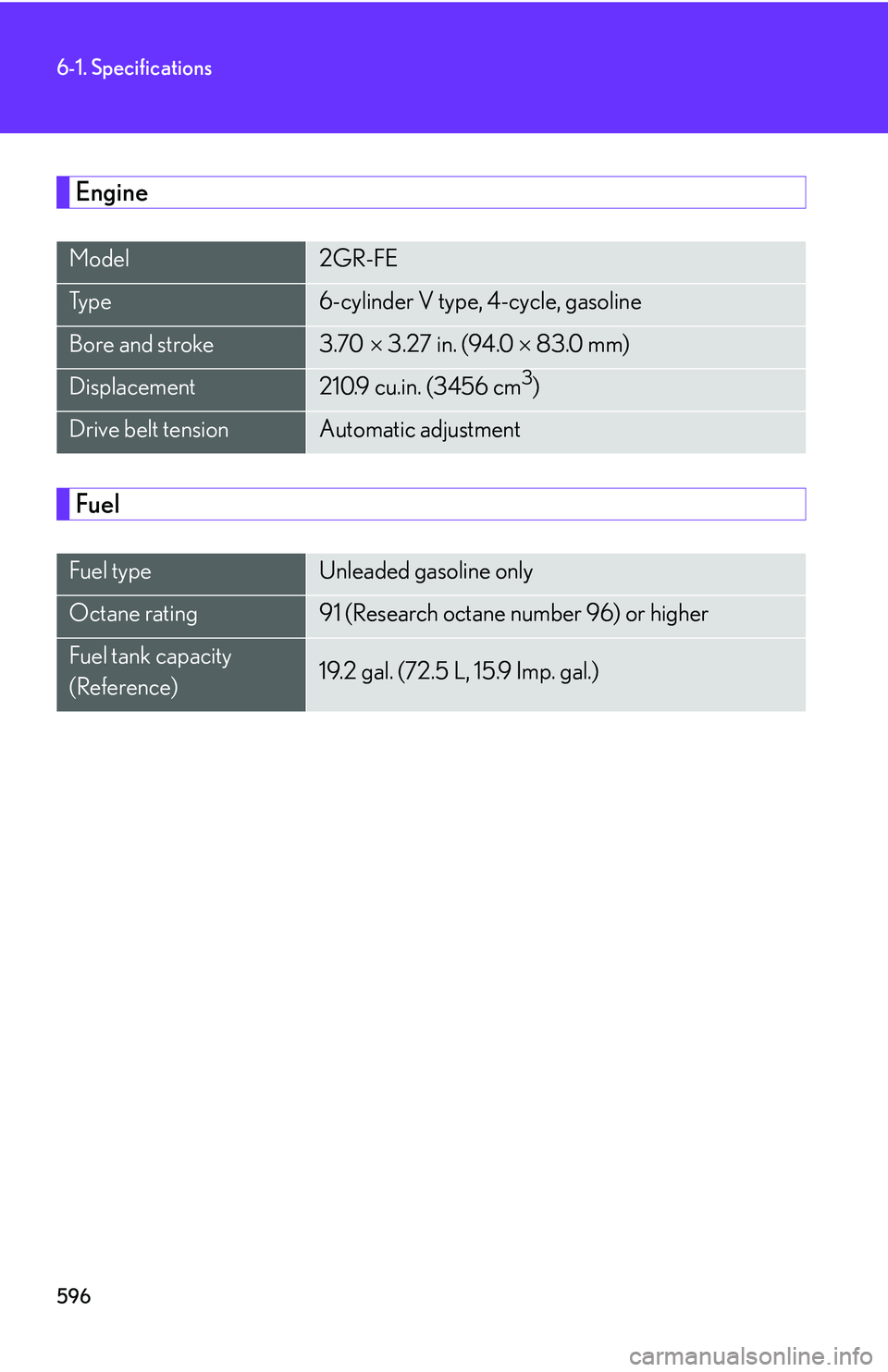
Engine
Fuel
Model2GR-FE
Ty p e6-cylinder V type, 4-cycle, gasoline
Bore and stroke3.70 × 3.27 in. (94.0 × 83.0 mm)
Displacement210.9 cu.in. (3456 cm3)
Drive belt tensionAutomatic adjustment
Fuel typeUnleaded gasoline only
Octane rating91 (Research octane number 96) or higher
Fuel tank capacity
(Reference)19.2 gal. (72.5 L, 15.9 Imp. gal.)
Page 667 of 821
597
6-1. Specifications
6
Vehicle specifications
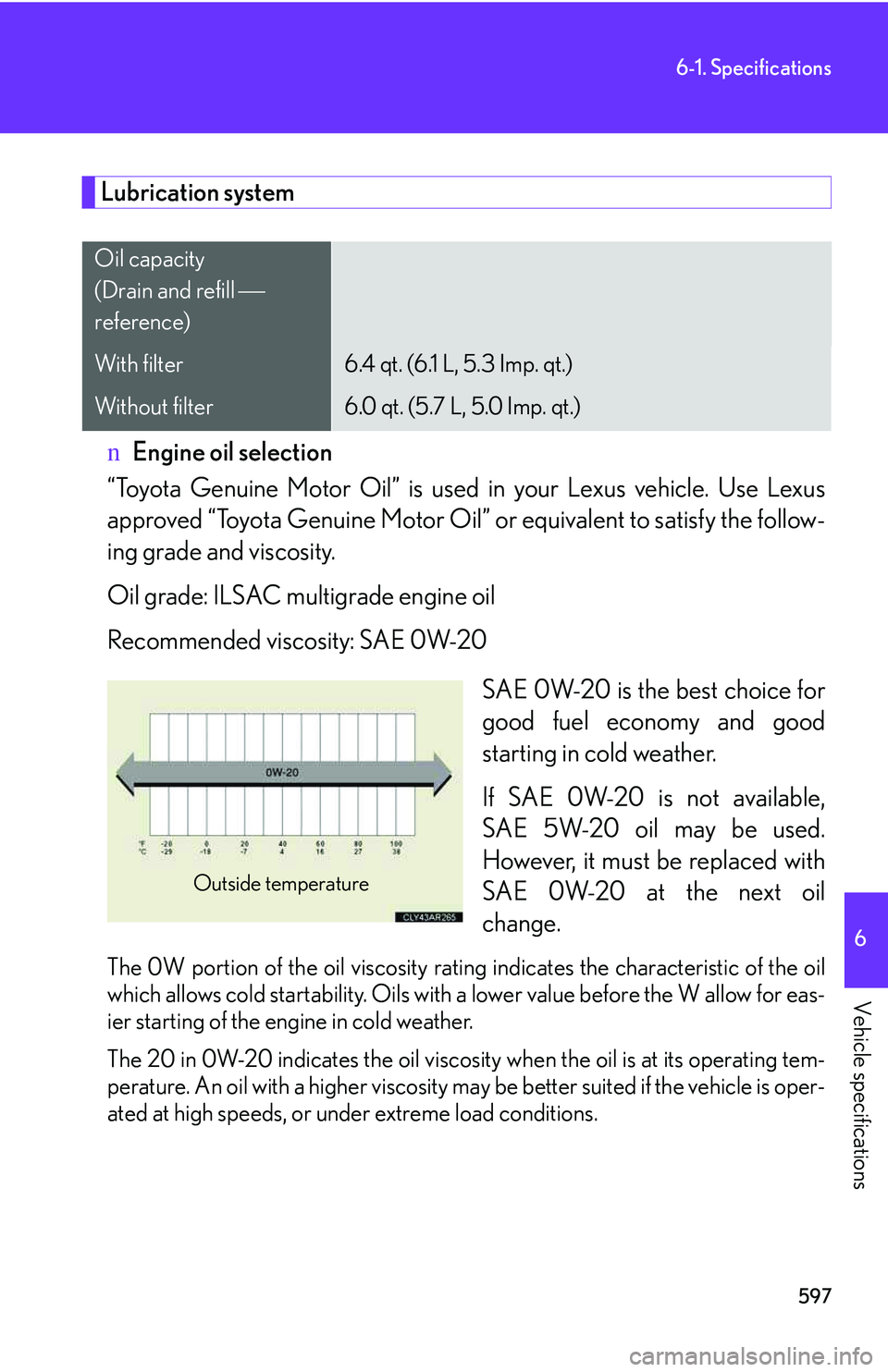
Lubrication system
nEngine oil selection
“Toyota Genuine Motor Oil” is used in your Lexus vehicle. Use Lexus
approved “Toyota Genuine Motor Oil” or equivalent to satisfy the follow-
ing grade and viscosity.
Oil grade: ILSAC multigrade engine oil
Recommended viscosity: SAE 0W-20
SAE 0W-20 is the best choice for
good fuel economy and good
starting in cold weather.
If SAE 0W-20 is not available,
SAE 5W-20 oil may be used.
However, it must be replaced with
SAE 0W-20 at the next oil
change.
The 0W portion of the oil viscosity rating indicates the characteristic of the oil
which allows cold startability. Oils with a lower value before the W allow for eas-
ier starting of the engine in cold weather.
The 20 in 0W-20 indicates the oil viscosity when the oil is at its operating tem-
perature. An oil with a higher viscosity may be better suited if the vehicle is oper-
ated at high speeds, or under extreme load conditions.
Oil capacity
(Drain and refill ⎯
reference)
With filter6.4 qt. (6.1 L, 5.3 Imp. qt.)
Without filter6.0 qt. (5.7 L, 5.0 Imp. qt.)
Outside temperature
Page 685 of 821

615
6-1. Specifications
6
Vehicle specifications
Warning: The temperature grades for this tire are established for a tire that
is properly inflated and not overloaded.
Excessive speed, underinflation, or excessive loading, either separately or in
combination, can cause heat buildup and possible tire failure.
Glossary of tire terminology
Tire related termMeaning
Cold tire inflation pres-
sure
Tire pressure when the vehicle has been parked for
three hours or more, or has not been driven more
than 1 mile or 1.5 km under that condition
Maximum inflation pres-
sure
The maximum cold inflated pressure to which a tire
may be inflated, shown on the sidewall of the tire
Recommended inflation
pressure
Cold tire inflation pressure recommended by a man-
ufacturer
Accessory weight
The combined weight (in excess of those standard
items which may be replaced) of automatic transmis-
sion, power steering, power brakes, power windows,
power seats, radio and heater, to the extent that these
items are available as factory-installed equipment
(whether installed or not)
Curb weight
The weight of a motor vehicle with standard equip-
ment, including the maximum capacity of fuel, oil and
coolant, and if so equipped, air conditioning and
additional weight optional engine
Maximum loaded vehicle
weight
The sum of:
(a) Curb weight
(b) Accessory weight
(c) Vehicle capacity weight
(d) Production options weight
Normal occupant weight150 lb. (68 kg) times the number of occupants speci-
fied in the second column of Table 1* that follows
Page 725 of 821

656
Alphabetical index
Floor mat ..................................................420
Fluid
Brake......................................................... 601
Washer ....................................................477
Fog lights
Switch ....................................................... 195
Wattage................................................. 605
Footwell lights ........................................396
Front fog lights
Switch ....................................................... 195
Wattage................................................. 605
Front passenger occupant
classification system .......................... 122
Front passenger's seat belt
reminder light...................................... 537
Front seats
Adjustment................................................. 61
Driver’s seat position memory....... 70
Flattening seatbacks.............................. 61
Front side marker light
Replacing light bulbs........................... 511
Wattage................................................. 605
Front turn signal lights
Replacing light bulbs........................... 511
Wattage................................................. 605
Fuel
Capacity .................................................596
Fuel gauge ..............................................166
Fuel pump shut off system ............ 532
Information........................................... 606
Refueling ................................................... 97
Type......................................................... 606
Fuel door ..................................................... 97
Fuel filler door ........................................... 97
Fuel pump shut off system .................532
Fuses ..........................................................498
Garage door opener .......................... 426
Gauges .......................................................166
Glove box ................................................400
Hands-free system for
mobile phone ...................................... 362
Hazard lights switch ............................ 524
Head-up display...................................... 179
Head restraints
Adjustment .............................................. 73
Headlight aim.........................................509
Headlight cleaner................................. 203
Headlights
Discharge headlight
precautions ........................................522
Replacing light bulbs ...........................511
Switch ........................................................ 184
Wattage ................................................. 605
Head-up display .................................. 179
Heaters
Seat heaters ........................................... 416
Side mirrors............................................ 281
Hill-start assist control ........................ 238
Hood .......................................................... 460
Hooks
Cargo........................................................ 421
Coat ........................................................... 419
HUD ............................................................ 179
Horn .............................................................165
FG
H