2011 Lexus ES350 brake
[x] Cancel search: brakePage 484 of 563

482
5-2. Steps to take in an emergency
ES350_UTo change “ENGINE START ST
OP” switch modes: Within 10
seconds of the buzzer sounding, release the brake pedal and
press the “ENGINE START STOP” switch. Modes can be
changed each time the switch is pressed. (→ P. 1 2 6 )
To start the engine: Press the “ENGINE START STOP” switch
within 10 seconds after the buzzer sounds, keeping the brake
pedal depressed.
In the event that the “ENGINE START STOP” switch still cannot be oper-
ated, contact your Lexus dealer.
■Stopping the engine
Shift the shift lever to P and press the “ENGINE START STOP” switch as you nor-
mally do when stopping the engine.
■Replacing the key battery
As the above procedure is the temporary measure, it is recommend that the elec-
tronic key battery be replaced immediately when the battery depletes. ( →P. 411)
STEP3
Page 491 of 563

5
When trouble arises
489
5-2. Steps to take in an emergency
ES350_U
If the vehicle becomes stuck
CAUTION
■When attempting to free a stuck vehicle
If you choose to rock the vehicle back and forth to free it, make sure the surround-
ing area is clear, to avoid striking other vehicles, objects or persons. The vehicle
may also lunge forward or lunge back suddenly as it becomes free. Use extreme
caution.
■When shifting the shift lever
Be careful not to shift the shift lever with the accelerator pedal depressed.
This may lead to unexpected rapid acceleration of the vehicle that may cause an
accident and result in death or serious injury.
NOTICE
■To avoid damaging the transmission and other components
●Avoid spinning the wheels and do not rev the engine.
●If the vehicle remains stuck after trying these procedures, the vehicle may require
towing to be freed.
Carry out the following procedures if the tires spin or the vehicle becomes
stuck in mud, dirt, or snow.
●Stop the engine. Set the parking brake and put the shift lever in P.
● Remove the mud, snow, or sand from around the stuck tire.
● Place wood, stones or some other material to help provide trac-
tion under the tires.
● Restart the engine.
● Carefully apply the accelerator to free the vehicle.
Page 492 of 563

490
5-2. Steps to take in an emergency
ES350_U
If your vehicle has to be stopped in an emergency
CAUTION
■If the engine has to be turned off while driving
Power assist for the brakes and steering wheel will be lost, making the brake pedal
harder to depress and the steering wheel heavier to turn. Decelerate as much as
possible before turning off the engine.
Only in an emergency, such as if it becomes impossible to stop the vehicle
in the normal way, stop the vehicle using the following procedure:
Steadily step on the brake pedal with both feet and firmly
depress it.
Do not pump the brake pedal repeatedly as this will increase the
effort required to slow the vehicle.
Shift the shift lever to N.
If the shift lever is shifted to N After slowing down, stop the vehicle in a safe place by the road.
Stop the engine.
If the shift lever cannot be shifted to N Keep depressing the brake pedal with both feet to reduce vehi-
cle speed as much as possible.
To stop the engine, press and
hold the “ENGINE START
STOP” switch for 3 consecutive
seconds or more, or press it
briefly 3 times or more in suc-
cession.
Stop the vehicle in a safe place by the road.
STEP1
STEP2
STEP3
STEP4
STEP3
STEP4
Press and hold for 3 seconds or more,
or press briefly 3 times or more
STEP5
Page 500 of 563

498
6-1. Specifications
ES350_U
Automatic Transaxle
*: The fluid capacity is a reference quantity. If replacement is necessary, contact
your Lexus dealer.
Brakes
*1: Minimum pedal clearance when depressed with a force of 112 lbf (500 N, 51kgf) while the engine is running.
*2: Parking brake pedal travel when depressed with a force of 67.4 lbf (300 N,3 0.6 kg f ) .
Fluid capacity*6.87 qt. (6.5 L, 5.72 Imp. qt.)
Fluid typeToyota Genuine ATF WS
NOTICE
■Transmission fluid type
Using automatic transmission fluid other than “Toyota Genuine ATF WS” may
cause deterioration in shift quality, locking up of your transaxle accompanied by
vibration, and ultimately damage the automatic transaxle of your vehicle.
Pedal clearance *12.4 in. (61 mm) Min.
Pedal free play0.04 0.24 in. (1.0 6.0 mm)
Brake pad wear limit0.04 in. (1.0 mm)
Parking brake lining wear limit0.04 in. (1.0 mm)
Parking brake pedal travel *27 10 clicks
Fluid typeSAE J1703 or FMVSS No. 116 DOT 3
Page 512 of 563
510
6-1. Specifications
ES350_U■
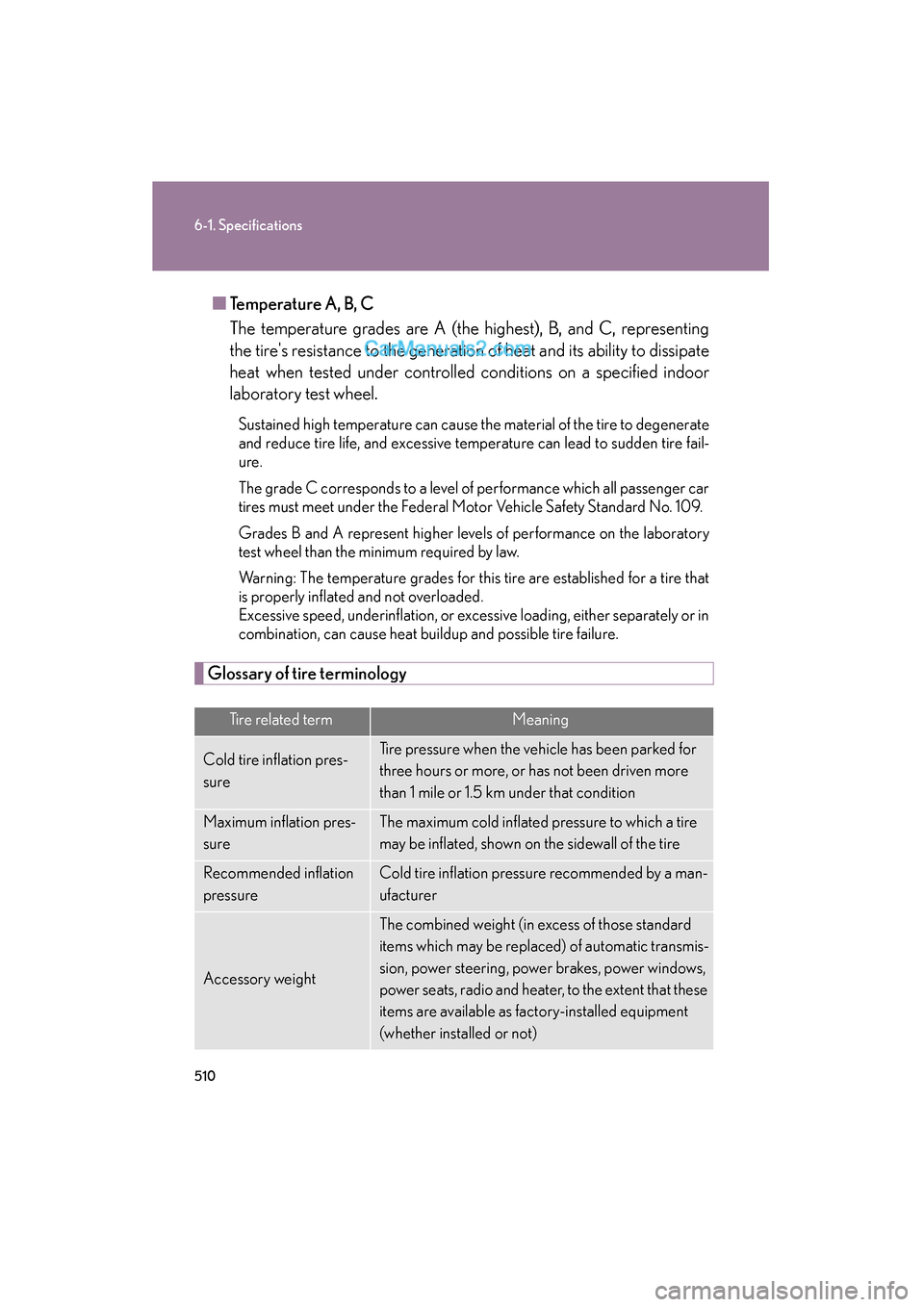
Temperature A, B, C
The temperature grades are A (the highest), B, and C, representing
the tire's resistance to the generation of heat and its ability to dissipate
heat when tested under controlled conditions on a specified indoor
laboratory test wheel.
Sustained high temperature can cause the material of the tire to degenerate
and reduce tire life, and excessive temperature can lead to sudden tire fail-
ure.
The grade C corresponds to a level of performance which all passenger car
tires must meet under the Federal Motor Vehicle Safety Standard No. 109.
Grades B and A represent higher levels of performance on the laboratory
test wheel than the minimum required by law.
Warning: The temperature grades for this tire are established for a tire that
is properly inflated and not overloaded.
Excessive speed, underinflation, or excessive loading, either separately or in
combination, can cause heat buildup and possible tire failure.
Glossary of tire terminology
Tire related termMeaning
Cold tire inflation pres-
sureTire pressure when the vehicle has been parked for
three hours or more, or has not been driven more
than 1 mile or 1.5 km under that condition
Maximum inflation pres-
sureThe maximum cold inflated pressure to which a tire
may be inflated, shown on the sidewall of the tire
Recommended inflation
pressureCold tire inflation pressure recommended by a man-
ufacturer
Accessory weight
The combined weight (in excess of those standard
items which may be replaced) of automatic transmis-
sion, power steering, power brakes, power windows,
power seats, radio and heater, to the extent that these
items are available as factory-installed equipment
(whether installed or not)
Page 513 of 563

511
6-1. Specifications
6
Vehicle specifications
ES350_U
Curb weight
The weight of a motor vehicle with standard equip-
ment, including the maximum capacity of fuel, oil and
coolant, and if so equipped, air conditioning and
additional weight optional engine
Maximum loaded vehicle
weight
The sum of:
(a) Curb weight
(b) Accessory weight
(c) Vehicle capacity weight
(d) Production options weight
Normal occupant weight150 lb. (68 kg) times the number of occupants speci-
fied in the second column of Table 1
* that follows
Occupant distributionDistribution of occupants in a vehicle as specified in
the third column of Table 1
* below
Production options
weight
The combined weight of installed regular production
options weighing over 5 lb. (2.3 kg) in excess of the
standard items which they replace, not previously
considered in curb weight or accessory weight,
including heavy duty brakes, ride levelers, roof rack,
heavy duty 12-volt battery, and special trim
RimA metal support for a tire or a tire and tube assembly
upon which the tire beads are seated
Rim diameter
(Wheel diameter)Nominal diameter of the bead seat
Rim size designationRim diameter and width
Rim type designationThe industry manufacturer's designation for a rim by
style or code
Rim widthNominal distance between rim flanges
Vehicle capacity weight
(Total load capacity)The rated cargo and luggage load plus 150 lb. (68
kg) times the vehicle's designated seating capacity
Tire related termMeaning
Page 544 of 563

542
ES350_U
Abbreviation list
Abbreviation/Acronym list
ABBREVIATIONSMEANING
A /CAir Conditioning
ABSAnti-lock Brake System
AFSAdaptive Front lighting System
AI-SHIFTArtificial Intelligence Shift
ALRAutomatic Locking Retractor
CRSChild Restraint System
DISPDisplay
ECUElectronic Control Unit
EDREvent data recorder
ELREmergency Locking Retractor
G AW RGross Axle Weight Ratings
GVWRGross Vehicle Weight Rating
I/MEmission inspection and maintenance
L ATC HLower Anchors and Tethers for Children
LEDLight Emitting Diode
MMTMethylcyclopentadienyl Manganese Tricarbonyl
MTBEMethyl Tertiary Butyl Ether
OBDOn Board Diagnostics
PCSPre-Collision System
SRSSupplemental Restraint System
TINTire Identification Number
TPMSTire Pressure Warning System
TRACTraction Control
Page 546 of 563
544
ES350_U
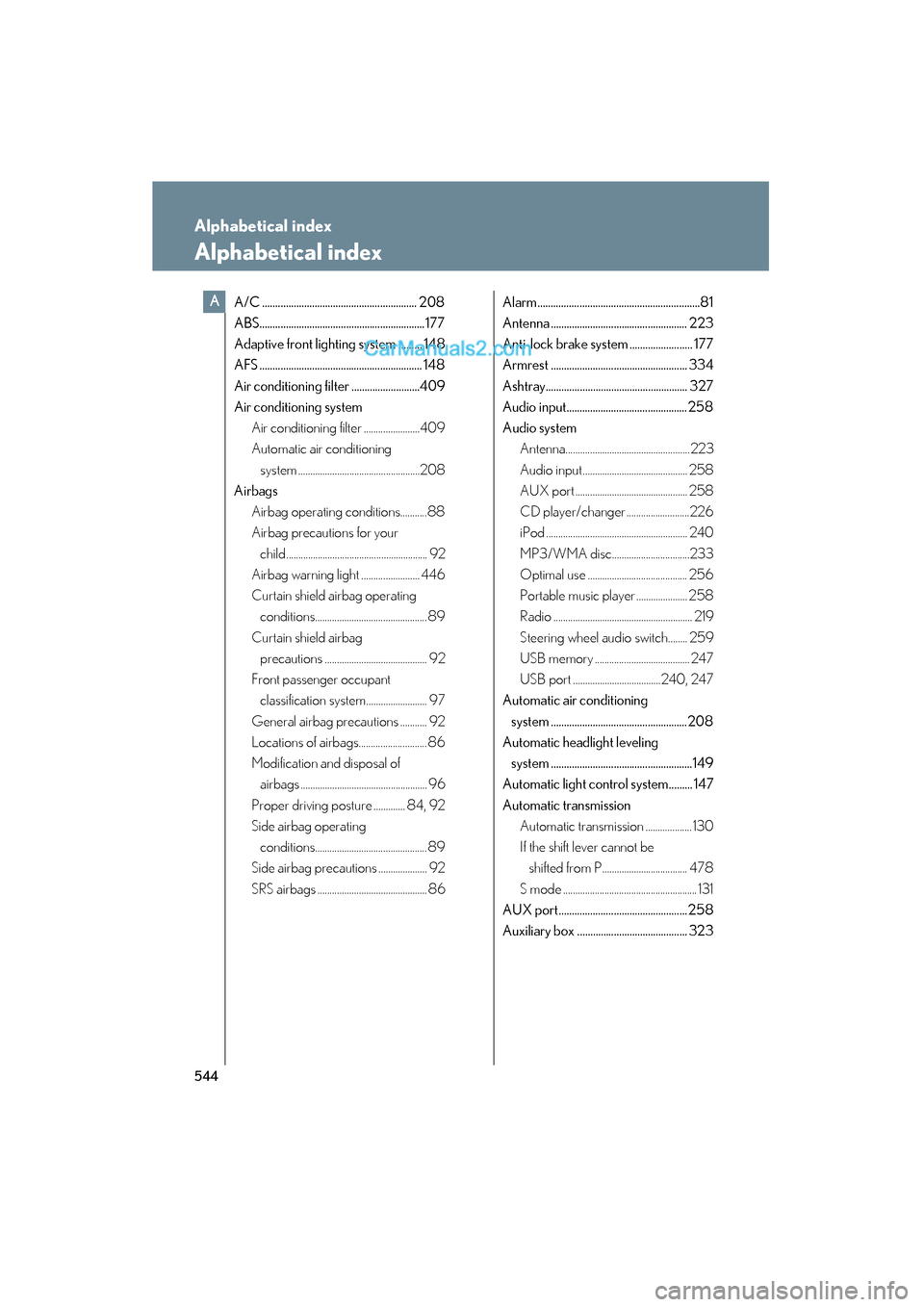
Alphabetical index
Alphabetical index
A/C ........................................................... 208
ABS............................................................... 177
Adaptive front lighting system ......... 148
AFS .............................................................. 148
Air conditioning filter ..........................409
Air conditioning systemAir conditioning filter .......................409
Automatic air conditioning system ..................................................208
Airbags
Airbag operating conditions...........88
Airbag precautions for your child.......................................................... 92
Airbag warning light ........................ 446
Curtain shield airbag operating conditions.............................................. 89
Curtain shield airbag precautions .......................................... 92
Front passenger occupant classification system......................... 97
General airbag precautions ........... 92
Locations of airbags............................ 86
Modification and disposal of airbags .................................................... 96
Proper driving posture ............. 84, 92
Side airbag operating conditions.............................................. 89
Side airbag precautions .................... 92
SRS airbags ............................................. 86 Alarm ..............................................................81
Antenna .................................................... 223
Anti-lock brake system ........................ 177
Armrest .................................................... 334
Ashtray...................................................... 327
Audio input.............................................. 258
Audio system
Antenna...................................................223
Audio input........................................... 258
AUX port .............................................. 258
CD player/changer ..........................226
iPod .......................................................... 240
MP3/WMA disc................................233
Optimal use ......................................... 256
Portable music player ..................... 258
Radio ......................................................... 219
Steering wheel audio switch........ 259
USB memory ....................................... 247
USB port ....................................240, 247
Automatic air conditioning
system ....................................................208
Automatic headlight leveling
system ......................................................149
Automatic light control system......... 147
Automatic transmission Automatic transmission ................... 130
If the shift lever cannot be shifted from P................................... 478
S mode ....................................................... 131
AUX port................................................. 258
Auxiliary box .......................................... 323A