Page 483 of 563
5
When trouble arises
481
5-2. Steps to take in an emergency
ES350_UAfter the operation is completed,
reinstall the cover.
Hook the upper claw of the cover
onto the upper catch on the vehi-
cle side, and then push on the
lower side of the cover.
Make sure that the lower claw of
the cover is securely fastened to
the lower catch on the vehicle side.
If the cover is not securely
attached, it may fall off while driv-
ing.
Changing “ENGINE START STOP” switch modes and starting the engine
Shift the shift lever to P and apply the brakes.
Touch the Lexus emblem side of
the electronic key to the
“ENGINE START STOP” switch.
An alarm will sound to indicate that
the start function cannot detect the
electronic key that is touched to
the “ENGINE START STOP”
switch if any of the doors is opened
and closed while the key is touched
to the switch.
STEP3
STEP1
STEP2
Page 492 of 563

490
5-2. Steps to take in an emergency
ES350_U
If your vehicle has to be stopped in an emergency
CAUTION
■If the engine has to be turned off while driving
Power assist for the brakes and steering wheel will be lost, making the brake pedal
harder to depress and the steering wheel heavier to turn. Decelerate as much as
possible before turning off the engine.
Only in an emergency, such as if it becomes impossible to stop the vehicle
in the normal way, stop the vehicle using the following procedure:
Steadily step on the brake pedal with both feet and firmly
depress it.
Do not pump the brake pedal repeatedly as this will increase the
effort required to slow the vehicle.
Shift the shift lever to N.
If the shift lever is shifted to N After slowing down, stop the vehicle in a safe place by the road.
Stop the engine.
If the shift lever cannot be shifted to N Keep depressing the brake pedal with both feet to reduce vehi-
cle speed as much as possible.
To stop the engine, press and
hold the “ENGINE START
STOP” switch for 3 consecutive
seconds or more, or press it
briefly 3 times or more in suc-
cession.
Stop the vehicle in a safe place by the road.
STEP1
STEP2
STEP3
STEP4
STEP3
STEP4
Press and hold for 3 seconds or more,
or press briefly 3 times or more
STEP5
Page 517 of 563
515
6-1. Specifications
6
Vehicle specifications
ES350_U
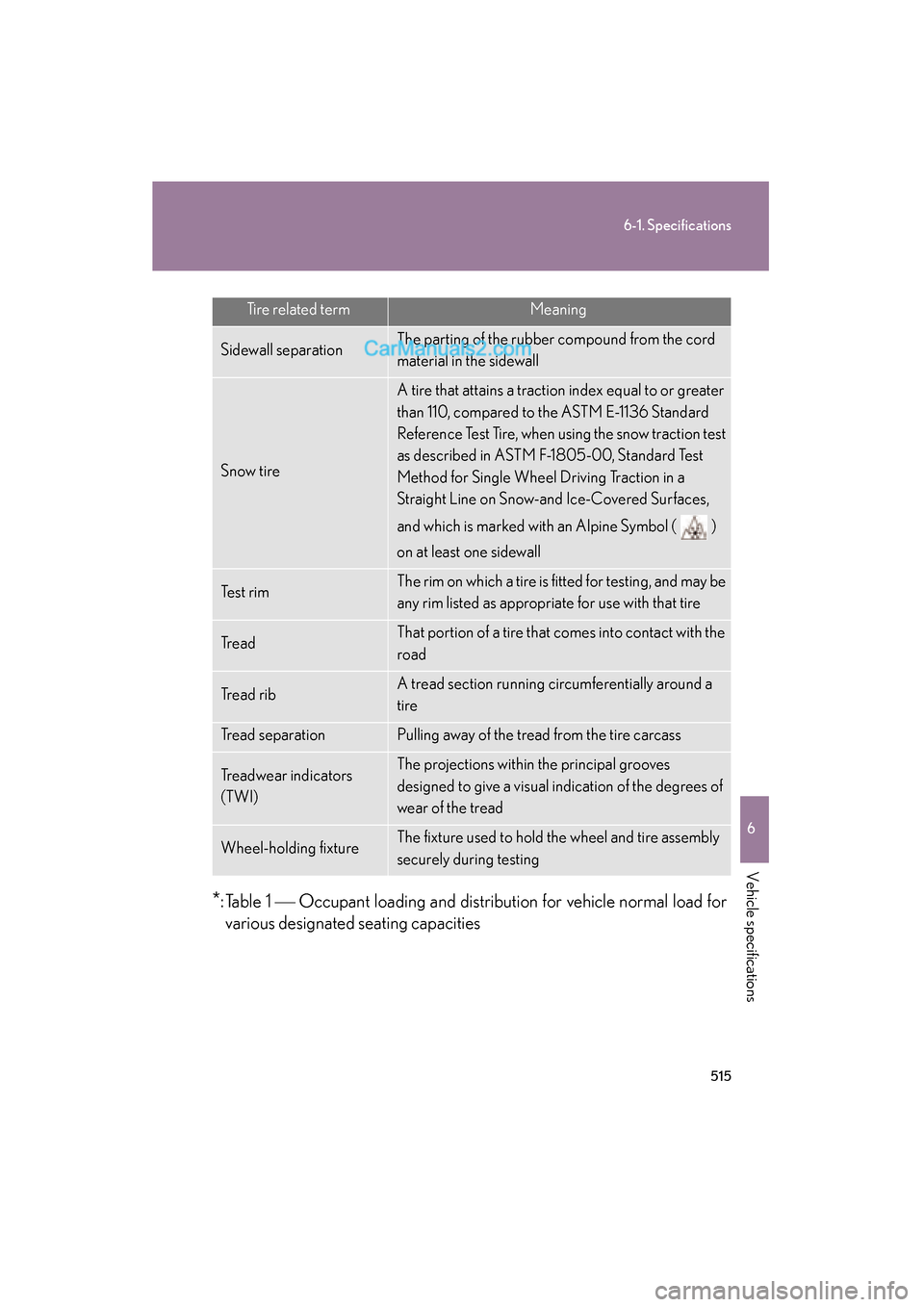
*: Ta b l e 1 Occupant loading and distribution for vehicle normal load forvarious designated seating capacities
Sidewall separationThe parting of the rubber compound from the cord
material in the sidewall
Snow tire
A tire that attains a traction index equal to or greater
than 110, compared to the ASTM E-1136 Standard
Reference Test Tire, when using the snow traction test
as described in ASTM F-1805-00, Standard Test
Method for Single Wheel Driving Traction in a
Straight Line on Snow-and Ice-Covered Surfaces,
and which is marked with an Alpine Symbol (
)
on at least one sidewall
Te s t r i mThe rim on which a tire is fitted for testing, and may be
any rim listed as appropriate for use with that tire
Tr e a dThat portion of a tire that comes into contact with the
road
Tr e a d r i bA tread section running circumferentially around a
tire
Tread separationPulling away of the tread from the tire carcass
Treadwear indicators
(TWI)The projections within the principal grooves
designed to give a visual indication of the degrees of
wear of the tread
Wheel-holding fixtureThe fixture used to hold the wheel and tire assembly
securely during testing
Tire related termMeaning
Page 531 of 563
529
7
ES350_U
For owners
Seat belt instructions for Canadian owners (in French)
The following is a French explanation of seat belt instructions extracted
from the seat belt section in this manual.
See the seat belt section for more detailed seat belt instructions in
English.
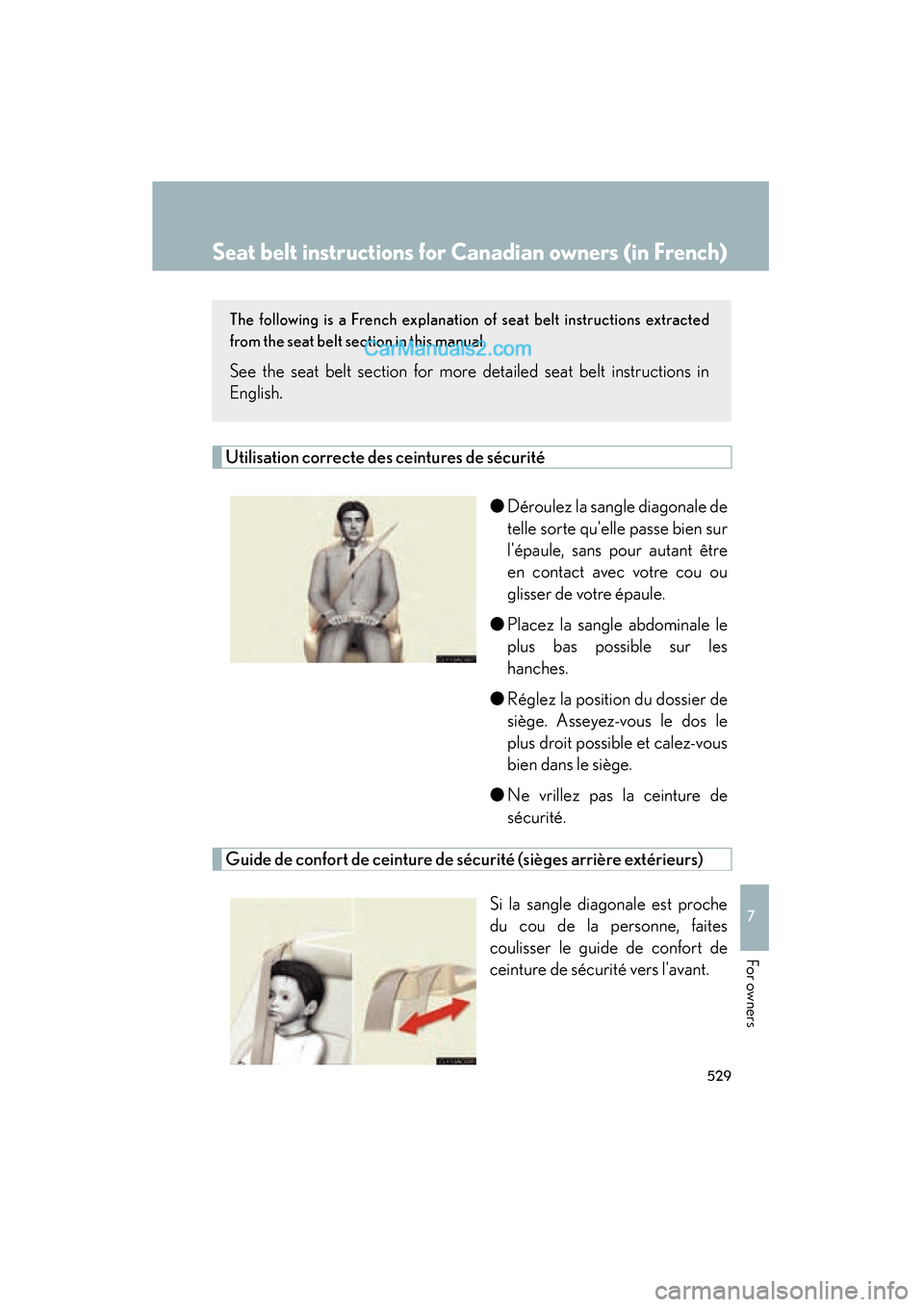
Utilisation correcte des ceintures de sécurité●Déroulez la sangle diagonale de
telle sorte qu'elle passe bien sur
l'épaule, sans pour autant être
en contact avec votre cou ou
glisser de votre épaule.
● Placez la sangle abdominale le
plus bas possible sur les
hanches.
● Réglez la position du dossier de
siège. Asseyez-vous le dos le
plus droit possible et calez-vous
bien dans le siège.
● Ne vrillez pas la ceinture de
sécurité.
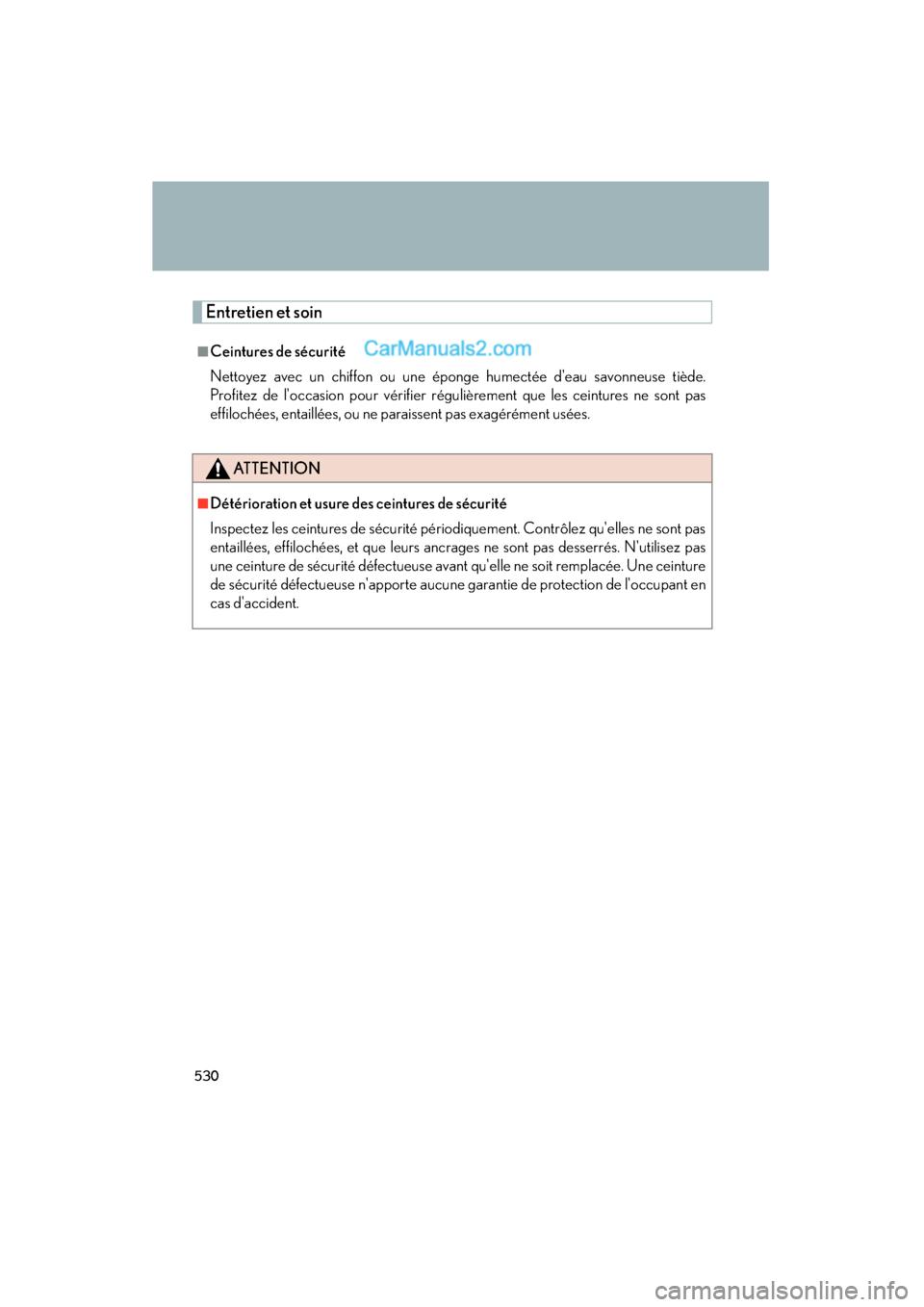
Guide de confort de ceinture de sécurité (sièges arrière extérieurs)
Si la sangle diagonale est proche
du cou de la personne, faites
coulisser le guide de confort de
ceinture de sécurité vers l'avant.
Page 532 of 563
530
ES350_U
Entretien et soin
■Ceintures de sécurité
Nettoyez avec un chiffon ou une éponge humectée d'eau savonneuse tiède.
Profitez de l'occasion pour vérifier régulièrement que les ceintures ne sont pas
effilochées, entaillées, ou ne paraissent pas exagérément usées.
ATTENTION
■Détérioration et usure des ceintures de sécurité
Inspectez les ceintures de sécurité périodiquement. Contrôlez qu'elles ne sont pas
entaillées, effilochées, et que leurs ancrages ne sont pas desserrés. N'utilisez pas
une ceinture de sécurité défectueuse avant qu'elle ne soit remplacée. Une ceinture
de sécurité défectueuse n'apporte aucune garantie de protection de l'occupant en
cas d'accident.
Page 533 of 563
531
7
ES350_U
For owners
SRS airbag instructions for Canadian owners (in French)
The following is a French explanation of SRS airbag instructions extracted
from the SRS airbag section in this manual.
See the SRS airbag section for more detailed SRS airbag instructions
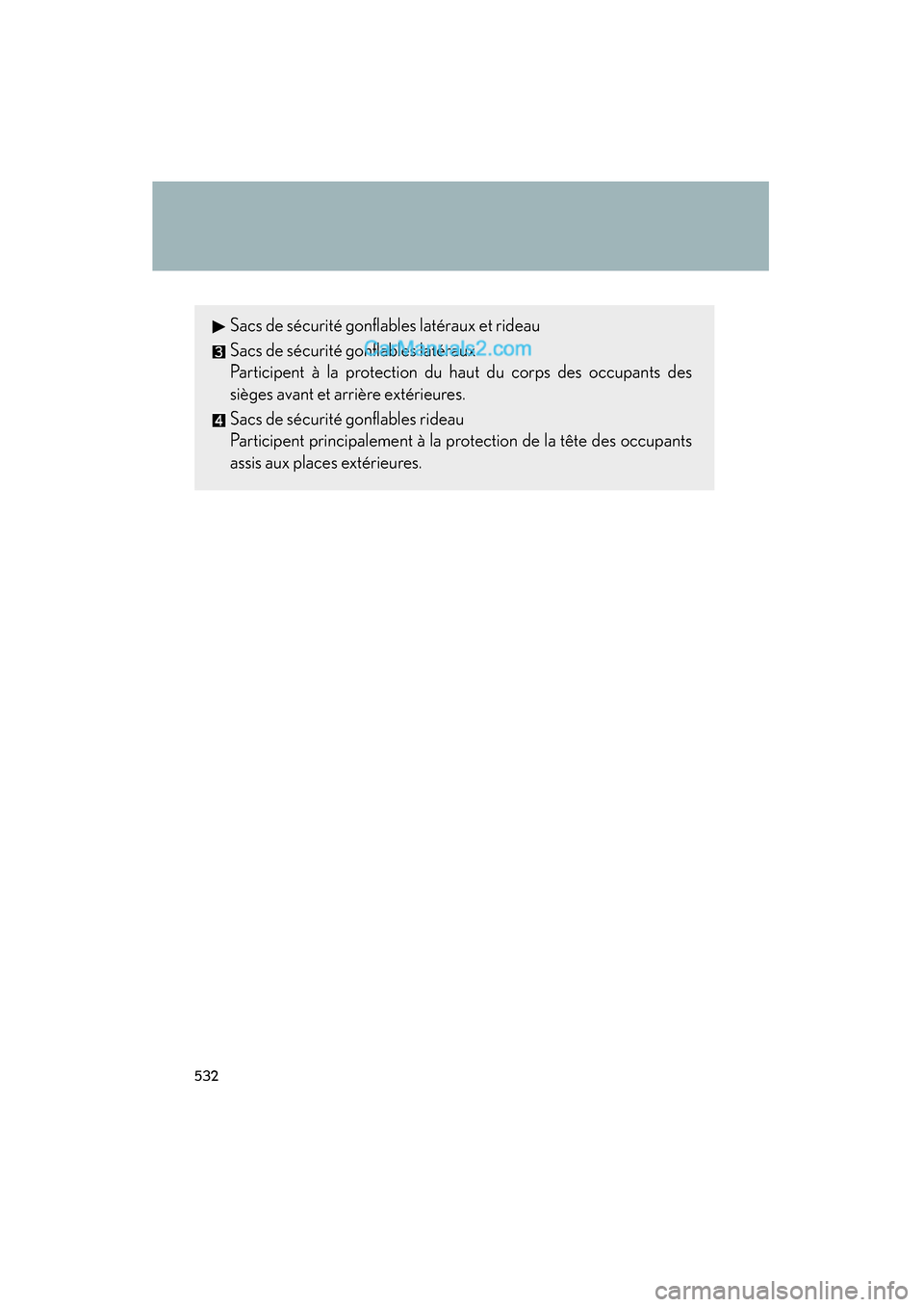
in English.Sacs de sécurité gonflables frontaux
Sac de sécurité gonflable conducteur/sac de sécurité gonflable
passager avant
Participent à la protection de la tête et du thorax du conducteur et
du passager avant contre les chocs avec les éléments de l'habitacle.
Sacs de sécurité gonflables de genoux
Participent à la protection du conducteur et du passager avant.
Page 534 of 563
532
ES350_U
Sacs de sécurité gonflables latéraux et rideau
Sacs de sécurité gonflables latéraux
Participent à la protection du haut du corps des occupants des
sièges avant et arrière extérieures.
Sacs de sécurité gonflables rideau
Participent principalement à la protection de la tête des occupants
assis aux places extérieures.
Page 535 of 563
533
7
ES350_U
For owners
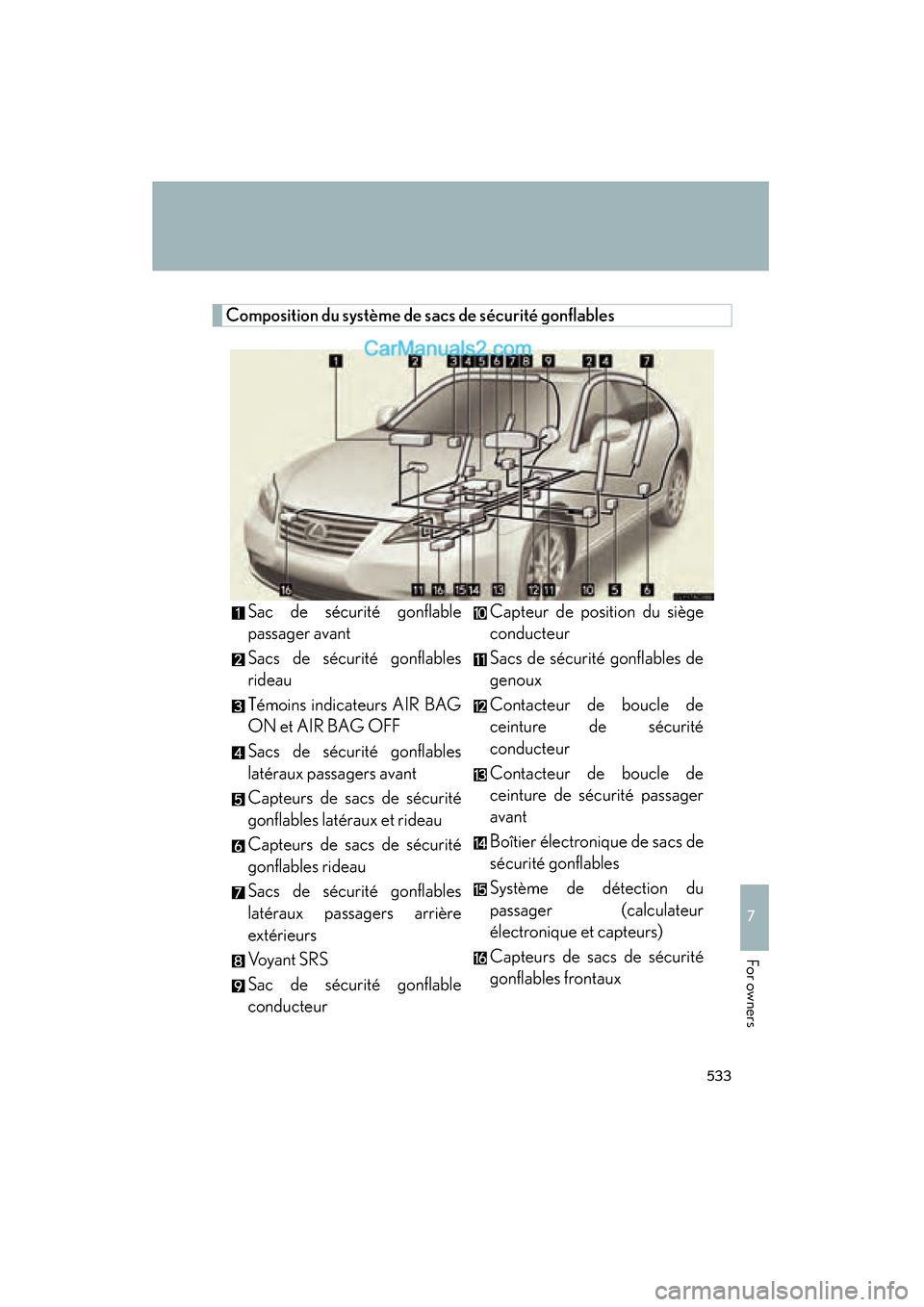
Composition du système de sacs de sécurité gonflablesSac de sécurité gonflable
passager avant
Sacs de sécurité gonflables
rideau
Témoins indicateurs AIR BAG
ON et AIR BAG OFF
Sacs de sécurité gonflables
latéraux passagers avant
Capteurs de sacs de sécurité
gonflables latéraux et rideau
Capteurs de sacs de sécurité
gonflables rideau
Sacs de sécurité gonflables
latéraux passagers arrière
extérieurs
Vo y a n t S R S
Sac de sécurité gonflable
conducteur Capteur de position du siège
conducteur
Sacs de sécurité gonflables de
genoux
Contacteur de boucle de
ceinture de sécurité
conducteur
Contacteur de boucle de
ceinture de sécurité passager
avant
Boîtier électronique de sacs de
sécurité gonflables
Système de détection du
passager (calculateur
électronique et capteurs)
Capteurs de sacs de sécurité
gonflables frontaux