Page 401 of 563
399
4-3. Do-it-yourself maintenance
4
Maintenance and care
ES350_U
■Tire types
1 Summer tiresSummer tires are high-speed performance tires best suited to highway driving
under dry conditions. Since summer tires do not have the same traction perfor-
mance as snow tires, summer tires are inadequate for driving on snow-covered
or icy roads. For driving on snow-covered roads or icy roads, the use of snow tires
is recommended. When installing snow tires, be sure to replace all four tires.
2 All season tires All season tires are designed to provide better traction in snow and to be ade-
quate for driving in most winter conditions, as well as for use year round. All sea-
son tires, however, do not have adequate traction performance compared with
snow tires in heavy or loose snow. Also, all season tires fall short in acceleration
and handling performance compared wi th summer tires in highway driving.
3 Snow tires For driving on snow-covered roads or icy roads, we recommend using snow tires.
If you need snow tires, select tires of the same size, construction and load capac-
ity as the originally installed tires. Since your vehicle has radial tires as original
equipment, make sure your snow tires also have radial construction. Do not install
studded tires without first checking lo cal regulations for possible restriction.
Snow tires should be installed on all wheels. ( →P. 1 9 1 )
■Initializing the tire pressure warning system
Initialize the tire pressure warning system with the tire inflation pressure adjusted to
the specified level.
■If you push the tire pressure reset switch accidentally
If initialization is performed, adjust the tire inflation pressure to the specified level
and initialize the tire pressure warning system again.
■When the initialization of the tire pressure warning system has failed
Initialization can be completed in a few minutes. However, in the following cases,
the settings have not been recorded and the system will not operate properly. If
repeated attempts to record tire inflation pressure settings are unsuccessful, have
the vehicle inspected by your Lexus dealer.
●When operating the tire pressure warning reset switch, the tire pressure warning
light does not blink 3 times.
●After carrying out the initialization procedure, the tire pressure warning light
blinks for 1 minute then stays on after driving for about 20 minutes.
Page 403 of 563
401
4-3. Do-it-yourself maintenance
4
Maintenance and care
ES350_U
CAUTION
■When inspecting or replacing tires
Observe the following precautions to prevent accidents.
Failure to do so may cause damage to parts of the drive train, as well as dangerous
handling characteristics, which may lead to an accident resulting in death or serious
injury.
●Do not mix tires of different makes, models or tread patterns. Also, do not mix
tires of remarkably different treadwear.
●Do not use tire sizes other than those recommended by Lexus.
●Do not mix differently constructed tires (radial, bias-belted or bias-ply tires).
●Do not mix summer, all season and winter tires.
●Do not tow the vehicle with the compact spare tire installed.
■When initializing the tire pressure warning system
Do not push the tire pressure warning reset switch without first adjusting the tire
inflation pressure to the specified level. Otherwise, the tire pressure warning light
may not come on even if the tire inflation pressure is low, or it may come on when
the tire inflation pressure is actually normal.
Page 411 of 563
409
4-3. Do-it-yourself maintenance
4
Maintenance and care
ES350_U
Air conditioning filter
The air conditioning filter must be cleaned or changed regularly to main-
tain air conditioning efficiency.
■Replacement method
Turn the “ENGINE START STOP” switch OFF.
Open the glove box. Remove
the glove box cover.
Remove the filter cover.
Remove the filter.
Be sure that the correct side of
the filter faces up when installing
it.
STEP1
STEP2
STEP3
STEP4
Page 415 of 563
413
4-3. Do-it-yourself maintenance
4
Maintenance and care
ES350_U
Checking and replacing fuses
If any of the electrical components do not operate, a fuse may have blown.
If this happens, check and replace the fuses as necessary.
Turn the “ENGINE START STOP” switch OFF.
Remove the engine compartment cover. (→P. 382)
Open the fuse box cover.
Engine compartment
Push the tabs in and lift the lid
off.
Driver's side instrument panel Remove the lid.
After a system failure, see “Fuse layout and amperage ratings”
(→ P. 416) for details about which fuse to check.STEP1
STEP2
STEP3
STEP4
Page 421 of 563
419
4-3. Do-it-yourself maintenance
4
Maintenance and care
ES350_U■
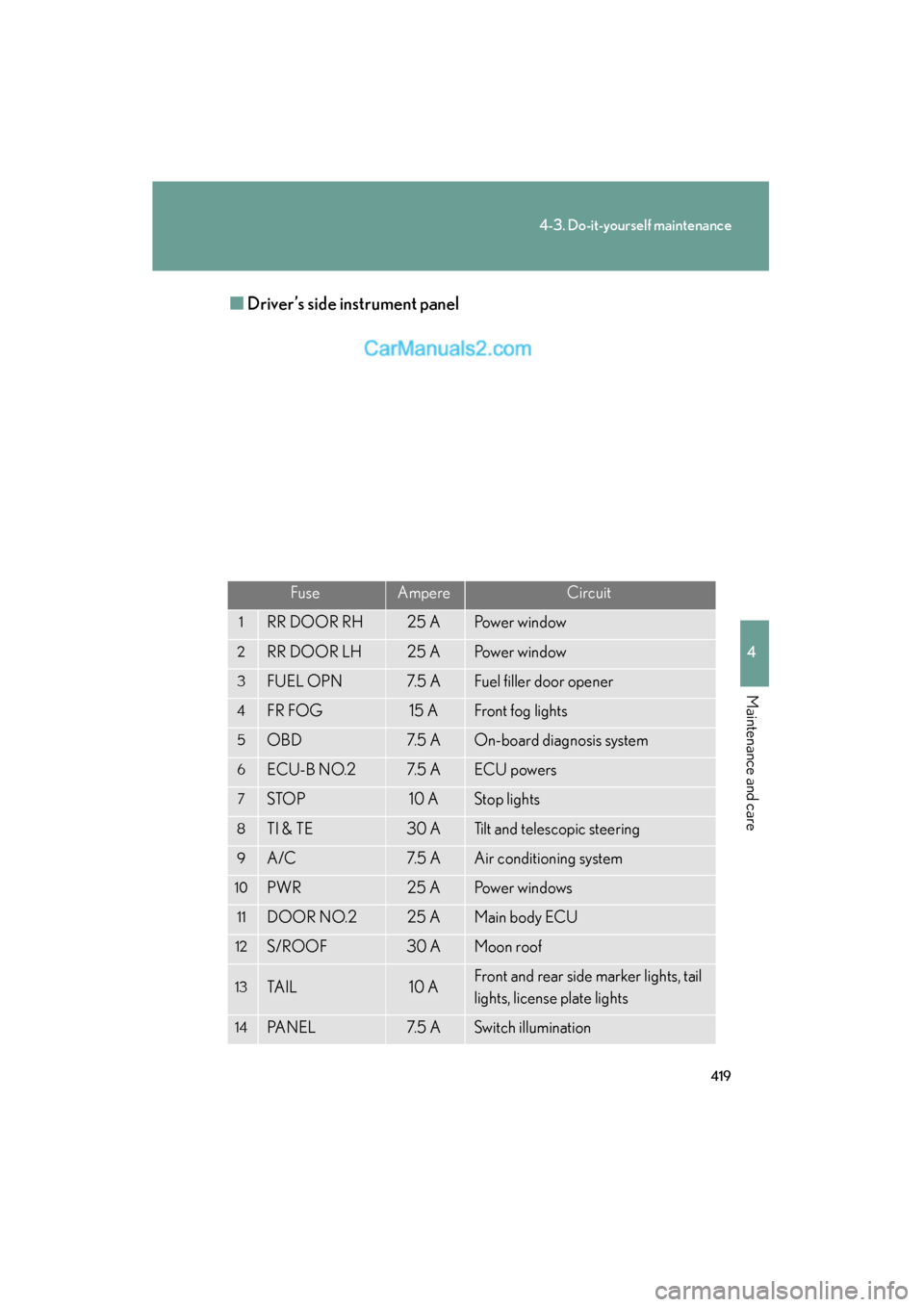
Driver’s side instrument panel
FuseAmpereCircuit
1RR DOOR RH25 APower window
2RR DOOR LH25 APower window
3FUEL OPN7. 5 AFuel filler door opener
4FR FOG15 AFront fog lights
5OBD7. 5 AOn-board diagnosis system
6ECU-B NO.27. 5 AECU powers
7STO P10 AStop lights
8TI & TE30 ATilt and telescopic steering
9A/C7. 5 AAir conditioning system
10PWR25 APower windows
11DOOR NO.225 AMain body ECU
12S/ROOF30 AMoon roof
13TA I L10 AFront and rear side marker lights, tail
lights, license plate lights
14PA N E L7. 5 ASwitch illumination
Page 436 of 563
434
ES350_U
5-1. Essential information
Emergency flashers
NOTICE
■To prevent battery discharge
Do not leave the emergency flashers on longer than necessary when the engine is
not running.
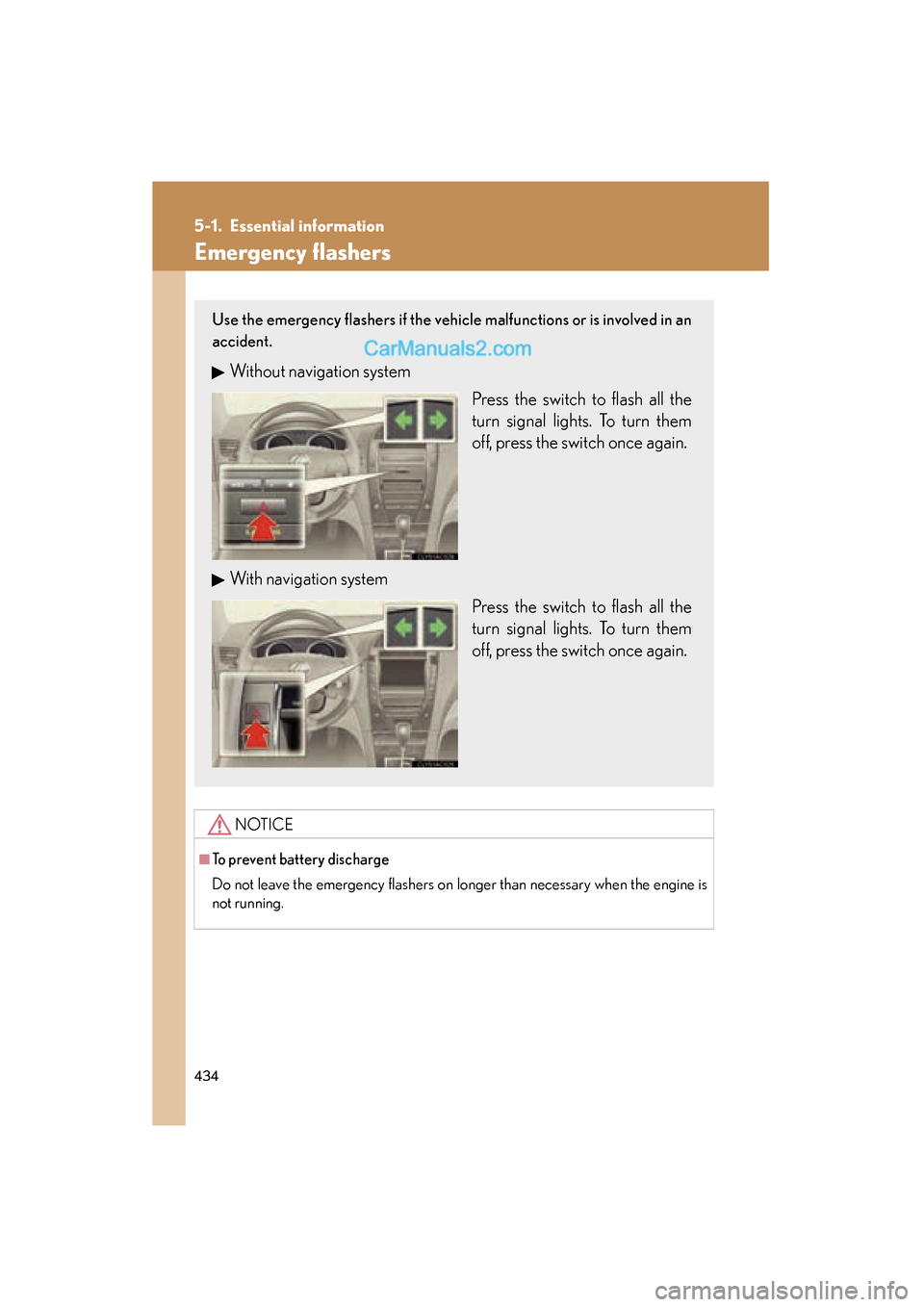
Use the emergency flashers if the vehicle malfunctions or is involved in an
accident.
Without navigation systemPress the switch to flash all the
turn signal lights. To turn them
off, press the switch once again.
With navigation system Press the switch to flash all the
turn signal lights. To turn them
off, press the switch once again.
Page 438 of 563

436
5-1. Essential information
ES350_U
Installing towing eyeletRemove the eyelet cover using a
flathead screwdriver.
To protect the bodywork, place a
rag between the screwdriver and
the vehicle body, as shown in the
illustration.
■Emergency towing procedureRelease the parking brake.
Shift the shift lever to N.
Turn the “ENGINE START STOP” switch to ACCESSORY (engine off)
or IGNITION ON mode (engine running).
CAUTION
■Caution while towing
●Use extreme caution when towing the vehicle.
Avoid sudden starts or erratic driving maneuvers which place excessive stress on
the emergency towing eyelets and the cables or chains. Always be cautious of the
surroundings and other vehicles while towing.
●If the engine is not running, the power assist for the brakes and steering will not
function, making steering and braking more difficult.
NOTICE
■To prevent causing serious da mage to the transmission
Never tow this vehicle from the rear with front wheels on the ground.
This may cause serious damage to the transmission.
STEP1
STEP2
STEP3
STEP1
Page 444 of 563
442
5-1. Essential information
ES350_U
Fuel pump shut off system
Follow the procedure below to restart the engine after the system is acti-
vated.Turn the “ENGINE START STOP” switch to ACCESSORY mode
or OFF.
Restart the engine.
NOTICE
■Before starting the engine
Inspect the ground under the vehicle.
If you find that fuel has leaked on to the ground, the fuel system has been damaged
and is in need of repair. Do not restart the engine.
To minimize the risk of fuel leakage when the engine stalls or an airbag
inflates upon collision, the fuel pump shut off system stops supplying fuel to
the engine.
STEP1
STEP2