Page 349 of 490
WARNING! (Continued)
•Failure to equip your vehicle with tires having
adequate speed capability can result in sudden tire
failure and loss of vehicle control.
CAUTION!
Replacing original tires with tires of a different size
may result in false speedometer and odometer read-
ings.
TIRE CHAINS
Due to limited clearance, tire chains are not recom-
mended.
CAUTION!
Damage to the vehicle may result if tire chains are
used.
SNOW TIRES
Some areas of the country require the use of snow tires
during the winter. All season tires can be identified by the
M+S designation on the tire sidewall.
If you need snow tires, select tires equivalent in size and
type to the original equipment tires. Use snow tires only
in sets of four; failure to do so may adversely affect the
safety and handling of your vehicle.
Snow tires generally have lower speed ratings than what
was originally equipped with your vehicle and should
not be operated at sustained speeds over 75 mph
(120 km/h). For speeds above 75 mph (120 km/h) refer to
original equipment or an authorized tire dealer for
recommended safe operating speeds, loading and cold
tire inflation pressures.
While studded tires improve performance on ice, skid
and traction capability on wet or dry surfaces may be
5
STARTING AND OPERATING 347
Page 350 of 490
poorer than that of non-studded tires. Some states pro-
hibit studded tires; therefore, local laws should be
checked before using these tire types.
TIRE ROTATION RECOMMENDATIONS
The tires on the front and rear of your vehicle operate at
different loads and perform different steering, driving,
and braking functions. For these reasons, they wear at
unequal rates.
These effects can be reduced by timely rotation of tires.
The benefits of rotation are especially worthwhile with
aggressive tread designs such as those on all season type
tires. Rotation will increase tread life, help to maintain
mud, snow and wet traction levels, and contribute to a
smooth, quiet ride.
Refer to the “Maintenance Schedule” for the proper
maintenance intervals. The reasons for any rapid or
unusual wear should be corrected prior to rotation being
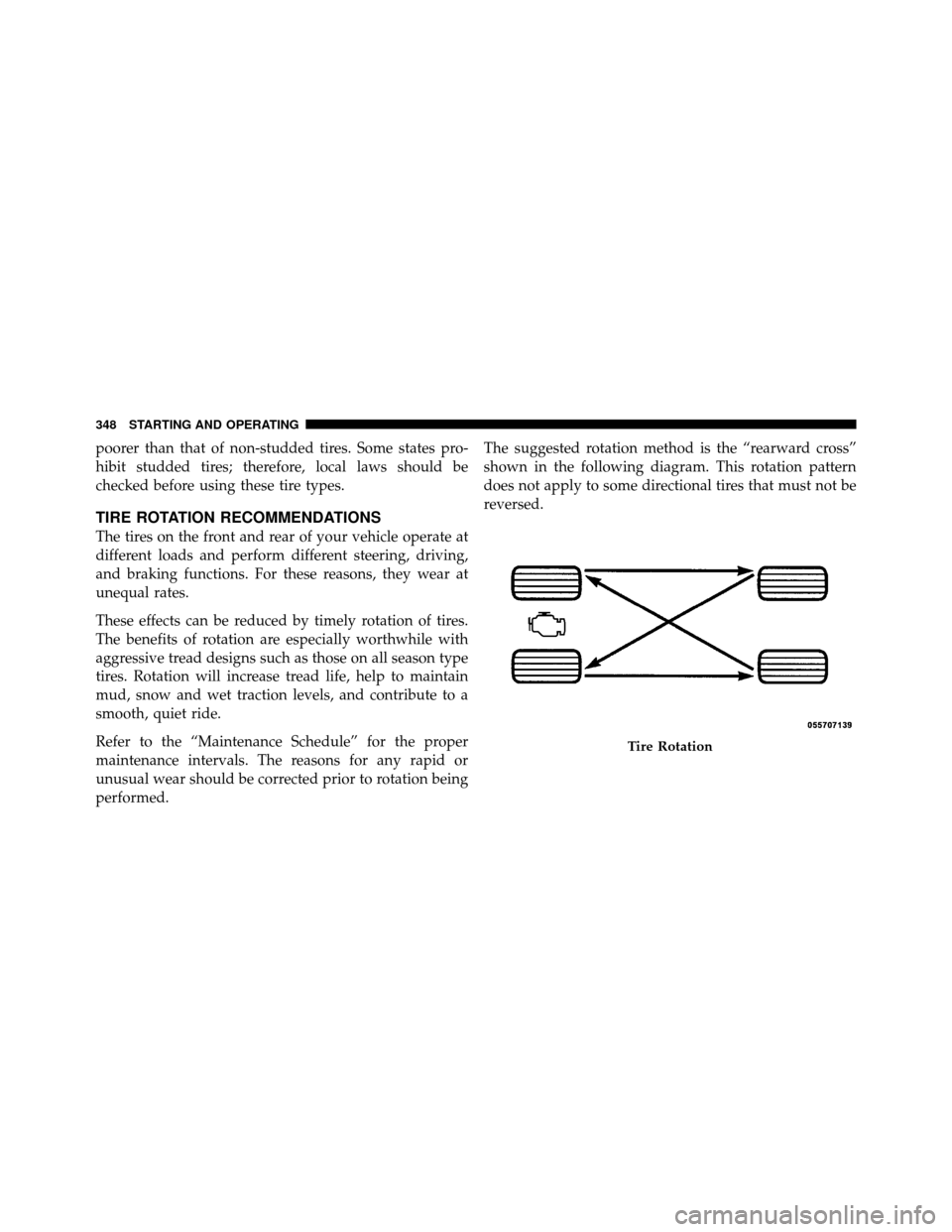
performed.The suggested rotation method is the “rearward cross”
shown in the following diagram. This rotation pattern
does not apply to some directional tires that must not be
reversed.
Tire Rotation
348 STARTING AND OPERATING
Page 352 of 490
For example, your vehicle may have a recommended
cold (parked for more than three hours) placard pressure
of 30 psi (207 kPa). If the ambient temperature is 68°F
(20°C) and the measured tire pressure is 27 psi (186 kPa),
a temperature drop to 20°F (-7°C) will decrease the tire
pressure to approximately 23 psi (158 kPa). This tire
pressure is sufficiently low enough to turn ON the Tire
Pressure Monitoring Telltale Light. Driving the vehicle
may cause the tire pressure to rise to approximately
27 psi (186 kPa), but the Tire Pressure Monitoring Telltale
Light will still be ON. In this situation, the Tire Pressure
Monitoring Telltale Light will turn OFF only after the
tires are inflated to the vehicle’s recommended cold
placard pressure value.CAUTION!
•The TPMS has been optimized for the original
equipment tires and wheels. TPMS pressures and
warnings have been established for the tire size
equipped on your vehicle. Undesirable system
operation or sensor damage may result when us-
ing replacement equipment that is not of the same
size, type, and/or style. Aftermarket wheels can
cause sensor damage. Do not use aftermarket tire
sealants or balance beads if your vehicle is
equipped with a TPMS, as damage to the sensors
may result.
•After inspecting or adjusting the tire pressure,
always reinstall the valve stem cap. This will
prevent moisture and dirt from entering the valve
stem, which could damage the Tire Pressure Moni-
toring Sensor.
350 STARTING AND OPERATING
Page 482 of 490

Remote Starting System.................... 24
Replacement Bulbs ....................... 435
Replacement Keys ........................ 15
Replacement Parts ....................... 403
Replacement Tires ....................... 346
Reporting Safety Defects ................... 462
Restraint, Head ......................... 141
Restraints, Child ....................... 74,81
Restraints, Infant ......................... 75
Restraints, Occupant ...................... 37
Retractable Cargo Area Cover ............... 179
Roll Over Warning ........................ 4
Roof Type Carrier ....................... 185
Rotation, Tires .......................... 348
Safety Checks Inside Vehicle ................. 85
Safety Checks Outside Vehicle ............... 87
Safety Defects, Reporting .................. 462
Safety Information, Tire ................... 328 Safety Tips
............................. 84
Safety, Exhaust Gas ....................... 84
Satellite Radio Antenna .................236,261
Schedule, Maintenance .................... 442
Seat Belt Maintenance .................... 431
Seat Belt Reminder ....................... 57
Seat Belts ............................ 37,85
Adjustable Shoulder Belt ................ 46
Adjustable Upper Shoulder Anchorage ...... 46
And Pregnant Women .................. 59
Child Restraint ....................... 74
Extender ........................... 59
Front Seat .......................... 41
Inspection .......................... 85
Pretensioners ........................ 53
Rear Seat ........................... 41
Seats ................................. 134
Adjustment ......................... 137
Heated ............................ 136
480 INDEX