2011 JEEP PATRIOT clutch
[x] Cancel search: clutchPage 293 of 490
STARTING PROCEDURES
Before starting your vehicle, adjust your seat, adjust both
inside and outside mirrors, and fasten your seat belts.
WARNING!
Never leave children alone in a vehicle. Leaving
unattended children in a vehicle is dangerous for a
number of reasons. A child or others could be seri-
ously or fatally injured. Do not leave the key in the
ignition. A child could operate power windows,
other controls, or move the vehicle.
Manual Transmission – If Equipped
Before starting the engine fully apply the parking brake,
press the clutch pedal to the floor, and place the shift
lever in NEUTRAL.NOTE:
•The engine will not start unless the clutch pedal is
pressed to the floor.
•If the key will not turn and the steering wheel is
locked, rotate the wheel in either direction to relieve
pressure on the locking mechanism and then turn the
key.
Automatic Transmission – If Equipped
The shift lever must be in the PARK or NEUTRAL
position before you can start the engine. Apply the brakes
before shifting to any driving gear.
NOTE:
You must press the brake pedal before shifting
out of PARK.5
STARTING AND OPERATING 291
Page 296 of 490
WARNING!
Remember to disconnect the engine block heater
cord before driving. Damage to the 110-115 Volt
electrical cord could cause electrocution.
MANUAL TRANSMISSION — IF EQUIPPED
Five–Speed Manual Transmission
WARNING!
You or others could be injured if you leave the
vehicle unattended without having the parking
brake fully applied. The parking brake should al-
ways be applied when the driver is not in the vehicle,
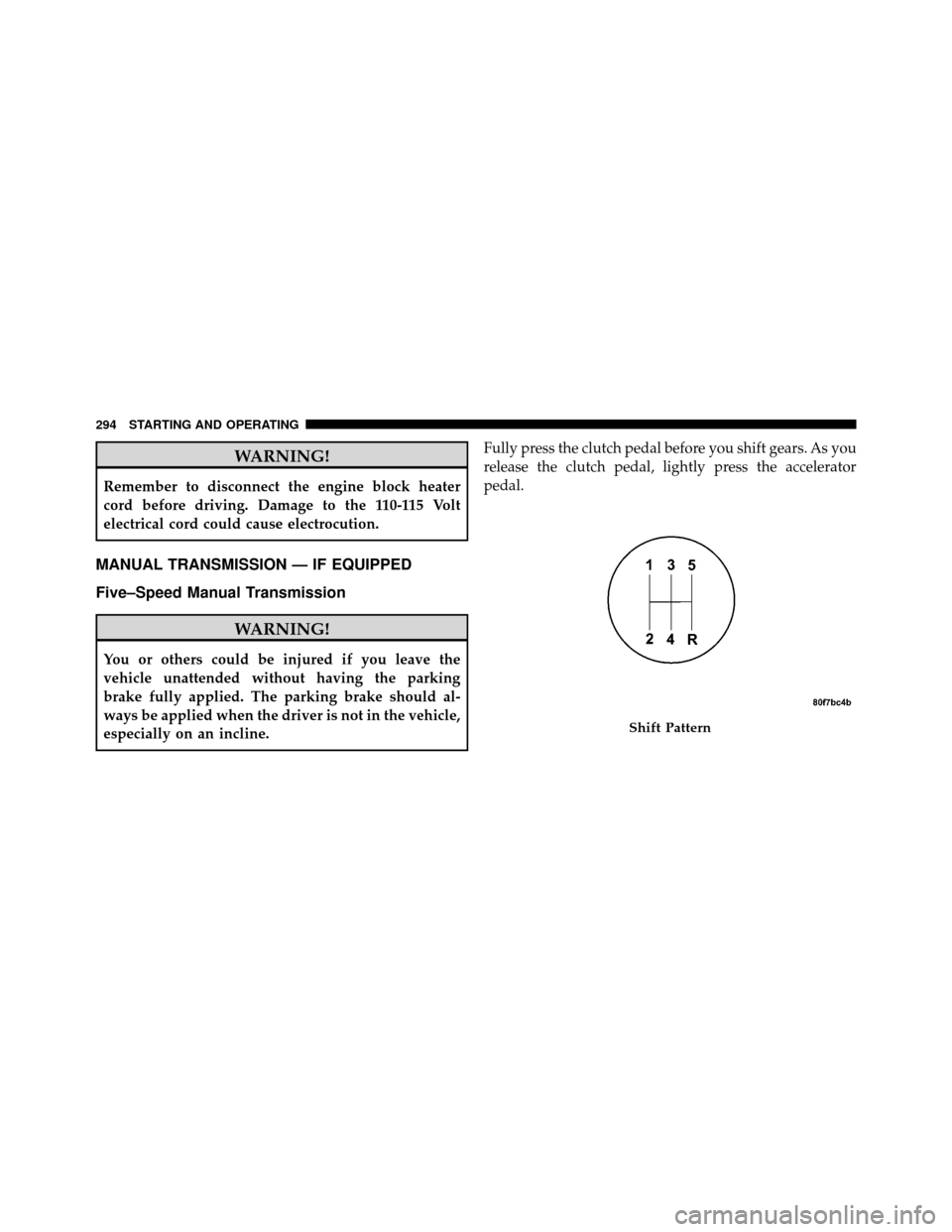
especially on an incline.Fully press the clutch pedal before you shift gears. As you
release the clutch pedal, lightly press the accelerator
pedal.
Shift Pattern
294 STARTING AND OPERATING
Page 297 of 490

Use each gear in numerical order, do not skip a gear. Be
sure the transmission is in first gear, (not third), when
starting from a standing position. Damage to the clutch
can result from starting in third gear.
For most city driving, you will find it easier to use only
the lower gears. For steady highway driving with light
accelerations, fifth gear is recommended.
Never drive with your foot resting on the clutch pedal,
and never try to hold the vehicle on a hill with the clutch
pedal partially engaged. This will cause abnormal wear
on the clutch.
Never shift into REVERSE until the vehicle has come to a
complete stop.
NOTE:During cold weather, until the transmission
lubricant is warm, you may experience slightly higher
shift efforts. This is normal and not harmful to the
transmission.Recommended Shift Speeds
To use your manual transmission for optimal fuel
economy, it should be upshifted as listed in the following
table.
Manual Transmission Recommended Shift Speeds
Units in mph (km/h)
Engine Size Accel-
eration Rate 1to2 2to3 3to4 4to5
All En- gines Accel 14 (23) 23 (37) 29 (47) 45 (72)
Cruise 12 (19) 18 (29) 25 (40) 32 (52)
Downshifting
Proper downshifting will improve fuel economy and
prolong engine life.
5
STARTING AND OPERATING 295
Page 298 of 490
CAUTION!
If you skip more than one gear while downshifting
or downshift at too high a vehicle speed, you could
damage the engine, transmission, or clutch.
To maintain a safe speed and prolong brake life, shift
down to second or first gear when descending a steep
grade.
When turning a corner or driving up a steep grade,
downshift early so that the engine will not be
overburdened.
AUTOMATIC TRANSMISSION — IF EQUIPPED
NOTE: The Continuously Variable Automatic Transmis-
sion (CVT) changes ratios in a continuous manner. This
may sometimes “feel” as if it is slipping, but this is
normal and does not harm anything.
CAUTION!
Damage to the transmission may occur if the follow-
ing precautions are not observed:
•Shift into PARK only after the vehicle has come to
a complete stop.
•Shift into or out of REVERSE only after the
vehicle has come to a complete stop and the engine
is at idle speed.
•Do not shift from REVERSE, PARK, or NEUTRAL
into any forward gear when the engine is above
idle speed.
•Before shifting into any gear, make sure your foot
is firmly on the brake pedal.
NOTE: You MUST press and hold the brake pedal down
while shifting out of PARK.
296 STARTING AND OPERATING
Page 326 of 490
Disabling/Enabling HSA
If you wish to turn on or off the HSA system, it can be
done using the Customer Programmable Features in the
Electronic Vehicle Information Center (EVIC). Refer to
“Electronic Vehicle Information Center (EVIC)” in “Un-
derstanding Your Instrument Panel” for further informa-
tion.
For vehicles not equipped with the EVIC, perform the
following steps:
NOTE:You must complete Steps 1 through 8 within
90 seconds.
1. Center the steering wheel (front wheels pointing
straight forward).
2. Shift the transmission into NEUTRAL.
3. Apply the parking brake.
4. Start the engine. 5. Release the clutch pedal.
6. Rotate the steering wheel one-half turn to the left.
7. Press the “ESC Off” switch (located in the lower
switch bank below the climate controls) four times within
20 seconds. The “ESC Activation/Malfunction Indicator
Light” should turn on and turn off two times.
8. Rotate the steering wheel back to center and then an
additional half-turn to the right.
9. Turn the ignition switch to the OFF position and then
back to the ON position. If the sequence was completed
properly, the “ESC Activation/Malfunction Indicator
Light” will blink several times to confirm HSA is dis-
abled.
10. Repeat these steps if you want to return this feature
to it’s previous setting.
324 STARTING AND OPERATING
Page 423 of 490
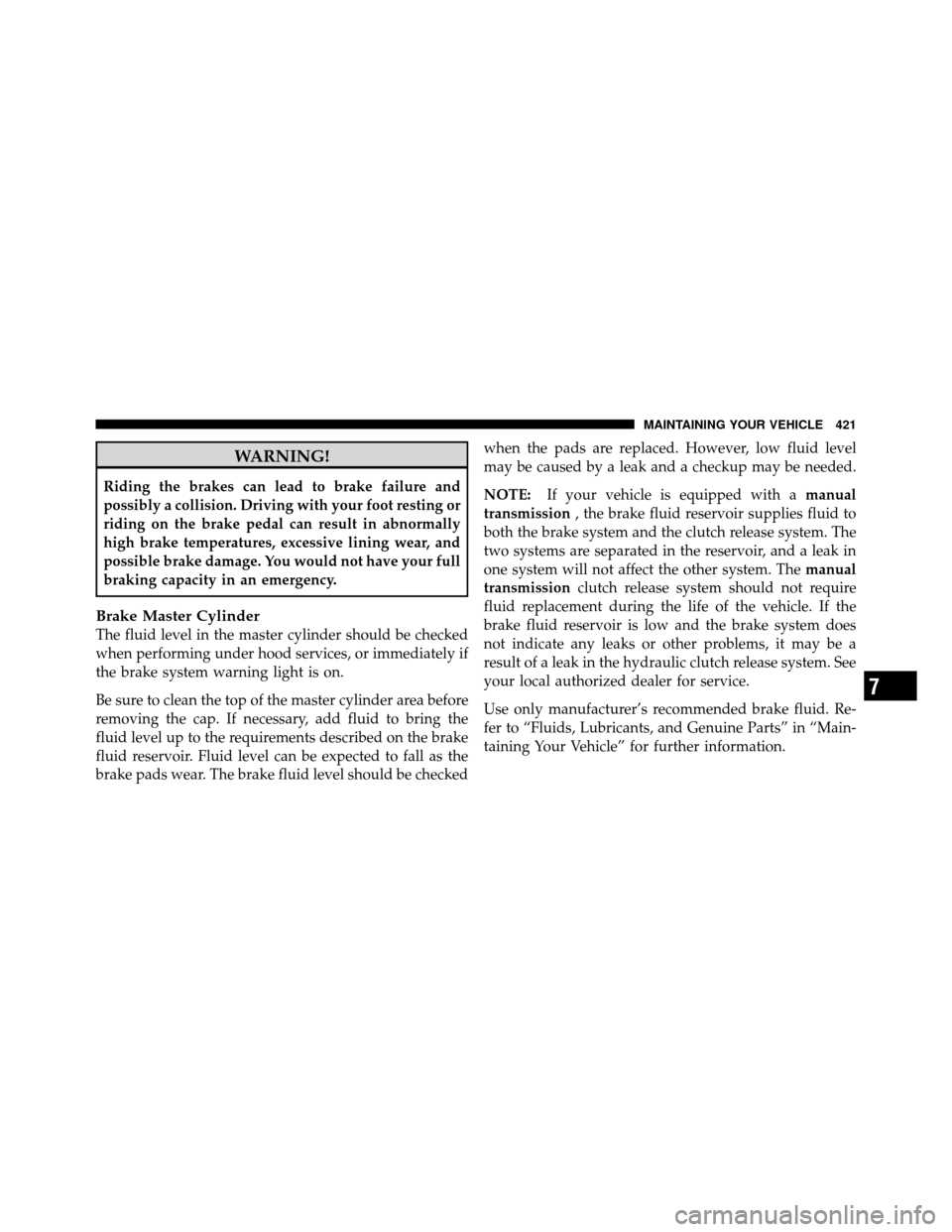
WARNING!
Riding the brakes can lead to brake failure and
possibly a collision. Driving with your foot resting or
riding on the brake pedal can result in abnormally
high brake temperatures, excessive lining wear, and
possible brake damage. You would not have your full
braking capacity in an emergency.
Brake Master Cylinder
The fluid level in the master cylinder should be checked
when performing under hood services, or immediately if
the brake system warning light is on.
Be sure to clean the top of the master cylinder area before
removing the cap. If necessary, add fluid to bring the
fluid level up to the requirements described on the brake
fluid reservoir. Fluid level can be expected to fall as the
brake pads wear. The brake fluid level should be checkedwhen the pads are replaced. However, low fluid level
may be caused by a leak and a checkup may be needed.
NOTE:
If your vehicle is equipped with a manual
transmission , the brake fluid reservoir supplies fluid to
both the brake system and the clutch release system. The
two systems are separated in the reservoir, and a leak in
one system will not affect the other system. The manual
transmission clutch release system should not require
fluid replacement during the life of the vehicle. If the
brake fluid reservoir is low and the brake system does
not indicate any leaks or other problems, it may be a
result of a leak in the hydraulic clutch release system. See
your local authorized dealer for service.
Use only manufacturer’s recommended brake fluid. Re-
fer to “Fluids, Lubricants, and Genuine Parts” in “Main-
taining Your Vehicle” for further information.
7
MAINTAINING YOUR VEHICLE 421
Page 425 of 490
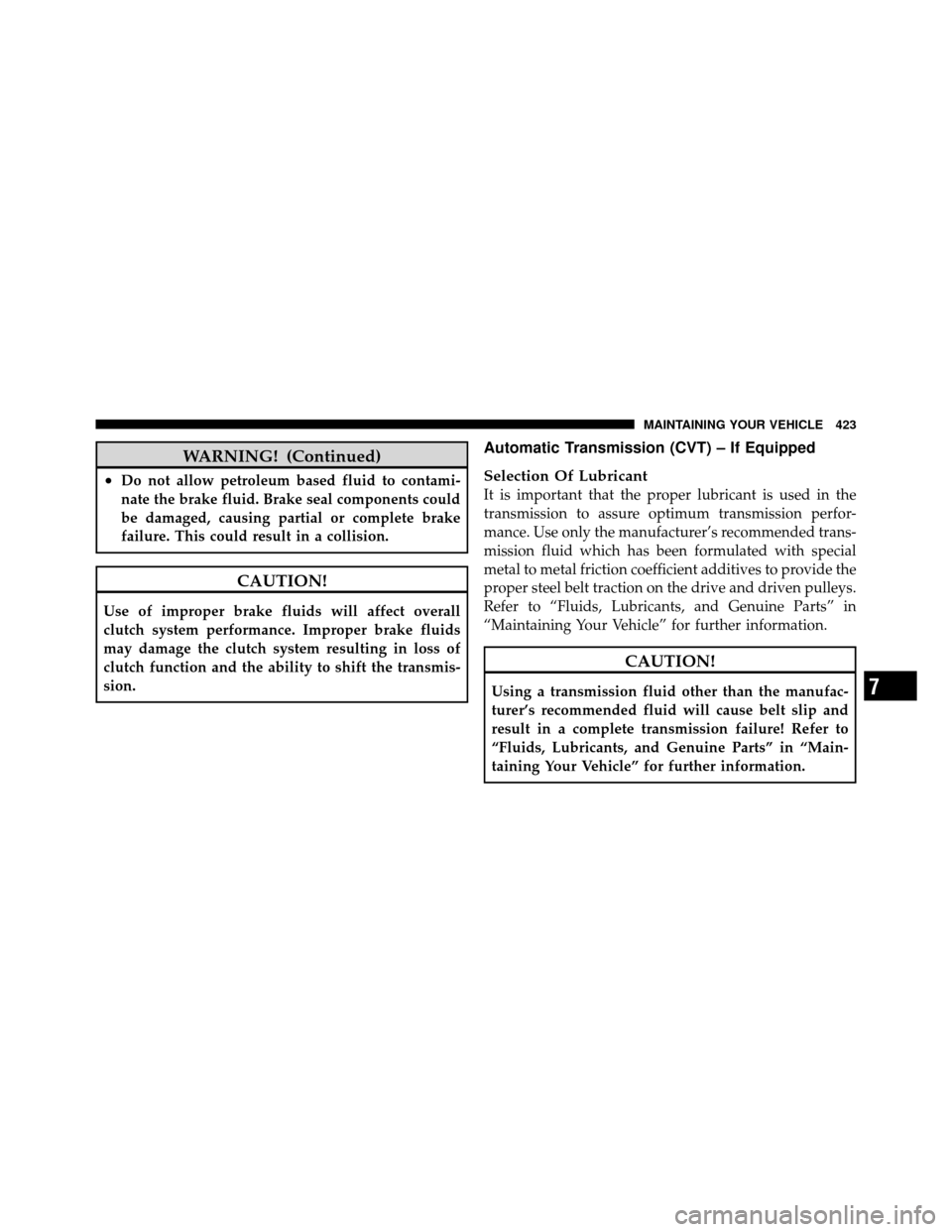
WARNING! (Continued)
•Do not allow petroleum based fluid to contami-
nate the brake fluid. Brake seal components could
be damaged, causing partial or complete brake
failure. This could result in a collision.
CAUTION!
Use of improper brake fluids will affect overall
clutch system performance. Improper brake fluids
may damage the clutch system resulting in loss of
clutch function and the ability to shift the transmis-
sion.
Automatic Transmission (CVT) – If Equipped
Selection Of Lubricant
It is important that the proper lubricant is used in the
transmission to assure optimum transmission perfor-
mance. Use only the manufacturer’s recommended trans-
mission fluid which has been formulated with special
metal to metal friction coefficient additives to provide the
proper steel belt traction on the drive and driven pulleys.
Refer to “Fluids, Lubricants, and Genuine Parts” in
“Maintaining Your Vehicle” for further information.
CAUTION!
Using a transmission fluid other than the manufac-
turer’s recommended fluid will cause belt slip and
result in a complete transmission failure! Refer to
“Fluids, Lubricants, and Genuine Parts” in “Main-
taining Your Vehicle” for further information.7
MAINTAINING YOUR VEHICLE 423
Page 472 of 490
Cargo CompartmentLight ............................. 178
Luggage Carrier ..................... 185
Cargo Light ............................ 178
Cargo Load Floor ........................ 181
Cargo Tie-Downs ........................ 182
Cellular Phone ........................ 98,273
Center High Mounted Stop Light ............ 437
Chains, Tire ............................ 347
Changing A Flat Tire ..................... 382
Chart, Tire Sizing ........................ 330
Check Engine Light
(Malfunction Indicator Light) ............... 402
Checking Your Vehicle For Safety ............. 84
Checks, Safety ........................... 84
Child Restraint .......................... 74
Child Restraint Tether Anchors ............... 79
Child Restraint with Automatic Belts ........... 77
Child Safety Locks ........................ 32 Child Seat
.............................. 81
Clean Air Gasoline ....................... 358
Cleaning Wheels ............................ 428
Climate Control ......................... 273
Clock ........................... 222,241,250
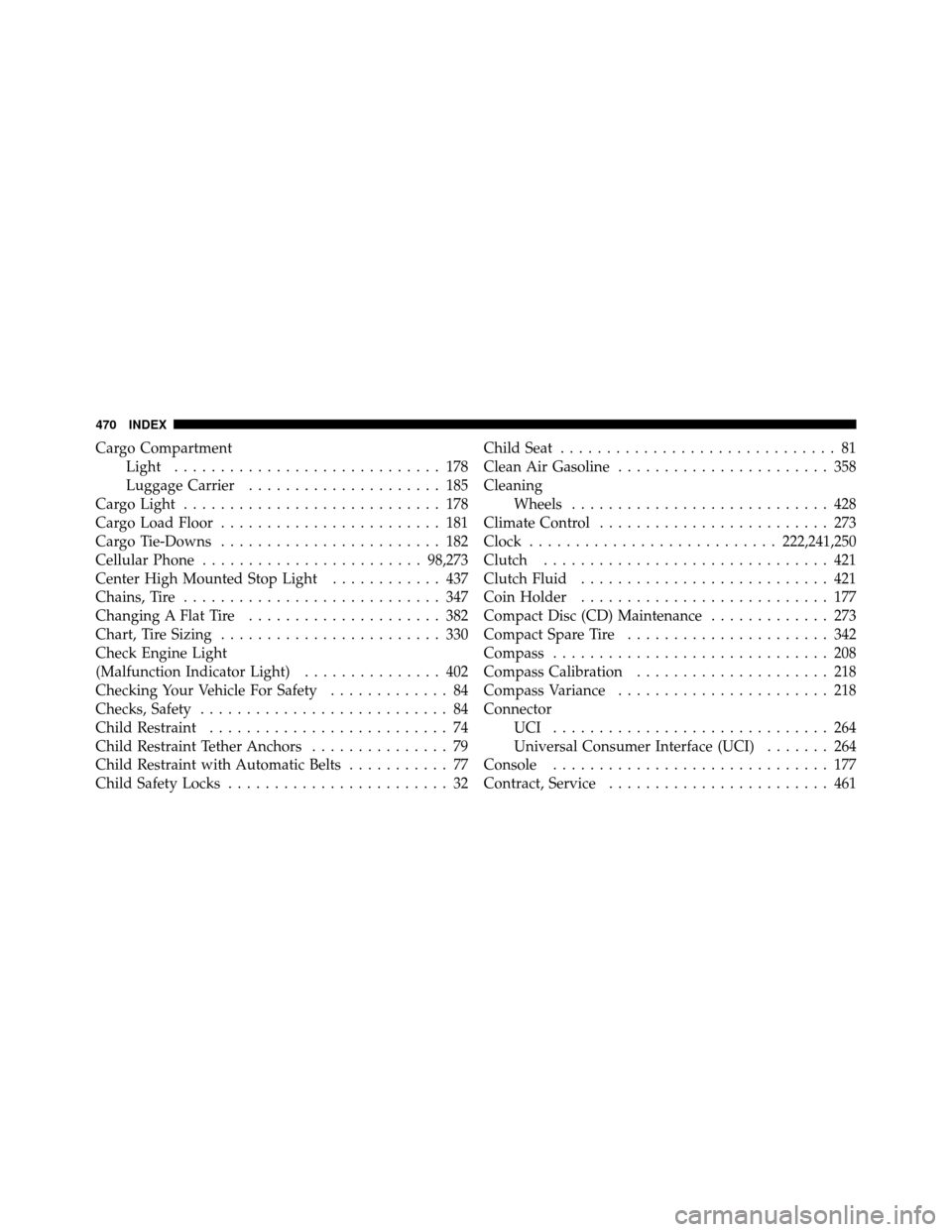
Clutch ............................... 421
Clutch Fluid ........................... 421
Coin Holder ........................... 177
Compact Disc (CD) Maintenance ............. 273
Compact Spare Tire ...................... 342
Compass .............................. 208
Compass Calibration ..................... 218
Compass Variance ....................... 218
Connector UCI .............................. 264
Universal Consumer Interface (UCI) ....... 264
Console .............................. 177
Contract, Service ........................ 461
470 INDEX