Page 391 of 587
WARNING!
•If you use a trailer brake controller with your
trailer, your trailer brakes may be activated and
deactivated with the brake switch. If so, when the
brake pedal is released, there may not be enough
brake pressure to hold the vehicle and trailer on a
hill and this could cause a collision with another
vehicle or object behind you. In order to avoid
rolling down the hill while resuming acceleration,
manually activate the trailer brake prior to releas-
ing the brake pedal. Always remember the driver
is responsible for braking the vehicle.(Continued)
WARNING! (Continued)
•HSA is not a parking brake. If you stop the vehicle
on a hill without putting the transmission in
PARK and using the parking brake, it will roll
down the hill and could cause a collision with
another vehicle or object. Always remember to use
the parking brake while parking on a hill, and that
the driver is responsible for braking the vehicle.
HSA Off
If you wish to turn off the HSA system, it can be done
using the Customer Programmable Features in the Elec-
tronic Vehicle Information Center (EVIC). Refer to “Elec-
tronic Vehicle Information Center (EVIC)” in “Under-
standing Your Instrument Panel” for further information.
5
STARTING AND OPERATING 389
Page 392 of 587
Ready Alert Braking – If Equipped
Ready Alert Braking may reduce the time required to
reach full braking during emergency braking situations.
It anticipates when an emergency braking situation may
occur by monitoring how fast the throttle is released by
the driver. When the throttle is released very quickly,
Ready Alert Braking applies a small amount of brake
pressure. This brake pressure will not be noticed by the
driver. The brake system uses this brake pressure to allow
a fast brake response if the driver applies the brakes.
Rain Brake Support – If Equipped
Rain Brake Support may improve braking performance
in wet conditions. It will periodically apply a small
amount of brake pressure to remove any water buildupon the front brake rotors. It only functions when the
windshield wipers are in the LO or HI mode, it does not
function in the intermittent mode. When Rain Brake
Support is active, there is no notification to the driver and
no driver interaction is required.
Hill Descent Control (HDC) — Four-Wheel Drive
Models With MP3023 Two-Speed Transfer Case
Only
HDC maintains vehicle speed while descending hills
during off-road driving situations and is available in 4WD
LOW range only. To enable HDC, press the HDC switch
or put the Selec-Terrain™ system in “ROCK” mode
(“ROCK” mode is only available in 4WD LOW range).
390 STARTING AND OPERATING
Page 393 of 587
When HDC is enabled, the HDC icon will be illuminated
in the instrument cluster. HDC will automatically apply
the brakes to control downhill speed to the selected level
when necessary on grades greater than approximately
8%. It will usually not activate on level ground.The HDC speed may be adjusted by the driver to suit the
driving conditions. The speed corresponds to the trans-
mission gear selected.
HDC operation can be overridden with brake application
to slow the vehicle down below the HDC control speed.
Conversely, if more speed is desired during HDC control,
the accelerator pedal will increase vehicle speed in the
usual manner. When either the brake or the accelerator is
released, HDC will control the vehicle back to the origi-
nal set speed.
HDC Operation in 4WD Low Range
To enable HDC, press the HDC switch or put the
Selec-Terrain™ system in the “ROCK” mode. The HDC
icon will be illuminated in the instrument cluster and
HDC will function. If the vehicle speed goes above
20 mph (32 km/h), the HDC icon will flash and HDC will
not function. To disable HDC, press the HDC switch.Hill Descent Switch
5
STARTING AND OPERATING 391
Page 394 of 587
4WD Low Range Set Speeds
•1st = 1 mph (1.6 km/h)
•2nd = 2.5 mph (4 km/h)
•3rd = 4 mph (6 km/h)
•4th = 5.5 mph (9 km/h)
•5th or D (Drive) = 7.5 mph (12 km/h)
•REVERSE = 1 mph (1.6 km/h)
•NEUTRAL = 2.5 mph (4 km/h)
•PARK = HDC will not function
HDC is intended for low speed off-road driving only.
At vehicle speeds above 20 mph (32 km/h), HDC will no
longer function. When the vehicle speed drops below
20 mph (32 km/h), HDC function will automatically
resume and the vehicle speed will return to the chosen set
speed.
WARNING!
HDC is only intended to assist the driver in control-
ling vehicle speed when descending hills. The driver
must remain attentive to the driving conditions and
is responsible for maintaining a safe vehicle speed.
ESC Activation/Malfunction Indicator Light and
ESC OFF Indicator Light
The “ESC Activation/Malfunction Indicator
Light” in the instrument cluster will come on
when the ignition switch is turned to the ON
position. It should turn off with the engine
running. If the “ESC Activation/Malfunction Indicator
Light” comes on continuously with the engine running, a
malfunction has been detected in the ESC system. If this
light remains on after several ignition cycles, and the
vehicle has been driven several miles (kilometers) at
392 STARTING AND OPERATING
Page 398 of 587
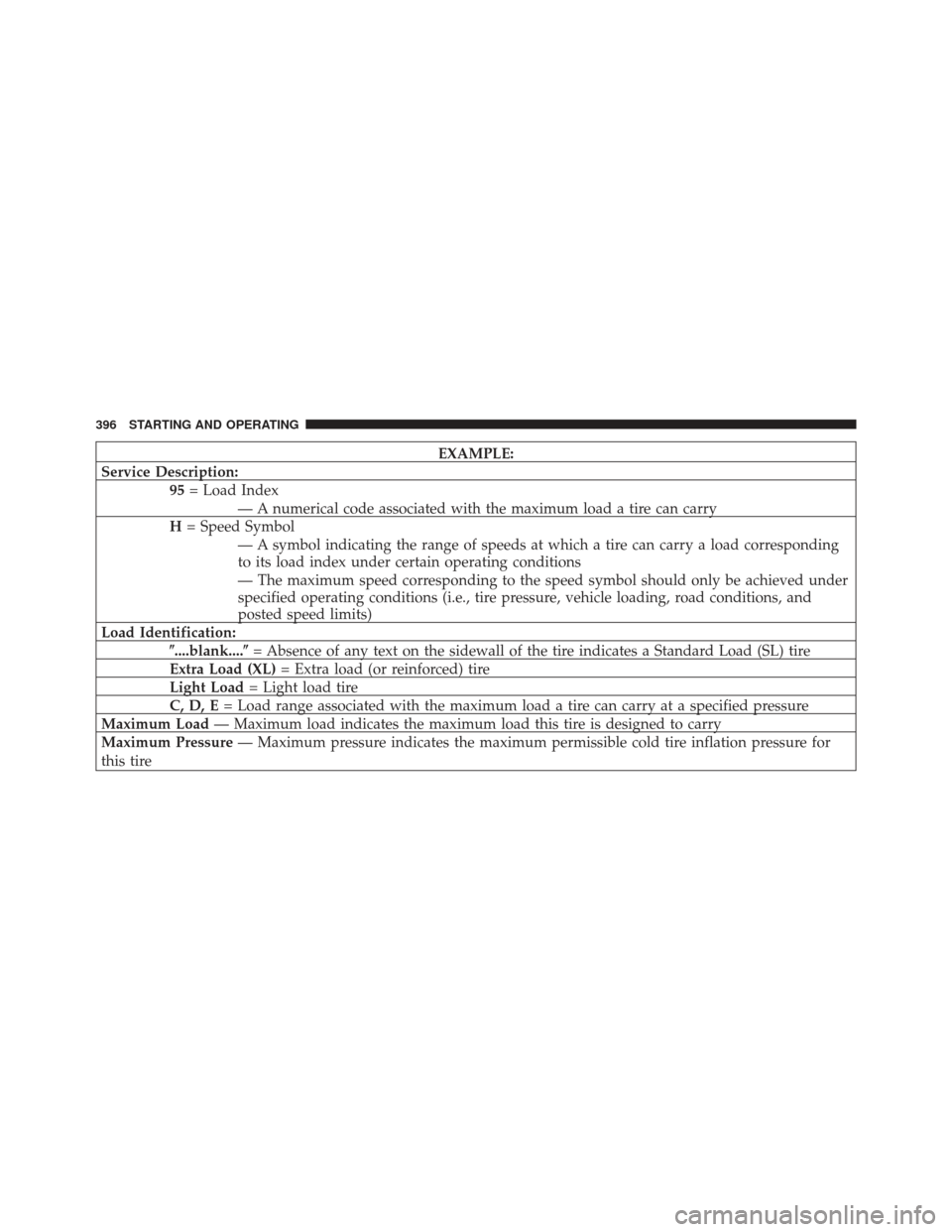
EXAMPLE:
Service Description: 95= Load Index
— A numerical code associated with the maximum load a tire can carry
H = Speed Symbol
— A symbol indicating the range of speeds at which a tire can carry a load corresponding
to its load index under certain operating conditions
— The maximum speed corresponding to the speed symbol should only be achieved under
specified operating conditions (i.e., tire pressure, vehicle loading, road conditions, and
posted speed limits)
Load Identification: �....blank....� = Absence of any text on the sidewall of the tire indicates a Standard Load (SL) tire
Extra Load (XL) = Extra load (or reinforced) tire
Light Load = Light load tire
C, D, E = Load range associated with the maximum load a tire can carry at a specified pressure
Maximum Load — Maximum load indicates the maximum load this tire is designed to carry
Maximum Pressure — Maximum pressure indicates the maximum permissible cold tire inflation pressure for
this tire
396 STARTING AND OPERATING
Page 406 of 587

WARNING! (Continued)
•Unequal tire pressures from one side of the ve-
hicle to the other can cause the vehicle to drift to
the right or left.
•Always drive with each tire inflated to the recom-
mended cold tire inflation pressure.
Economy
Improper inflation pressures can cause uneven wear
patterns to develop across the tire tread. These abnormal
wear patterns will reduce tread life resulting in a need for
earlier tire replacement. Under-inflation also increases
tire rolling resistance and results in higher fuel
consumption.
Ride Comfort and Vehicle Stability
Proper tire inflation contributes to a comfortable ride.
Over-inflation produces a jarring and uncomfortable
ride. Both under-inflation and over-inflation affect thestability of the vehicle and can produce a feeling of
sluggish response or over responsiveness in the steering.
Unequal tire pressures can cause erratic and unpredict-
able steering response.
Unequal tire pressure from side to side may cause the
vehicle to drift left or right.
Tire Inflation Pressures
The proper cold tire inflation pressure is listed on the
driver’s side “B” Pillar.
The pressure should be checked and adjusted, as well as
inspected for signs of tire wear or visible damage, at least
once a month. Use a good quality pocket-type gauge to
check tire pressure. Do not make a visual judgement
when determining proper inflation. Radial tires may look
properly inflated even when they are under-inflated.
404 STARTING AND OPERATING
Page 407 of 587
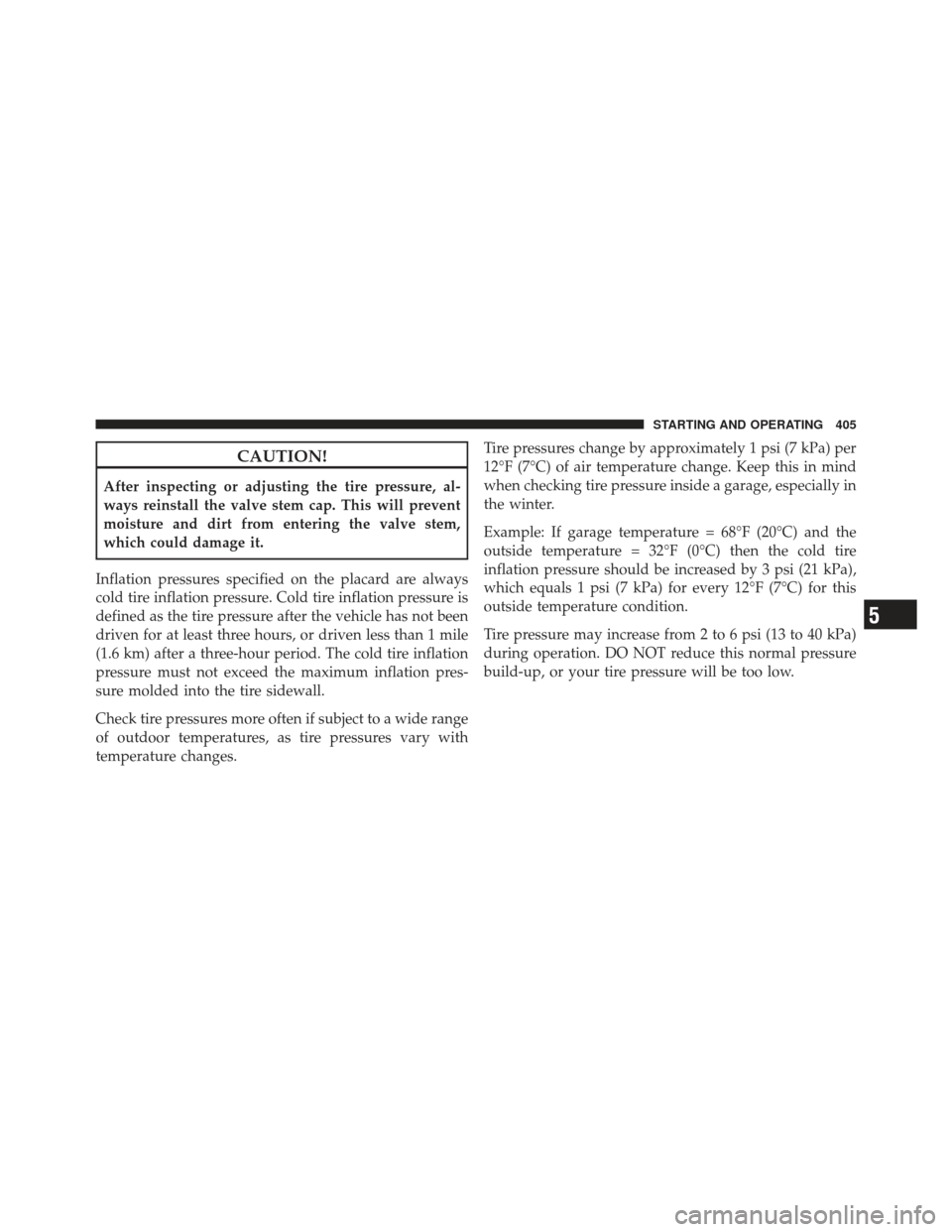
CAUTION!
After inspecting or adjusting the tire pressure, al-
ways reinstall the valve stem cap. This will prevent
moisture and dirt from entering the valve stem,
which could damage it.
Inflation pressures specified on the placard are always
cold tire inflation pressure. Cold tire inflation pressure is
defined as the tire pressure after the vehicle has not been
driven for at least three hours, or driven less than 1 mile
(1.6 km) after a three-hour period. The cold tire inflation
pressure must not exceed the maximum inflation pres-
sure molded into the tire sidewall.
Check tire pressures more often if subject to a wide range
of outdoor temperatures, as tire pressures vary with
temperature changes. Tire pressures change by approximately 1 psi (7 kPa) per
12°F (7°C) of air temperature change. Keep this in mind
when checking tire pressure inside a garage, especially in
the winter.
Example: If garage temperature = 68°F (20°C) and the
outside temperature = 32°F (0°C) then the cold tire
inflation pressure should be increased by 3 psi (21 kPa),
which equals 1 psi (7 kPa) for every 12°F (7°C) for this
outside temperature condition.
Tire pressure may increase from 2 to 6 psi (13 to 40 kPa)
during operation. DO NOT reduce this normal pressure
build-up, or your tire pressure will be too low.
5
STARTING AND OPERATING 405
Page 415 of 587
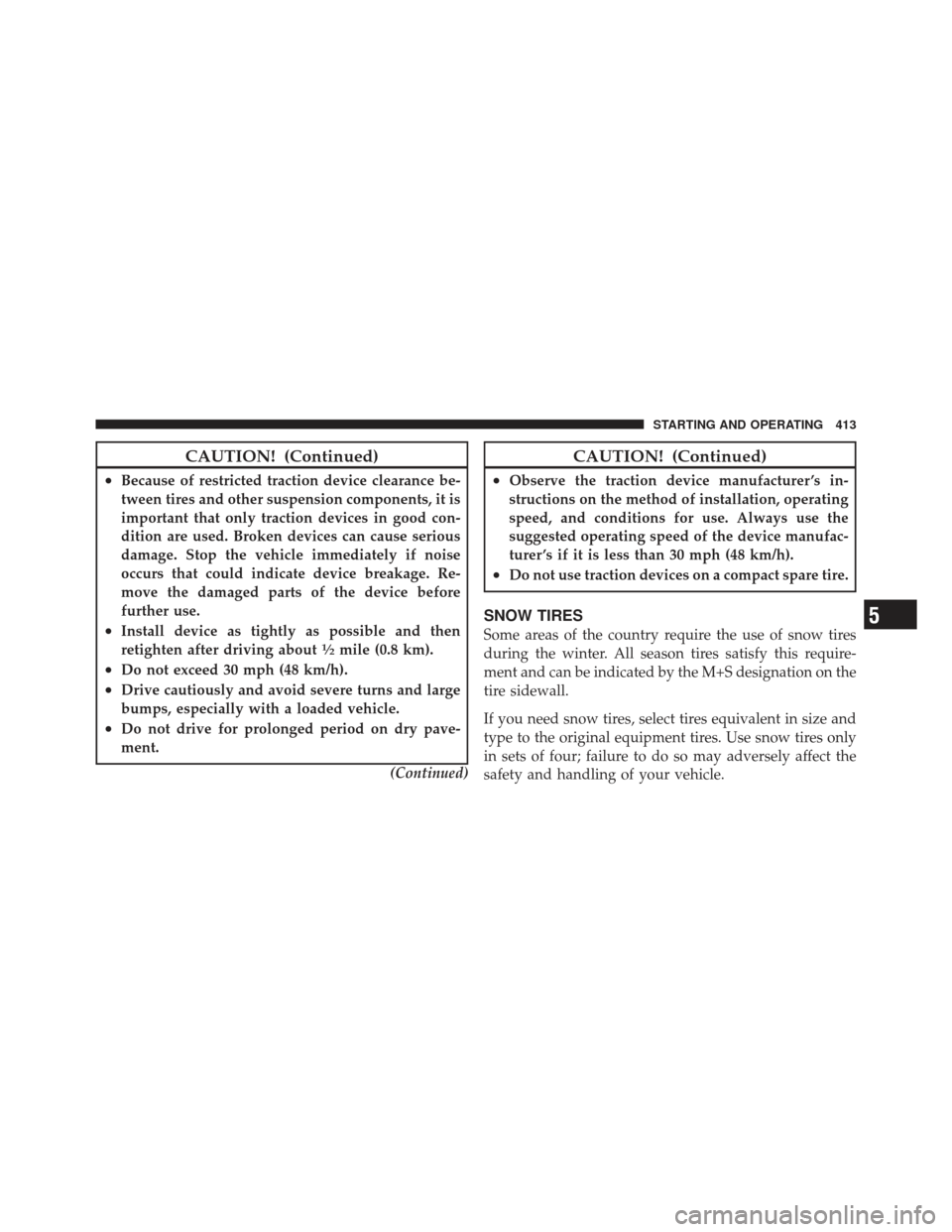
CAUTION! (Continued)
•Because of restricted traction device clearance be-
tween tires and other suspension components, it is
important that only traction devices in good con-
dition are used. Broken devices can cause serious
damage. Stop the vehicle immediately if noise
occurs that could indicate device breakage. Re-
move the damaged parts of the device before
further use.
•Install device as tightly as possible and then
retighten after driving about12mile (0.8 km).
•Do not exceed 30 mph (48 km/h).
•Drive cautiously and avoid severe turns and large
bumps, especially with a loaded vehicle.
•Do not drive for prolonged period on dry pave-
ment.(Continued)
CAUTION! (Continued)
•Observe the traction device manufacturer ’s in-
structions on the method of installation, operating
speed, and conditions for use. Always use the
suggested operating speed of the device manufac-
turer ’s if it is less than 30 mph (48 km/h).
•Do not use traction devices on a compact spare tire.
SNOW TIRES
Some areas of the country require the use of snow tires
during the winter. All season tires satisfy this require-
ment and can be indicated by the M+S designation on the
tire sidewall.
If you need snow tires, select tires equivalent in size and
type to the original equipment tires. Use snow tires only
in sets of four; failure to do so may adversely affect the
safety and handling of your vehicle.
5
STARTING AND OPERATING 413