2011 HYUNDAI VERACRUZ fuel
[x] Cancel search: fuelPage 401 of 419
Maintenance
84
7
Never sit in a parked or stopped vehi-
cle for any extended time with the
engine running.
When the engine stalls or fails to start, excessive attempts to restart the
engine may cause damage to theemission control system.
G270303BEN
Operating precautions for catalytic converters (if equipped)
Your vehicle is equipped with a catalytic
converter emission control device.
Therefore, the following precautions
must be observed:
Use only UNLEADED FUEL for gaso- line engines.
Do not operate the vehicle when there are signs of engine malfunction, such
as misfire or a noticeable loss of per-
formance. Do not misuse or abuse the engine.
Examples of misuse are coasting withthe ignition off and descending steep
grades in gear with the ignition off.
Do not operate the engine at high idle speed for extended periods (5 minutesor more).
Do not modify or tamper with any part of the engine or emission control sys-
tem. All inspections and adjustments
must be made by an authorized
HYUNDAI dealer.
Avoid driving with a very low fuel level. If you run out of gasoline, it couldcause the engine to misfire and result
in excessive loading of the catalytic
converter.
Failure to observe these precautionscould result in damage to the catalytic
converter and to your vehicle.
Additionally, such actions could void your
warranties.
Diesel Particulate Filter (if equipped)
The Diesel Particulate Filter (DPF) sys-
tem removes the soot emitted from the
vehicle.
Unlike a disposable air filter, the DPF
system automatically burns (oxidizes)
and removes the accumulated soot
according to the driving condition. In other words, the active burning by
engine control system and high exhaust
gas temperature caused by normal/high
driving condition burns and removes the
accumulated soot.
However, if the vehicle continues to be
driven at low speed for long time, the
accumulated soot may not be automati-
cally removed because of low exhaust
gas temperature. In this particular case,the amount of soot is out of detection
limit, the soot oxidation process by
engine control system may not happen
and the malfunction indicator light may
blink. When the malfunction indicator light
blinks, it may stop blinking by driving the
vehicle at more than 60km/h (37 mph) orat more than second gear with 1500 ~
2000 engine rpm for a certain time (for
about 25 minutes). If the malfunction indicator light contin-
ues to be blinked in spite of the proce-
dure, please visit an authorized
HYUNDAI dealer and then check theDPF system.
If you continue to drive with the malfunc-
tion indicator light blinking for a long
time, the DPF system can be damaged
and fuel consumption can be worsen.
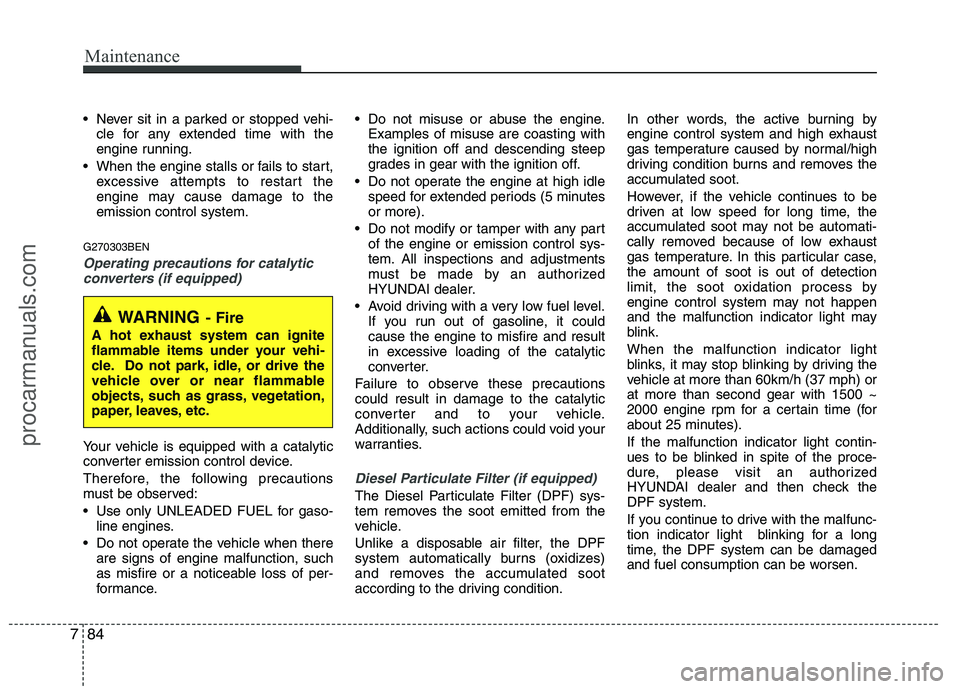
WARNING
- Fire
A hot exhaust system can ignite
flammable items under your vehi-
cle. Do not park, idle, or drive the
vehicle over or near flammable
objects, such as grass, vegetation,
paper, leaves, etc.
procarmanuals.com
Page 406 of 419
85
Specifications & Consumer information
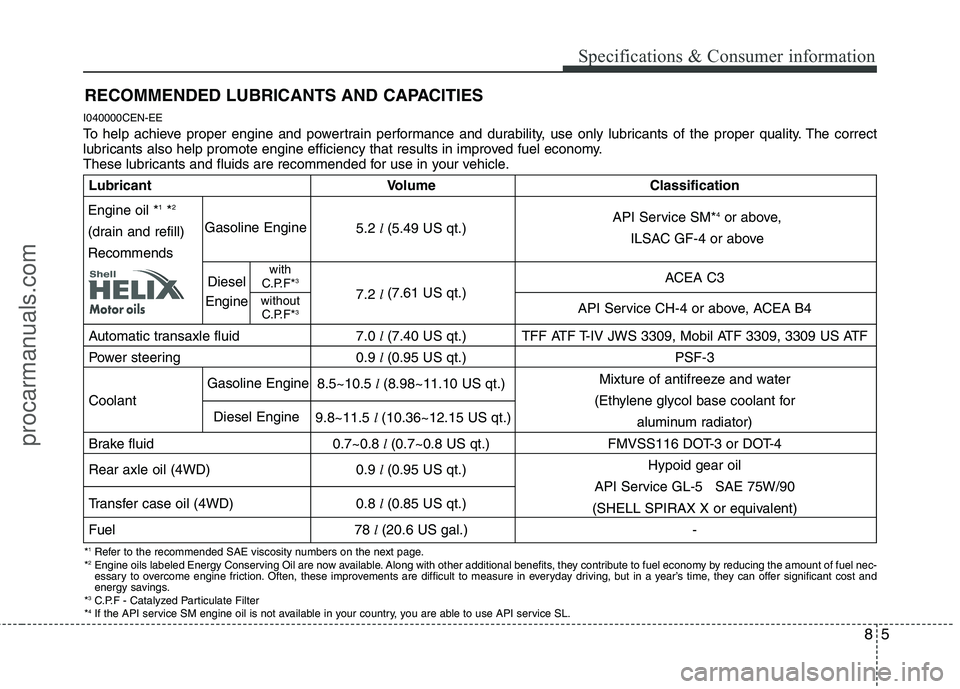
RECOMMENDED LUBRICANTS AND CAPACITIES
I040000CEN-EE
To help achieve proper engine and powertrain performance and durability, use only lubricants of the proper quality. The correct
lubricants also help promote engine efficiency that results in improved fuel economy.
These lubricants and fluids are recommended for use in your vehicle.
* 1
Refer to the recommended SAE viscosity numbers on the next page.
* 2
Engine oils labeled Energy Conserving Oil are now available. Along with other additional benefits, they contribute to fuel economy by reducing the amount of fuel nec-
essary to overcome engine friction. Often, these improvements are difficult to measure in everyday driving, but in a year’s time, they can offer significant cost and
energy savings.
* 3
C.P.F - Catalyzed Particulate Filter
* 4
If the API service SM engine oil is not available in your country, you are able to use API service SL.
Lubricant Volume Classification
5.2 l (5.49 US qt.)
ACEA C3
7.2 l (7.61 US qt.)
API Service CH-4 or above, ACEA B4
Automatic transaxle fluid 7.0 l (7.40 US qt.) TFF ATF T-IV JWS 3309, Mobil ATF 3309, 3309 US ATF
Power steering 0.9 l (0.95 US qt.) PSF-3
8.5~10.5 l (8.98~11.10 US qt.) Mixture of antifreeze and water
Coolant (Ethylene glycol base coolant for
9.8~11.5 l (10.36~12.15 US qt.)
aluminum radiator)
Brake fluid 0.7~0.8 l (0.7~0.8 US qt.) FMVSS116 DOT-3 or DOT-4
Rear axle oil (4WD) 0.9 l (0.95 US qt.) Hypoid gear oil
API Service GL-5 SAE 75W/90
Transfer case oil (4WD) 0.8 l (0.85 US qt.)
(SHELL SPIRAX X or equivalent)
Fuel 78 l (20.6 US gal.) -
Engine oil * 1
*2
(drain and refill) Recommends Gasoline Engine
Gasoline EngineDiesel
Engine with
C.P.F* 3
without C.P.F* 3
Diesel Engine API Service SM*
4
or above,
ILSAC GF-4 or above
procarmanuals.com
Page 407 of 419
Specifications & Consumer information
6
8
I040100BUN Recommended SAE viscosity
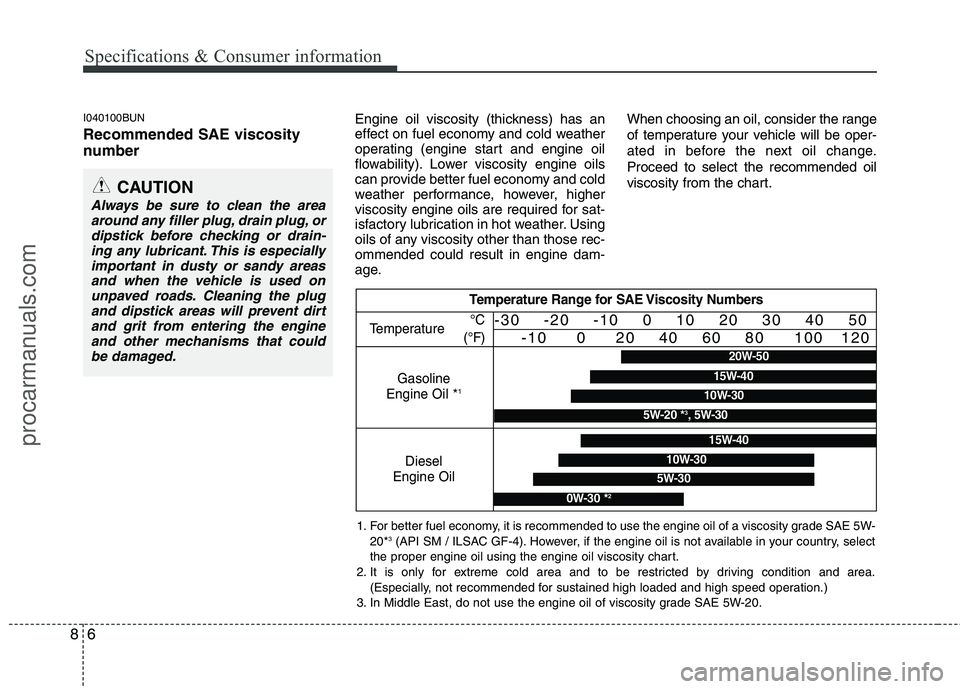
number Engine oil viscosity (thickness) has an
effect on fuel economy and cold weather
operating (engine start and engine oil
flowability). Lower viscosity engine oils
can provide better fuel economy and cold
weather performance, however, higher
viscosity engine oils are required for sat-
isfactory lubrication in hot weather. Using
oils of any viscosity other than those rec-ommended could result in engine dam-
age.When choosing an oil, consider the range
of temperature your vehicle will be oper-
ated in before the next oil change.Proceed to select the recommended oil
viscosity from the chart.
CAUTION
Always be sure to clean the area
around any filler plug, drain plug, or
dipstick before checking or drain-ing any lubricant. This is especiallyimportant in dusty or sandy areas
and when the vehicle is used on unpaved roads. Cleaning the plugand dipstick areas will prevent dirt and grit from entering the engine and other mechanisms that could
be damaged.
Temperature Range for SAE Viscosity Numbers
Temperature
Gasoline
Engine Oil * 1°C
(°F)-30 -20 -10 0 10 20 30 40 50 -10 0 20 40 60 80 100 120
Diesel
Engine Oil
5W-30
15W-40
10W-30
0W-30 * 2
1. For better fuel economy, it is recommended to use the engine oil of a viscosity grade SAE 5W-
20* 3
(API SM / ILSAC GF-4). However, if the engine oil is not available in your country, select
the proper engine oil using the engine oil viscosity chart.
2. It is only for extreme cold area and to be restricted by driving condition and area. (Especially, not recommended for sustained high loaded and high speed operation.)
3. In Middle East, do not use the engine oil of viscosity grade SAE 5W-20.
20W-50
10W-30
15W-40
5W-20 * 3
, 5W-30
procarmanuals.com
Page 413 of 419

Index
4
I
Central door lock switch ··········································4-14
Child-protector rear door lock ·································4-16
Drinks holders, see cup holders ···································4-118
Driver's air bag ·······························································3-45
Driving at night ······························································5-38
Driving in flooded areas ················································5-39
Driving in the rain ··························································5-39
Economical operation ····················································5-35
Electric chromic mirror (ECM) ·····································4-41
Electric power steering ··················································4-42
Emergency starting ··························································6-4 Jump starting ······························································6-4
Push starting ·······························································6-5
Emergency tailgate safety release ··································4-18
Emergency towing ·························································6-23
Emergency while driving ·················································6-2
Emergency commodity ··················································6-26
Emission control system ················································7-82 Crankcase emission control system ·························7-82
Evaporative emission control system ·······················7-82
Exhaust emission control system ·····························7-83
Engine compartment ················································2-4, 7-2
Engine coolant ·······························································7-31
Engine number ·································································8-8
Engine oil ·······································································7-30 Engine overheats ······························································6-6
Engine temperature gauge ·············································4-51
Engine will not start ·························································6-3
Evaporative emission control system ····························7-82
Exhaust emission control system ···································7-83Explanation of scheduled maintenance items ················7-27
Exterior care ···································································7-76
Exterior features ···························································4-123
Roof rack ································································4-123
Flat tire ···········································································6-12 Changing tires ··························································6-14
Compact spare tire ···················································6-19
Jack and tools ···························································6-12
Removing and storing the spare tire ························6-13
Floor mat anchor(s) ·····················································4-122Fluid Washer fluid ······························································7-36
Brakes fluid ·······························································7-34
Folding the rear seat ······················································3-16
Four wheel drive (4WD) ················································5-14
Front fog light bulb replacement ···································7-70Front seat adjustment - manual ········································3-4
Front seat adjustment - power ··········································3-9
Fuel filler lid ··································································4-30
Fuel filter (for diesel) ·····················································7-37
E
F
procarmanuals.com
Page 414 of 419

I5
Index
Fuel gauge ······································································4-46
Fuel requirements ····························································1-2Fuses ··············································································7-57
Fuse/relay panel description ····································7-61
Main fuse and multi fuse ·········································7-60
Memory fuse ·····························································7-59
Gauge Engine temperature gauge ·········································4-51
Fuel gauge ································································4-52
Glove box ·····································································4-114
Hazard warning flasher ··················································4-72
Hazardous driving conditions ········································5-37
Headlight bulb replacement ···········································7-68
Headlight leveling device ··············································4-77
Headrest ··································································3-5, 3-12
Heating and air conditioning ·········································4-90High mounted stop light replacement ····························7-74
Highway driving ····························································5-40Hood ···············································································4-28Horn ···············································································4-40
How to use this manual ···················································1-2 ISOFIX system ······························································3-36
Immobilizer system ·························································4-4
Indicators and warnings ·················································4-57
Indicator symbols on the instrument cluster ····················1-6
Instrument cluster ··························································4-49
Engine temperature gauge ········································4-51
Fuel gauge ································································4-52
Instrument panel illumination ··································4-50Odometer ··································································4-53Speedometer ·····························································4-50
Tachometer ·······························································4-51
Trip computer ···························································4-54
Warning and indicators ············································4-57
Instrument panel illumination ········································4-50
Instrument panel overview ···············································2-3
Interior care ····································································7-81
Interior features ····························································4-117 Ashtray ···································································4-117
Cigarette lighter ······················································4-117
Cup holder ······························································4-118
Digital clock ···························································4-120
Aux, USB and iPod ················································4-127
Floor mat anchor(s) ················································4-122
Luggage net (holder) ··············································4-123
Power outlet ···························································4-119
Sunvisor ··································································4-119
G
H
I
procarmanuals.com