2011 HYUNDAI VERACRUZ stop start
[x] Cancel search: stop startPage 322 of 419
75
Maintenance
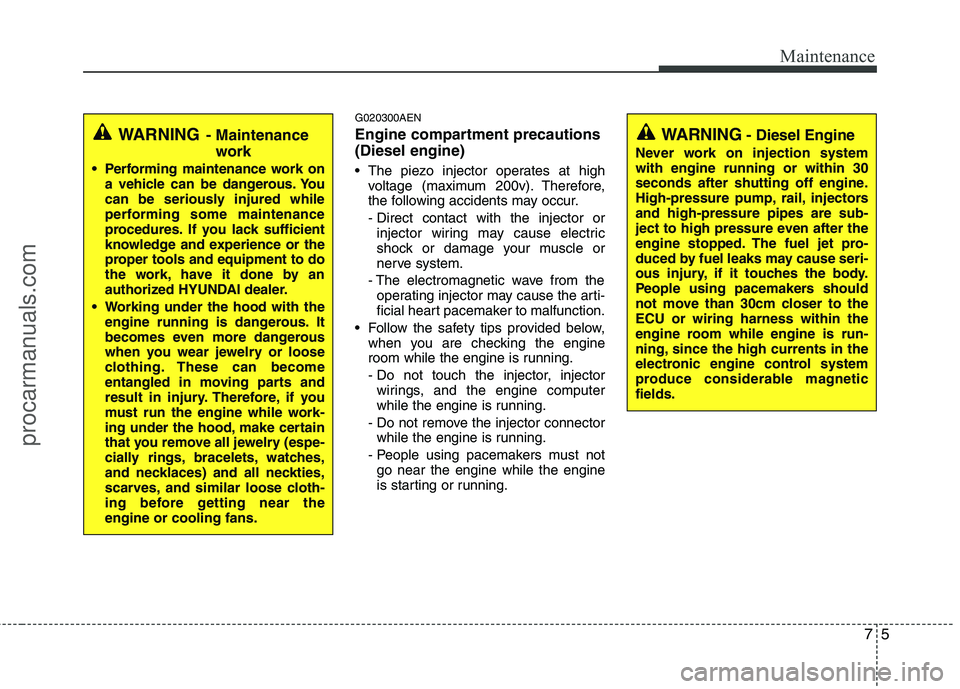
G020300AEN
Engine compartment precautions (Diesel engine)
The piezo injector operates at highvoltage (maximum 200v). Therefore,
the following accidents may occur.
- Direct contact with the injector orinjector wiring may cause electric
shock or damage your muscle or
nerve system.
- The electromagnetic wave from the operating injector may cause the arti-
ficial heart pacemaker to malfunction.
Follow the safety tips provided below, when you are checking the engine
room while the engine is running.
- Do not touch the injector, injectorwirings, and the engine computer
while the engine is running.
- Do not remove the injector connector while the engine is running.
- People using pacemakers must not go near the engine while the engine
is starting or running.
WARNING - Maintenance
work
Performing maintenance work on a vehicle can be dangerous. You
can be seriously injured while
performing some maintenance
procedures. If you lack sufficient
knowledge and experience or the
proper tools and equipment to do
the work, have it done by an
authorized HYUNDAI dealer.
Working under the hood with the engine running is dangerous. It
becomes even more dangerous
when you wear jewelry or loose
clothing. These can become
entangled in moving parts and
result in injury. Therefore, if you
must run the engine while work-
ing under the hood, make certain
that you remove all jewelry (espe-
cially rings, bracelets, watches,
and necklaces) and all neckties,
scarves, and similar loose cloth-
ing before getting near theengine or cooling fans.WARNING - Diesel Engine
Never work on injection system with engine running or within 30
seconds after shutting off engine.
High-pressure pump, rail, injectorsand high-pressure pipes are sub-
ject to high pressure even after the
engine stopped. The fuel jet pro-
duced by fuel leaks may cause seri-
ous injury, if it touches the body.
People using pacemakers should
not move than 30cm closer to theECU or wiring harness within the
engine room while engine is run-
ning, since the high currents in the
electronic engine control system
produce considerable magneticfields.
procarmanuals.com
Page 344 of 419
727
Maintenance
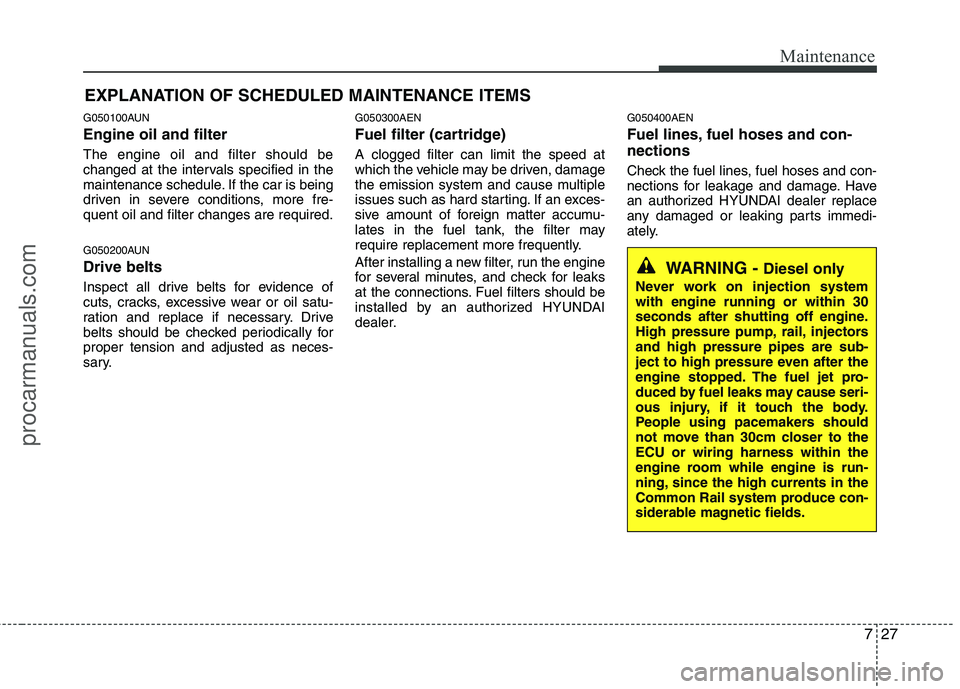
EXPLANATION OF SCHEDULED MAINTENANCE ITEMS
G050100AUN Engine oil and filter The engine oil and filter should be
changed at the intervals specified in the
maintenance schedule. If the car is being
driven in severe conditions, more fre-quent oil and filter changes are required.
G050200AUN Drive belts
Inspect all drive belts for evidence of
cuts, cracks, excessive wear or oil satu-
ration and replace if necessary. Drive
belts should be checked periodically forproper tension and adjusted as neces-
sary. G050300AEN
Fuel filter (cartridge) A clogged filter can limit the speed at
which the vehicle may be driven, damage
the emission system and cause multiple
issues such as hard starting. If an exces-
sive amount of foreign matter accumu-
lates in the fuel tank, the filter may
require replacement more frequently.
After installing a new filter, run the engine
for several minutes, and check for leaks
at the connections. Fuel filters should be
installed by an authorized HYUNDAI
dealer.
G050400AEN
Fuel lines, fuel hoses and con- nections
Check the fuel lines, fuel hoses and con-
nections for leakage and damage. Have
an authorized HYUNDAI dealer replace
any damaged or leaking parts immedi-
ately.
WARNING -
Diesel only
Never work on injection system with engine running or within 30
seconds after shutting off engine.
High pressure pump, rail, injectorsand high pressure pipes are sub-
ject to high pressure even after the
engine stopped. The fuel jet pro-
duced by fuel leaks may cause seri-
ous injury, if it touch the body.
People using pacemakers should
not move than 30cm closer to theECU or wiring harness within the
engine room while engine is run-
ning, since the high currents in the
Common Rail system produce con-
siderable magnetic fields.
procarmanuals.com
Page 381 of 419

Maintenance
64
7
Engine compartment main fuse panel
Description Fuse rating Protected component
IGN 1 40A Ignition switch(ACC, IG1)
IGN 2 40A Start relay, Ignition switch(IG2, START)
I/P B+1 50A Fuse(DR LOCK 20A, STOP LP 15A, TAIL LH/RH 10A)
I/P B+2 50A Fuse(P/SEAT 30A, KEY SOL 10A, SUNROOF 15A, RSE/SMART KEY 10A, DEICER 15A), Memory fuse (AUDIO1 15A, ROOM LP 15A)
P/WDW 40A Fuse(P/WDW LH/RH 25A)
BLOWER 40A Blower relay
RR HTD 40A Rear defogger relay, Fuse(MIRR HTD 10A)
ECU 30A Engine control relay (ECU DSL 20A/IGN COIL 20A, ECU2 10A, SNSR1 15A, SNSR2 15A, SNSR3 15A)
ABS 1 40A ABS/ESP control module, Multipurpose check connector
ABS 2 40A ABS/ESP control module, Multipurpose check connector
TCU 1 15A TCM
TPMS 10A Semi active engine mounting solenoid
B/ALARM 10A Burglar alarm horn relay
F/PUMP 20A Fuel pump relay T/SIG 15A BCM
A/CON 10A A/C relay
ECU 1 10A ECM(GSL)
IGN COIL (GSL) 20A Ignition coil #1~#6, Condenser
SNSR 1 (GSL) 15A ECM(GSL), Mass air flow sensor, Oil control valve, Immobilizer module, PCSV, VIV
SNSR 2 (GSL) 15A Fuel pump relay, Oxygen sensor #1~#4
SNSR 3 (GSL) 10A Injector #1~#6, Condenser/Radiator fan relay, A/C relay
ECU 2 (GSL) 10A ECM(GSL)
ECU DSL 20A ECM(DSL), PTC heater relay #1(DSL)
procarmanuals.com
Page 401 of 419
Maintenance
84
7
Never sit in a parked or stopped vehi-
cle for any extended time with the
engine running.
When the engine stalls or fails to start, excessive attempts to restart the
engine may cause damage to theemission control system.
G270303BEN
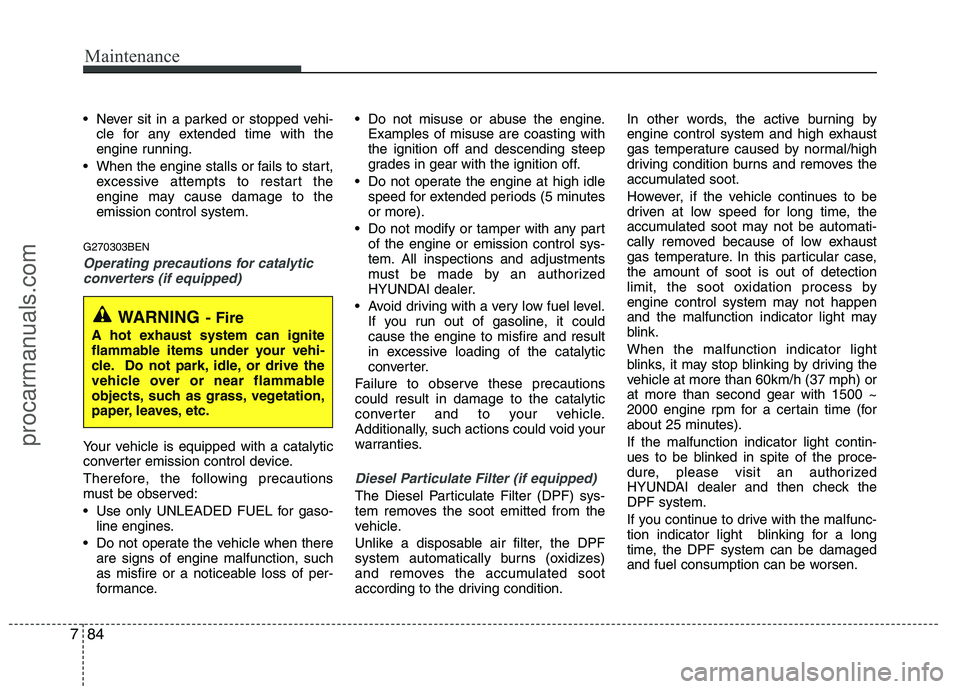
Operating precautions for catalytic converters (if equipped)
Your vehicle is equipped with a catalytic
converter emission control device.
Therefore, the following precautions
must be observed:
Use only UNLEADED FUEL for gaso- line engines.
Do not operate the vehicle when there are signs of engine malfunction, such
as misfire or a noticeable loss of per-
formance. Do not misuse or abuse the engine.
Examples of misuse are coasting withthe ignition off and descending steep
grades in gear with the ignition off.
Do not operate the engine at high idle speed for extended periods (5 minutesor more).
Do not modify or tamper with any part of the engine or emission control sys-
tem. All inspections and adjustments
must be made by an authorized
HYUNDAI dealer.
Avoid driving with a very low fuel level. If you run out of gasoline, it couldcause the engine to misfire and result
in excessive loading of the catalytic
converter.
Failure to observe these precautionscould result in damage to the catalytic
converter and to your vehicle.
Additionally, such actions could void your
warranties.
Diesel Particulate Filter (if equipped)
The Diesel Particulate Filter (DPF) sys-
tem removes the soot emitted from the
vehicle.
Unlike a disposable air filter, the DPF
system automatically burns (oxidizes)
and removes the accumulated soot
according to the driving condition. In other words, the active burning by
engine control system and high exhaust
gas temperature caused by normal/high
driving condition burns and removes the
accumulated soot.
However, if the vehicle continues to be
driven at low speed for long time, the
accumulated soot may not be automati-
cally removed because of low exhaust
gas temperature. In this particular case,the amount of soot is out of detection
limit, the soot oxidation process by
engine control system may not happen
and the malfunction indicator light may
blink. When the malfunction indicator light
blinks, it may stop blinking by driving the
vehicle at more than 60km/h (37 mph) orat more than second gear with 1500 ~
2000 engine rpm for a certain time (for
about 25 minutes). If the malfunction indicator light contin-
ues to be blinked in spite of the proce-
dure, please visit an authorized
HYUNDAI dealer and then check theDPF system.
If you continue to drive with the malfunc-
tion indicator light blinking for a long
time, the DPF system can be damaged
and fuel consumption can be worsen.
WARNING
- Fire
A hot exhaust system can ignite
flammable items under your vehi-
cle. Do not park, idle, or drive the
vehicle over or near flammable
objects, such as grass, vegetation,
paper, leaves, etc.
procarmanuals.com
Page 415 of 419
Index
6
I
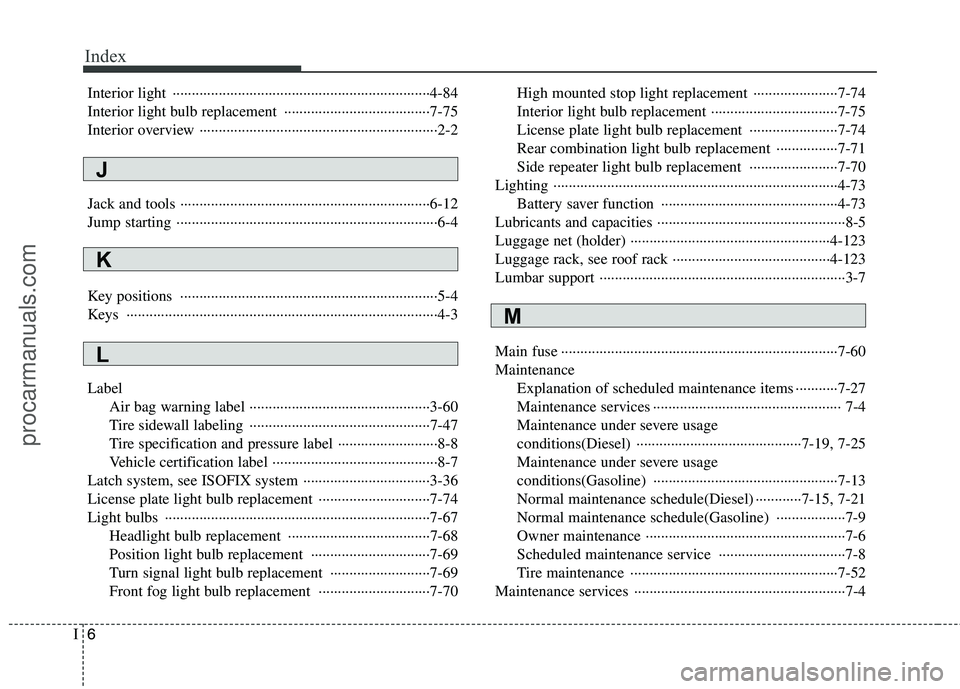
Interior light ···································································4-84
Interior light bulb replacement ······································7-75
Interior overview ······························································2-2
Jack and tools ·································································6-12
Jump starting ····································································6-4
Key positions ···································································5-4
Keys ·················································································4-3 Label
Air bag warning label ···············································3-60
Tire sidewall labeling ···············································7-47
Tire specification and pressure label ··························8-8
Vehicle certification label ···········································8-7
Latch system, see ISOFIX system ·································3-36
License plate light bulb replacement ·····························7-74
Light bulbs ·····································································7-67 Headlight bulb replacement ·····································7-68
Position light bulb replacement ·······························7-69
Turn signal light bulb replacement ··························7-69
Front fog light bulb replacement ·····························7-70 High mounted stop light replacement ······················7-74
Interior light bulb replacement ·································7-75
License plate light bulb replacement ·······················7-74
Rear combination light bulb replacement ················7-71
Side repeater light bulb replacement ·······················7-70
Lighting ··········································································4-73 Battery saver function ··············································4-73
Lubricants and capacities ·················································8-5Luggage net (holder) ····················································4-123
Luggage rack, see roof rack ·········································4-123
Lumbar support ································································3-7
Main fuse ········································································7-60 Maintenance Explanation of scheduled maintenance items ···········7-27Maintenance services ················································· 7-4
Maintenance under severe usage
conditions(Diesel) ···········································7-19, 7-25
Maintenance under severe usage conditions(Gasoline) ················································7-13 Normal maintenance schedule(Diesel) ············7-15, 7-21
Normal maintenance schedule(Gasoline) ··················7-9
Owner maintenance ····················································7-6
Scheduled maintenance service ·································7-8
Tire maintenance ······················································7-52
Maintenance services ·······················································7-4
L
M
K
J
procarmanuals.com