2011 HYUNDAI VERACRUZ fuel filter
[x] Cancel search: fuel filterPage 339 of 419
Maintenance
22
7
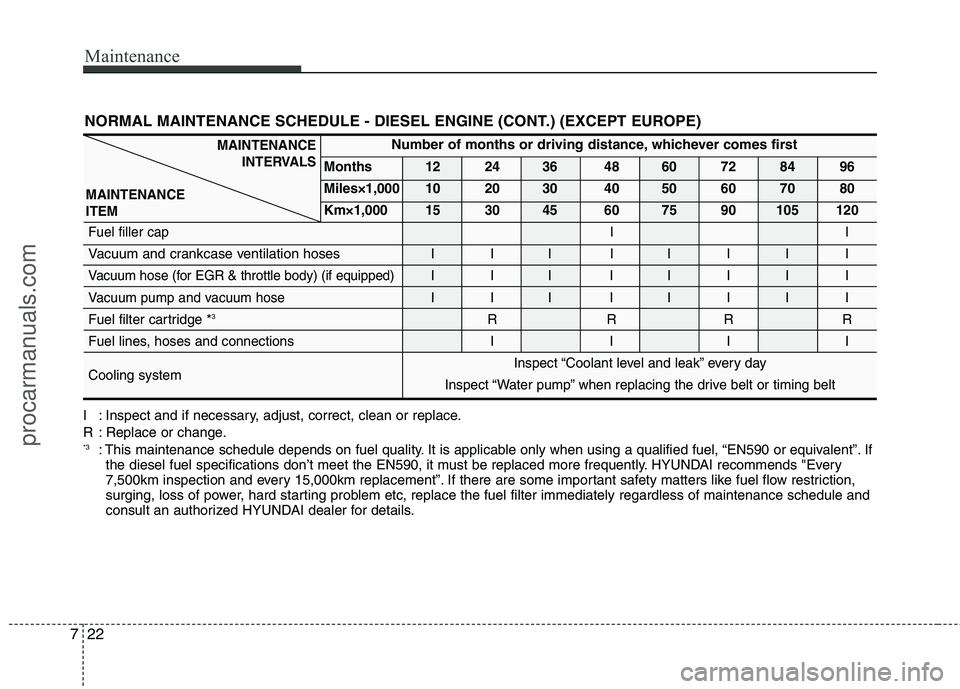
NORMAL MAINTENANCE SCHEDULE - DIESEL ENGINE (CONT.) (EXCEPT EUROPE)
MAINTENANCE
INTERVALS
MAINTENANCE ITEMNumber of months or driving distance, whichever comes first
Months 12 24 36 48 60 72 84 96
Miles×1,000 10 20 30 40 50 60 70 80
Km×1,000 15 30 45 60 75 90 105 120
Fuel filler cap II
Vacuum and crankcase ventilation hosesIIIIIIII
Vacuum hose (for EGR & throttle body) (if equipped)
III IIIII
Vacuum pump and vacuum hoseIII IIIII
Fuel filter cartridge * 3
RRRR
Fuel lines, hoses and connections I I I I Cooling system
Inspect “Coolant level and leak” every day
Inspect “Water pump” when replacing the drive belt or timing belt
I : Inspect and if necessary, adjust, correct, clean or replace.
R : Replace or change. *3 : This maintenance schedule depends on fuel quality. It is applicable only when using a qualified fuel, “EN590 or equivalent”. If
the diesel fuel specifications don’t meet the EN590, it must be replaced more frequently. HYUNDAI recommends "Every
7,500km inspection and every 15,000km replacement”. If there are some important safety matters like fuel flow restriction,
surging, loss of power, hard starting problem etc, replace the fuel filter immediately regardless of maintenance schedule and
consult an authorized HYUNDAI dealer for details.
procarmanuals.com
Page 344 of 419
727
Maintenance
EXPLANATION OF SCHEDULED MAINTENANCE ITEMS
G050100AUN Engine oil and filter The engine oil and filter should be
changed at the intervals specified in the
maintenance schedule. If the car is being
driven in severe conditions, more fre-quent oil and filter changes are required.
G050200AUN Drive belts
Inspect all drive belts for evidence of
cuts, cracks, excessive wear or oil satu-
ration and replace if necessary. Drive
belts should be checked periodically forproper tension and adjusted as neces-
sary. G050300AEN
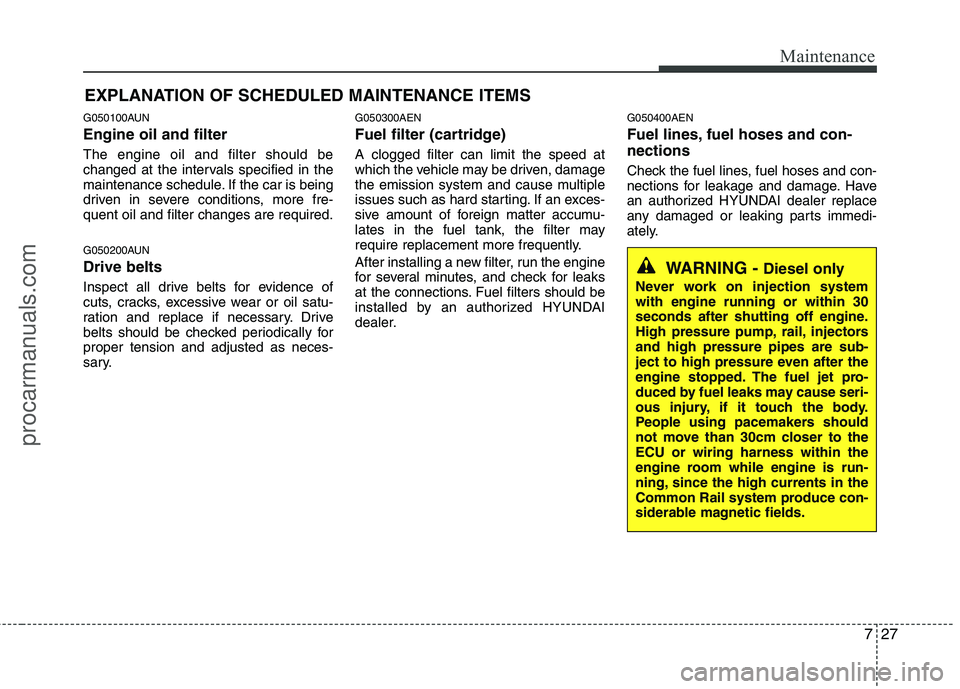
Fuel filter (cartridge) A clogged filter can limit the speed at
which the vehicle may be driven, damage
the emission system and cause multiple
issues such as hard starting. If an exces-
sive amount of foreign matter accumu-
lates in the fuel tank, the filter may
require replacement more frequently.
After installing a new filter, run the engine
for several minutes, and check for leaks
at the connections. Fuel filters should be
installed by an authorized HYUNDAI
dealer.
G050400AEN
Fuel lines, fuel hoses and con- nections
Check the fuel lines, fuel hoses and con-
nections for leakage and damage. Have
an authorized HYUNDAI dealer replace
any damaged or leaking parts immedi-
ately.
WARNING -
Diesel only
Never work on injection system with engine running or within 30
seconds after shutting off engine.
High pressure pump, rail, injectorsand high pressure pipes are sub-
ject to high pressure even after the
engine stopped. The fuel jet pro-
duced by fuel leaks may cause seri-
ous injury, if it touch the body.
People using pacemakers should
not move than 30cm closer to theECU or wiring harness within the
engine room while engine is run-
ning, since the high currents in the
Common Rail system produce con-
siderable magnetic fields.
procarmanuals.com
Page 345 of 419

Maintenance
28
7
G050600AUN
Vapor hose and fuel filler cap
The vapor hose and fuel filler cap should
be inspected at those intervals specified
in the maintenance schedule. Make sure
that a new vapor hose or fuel filler cap iscorrectly replaced.
G050700AUN
Vacuum crankcase ventilation hoses (if equipped)
Inspect the surface of hoses for evidence
of heat and/or mechanical damage. Hard
and brittle rubber, cracking, tears, cuts,
abrasions, and excessive swelling indi-
cate deterioration. Particular attention
should be paid to examine those hose
surfaces nearest to high heat sources,
such as the exhaust manifold. Inspect the hose routing to assure that the hoses do not come in contact with
any heat source, sharp edges or movingcomponent which might cause heat dam-
age or mechanical wear. Inspect all hose
connections, such as clamps and cou-
plings, to make sure they are secure, and
that no leaks are present. Hoses should
be replaced immediately if there is any
evidence of deterioration or damage. G050800AEN
Air cleaner filter
A Genuine HYUNDAI air cleaner filter is recommended when the filter isreplaced.
G050900AUN
Spark plugs (for gasoline engine)
Make sure to install new spark plugs of
the correct heat range. G051000AEN
Valve clearance (if equipped)
Inspect excessive valve noise and/or
engine vibration and adjust if necessary.
An authorized HYUNDAI dealer should
perform the operation.
G051100AUN Cooling system
Check cooling system components, such
as radiator, coolant reservoir, hoses and
connections for leakage and damage.
Replace any damaged parts.
G051200AUN Coolant The coolant should be changed at the
intervals specified in the maintenance
schedule.
G051500AUN Brake hoses and lines
Visually check for proper installation,
chafing, cracks, deterioration and any
leakage. Replace any deteriorated or
damaged parts immediately.
G051600AUN Brake fluid
Check brake fluid level in the brake fluid
reservoir. The level should be between
“MIN” and “MAX” marks on the side of
the reservoir. Use only hydraulic brake
fluid conforming to DOT 3 or DOT 4specification.
procarmanuals.com
Page 354 of 419
737
Maintenance
FUEL FILTER (FOR DIESEL)
G150100AEN
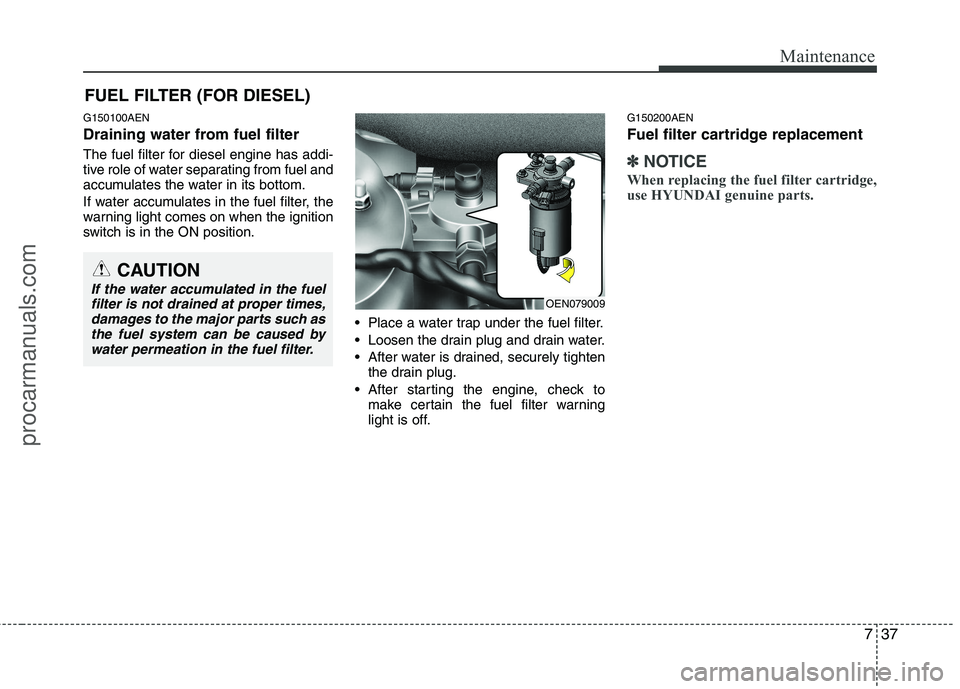
Draining water from fuel filter
The fuel filter for diesel engine has addi-
tive role of water separating from fuel and
accumulates the water in its bottom.
If water accumulates in the fuel filter, the
warning light comes on when the ignition
switch is in the ON position.
Place a water trap under the fuel filter.
Loosen the drain plug and drain water.
After water is drained, securely tightenthe drain plug.
After starting the engine, check to make certain the fuel filter warning
light is off. G150200AEN
Fuel filter cartridge replacement
✽✽
NOTICE
When replacing the fuel filter cartridge,
use HYUNDAI genuine parts.
CAUTION
If the water accumulated in the fuel filter is not drained at proper times,damages to the major parts such as
the fuel system can be caused bywater permeation in the fuel filter.OEN079009
procarmanuals.com
Page 382 of 419

765
Maintenance
Description Fuse ratingProtected component
SNSR 1 (DSL) 15A Fuel metering unit, EGR actuator, Immobilizer module, EVGT actuator
SNSR 2 (DSL) 15A Fuel pump relay, Rail pressure control valve
SNSR 3 (DSL) 10A Condenser/Radiator fan relay, A/C relay, Lambda sensor
ECU 2 (DSL) 10A Stop lamp switch(DSL)
H/LP LO RH 15A Head lamp(Low) relay RH
H/LP LO LH 15A Head lamp(Low) relay LH
H/LP HI 20A Head lamp(High) relay
FR FOG 15A Front fog lamp relay HORN 15A Horn relay
ABS 10A ABS/ESP control module, ESP switch
DIAG 10A Multipurpose check connector
ECU 3 10A ECM
TCU 2/ GLOW 10A TCM, Stop lamp switch(GSL), Glow control module(DSL), Fuel filter warning sensor(DSL), Air flow sensor(DSL)
SHUNT CONN - Shunt connector
procarmanuals.com
Page 383 of 419

Maintenance
66
7
Engine compartment sub fuse panel (Gasoline engine)
Description Fuse rating Protected component
I/P BOX B+3 40A Fuse( RR FOG 15A, FUEL LID 15A, FR WIPER 30A, TILT & TELE 15A)
C/FAN 40A Condenser fan relay #1
R/FAN 40A Radiator fan relay
P T/GATE 30A Power tail gate control module
RR BLOWER 20A Rear A/C relay AMP 30A JBL amp
P/OUTLET 30A Console & rear power outlet relay
Engine compartment sub fuse panel (Diesel engine)
Description Fuse rating Protected component
GLOW 80A Glow control module
PTC HTR 1 50A PTC heater relay #1
PTC HTR 2 50A PTC heater relay #2
PTC HTR 3 50A PTC heater relay #3
F/FILTER 30A Fuel filter heater relay
I/P BOX B+3 40A Fuse( RR FOG 15A, FUEL LID 15A, FR WIPER 30A, TILT & TELE 15A)
C/FAN 40A Condenser fan relay #1
R/FAN 40A Radiator fan relay
P T/GATE 30A Power tail gate control module
RR BLOWER 20A Rear A/C relay AMP 30A JBL amp
P/OUTLET 30A Console & rear power outlet relay
AC INVERTER 30A -
procarmanuals.com
Page 399 of 419
Maintenance
82
7
EMISSION CONTROL SYSTEM (IF EQUIPPED)
G270000AEN
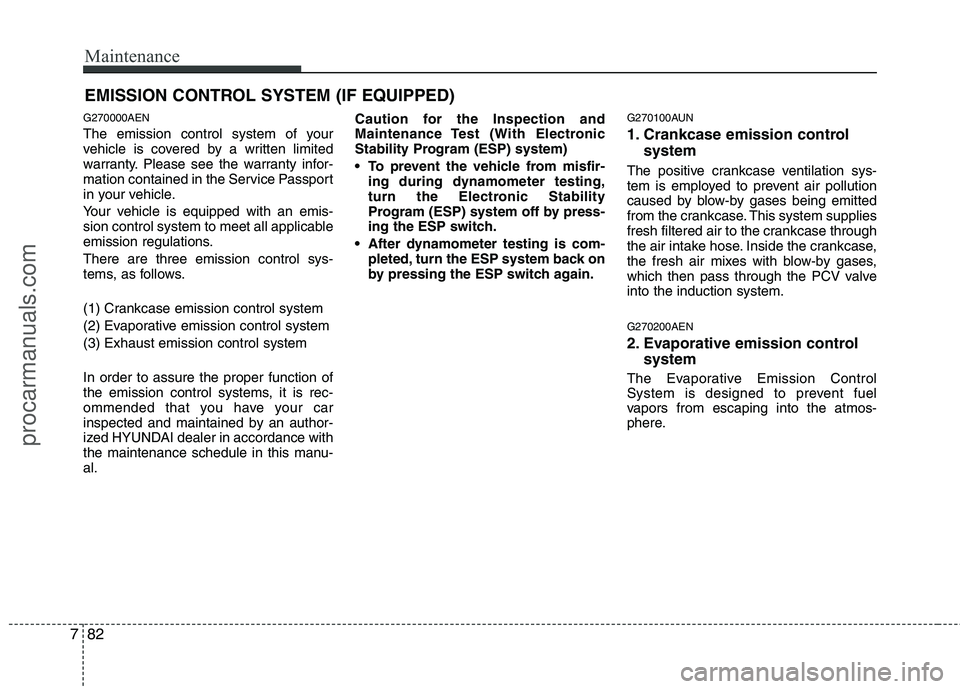
The emission control system of your
vehicle is covered by a written limited
warranty. Please see the warranty infor-
mation contained in the Service Passport
in your vehicle.
Your vehicle is equipped with an emis-
sion control system to meet all applicable
emission regulations. There are three emission control sys-
tems, as follows.
(1) Crankcase emission control system
(2) Evaporative emission control system(3) Exhaust emission control system In order to assure the proper function of
the emission control systems, it is rec-
ommended that you have your car
inspected and maintained by an author-
ized HYUNDAI dealer in accordance with
the maintenance schedule in this manu-al. Caution for the Inspection and
Maintenance Test (With Electronic
Stability Program (ESP) system)
To prevent the vehicle from misfir-
ing during dynamometer testing,
turn the Electronic Stability
Program (ESP) system off by press-
ing the ESP switch.
After dynamometer testing is com- pleted, turn the ESP system back on
by pressing the ESP switch again. G270100AUN
1. Crankcase emission control
system
The positive crankcase ventilation sys-
tem is employed to prevent air pollution
caused by blow-by gases being emitted
from the crankcase. This system supplies
fresh filtered air to the crankcase through
the air intake hose. Inside the crankcase,
the fresh air mixes with blow-by gases,
which then pass through the PCV valveinto the induction system. G270200AEN
2. Evaporative emission control system
The Evaporative Emission Control
System is designed to prevent fuel
vapors from escaping into the atmos-
phere.
procarmanuals.com
Page 401 of 419
Maintenance
84
7
Never sit in a parked or stopped vehi-
cle for any extended time with the
engine running.
When the engine stalls or fails to start, excessive attempts to restart the
engine may cause damage to theemission control system.
G270303BEN
Operating precautions for catalytic converters (if equipped)
Your vehicle is equipped with a catalytic
converter emission control device.
Therefore, the following precautions
must be observed:
Use only UNLEADED FUEL for gaso- line engines.
Do not operate the vehicle when there are signs of engine malfunction, such
as misfire or a noticeable loss of per-
formance. Do not misuse or abuse the engine.
Examples of misuse are coasting withthe ignition off and descending steep
grades in gear with the ignition off.
Do not operate the engine at high idle speed for extended periods (5 minutesor more).
Do not modify or tamper with any part of the engine or emission control sys-
tem. All inspections and adjustments
must be made by an authorized
HYUNDAI dealer.
Avoid driving with a very low fuel level. If you run out of gasoline, it couldcause the engine to misfire and result
in excessive loading of the catalytic
converter.
Failure to observe these precautionscould result in damage to the catalytic
converter and to your vehicle.
Additionally, such actions could void your
warranties.
Diesel Particulate Filter (if equipped)
The Diesel Particulate Filter (DPF) sys-
tem removes the soot emitted from the
vehicle.
Unlike a disposable air filter, the DPF
system automatically burns (oxidizes)
and removes the accumulated soot
according to the driving condition. In other words, the active burning by
engine control system and high exhaust
gas temperature caused by normal/high
driving condition burns and removes the
accumulated soot.
However, if the vehicle continues to be
driven at low speed for long time, the
accumulated soot may not be automati-
cally removed because of low exhaust
gas temperature. In this particular case,the amount of soot is out of detection
limit, the soot oxidation process by
engine control system may not happen
and the malfunction indicator light may
blink. When the malfunction indicator light
blinks, it may stop blinking by driving the
vehicle at more than 60km/h (37 mph) orat more than second gear with 1500 ~
2000 engine rpm for a certain time (for
about 25 minutes). If the malfunction indicator light contin-
ues to be blinked in spite of the proce-
dure, please visit an authorized
HYUNDAI dealer and then check theDPF system.
If you continue to drive with the malfunc-
tion indicator light blinking for a long
time, the DPF system can be damaged
and fuel consumption can be worsen.
WARNING
- Fire
A hot exhaust system can ignite
flammable items under your vehi-
cle. Do not park, idle, or drive the
vehicle over or near flammable
objects, such as grass, vegetation,
paper, leaves, etc.
procarmanuals.com