Page 330 of 427
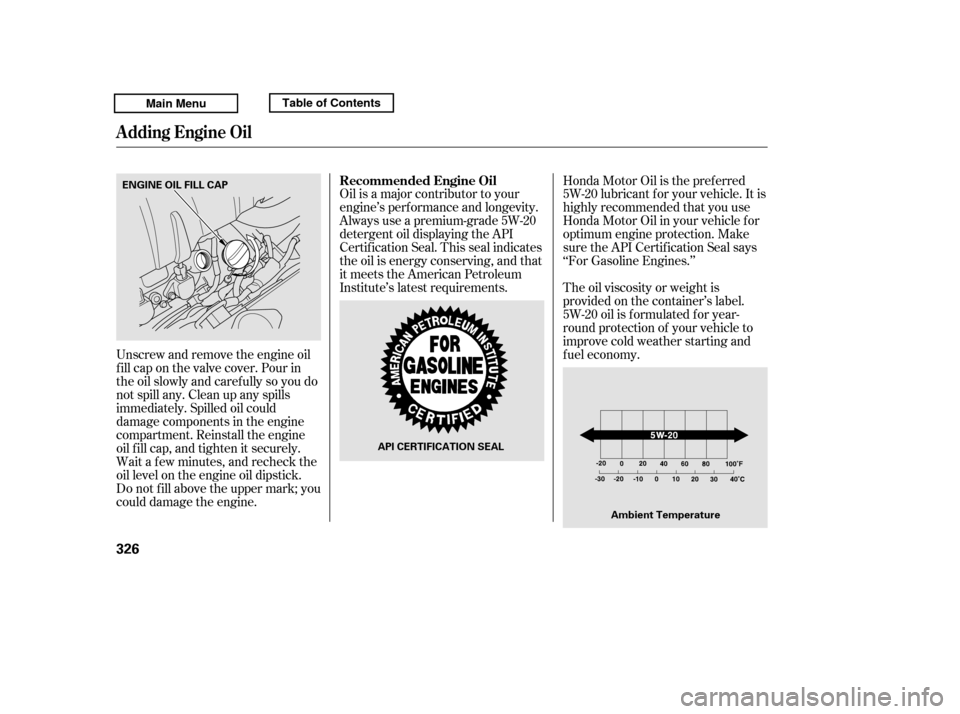
Oil is a major contributor to your
engine’s perf ormance and longevity.
Always use a premium-grade 5W-20
detergent oil displaying the API
Certif ication Seal. This seal indicates
the oil is energy conserving, and that
it meets the American Petroleum
Institute’s latest requirements.Honda Motor Oil is the pref erred
5W-20 lubricant f or your vehicle. It is
highly recommended that you use
Honda Motor Oil in your vehicle f or
optimum engine protection. Make
sure the API Certif ication Seal says
‘‘For Gasoline Engines.’’
The oil viscosity or weight is
provided on the container’s label.
5W-20 oil is f ormulated f or year-
round protection of your vehicle to
improve cold weather starting and
f uel economy.
Unscrew and remove the engine oil
fill cap on the valve cover. Pour in
the oil slowly and caref ully so you do
not spill any. Clean up any spills
immediately. Spilled oil could
damage components in the engine
compartment. Reinstall the engine
oil f ill cap, and tighten it securely.
Wait a f ew minutes, and recheck the
oil level on the engine oil dipstick.
Do not f ill above the upper mark; you
could damage the engine. Recommended Engine Oil
A dding Engine Oil
326
API CERTIFICATION SEAL
Ambient Temperature
ENGINE OIL FILL CAP
Main MenuTable of Contents
Page 331 of 427

Open the hood, and remove the
engine oil f ill cap. Remove the oil
drain bolt and washer f rom the
bottom of the engine. Drain the oil
into an appropriate container.
You may use a synthetic motor oil if
it meets the same requirements
given f or a conventional motor oil: it
displays the API Certif ication Seal,
and it is the proper weight. You must
f ollow the oil and f ilter change
intervals shown on the odometer/
trip meter display or on the multi-
inf ormation display.
Your vehicle does not require any oil
additives. Additives may adversely
af f ect the engine or transmission
perf ormance and durability.
Always change the oil and f ilter
according to the maintenance
messages shown on the inf ormation
display or multi-inf ormation display
(depending on models). The oil and
f ilter collect contaminants that can
damage your engine if they are not
removed regularly.
Changing the oil and f ilter requires
special tools and access f rom
underneath the vehicle. The vehicle
should be raised on a service station-
type hydraulic lif t f or this service.
Unless you have the knowledge and
proper equipment, you should have
this maintenance done by a skilled
mechanic.
Run the engine until it reaches
normal operating temperature,
then shut it off.
1. 2.
CONT INUED
Synthetic Oil Changing the Engine Oil and
Filter
Engine Oil A dditives
A dding Engine Oil, Changing the Engine Oil and Filter
Maint enance
327
WASHER DRAIN BOLT
Main MenuTable of Contents
Page 334 of 427

Make sure the engine and radiator
are cool.
When the radiator and engine are
cool, relieve any pressure in the
cooling system by turning the
radiator cap counterclockwise,
without pressing down.
Remove the radiator cap by
pushing down and turning
counterclockwise.The coolant level should be up to
the base of the f iller neck. Add
coolant if it is low.
Pourthecoolantslowlyand
caref ully so you do not spill any.
Clean up any spill immediately; it
could damage components in the
engine compartment.
Put the radiator cap back on, and
tighten it fully.
Pour coolant into the reserve tank.
Fill it to half way between the MAX
and MIN marks. Put the cap back
on the reserve tank.
Do not add any rust inhibitors or
other additives to your vehicle’s
cooling system. They may not be
compatible with the coolant or
engine components. Check the f luid level in the
windshield washer reservoir at least
monthly during normal use.
Fill the reservoir with a good-quality
windshield washer f luid. This
increases the cleaning capability and
prevents f reezing in cold weather.
The washer level indicator will come
on when the level is low (see page
).
If the washer f luid is low, a
‘‘WASHER FLUID LOW’’ message
appears on the multi-inf ormation
display.
When you ref ill the reservoir, clean
the edges of the windshield wiper
blades with windshield washer f luid
on a clean cloth. This will help to
condition them.
3. 4. 5.
1. 2. 67
On models without navigation system
On models with navigation system
Windshield Washers
Engine Coolant, Windshield Washers
330
RADIATOR CAP
Main MenuTable of Contents
Page 335 of 427
CONT INUED
Check the f luid level with the engine
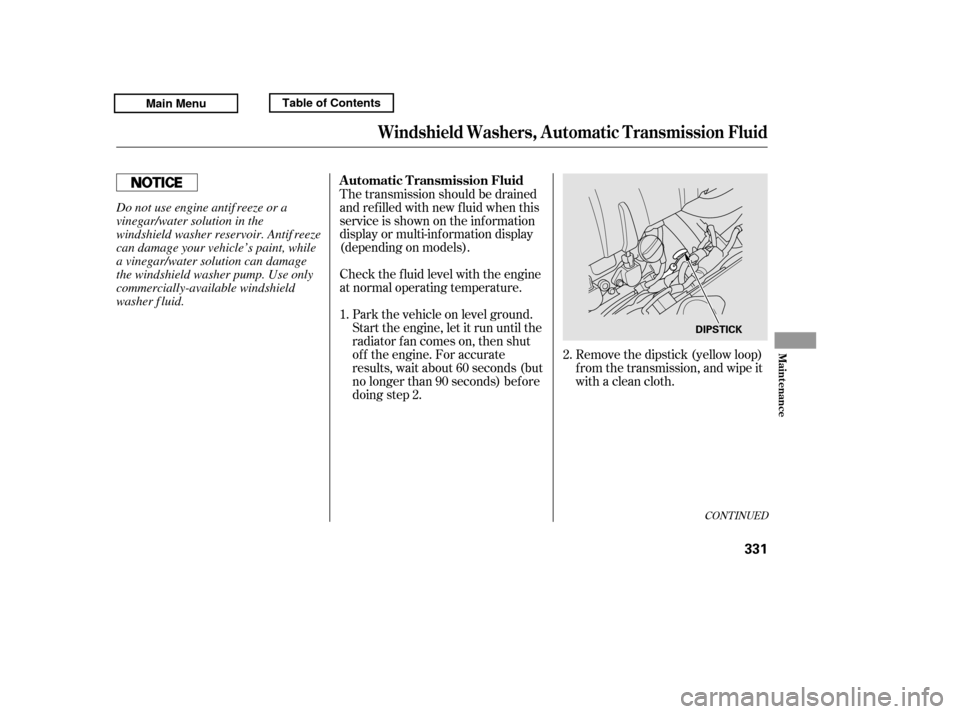
at normal operating temperature.Park the vehicle on level ground.
Start the engine, let it run until the
radiator f an comes on, then shut
of f the engine. For accurate
results, wait about 60 seconds (but
no longer than 90 seconds) bef ore
doing step 2. Remove the dipstick (yellow loop)
f rom the transmission, and wipe it
with a clean cloth.
The transmission should be drained
and ref illed with new f luid when this
service is shown on the inf ormation
display or multi-inf ormation display
(depending on models). 1.
2.
Windshield Washers, A utomatic T ransmission Fluid
Automatic Transmission Fluid
Maint enance
331
DIPSTICK
Do not use engine antif reeze or a
vinegar/water solution in the
windshield washer reservoir. Antif reeze
can damage your vehicle’s paint, while
a vinegar/water solution can damage
the windshield washer pump. Use only
commercially-available windshield
washer f luid.
Main MenuTable of Contents
Page 337 of 427
The rear dif f erential should be
drained and ref illed with new f luid
when this service is indicated by a
maintenance message on the
inf ormation display or multi-
inf ormation display. This service
may be needed more of ten under
certain driving conditions (see page). Always use Honda VTM-4
Dif f erential Fluid, and have your
dealer replace the rear differential
f luid.
The transf er assembly should be
drained and ref illed with new f luid
when this service is indicated by a
maintenance message on the
inf ormation display or multi-
inf ormation display.
Always use Hypoid gear oil GL4 or
GL5 with a viscosity of SAE 90 or
80W-90, and have your dealer
replace the transfer assembly fluid.
324
Rear Dif f erential Fluid
Transf er Assembly Fluid
Rear Differential Fluid, Transfer Assembly Fluid
Maint enance
333
Main MenuTable of Contents
Page 338 of 427
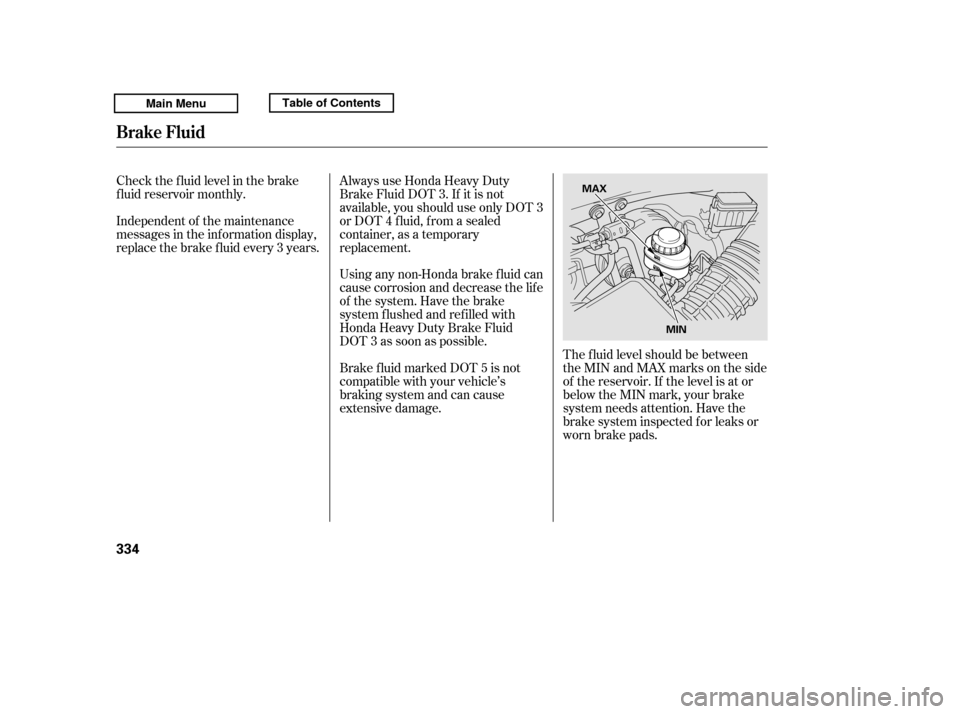
The f luid level should be between
theMINandMAXmarksontheside
of the reservoir. If the level is at or
below the MIN mark, your brake
system needs attention. Have the
brake system inspected f or leaks or
worn brake pads.
Using any non-Honda brake f luid can
cause corrosion and decrease the lif e
of the system. Have the brake
system f lushed and ref illed with
Honda Heavy Duty Brake Fluid
DOT 3 as soon as possible.
Brake f luid marked DOT 5 is not
compatible with your vehicle’s
braking system and can cause
extensive damage.
Check the f luid level in the brake
f luid reservoir monthly.
Always use Honda Heavy Duty
Brake Fluid DOT 3. If it is not
available, you should use only DOT 3
or DOT 4 f luid, f rom a sealed
container, as a temporary
replacement.
Independent of the maintenance
messages in the inf ormation display,
replace the brake f luid every 3 years.
Brake Fluid
334
MAX
MIN
Main MenuTable of Contents
Page 349 of 427

The floor mats that came with your
vehicle hook over the f loor mat
anchors. This keeps the f loor mats
f rom sliding f orward, possibly
interf ering with the pedals, or
backwards, making the f ront
passenger’s weight sensors
inef f ective.
If you remove a f loor mat, make sure
tore-anchoritwhenyouputitback
in your vehicle.A non-Honda f loor mat may not f it
your vehicle properly. This could
prevent the proper operation of the
f olding rear seats and the passenger’s
seat weight sensors. We recommend
using genuine Honda f loor mats. Do
not put additional f loor mats on top
of the anchored mats.
This f ilter removes the dust and
pollenthatisbroughtinfromthe
outside through the heating and
cooling system/climate control
system.
Have your dealer replace the filter
when this service is indicated by a
maintenance message on the
inf ormation display or multi-
inf ormation display (depending on
the models). It should be replaced
every 15,000 miles (24,000 km) if you
drive primarily in urban areas that
have high concentrations of soot in
the air, or if the flow from the
heating and cooling system/climate
control system becomes less than
usual.
Floor Mats, Dust and Pollen Filter
Floor Mats
Dust and Pollen Filter
Maint enance
345
Main MenuTable of Contents
Page 355 of 427
In addition to proper inf lation,
correct wheel alignment helps to
decrease tire wear. If you f ind a tire
is worn unevenly, have your dealer
check the wheel alignment.
Have your dealer check the tires if
you f eel a consistent vibration while
driving. A tire should always be
rebalanced if it is removed f rom the
wheel. When you have new tires
installed, make sure they are
balanced. This increases riding
comf ort and tire lif e. For best results,
have the installer perform a dynamic
balance.
The service lif e of your tires is
dependent on many f actors,
including, but not limited to, driving
habits, road conditions, vehicle
loading, inf lation pressure,
maintenance history, speed, and
environmental conditions (even
when the tires are not in use).
In addition to your regular
inspections and inf lation pressure
maintenance, it is recommended that
you have annual inspections
perf ormed once the tires reach f ive
years old. It is also recommended
that all tires, including the spare, be
removed f rom service af ter 10 years
from the date of manufacture,
regardless of their condition or state
of wear.
The last f our digits of the TIN (tire
identif ication number) are f ound on
the sidewall of the tire and indicate
the date of manufacture (See
on page ). To help increase tire lif e and
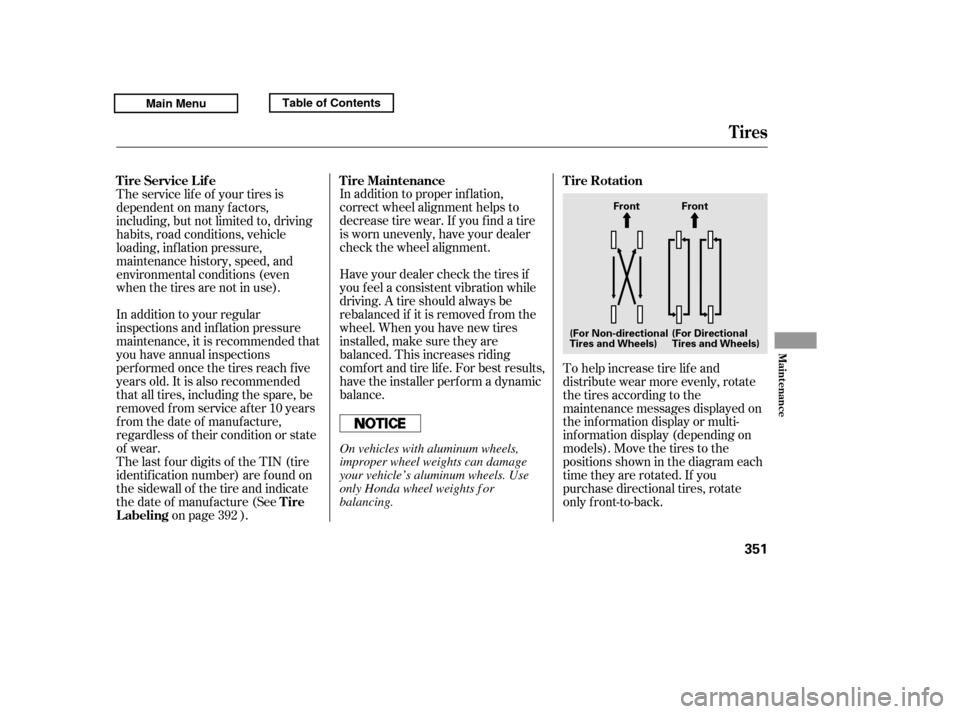
distribute wear more evenly, rotate
the tires according to the
maintenance messages displayed on
the inf ormation display or multi-
inf ormation display (depending on
models). Move the tires to the
positions shown in the diagram each
time they are rotated. If you
purchase directional tires, rotate
only f ront-to-back.
392 Tire Rotation
T ire Maintenance
Tire Service Lif e
Tire
Labeling
Tires
Maint enance
351
Front
(For Non-directional
Tires and Wheels) (For Directional
Tires and Wheels)Front
On vehicles with aluminum wheels,
improper wheel weights can damage
your vehicle’s aluminum wheels. Use
only Honda wheel weights f or
balancing.
Main MenuTable of Contents