Page 378 of 427

Saf ely pull of f the road, and shut
of f the engine. Turn on the hazard
warning indicators.
Let the vehicle sit f or a minute.
Open the hood, and check the oil
level (see page ). An engine
very low on oil can lose pressure
during cornering and other driving
maneuvers.
If necessary, add oil to bring the
level back to the full mark on the
dipstick (see page ).
Start the engine, and watch the oil
pressure indicator. If it does not go
out within 10 seconds, turn of f the
engine. There is a mechanical
problem that needs to be repaired
bef ore you can continue driving
(see on page).
This indicator should never come on
when the engine is running. If it
starts flashing or stays on, the oil
pressure has dropped very low or
lost pressure. Serious engine
damage is possible, and you should
take immediate action.
You will also see a ‘‘CHECK
ENGINE OIL LEVEL’’ message on
the multi-information display when
this indicator comes on.
If the charging system indicator
comes on brightly when the engine
is running, the battery is not being
charged.
You will also see a ‘‘CHECK
CHARGING SYSTEM’’ message on
the multi-information display (see
page ).
Immediately turn of f all electrical
accessories. Try not to use other
electrically operated controls such as
the power windows. Keep the engine
running; starting the engine will
discharge the battery rapidly.
Go to a service station or garage
where you can get technical
assistance.
1. 2. 3. 4.
253
326
383 90
On models with navigation system
On models with navigation system
Emergency T owing
L ow Oil Pressure
Indicator
Charging System
Indicator
L ow Oil Pressure Indicator, Charging System Indicator
374
Running the engine with low oil
pressure can cause serious mechanical
damage almost immediately. Turn of f
the engine as soon as you can saf ely get
the vehicle stopped.
Main MenuTable of Contents
Page 379 of 427

If this indicator comes on
while driving, it means one
of the engine’s emissions control
systems may have a problem. Even
though you may f eel no dif f erence in
your vehicle’s perf ormance, it can
reduce your f uel economy and cause
increased emissions. Continued
operation may cause serious damage.
If you have recently ref ueled your
vehicle, the indicator coming on
could be due to a loose or missing
f uel f ill cap. Tighten the cap until it
clicks at least once. Tightening the
cap will not turn the indicator of f
immediately; it can take several days
of normal driving. If the indicator comes on repeatedly,
even though it may turn of f as you
continue driving, have your vehicle
checked by the dealer as soon as
possible.
The indicator may also come on with
the ‘‘D’’ indicator.
You will also see a ‘‘CHECK FUEL
CAP’’ message on the inf ormation
display.
You will also see a ‘‘TIGHTEN FUEL
CAP’’ message on the multi-
inf ormation display.
You will also see a ‘‘CHECK
EMISSION SYSTEM’’ message on
the multi-information display (see
page ).90On models without navigation system
On models with navigation system
On models with navigation system
Malf unct ion Indicat or L amp
T aking Care of t he Unexpect ed
375
If you keep driving with the
malf unction indicator lamp on, you can
damage your vehicle’s emissions
controls and engine. Those repairs may
not be covered by your vehicle’s
warranties.
Main MenuTable of Contents
Page 380 of 427

Your vehicle has certain ‘‘readiness
codes’’ that are part of the on-board
diagnostics f or the emissions
systems. In some states, part of the
emissions testing is to make sure
these codes are set. If they are not
set, the test cannot be completed.
If the battery in your vehicle has
been disconnected or gone dead,
thesecodesmaybeerased.Itcan
take several days of driving under
various conditions to set the codes
again.To check if they are set, turn the
ignition switch to the ON (II)
position, without starting the engine.
The malf unction indicator lamp will
come on f or 20 seconds. If it then
goes of f , the readiness codes are set.
If it blinks f ive times, the readiness
codes are not set. If possible, do not
take your vehicle f or an emissions
test until the readiness codes are set.
Refer to for
more inf ormation (see page ).
If the brake system indicator comes
on while driving, the brake f luid level
is probably low. Press lightly on the
brake pedal to see if it f eels normal.
If it does, check the brake f luid level
thenexttimeyoustopataservice
station (see page ).
The brake system indicator normally
comesonwhenyouturntheignition
switch to the ON (II) position, and as
a reminder to check the parking
brake. It will stay on if you do not
f ully release the parking brake.
400
334
Readiness Codes
Emissions T esting Brake System
Indicator
Malf unction Indicat or L amp, Brake Syst em Indicat or
376
U.S. Canada
Main MenuTable of Contents
Page 387 of 427
CONT INUED
If your vehicle needs to be towed,
call a prof essional towing service or
organization. Never tow your vehicle
with just a rope or chain. It is very
dangerous.The operator will load
your vehicle on the back of a truck.
Any other method of towing will
damage the drive system. When you
contact the towing agency, inf orm
them a f lat-bed is required. If your vehicle gets stuck in sand,
mud, or snow, call a towing service
to pull it out (see the previous
column).
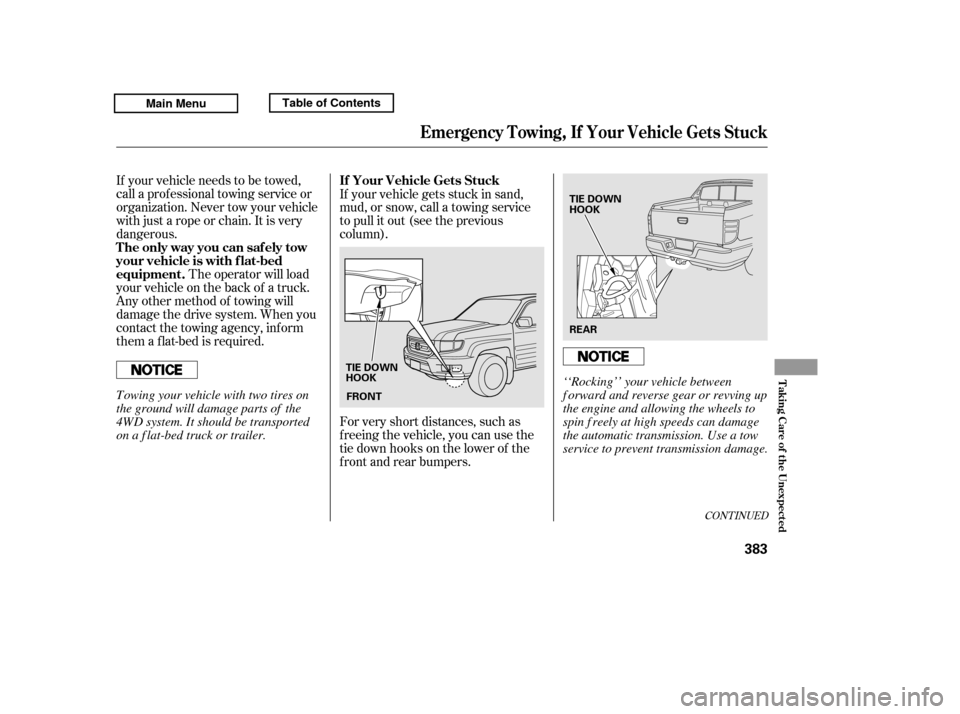
For very short distances, such as
f reeing the vehicle, you can use the
tie down hooks on the lower of the
f ront and rear bumpers.
Emergency Towing, If Your Vehicle Gets Stuck
The only way you can saf ely tow
your vehicle is with f lat-bed
equipment.
If Your Vehicle Gets Stuck
T aking Care of t he Unexpect ed
383
FRONT
REAR
TIE DOWN
HOOK TIE DOWN
HOOK
‘‘Rocking’’ your vehicle between
f orward and reverse gear or revving up
the engine and allowing the wheels to
spin f reely at high speeds can damage
the automatic transmission. Use a tow
service to prevent transmission damage.
Towing your vehicle with two tires on
the ground will damage parts of the
4WD system. It should be transported
on a f lat-bed truck or trailer.
Main MenuTable of Contents
Page 390 of 427
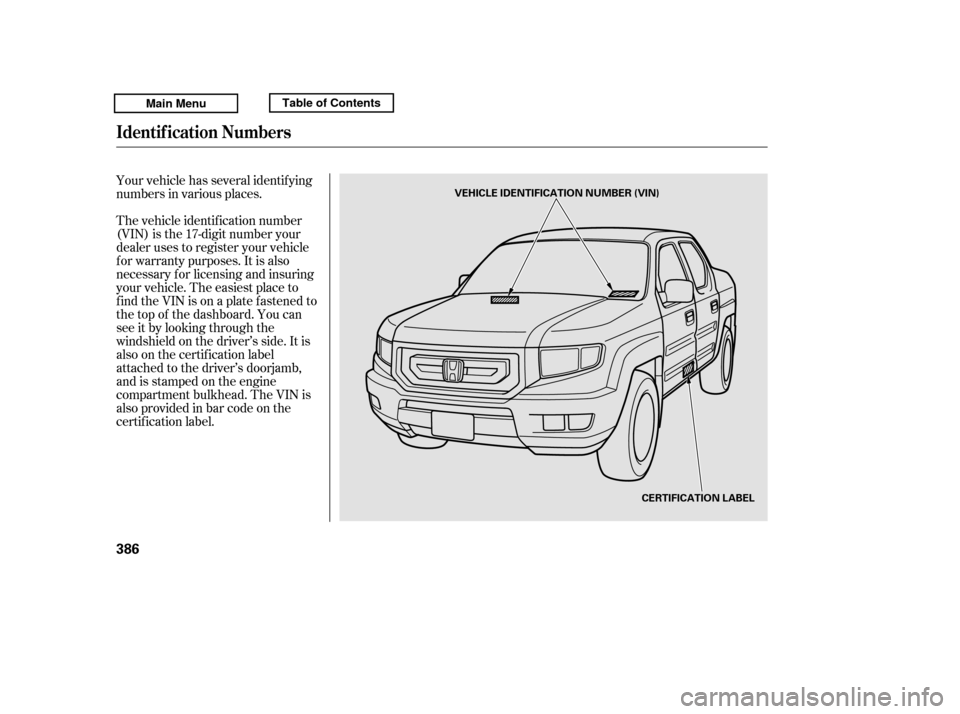
Your vehicle has several identif ying
numbers in various places.
The vehicle identif ication number
(VIN) is the 17-digit number your
dealer uses to register your vehicle
f or warranty purposes. It is also
necessary f or licensing and insuring
your vehicle. The easiest place to
find the VIN is on a plate fastened to
the top of the dashboard. You can
seeitbylookingthroughthe
windshield on the driver’s side. It is
also on the certification label
attached to the driver’s doorjamb,
and is stamped on the engine
compartment bulkhead. The VIN is
also provided in bar code on the
certif ication label.
Identif ication Numbers
386
CERTIFICATION LABEL
VEHICLE IDENTIFICATION NUMBER (VIN)
Main MenuTable of Contents
Page 391 of 427
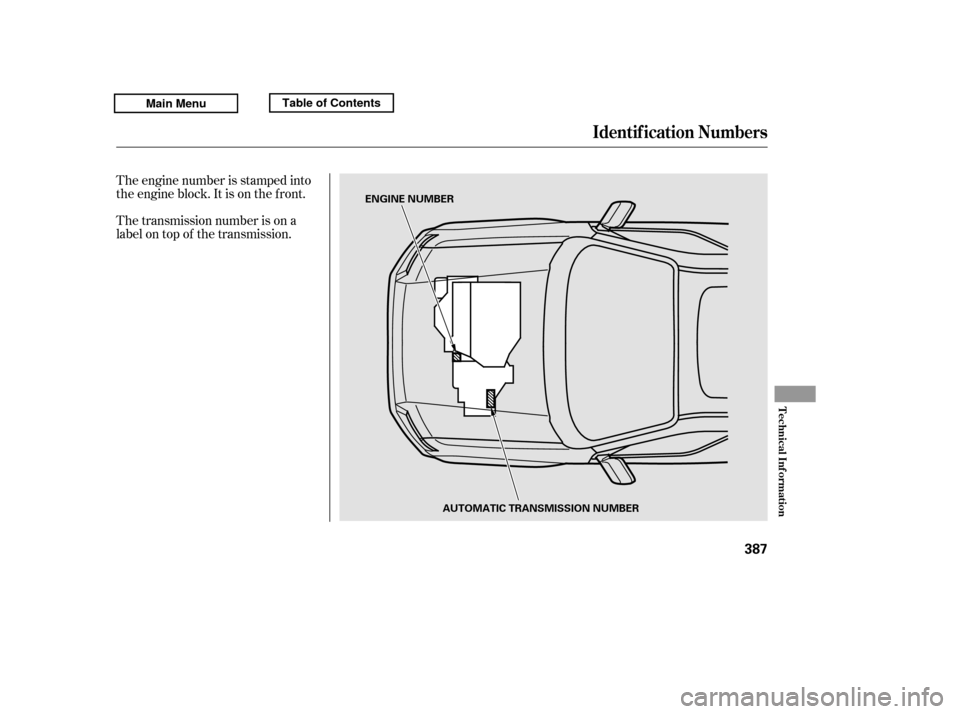
The engine number is stamped into
the engine block. It is on the f ront.
The transmission number is on a
label on top of the transmission.
Identif ication Numbers
T echnical Inf ormation
387
ENGINE NUMBERAUTOMATIC TRANSMISSION NUMBER
Main MenuTable of Contents
Page 392 of 427

�µ�µ
�Î �Î
�Î �Î �Î
�Î
�Î
�Î
�Î�Î�Î �Î
�Î
�Î
Specif icat ions
388
Air Conditioning
Seating Capacities
Dimensions
Capacities
Weights 206.9 in (5,255 mm)
77.8 in (1,976 mm)
70.3 in (1,786 mm)
Refrigerant type
Charge quantity
Lubricant type HFC-134a (R-134a)
19.4 21.2 oz (550 600 g)
ND-OIL8
Total
FrontRear 32
5
1,470 lbs (670 kg)
1,520 lbs (690 kg)
10,088 lbs (4,575 kg)
Length
Width
Height
Wheelbase
Track
66.9 in (1,700 mm)
67.1 in (1,705 mm)
122.0 in (3,100 mm)
The GCWR must be reduced 2 percent for every 1,000 feet (305
meters) of elevation. Fuel tank
Engine
coolant
Engine oil Automatic
transmission
fluidRear
differential
fluid
22.01 US gal (83.3
)
1.64 US gal (6.2)
2.14 US gal (8.1)
4.2 US qt (4.0
)
4.5 US qt (4.3
)
5.3 US qt (5.0
)
3.3 US qt (3.1)
8.5 US qt (8.0)
2.79 US qt (2.64
)
3.01 US qt (2.85)
Including the coolant in the reserve tank and that remaining in the
engine
Reserve tank capacity:
0.16 US gal (0.6
)
Excluding the oil remaining in the engine
71.2 in (1,808 mm)
Gross vehicle weight rating
Gross combined weight
rating (GCWR)
Maximum load limit
(Payload) See the tire information label
attached to the driver’s doorjamb. Approx.
FrontRear
1: 2:
1: 2: 3:
ChangeTotal
Change
Including
filter
Without
filter
Total
ChangeTotal
Change Total
On vehicles without moonroof
On vehicles with moonroof
1:
2:
On vehicles without moonroof
On vehicles with moonroof
1
231 2
1
2
Main MenuTable of Contents
Page 393 of 427

�µ �µ
�µ�µ �µ �µ�µ�µ�µ�µ�µ�µ�µ�µ�µ�µ�µ�µ �µ �µ�Î
�Î
�Î�Î
Specif icat ions
Technical Inf ormation
389
Fuses
Engine
Alignment
Lights Battery
Tires
Capacities
Interior
Under-hoodType
BorexStroke
Displacement
Compression ratio
Spark plugs
Toe-in
CamberCaster3.50 x 3.66 in (89.0 x 93.0 mm)
211.8 cu-in (3,471 cm
)
10.0 : 1
ILZKR7B11 SXU22HCR11
0.00 in (0.0 mm)
0.00 in (0.0 mm) 0°50’
0°50’
1°53’
P245/65R17 105T
Water cooled 4-stroke SOHC VTEC,
V6 gasoline engine
0.45 US qt (0.43
)
0.48 US qt (0.45)
4.8 US qt (4.5
)
Headlights
Front turn signal/parking/
hazard lights
Daytime running light
Fog light
Rear turn signal/hazard lights
Brake/Taillights
Back-up lights
License plate lights
High-mount brake lights
Individual map lights
Bed lights
Console compartment light
Glove box light
Vanity mirror light
Door courtesy lights 12 V 60/55 W (HB2)
12 V 28/8 W
12 V 21 W
12 V
12 V
12 V
12 V
12 V
12 V
12 V
12 V
12 V
12 V
12 V
21/5 W
18 W
3CP
3CP8W5W
3CP
1.4 W
3.4 W2W
3.8 W
Capacity 12 V 12 V72 AH/20 HR
60 AH/5 HR Size
Pressure
60 psi (420 kPa , 4.2 kgf/cm
)
32 psi (220 kPa , 2.2 kgf/cm)
T165/90R17 105M
12 V 55 W
12 V 60 W
P245/60R18 104T
See page 382 or the fuse label
attached to the inside of the fuse
box lid under the dashboard.
See page 381 or the fuse box lid.
Transfer
assembly
fluid
Windshield
washer
reservoir
FrontRear
FrontRear
Front
FrontRear NGK:
DENSO:
High/Low
ChangeTotal
Front/Rear
Spare
Front/Rear
Spare
1:2: U.S. RT, RTS models, and Canadian DX, VP models
U.S. RTL models, and Canadian EX-L models
(HB3)(H11)
12
Main MenuTable of Contents